

General News
Satellite Mobile Phones to Take Overtake GSM Phones – Aroh

Mr. Andrew Aroh is the founding President of the Society of Satellite Professionals International (SSPI) Nigeria. He is a renowned Satellite Communication technology development expertise, and has hosted two satellite industry conference and Exhibitions in Nigeria since 2007. he spoke to chris alu in Abuja on issues in Satellite Communications in the country.
Understanding Satellite footprint
Good, the Footprint provides a picture of the signal that is received at a location in the country with respect to what effective Isotropic Radiated Power (EIRP) is from the satellite. This picture gives us a good idea of what areas of the country receive the lowest level signals and what areas receive the highest signals.
SSPI Nigeria in conjunction with its headquarters in New York (USA) creates and promotes programs that provide (General Services Administration Programs) professionals engineering services for all space related government agencies as well as the corporate events sponsors using or, offering satellite-based communications business services. The general services administration programs covers but not limited to the following areas regulations; strategic planning; concept development and requirement analysis; system design, engineering and integration; test and evaluation.
In the case of footprint, to ensure effective communications at all times, the designated side of the satellite that has the antennas attached to it is always pointed toward the area on the earth that a signal covers.
As system planners, it is out task to ensure that any earth station design introduced into a satellite communications system has the necessary virtue of giving reliable, high quality communications.
Whilst modern satellite antenna systems seek to improve the usage of the basic resources, a further requirement is that of re-configurability of the coverage while in orbit.
With this capability the antenna radiation characteristics will be subject to modification so as to change the coverage area to meet different traffic demands, modify the coverage area offer the satellite has been relocated in a different orbital location.
Provide discrimination against interference signals from varying locations.
A major factor in the development of modern communication satellite is the increasingly stringent requirements in terms of beam-pointing accuracy that must be met by the on-board antenna subsystem for some missions the required pointing accuracy cannot be met by the spacecraft attitude orbit control system (AOCS) control loop to involve an RF sensor, integrated within the antenna to be pointed, which serves to lock the beam onto a ground beacon, positioned within the required coverage zone. More sophisticated RF sensing techniques will become an integrate part of the design of most satellite antennas.
Satellite phones and GSM phones competing
Improvements in handsets have already taken place such that smaller, more streamlined terminals have been introduced to the MSS market. There are now satellite mobile phones that weigh less than 120g. Unlike the GSM handsets, the reliability of satellite takes away any inconvenience or worry of interrupted calls and lack of reception especially in urban areas and remote locations providing the advantages of easy mobility and seamless service beyond land-based telecommunication systems.
Competitively, Satellite Communications has more advanced wireless technology for personal tracking. A typical example is the Globaltracker –sport satellite GPS messenger and personal tracker. This is a small satellite/GPS hand-device that enables you to be in communication with family, friends and employees anywhere, anytime. Spot can communicate pre-programmed messages even where GSM does not work and your location can be tracked on the Globaltracker map.
Generally, market projections have shown that the satellite phones already incorporate GSM phones, so that very soon subscribers will prefer to buy satellite phones instead of GSM phones. The prices of satellite phones are coming down drastically to enhances its market competitiveness with GSM phones.
Aeronautical Satellite Communication
Despite an industry- wide downturn, aeronautical satellite communication services are gaining momentum. Offering aeronautical services can be a very sound business for service providers who own and operate a global network of ground earth stations.
Industry observers also are recognizing the value for aeronautical communications and other niche services where satellites hold a technological edge and provide a rare opportunity to turn a profit.
Aeronautical satellite communications service is a market that has been evolving for many years and may finally have come of age. Demand is growing, particularly among business travelers onboard commercial airliners. Roughly 70 to 80 percent of aeronautical services revenues come from commercial business passengers. Such users need to communicate instantly. As a result of this demand, an increasing number of airlines are upgrading their in-flight communications infrastructure. This demand is generating revenue opportunities for Earth stations operators, Equipment manufacturers and Content distributors.
Professionalism in the sector
A few years ago, Nigeria drafted a roadmap for the pursuit of focused space program.
The expert committee considered the preparation of the roadmap under two groups, namely – Satellite Development and Rocket Propulsion to arrive among others at the following:
Space related programs must be encouraged right from the primary to tertiary institutions in terms of space education and capacity building, so as to create a continuous pool of experts.
Space technology research and development of personnel must be encouraged in terms of adequate motivation. The expert committee noted the challenges of the space program but believed that a focused space program with these challenges would in due course position Nigeria among other nations of the world in knowledge-driven economy and leverage Nigeria among the committees of space nations. In support of the above motives, that SSPI Nigeria created SSPI Nigeria Student’s chapters, mentorship forum, and SSPI student’s satellite programs
We encourages start-up of student chapters in Universities, Polytechnics, Colleges and other tertiary institutions of learning all over Nigeria.
Service provision between Vsat and WiMax
The only way to measure efficiency and reliability in the global telecommunications market is the ability to provide world class Vsat and wireless network services to broad subscribers.
For satellite telecommunications, quality of service (QOS) is the same across the board, whether a business is located in the jungles or in the beautiful mega city.
This seamless uninterrupted world class service provision has become the bane of satellite communications; judging by the growing needs of subscribers who would want to enjoy.
Voice, data, video and other available communications services on a single network
Consider the typical satellite-based products such as modem, modem accessories, converters, transceivers, amplifiers and terminals. These products come in the range of equipment some of which range among the most efficient in specific industry areas like: the Low Density Parity Check Coding (LDPC) regarded as the industry’s most bandwidth – efficient forward Error Correction (FEC), among others.
Today, there are satellite companies that have experienced extremely high demand for Vsat connectivity both in the metropolitan and rural areas. Such companies will continue to invest in new satellite capacity solutions, which are targeted at enhancing internet usage in the country at affordable costs.
For Wimax, the service provision is currently in C-band which is dedicated to satellite base stations and needed to provide Wimax technology. We all know the limitations of the current operating base stations in terms of power and quality of service. Wimax uses lien of sight (LOS) as well as near line of sight (NLOS) transmissions.
Unlike Vsat, WiMax lacks a clear edge and does not offer more friendly services as a one-stop shop to develop all needed services to any subscribers on one platform. People have talked about spectral efficiency, throughput (through OFDMA) as the two main advantages of Mobile WiMax. But consider the fact that the intelligent Mobile Gateway design is said to address existing limitations within the mobile network by providing voice and data convergence in terms of capacity, throughput, mobility, high availability through full redundancy, fault tolerant, self-healing capabilities.
Therefore considering the ARPU, Opex as well as Capex, then it becomes clear that the cost effectiveness moves to VSAT. In addition, there are a lot of features and standards that every Wimax provide has to support to be compliant
Position of Vsat in the Next Five Years
Vsat satellite data communications are not only strategic to the United States but to China and Nigeria. The great growth in the U.S. for Vsat broadband is now emerging in China and Nigeria. This is a stable satellite platform for numerous government and business applications that will enhance knowledge, productivity, and profits.
The architecture for a typical Vsat network employs a common hub and star topology. Interactive data communications can be addressed by properly engineered bi-directional satellite links that involve multiple transmitting earth stations.
The Vsat demonstrates that such networks are practical (e.g, easy to install and centrally managed), reliable (e.g, 99.9% availability) and cost effective (e.g., saving users as much as 20% over what an equivalent terrestrial network would cost).
Since 2005, Vsat systems have become attractive to smaller enterprises as well as for big organizations in Nigeria.
In the next five years, the bright spot in the Vsat market is the growth in revenue from applications. The convergence in communications services has provided a new lease of life for the (FSS) segment. Voice transmission is diminishing while data is expanding in a quantum basis. Today you can have one network like the World Wide Web IP that can carry not one application but many more. In a Mesh network you can communicate to any site without first connecting to a central hub site.
Growing Digital Divide
A clear digital divide exists between IT resources in African countries, where state-of-the-art networks, telephone, radio, TV, Internet, satellite are needed.
This divide demonstrates the differences in facilities for people to communicate, based on their geographic location, living standard, and level of education.
Even though access to communications resources increase each year, from a million Internet users worldwide in 1990 to five billion in 2010. This clearly requires a favourable regulatory framework, the creative application of new technologies especially Vsat satellite access solutions, creative content and services focused on local requirements, and the integration that will benefit all the people
The key for satellite service providers is to adjust to the specific end-user applications in fields such as government, education, and business.
The Global Market is changing in two ways; first in broadband via small, low cost terminals at Ku and Ka-band frequencies, and secondly in the high demand for satellite communications in homeland security and military applications. The trends are very clear; China will soon lead the U.S. with a strong support of broadband Vsat satellite technologies.
The convergence of communications services will convert the African market into the leading economic platform for worldwide economic expansion.
Terrestrial networks based on land transport systems will be seamlessly converged with advanced satellite based telecommunication network technologies.
The rapid introduction of wired line or wireless broadband transmission and the availability of low-cost computer equipment are essential for the success of the Africa region and Nigerian in particular.
About SSPI
The Society of Satellite Professionals International (SSPI) is an international professional development, member- benefit society serving professionals in the satellite communications industry, throughout their working lives.
Through the establishment of local chapters (such as SSPI Nigeria) SSPI furthers the purposes of the society at the regional level providing members with the opportunities to advance their careers through information sharing, outreach and professional networking, and promoting entry of talented students and new graduates into the profession thereby contributing to the growth and development of the communications industry regionally and the world at large.
SSPI Nigeria vision is to encourage the enhancement of professionalism in the satellite communications industry for members through creation, promotion and support of educational programs as well as the adaptation of the provision of telecom/broadcast services via satellite into the fast growing ICT market in Nigeria.
Challenges of Satellite Communications
For the Satellite Communication Industry, though existing geo-synchronous satellites are able to reach rural and remote areas, they provide slow internet connectivity because of their distance from the earth and they’re expensive and fully subscribed.
SSPI Nigeria is aware that Satellite-based companies will soon deliver fiber like internet backhaul services using a constellation of medium-orbit satellite. This means that data can be quickly transmitted to and from even the most remote locations such as Inland Nigeria and Africa at large.
The satellite constellation will provide high-speed, low-latency backhaul services at speeds reaching into the gigabits per second.



Justice Mojisola Dada of the Lagos State Special Offences Court in Ikeja has remanded, Andrew Odekina, an alleged hacker, who is part of a fraud syndicate that stole N3.09 billion from First City Monument Bank (FCMB).

Justice Dada ordered that Odekina be kept behind bars after he was arraigned before her by the Economic and Financial Crimes Commission (EFCC).
The EFCC informed the judge that the defendant was among the suspects who allegedly carried out a major cyber-enabled fraud that resulted in over N3 billion being siphoned from the bank’s customer accounts.
The anti-graft agency also accused the defendant of retaining proceeds linked to the large-scale hacking operation that targeted some FCMB customers.
The Commission stated that its investigation found cybercriminals had unlawfully accessed the bank’s applications, allowing them to transfer N3.09 billion from various accounts.
Odekina was specifically charged with receiving and retaining N9.87 million, believed to be part of the stolen N3.09 billion, in his FCMB account in 2025.
The offence, according to the EFCC, contravenes the provisions of the EFCC (Establishment) Act, 2004.
The charge states that the defendant, alongside accomplices still at large, knowingly retained control of funds traced to fraudulent digital transactions carried out on the bank’s platform.
The defendant, however, pleaded not guilty to the charge.
Based on his plea, Babatunde Sonoiki, prosecutor, urged the court to fix a trial date and remand the defendant in the custody of the Nigerian Correctional Service pending the conclusion of the trial.
The defendant appeared in court without legal representation.
After listening to the lawyer, Justice Dada adjourned the case to May 11 for trial and ordered that Odekina be remanded to the Kirikiri Correctional Facility.

South East Development Commission (SEDC) has launched the South East Venture Capital Programme (SEVCP), to expand access to capital for startups and strengthen Nigeria’s investment landscape.

The Commission said the programme represents a direct institutional response to the federal government’s commitment to expand access to local funding and attract sustained investment into high- growth sectors across South East Nigeria.
It also said that it is part of the developmental initiative by the SEDC as contained in the road map for the region that was presented to the House of Representatives Committee on South East Development.
A statement issued by the commission says the SEVCP is a funded, coordinated, and time- bound intervention designed to catalyse the region’s digital, innovation, and technology ecosystem.
“As part of its initial rollout, the first phase of the program, the South East Pitch Competition, is now officially open for applications. At the core of the program is the South East Venture Capital Fund, a blended finance vehicle designed to mobilise up to $50 million in public, institutional, development finance, diaspora, and private capital into the region.
“SEDC anchors the Fund through the South East Investment Company, its wholly owned investment vehicle, which participates as a Limited Partner. This structure ensures professional fund management, institutional accountability, and alignment with global investment standards,” the statement said.
The commission also said that SEVCP is built as an integrated platform comprising five interlinked workstreams: fund operationalisation, a flagship Pitch Competition, a structured incubation and acceleration programme, a financing partnerships strategy to complete the fund raise, and a network of implementing partners across the region.
“Each component is designed to reinforce the others and ensure continuity from deal sourcing to investment and growth.The South East Pitch Competition serves as the primary entry point into the Fund’s investment pipeline. Thirty startups will be selected across the five states, with twenty placed in the Accelerator Track and ten in the Incubation Track.
“These startups will receive SAFE investments totalling 450,000 dollars in the first cohort. Accelerator participants will receive 20,000 dollars each, while incubation participants will receive 5,000 dollars each. Investments will be milestone-based and structured to balance founder flexibility with investor protection.
“The Pitch Competition Finals is scheduled to take place on 13 May 2026, followed by an Investment Ceremony on 14 May 2026. Selected startups will participate in a structured hybrid incubation and acceleration programme delivered across key locations in the region.
“The South East has long demonstrated strong entrepreneurial capacity, commercial depth, and human capital, the statement indicated. It noted that what has been missing is a coordinated system to channel capital into that capacity at scale, with the structure and governance required by serious investors. The SEVCP provides that system, and the Pitch Competition establishes the first layer of access,” it said.
According the tstatement, applications opened on 13 March 2026 and were originally scheduled to close on 27 March 2026.
“It indicated that the deadline has now been extended to 3 April 2026 to enable broader participation across the region, adding that this will be the final extension.
“The Accelerator Track is open to startups with demonstrable product market fit, active users, and revenue traction. The Incubation Track is open to founders with validated ideas and a minimum viable product. Eligible startups must be based in, operating in, or delivering clear impact within the South East, or be founded by individuals of South East origin with a defined regional focus. All applications must demonstrate a meaningful technology component,” it said.
The commission said that SEVCP represents a long-term commitment to building a structured and investable startup ecosystem in the South East.
“The inaugural cohort will form the foundation of a pipeline that the Commission intends to scale over successive cycles. Founders building within the region, and those looking to build within it, are encouraged to apply before the deadline,” the statement added.
General News
PIAFo Drives Urgent Call for National Dig-Once Policy to Boost Nigeria’s 125,000km Fibre Network

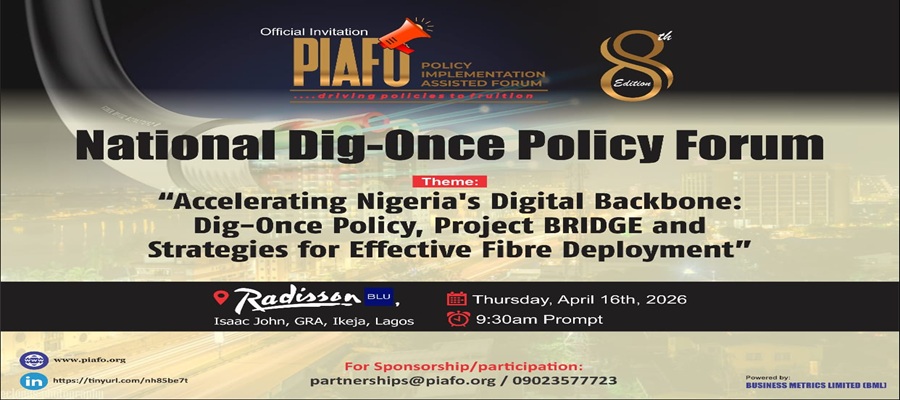
Key players across Nigeria’s digital economy, telecommunications, and infrastructure ecosystem are set for the National Dig-Once Policy Forum to champion a new course towards increasing Nigeria’s digital backbone network to 125,000km of fibre-optic infrastructure.

PIAFo
The event, which marks the 8th edition of Policy Implementation Assisted Forum (PIAFo), is a high-level industry dialogue aimed at accelerating the formulation and adoption of a National Dig-Once Policy as a critical enabler of safe, coordinated and cost-effective fibre infrastructure deployment in the country.
The forum, themed “Accelerating Nigeria’s Digital Backbone: Dig Once Policy, Project BRIDGE and Strategies for Effective Fibre Deployment,” is slated for Thursday April 16, 2026 at Radisson Blu Hotel, Ikeja GRA, Lagos.
According to the organisers, Business Metrics Limited (BML), the introduction of $2 billion Project BRIDGE initiative by the Federal Government to expand fibre infrastructure by additional 90,000km from 35,000km to 125,000km by 2030 requires some new measures to ensure successful implementation of the ambitious target and avoid mistakes of the past.
Industry stakeholders have identified that the success of a national connectivity backbone rollout depends largely on institutionalising a Dig Once Policy framework, which encourages the installation of fibre ducts and conduits whenever roads, railways, and other major public infrastructure are being constructed or rehabilitated.
According to industry data shared by the Nigerian Communications Commission, lack of such a framework is taking a toll on the telecoms sector and broadband drive as operators recorded over 50,000 fibre cut incidents across the country in 2024, with more than 60 per cent occurring during road construction and rehabilitation activities. These disruptions have resulted in billions of naira in repair costs, network outages, and service degradation.
Telecom operators in Lagos State alone said they spent over N5 billion in 2024 to repair and replace damaged fibre infrastructure in the state, while lamenting that the development continues to slow down network upgrade and expansion drive.
Beyond infrastructure damage, telecom operators also face challenges such as high Right of Way (RoW) charges, uncoordinated civil works, and repeated excavation of roads for fibre deployment.
PIAFo 8.0 aims to address these challenges by fostering collaboration among stakeholders responsible for planning, financing, constructing, and maintaining Nigeria’s digital infrastructure.
Specifically, the forum seeks to align federal, state, and local infrastructure planning around a unified Dig-Once framework; strengthen collaboration between telecom operators, infrastructure companies, and public works authorities; translate policy intentions into actionable guidelines and implementation timelines; and build stakeholder support for Project BRIDGE and complementary national fibre initiatives.
Speaking about the event, Team Lead at Business Metrics Limited, Omobayo Azeez, said Nigeria is being denied access to robust connectivity it should derive from up to eight high-capacity undersea cable networks landed on its shores because of difficulties around terrestrial fibre infrastructure expansion.
“The Project BRIDGE initiative should excite everyone because of ambitious targets. But for those who understand the operating terrain, and why it took the industry over 20 years to achieve around 35,000km of fibre network that the country currently operates for broadband connectivity, the project calls for a major shift in execution approach with the adoption of a National Dig-Once Policy as the starting point.
“PIAFo, now in its 8th edition, is again serving as the viable platform for representatives from government ministries and agencies, senior telecom executives, infrastructure companies, data centre operators, equipment manufacturers, state governments, and industry associations to chart the way forward.”
The forum will feature keynote addresses, expert panel discussions, and strategic networking sessions designed to drive pragmatic outcomes that will accelerate Nigeria’s journey toward a resilient and inclusive digital economy.

Mobile Money Transactions Accounted for $2 trillion in 2025

MoneyMaster Enhances App, Rewards Users with Data and Airtime Bonuses

Nigeria, Finland Sign Cybersecurity Pact

Firm Shares Tips for Updating Your Digital Habits for an AI-driven World

EU Pumps €290m into Nigeria’s Digital, Health, Agri Sectors

Kaspersky Discovers New Phishing Campaign Exploiting Google Tasks Notifications to Steal Corporate Credentials

esentry 2025 Report Shows Healthcare, Financial Services and Telecoms as Staging Grounds for Increased Cyberattacks in Africa

AfDB, UNDP Launch $10Bn AI Initiative for Africa

MultiChoice Suspends Yearly DStv Price Hike as Canal+ Pushes Growth

MTN Nigeria Posts Record N1.70 Trillion Pre‑Tax Profit, Declares N20 Dividend for 2025




 E-Financial2 days ago
DLM SPV PLC Lists ₦9.00bn AAA-Rated Medium-Term Notes on FMDQ Exchange, Sets Benchmark in Corporate Bond Market

 News2 days ago
Metaverse Collapses, Horizon Worlds Shuts Down on Quest

 Telecom2 days ago
Legend Internet, Spectranet in Merger Talks

 News2 days ago
NITDA Reaffirms Commitment to Advancing Creative Economy with Digital Initiatives

 E-Financial2 days ago
SEC Issues Six-Week Ultimatum to Market Operators to Submit Recapitalisation Plan

 News2 days ago
Nigeria Spends $470m on AI-powered Surveillance Devices- Report

 News2 days ago
FG Plans New HIV Prevention Injection in 8 States, FCT
 E-Business2 days ago
Qualified Cybersecurity Staff Shortage Among Key Obstacles in Curbing Supply Chain Risks