

News
SERAP Sues Buhari over ‘Missing N11 Trillion Electricity Fund’

Socio-Economic Rights and Accountability Project (SERAP) has sued President Muhammadu Buhari “for failing to investigate allegations that over N11 trillion meant to provide regular electricity supply since 1999 may have been stolen, mismanaged, or diverted into private pockets.

SERAP is seeking “an order of mandamus to direct and compel President Buhari to investigate how over N11 trillion meant to provide regular electricity supply has allegedly been squandered by governments since 1999” in the suit number FHC/L/CS/1119/2022 filed last week at the Federal High Court in Lagos.
According to reports, the electricity grid has failed at least three times in the past five months and 130 times in the past seven years, leaving many homes in the country in the dark.
The World Bank estimates that Nigerian businesses lose $29 billion annually due to epileptic power supply.
SERAP is also seeking “an order of mandamus to compel President Buhari to ensure the prosecution of anyone suspected to be responsible for the missing electricity fund, as appropriate, and to ensure the tracing and full recovery of any missing public funds.”
SERAP is arguing that, “It is in the public interest to ensure justice and accountability for alleged corruption and mismanagement in the electricity sector, which has resulted in the failure of governments to solve Nigeria’s perennial power problem.”
According to SERAP, “The staggering amounts of public funds alleged to have been stolen over the years in the sector have had catastrophic effects on the lives of millions of Nigerians, akin to crimes against humanity against the Nigerian people.”
SERAP is arguing that, “The failure to trace, find and recover the missing electricity fund is antithetical to the public interest, the requirements of the Nigerian Constitution 1999 [as amended], and the country’s international obligations.”
SERAP is also arguing that, “Nigerians have for far too long been denied justice and the opportunity to get to the bottom of why they continue to pay the price for corruption in the electricity sector–staying in darkness, but still made to pay crazy electricity bills.”
SERAP is also arguing that, “Investigating the allegations of missing N11 trillion electricity funds, prosecuting suspected perpetrators and recovering any missing public funds would end a culture of impunity. It would also address persistent collapse of the electricity grid, and improve access to and affordability of electricity in the country.”
SERAP is also arguing that, “Corruption in the electricity sector and the lack of transparency and accountability in the use of public funds to support the operations of DISCOS have resulted in regular blackouts, electricity grid collapse, and unlawful hike in electricity tariffs.”
SERAP is also seeking “an order of mandamus to direct and compel President Buhari to refer to the International Criminal Court all unimplemented reports of corruption in the electricity sector gathering dust on the shelves, and to arrest and surrender those named in the reports to the court for prosecution.”
Joined in the suit as Respondent is Mr Abubakar Malami, SAN, Attorney General of the Federation and Minister of Justice.
The suit filed on behalf of SERAP by its lawyers Kolawole Oluwadare and Ms Adelanke Aremo, read in part: “Nigeria has made legally binding commitments under the UN Convention against Corruption to ensure accountability in the management of public resources. These commitments ought to be fully upheld and respected.”
“Corruption in the electricity sector has also continued to disproportionately affect the most disadvantaged and vulnerable sectors of the population who cannot readily afford expensive generators in order to have a reliable power supply.”
“The failure of successive governments and high-ranking government officials to prevent corruption in the electricity sector and to bring suspected perpetrators to justice is the primary cause of the persistent crisis in the electricity sector, including the exploitation of electricity consumers, and collapse of the electricity grid.”
“The African Commission on Human and Peoples’ Rights has adjudged the failure of the States to provide basic services such as electricity as violating the right to health.”
“Citizens are frustrated at persistent allegations of corruption in the sector, and the impacts on their human rights. Prosecuting perpetrators would address the grave travesty that has for many years occurred in the power sector.”
“Impunity for corruption in the electricity sector has for many years forced ordinary Nigerians to stay in darkness, but still made to pay crazy electricity bills.”
“Successive governments have failed to increase power generation and provide Nigerians with regular and uninterrupted electricity supply, with many electricity contracts shrouded in secrecy, and trillions of Naira going down the drain.”
“Impunity for corruption in the electricity sector will continue as long as high-ranking public officials go largely unpunished for their alleged crimes.”
“The Buhari administration has legal obligations under Section 15(5) of the Nigerian Constitution to abolish all corrupt practices and abuse of power, and article 26 of the UN Convention against Corruption to ensure effective prosecution of allegations of corruption.”
“Alleged corruption and mismanagement in the electricity sector and the repeated collapse of the electricity grid have continued to deprive Nigerians of economic opportunities, subjecting them to cruel and degrading treatment.”
“Under Section 16(1) of the Constitution, the government has a responsibility to ‘secure the maximum welfare, freedom and happiness of every citizen on the basis of social justice and equality of status and opportunity.’”
“Section 16(2) further provides that, ‘the material resources of the nation are harnessed and distributed as best as possible to serve the common good.’”
“The failure by successive governments to tell Nigerians the truth about allegations of corruption in the power sector amounts to a failure to ensure that electricity services are progressively made available, on the basis of equality and non-discrimination.”
“The details of the missing N11 trillion electricity funds are contained in a SERAP report titled: From Darkness to Darkness: How Nigerians are paying the Price for Corruption in the Electricity Sector.”https://www.tvcnews.tv/2022/06/governor-sanni-bello-gives-out-deputys-daughter-in-marriage/
“According to the report, the total estimated financial loss to Nigeria from corruption in the electricity sector starting from the return to democracy in 1999 to date is over N11 trillion. This represents public funds, private equity and social investment (or divestments) in the power sector.”
“It is estimated that the loss may reach over N20 trillion in the next decade given the rate of Government investment and funding in the power sector amidst dwindling fortune and recurrent revenue shortfalls.”
No date has been fixed for the hearing of the suit.


Bank of Industry (BoI) and MTN Nigeria Foundation have launched a N1 billion Y’ellopreneur 3.0 Matching Fund to support women-owned businesses across Nigeria.

The fund was launched at the official unveiling of the BOI–MTN Foundation Y’ellopreneur 3.0 Matching Fund held in Lagos.
Dr Olasupo Olusi, managing director of BoI, said the initiative reflects a shared commitment to entrepreneurship and women’s empowerment.
Represented by Oluwatoyin Edu, executive director, MSMEs, Olusi, said the partnership has grown from a N100 million youth programme in 2018 to a N1 billion fund, financed equally by both institutions.
“Today, we are pleased to deepen this collaboration with the launch of the N1 billion Y’ellopreneur 3.0 Matching Fund.
“This programme aligns strongly with BoI’s 2025–2027 strategy for enterprise development and economic transformation,” he said.
Olusi said 1,000 women entrepreneurs would receive structured training, while 200 women-led MSMEs would access loans of up to N5 million each.
The BoI boss added that the programme targets sectors including agro-processing, light manufacturing, fashion, energy, waste management and digital services.
Mrs Mosun Belo-Olusoga, chairman of MTN Nigeria Foundation, said the initiative highlighted women’s critical role in economic development.
According to her, the foundation now treats women’s empowerment as central to nation-building, rather than a corporate social responsibility obligation.
Belo-Olusoga said over 5,700 women had been trained, with the programme designed to bridge economic gaps limiting women’s participation.
“This fund provides equipment financing, enabling women to transition from small-scale operations to industrial-level businesses,” she said.
She stressed the need for greater awareness, especially in rural communities, to ensure inclusiveness.
Mrs Odunayo Sanya, executive director of the foundation, said the initiative combined capacity building with access to capital.
Sanya said beneficiaries would undergo a five-week training programme by Pan-Atlantic University Enterprise Development Centre, ending with business growth plans.
She said the foundation aimed to build 30,000 female-led businesses in five years, with 10,000 expected to receive funding.
“We believe this partnership with BoI opens the door to scaling women-owned businesses through working capital and equipment financing,” she said.
Mrs Ibijoke Sanwo-Olu, wife of Lagos State governor, described the initiative as timely in tackling unemployment and unlocking women’s economic potential.
Represented by Mrs Oyinlola Agoro, she said equipping women with skills, mentorship and planning tools is vital for resilient enterprises.
Sanwo-Olu commended earlier phases, which trained over 5,700 women and supported 122 beneficiaries with equipment.
“This shows that when women are empowered, families thrive, communities prosper and the economy grows stronger.
“The N1 billion matching fund will deepen financial inclusion and promote women-led enterprises,” she said.
She reaffirmed her commitment to initiatives promoting women’s empowerment, economic independence and inclusive development.
News
NSIA Sign MoU with UK’s Asset Green Ltd to Develop $496M Integrated Dairy Livestock Production Platform in Nigeria

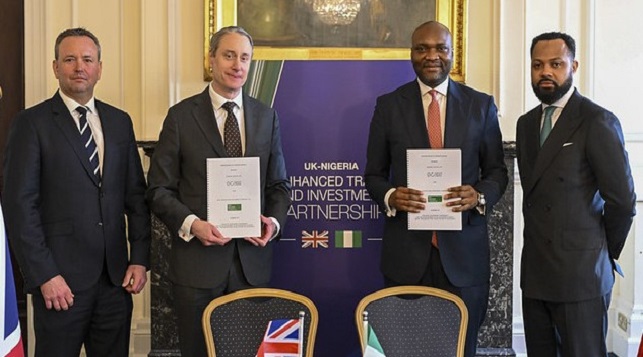
The Nigeria Sovereign Investment Authority (NSIA) has signed a Memorandum of Understanding (MoU) with UK‑based Asset Green Ltd to advance the development of a large‑scale integrated dairy livestock production and processing platform set to transform Nigeria’s dairy industry and strengthen national food security.

Signed on Tuesday in London ahead of the State Visit, the MoU outlines the framework for collaboration and the project‑development cost commitments leading up to the formal shareholders’ agreement.
This initiative represents one of the most ambitious integrated dairy investments ever undertaken in Nigeria. It will combine 20,000 hectares of climate‑smart, regenerative crop and forage production with a modern 10,000‑milking cow dairy operation, supported by a state‑of‑the‑art processing plant capable of producing fresh milk, milk powders, butter, cream, and up to 15,000 metric tonnes of infant formula annually.
Designed to reduce Nigeria’s reliance on imported milk powder, the project will modernise agricultural practices, improve nutrition, and integrate up to 10,000 rural households into the supply chain through inclusive out‑grower schemes. Once operational, the platform is expected to generate over US$620 million annually and create 2,500 direct and 5,000 indirect jobs nationwide.
British Deputy High Commissioner, Jonny Baxter, said: “Over a decade ago, the UK provided pivotal support to Nigeria in establishing the NSIA, offering legal and financial expertise that helped lay the foundation for its successful launch and strengthening its governance and credibility.
“That early institutional investment has paid dividends, helping to build a resilient Nigerian institution capable of creating jobs and driving transformational, long‑term development.
“The NSIA and Asset Green partnership is a powerful example of how that groundwork continues to deliver impact – a full‑circle moment that reflects the long-term economic cooperation between the UK and Nigeria and the shared commitment to deepening sustainable, private‑sector‑driven growth.”
NSIA Managing Director & CEO, Aminu Umar‑Sadiq, said: “NSIA is pleased to partner with Asset Green on this transformative investment. With a project size of almost US$500 million, this is one of the most ambitious initiatives aimed at strengthening Nigeria’s food and nutrition security in a generation.
“By combining climate‑smart farming, advanced processing capacity, and inclusive out‑grower participation, we are laying the foundation for a modern, competitive dairy sector that reduces import dependence, creates meaningful jobs, and delivers long‑term value for Nigerians.”
Asset Green Ltd Director & Agrium Capital Ltd CEO, Rod Bassett, said: “This partnership between NSIA and Asset Green is the business and investment innovation required to unlock the potential of the agriculture sector in Nigeria, with the development of such a future (dairy) food system.
“The foundation of the approach is one of collaborating with NSIA and their shared vision and purpose to establish a platform to catalyse the development of such a national strategic priority. We are incredibly proud to partner with Nigeria’s premier investment institution.
“The development of greenfield projects have consistently played a major role in our history, establishing industries or nurturing young businesses that are able to deliver catalytic transformation.
This US$500 million greenfield investment in Nigeria’s dairy industry allows for the development of advanced and necessary infrastructure spanning the full production and supply system to enhance local production, reduce the reliance on the huge imports of dairy goods into Nigeria, deliver environmental services and strengthen national food sovereignty and nutritional resilience.”

In March 2026, Kaspersky Threat Research has identified a new malicious campaign targeted at developers looking for installation instructions for Claude Code, a development agent created by Anthropic. When searching for “Claude Code download”, sponsored advertisements appear at the top of the search results.

One of these ads redirects users to a malicious webpage that closely imitates the official installation documentation for Claude Code. As a result, users are tricked into installing malware which harvests sensitive information including credentials, crypto wallet data, browser sessions, and other confidential files. Similar malicious campaigns mimic other popular AI tools, including OpenClaw.
The fake documentation page is visually identical to the legitimate one and is hosted on the website-building and hosting platform Squarespace. Because the page precisely copies the original instructions, users may not notice the difference when copying and executing installation commands.
However, instead of installing the developer tool, the commands deliver malware to the victim’s system. Depending on the operating system, the malicious commands deploy different infostealers:
. Windows systems receive Amatera, an information-stealing malware that collects data from user directories, web browsers, and cryptocurrency wallets before sending the stolen information to a remote server. Amatera has previously been observed in campaigns using the ClickFix distribution technique and is operated under a Malware-as-a-Service (MaaS) model.
. macOS systems receive AMOS, another infostealer previously documented in several malware campaigns targeting Apple devices. It has been described by Kaspersky before.
Kaspersky researchers also identified similar malicious campaigns targeting other popular AI tools, including OpenClaw and Doubao. Using the same approach, attackers registered multiple domains and distributed files containing the Amatera infostealer while disguising them as legitimate downloads for these tools.
“The campaign poses significant risks because AI development tools such as Claude Code and OpenClaw are widely used not only by hobbyists and automation enthusiasts but also by professional developers working in large organisations.
If infected, victims may unknowingly expose source code from active projects, confidential corporate data, authentication credentials, and private accounts. This makes such campaigns particularly dangerous for businesses whose developers rely on AI-assisted coding tools,” comments Vladimir Gursky, cybersecurity expert at Kaspersky.
In December 2025, Kaspersky detected that attackers spread a macOS infostealer using Google Ads. A specially generated chat interface designed to resemble a ChatGPT tutorial pretended to guide users through installing the Atlas Browser. The malicious instructions appeared to be hosted on a legitimate site associated with OpenAI, helping attackers gain users’ trust.

UBA, NiDCOM Deepen Collaboration to Unlock Diaspora Capital for Nigeria’s Growth

Vitel Wireless Lures Subscribers with “Data that Never Expires” Campaign

FG Deploys Technology, Approves $54m Drugs to Tackle Tuberculosis

BoI, MTN Foundation Launch N1Bn Fund for Women Entrepreneurs

Luno Launches First Crypto Prediction Market in Nigeria

Kaspersky Discovers New Phishing Campaign Exploiting Google Tasks Notifications to Steal Corporate Credentials

esentry 2025 Report Shows Healthcare, Financial Services and Telecoms as Staging Grounds for Increased Cyberattacks in Africa

AfDB, UNDP Launch $10Bn AI Initiative for Africa

Mutual Benefits Assurance Settles ₦5.9bn Claims in January 2026

MultiChoice Suspends Yearly DStv Price Hike as Canal+ Pushes Growth




 Broadcasting3 days ago
Spotify’s Loud & Clear Report Reveals Over ₦60Bn Revenue for Nigerian Artists in 2025

 E-Financial3 days ago
CBN Relaxes Dormant Account Rules with Removal of Affidavit Requirement

 Telecom3 days ago
PwC Warns Nigeria Telcos of AI Fraud Risks

 News3 days ago
Elumelu Tags Elon Musk, Disowns AI-Generated Scam Video

 E-Financial3 days ago
Crypto Transactions Hit $96Bn in Nigeria -SEC

 E-Business3 days ago
FG Determined to Protect Rights, Privacy Online- NITDA

 E-Business3 days ago
Firm Warns of Malware Aiming to Steal Data from Individuals, Organisations in Nigeria

 News3 days ago
NITDA DG Appraised the Role of Teachers as Key to Nigeria’s Digital Transformation