

News
SERAP Threatens Court Action against FG over Abduction Segun Olatunji, FirstNews Editor


Socio-Economic Rights and Accountability Project (SERAP), has charged President Bola Tinubu to order the release of Segun Olatunji, editor of FirstNews.

SERAP said failure to release Olatunji within 48 hours would lead to legal action against the President.
Posting on X, SERAP wrote: “BREAKING: The Tinubu administration must immediately release Segun Olatunji, editor of FirstNews who was reportedly arrested in Lagos by the military. Journalists should never be arrested for doing their job. We’ll see in court if he is not released within 48 hours. @officialABAT”
Olatunji was recently abducted by gunmen suspected to be soldiers on Friday from his home in the Iyana Odo, Abule Egba area of Lagos State.
In a statement on Saturday, the management of the online newspaper linked the action to a recent story published by FirstNews titled, “Revealed: “Defence Chief running office like family business – Public Interest Lawyers”, published by many other online platforms.
The management also linked his abduction to another report titled, “EXCLUSIVE: How contractor, company stole N100bn, laundered funds for top govt officials – Investigation”, which was later pulled down.


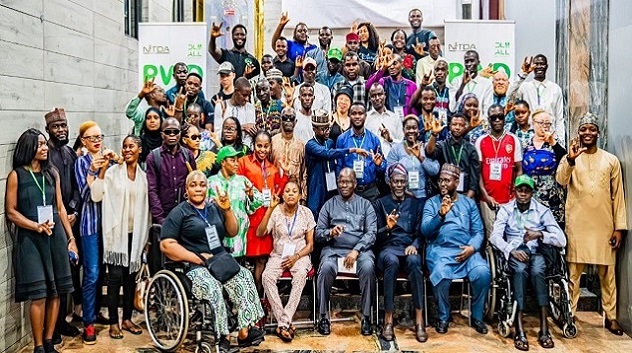
The National Information Technology Development Agency (NITDA) has reaffirmed its commitment to inclusive digital development following the completion of a two-day digital literacy training for persons with disabilities (PWDs) in Abuja.

The programme, organised under NITDA’s Digital Literacy for All (DL4ALL) initiative, the programme trained 50 participants in practical digital skills to enhance their participation in Nigeria’s expanding digital economy.
In his remarks, the Director-General, Kashifu Inuwa CCIE, stated that the programme reflects the agency’s determination to ensure accessibility remains a core component of national digital transformation efforts.
He explained that genuine digital advancement cannot be realised without the inclusion of persons with disabilities, adding that millions of Nigerians remain constrained by limited access to accessible and inclusive digital platforms.
“In many cases, the problem is not the absence of digital tools but the lack of accessibility. Platforms that do not support assistive technologies, non-captioned content and inaccessible websites effectively shut people out and limit opportunities,” he added.
Inuwa further explained that the initiative aligns with President Bola Ahmed Tinubu’s Renewed Hope Agenda, which prioritises inclusivity as a driver of national development. He stressed that persons with disabilities should be recognised as active contributors to economic growth rather than dependants.
“When equipped with the right skills and technologies, persons with disabilities become innovators, entrepreneurs and professionals who contribute meaningfully across sectors,” he added.
He acknowledged the role of Inclusive Friends Association (IFA) and SIMBED in delivering the training, describing the collaboration as a model of how government and civil society partnerships can advance inclusive development.
Highlighting NITDA’s broader digital literacy drive, the Director-General said the DL4ALL programme is a key component of the agency’s Strategic Roadmap and Action Plan, which targets 70 per cent digital literacy by 2027 and 95 per cent by 2030.
He explained that the initiative operates through three main tracks: an informal sector programme that has trained more than 480,000 Nigerians across 30 states and the Federal Capital Territory since September 2024; an education sector programme focused on embedding digital skills into learning institutions; and a workforce readiness programme designed to strengthen digital competence in both public and private sectors.
“This programme is not merely a pilot. It is proof that inclusive and intentional training works, and that persons with disabilities can excel when given equal opportunities,” Inuwa stated.
Also speaking, the Managing Director and Chief Executive Officer of SIMBED, Mr Daniel Onunkwo, described the training as a significant step towards closing the digital inclusion gap for persons with disabilities.
Onunkwo added that the initiative sends a strong message about equity and national progress, adding that SIMBED remains committed to expanding digital empowerment for persons with disabilities.
Similarly, the Executive Director of Inclusive Friends Association, Grace Jerry, represented by Tracy Agbamu, commended NITDA for demonstrating intentional leadership in promoting inclusion under the Renewed Hope Agenda.
She urged participants to continue applying the skills acquired and to serve as digital inclusion advocates within their communities.
The training programme further strengthens NITDA’s vision of building a digitally inclusive Nigeria where access to digital opportunities is determined not by physical ability but by empowerment and innovation.

Artificial intelligence (AI) will this year become a central pillar of leadership strategy, shaping how organisations plan to grow, compete and reinvent their operating models.

However, the gap between ambition and execution will remain one of the defining challenges of 2026.
This is one of the key findings of Accenture’s latest Pulse of Change report, which shows that global executives’ intent around AI is strong and accelerating.
The study is grounded in a global survey of 8 000 executives and employees, and is designed to measure AI adoption, strategy and workforce impact across industries and regions.
According to the report, across industries, leaders are no longer asking whether AI should be adopted. Instead, they are focused on how AI can be scaled to deliver measurable enterprise value, transform decision-making and unlock new revenue streams.
A total of 86% of surveyed C-suite executives plan to increase their AI investments in 2026, signalling that AI has moved from experimentation to a board-level growth priority, it notes.
Shifting AI priorities
One of the most notable changes highlighted in the report is how executives now view the purpose of AI.
“While early adoption focused heavily on automation and cost reduction, company leaders are increasingly positioning AI as a driver of growth,” it states.
“Nearly eight in 10 surveyed executives believe AI will contribute more to revenue generation than cost savings in the year ahead, reflecting a strategic pivot toward AI-enabled products, services and customer experiences.”
According to the study, daily AI usage among senior leaders has risen sharply, with 38% of surveyed executives now using AI tools every day, compared to 8% at the start of 2024. This signals that AI is no longer delegated solely to technology teams; it is becoming embedded in executive workflows, strategic planning and decision-making processes.
While leadership engagement with AI is deepening, the report suggests that enthusiasm at the top does not automatically translate into impact across the organisation.
Scaling AI remains elusive
Despite growing investment and executive confidence, only 32% of respondents report achieving sustained, enterprise-wide impact from AI. Most companies remain stuck in isolated use cases or pilot programmes that fail to scale meaningfully across business units, the report notes.
“Executives largely believe they have articulated a clear vision for AI-driven change, but employee perceptions tell a different story. Just 18% of workers strongly agree that leadership has communicated a compelling AI vision, and only one in five say they understand how AI will affect their role in the future.
“This disconnect suggests that while executives are planning ambitious AI transformations, those plans are not always translating into clarity or confidence on the ground.”
The result is a growing execution gap: leaders are moving faster in strategy than organisations are moving in practice.
Human-AI collaboration
Despite these challenges, the report reveals a strong foundation for progress. Employees largely recognise the benefits of AI, with 79% stating that AI has positively influenced their ability to learn new skills.
Many also associate AI with increased innovation and problem-solving capacity, indicating that resistance is less about fear of technology and more about lack of involvement in change design.
“However, comfort with advanced AI capabilities remains limited. Only 27% of surveyed employees say they are comfortable delegating tasks to AI agents, and regular AI usage among workers has declined slightly compared to previous months. This points to the need for executives to focus not just on deployment, but on trust, enablement and shared ownership of AI systems.”
For executives planning to scale AI in 2026, the message is clear: value will come from treating AI as a workforce transformation initiative, not just a technology investment, the report asserts.
“In the year ahead, AI success will be defined less by how much organisations spend and more by how effectively executives align people, processes and technology. Those who bridge the gap between executive intent and employee experience will be best positioned to turn AI from a strategic promise into a sustained competitive advantage.”

New Horizons Nigeria has launched a N50 million initiative aimed at transforming 21 Almajiri children into skilled computer technicians within 90 days, to tackle youth unemployment and harness human potential.

The Almajiri-to-Tech programme, officially launched in Abuja on Monday, provides participants with full training, meals, clothing, tools, and logistics support, all fully funded.
Speaking at the launch, the Chief Executive Officer of New Horizons, Tim Akano, said the programme represents a new journey in the history of Nigeria by restoring the original purpose of the Almajiri system, which he described as “children sent out to seek knowledge.”
“The word Almajiri comes from an Arabic term meaning emigrant and seeker of knowledge. Historically, children were sent to learn morals, responsibility, and skills to add value to society,” Akano said.
He added that the disruption of this system during colonial times forced many children onto the streets, a challenge that persists today.
Akano highlighted the urgency of addressing the Almajiri issue, noting that there are an estimated 15 million Almajiris in the country, with a population growth rate of around three per cent annually.
“If we do not solve this problem as a country, we are sitting on a time bomb,” he warned.
According to him, the programme focuses on hands-on technical skills rather than theory. Trainees will learn to repair mobile phones, laptops, televisions, radios, standing fans, and other electronic devices, as well as build inverter batteries using recycled electronic waste.
“We are not teaching theory. We are teaching practical skills you can use to earn a living,” Akano said, stressing that the programme will not interfere with the participants’ Quranic education.
“We are still going to allow you, within the period of learning. Your learning computer here is not stopping your Quranic education.
“You still have time within our space here. Whenever you want to go and pray, you can pray, then come back to class,” the CEO stressed.
He added that participants will also receive daily meals, water, T-shirts identifying them as technicians-in-training, and access to all necessary tools and equipment throughout the 90-day programme.
Akano said the initiative is part of a larger mission by New Horizons Nigeria, which has spent the past 21 years training about 100,000 Nigerians annually in IT and related skills.
He said the new programme aims to “take human genius off the streets and convert it into human capital, enabling these youths to contribute meaningfully to the economy.”
He added that equipping Almajiris with skills could add 15 million people to Nigeria’s workforce and potentially increase the country’s GDP by as much as $20 billion, stressing that productivity depends on practical skills and opportunity.
“Everything that can be taught can be learned. If someone can memorize the Quran cover to cover, there is nothing that cannot be done. What they lack is information, opportunity, and infrastructure, and we are providing all of that,” Akano said.
Akano also stressed that the initiative is designed to inspire other organizations and government agencies to replicate similar programmes across the country.
“This is not just about 21 children; it is about showing Nigeria what is possible when resources meet intention and planning.
“If we succeed in empowering these Almajiris, we demonstrate that the country can turn social challenges into economic opportunities. It’s a blueprint for Nigeria’s future,” he said, noting that the initiative combines social reform, technical education, and economic empowerment.
Also speaking, one of the trainees, Fatima Umar, appreciated the organisers and promised to maximise the opportunity.
“We’ll make you proud of us. We have nothing to say here but to thank and appreciate you. May Almighty Allah continue to guide and protect you,” Umar said.

New Investment Fund Targets Acceleration of Emerging Technology in Nigeria

Zenith Bank Gets Regulatory Approval for Full Takeover of Paramount Bank

Firm Detected a Fivefold Surge in QR Code Phishing Attacks in the Second Half of 2025

NITDA Commits to Digital Inclusion for Persons with Disabilities

MTN Nigeria Suffers 9,218 Fibre Cuts in 2025 as Vandalism, Theft Cripple Network

Banks quietly move to enforce new ₦50 transfer levy from Jan. 1

FIRS Declares NIN, CAC Numbers as Tax IDs from 2026

Jumia CEO says Black Friday Signals Nigeria’s E-Commerce Maturity

Galaxy Backbone Celebrates the Federal Government’s Paperless Civil Service Milestone

19 Nigerian Banks Meet CBN Recapitalization Targets Ahead of March Deadline




 Telecom3 days ago
Spacecoin Secures Licenses to Roll Out Satellite Connectivity in Nigeria, Kenya

 Telecom3 days ago
Google Report: Nigeria Leads Global AI Adoption in Learning, Entrepreneurship

 E-Business3 days ago
What the Retail and E-commerce Sector Should Expect in 2026 in Era of AI-driven Shopping and Privacy

 Telecom3 days ago
AVEVA Names Khaled Salah Vice President for Africa to Drive Growth

 E-Financial3 days ago
FG Shops for N900Bn from Domestic Market with High-Yield Bonds

 E-Financial3 days ago
CBN Raises Alarm over Loan Defaults by Households, Corporates

 Telecom3 days ago
Netflix Switches Warner Bros. Bid to $27.75 Cash Offer as MultiChoice Secures HBO Future

 General News3 days ago
Taraba Adopts Electronic Case Management System