

News
Shell’s Intervention Offers Hope to COVID-19 Patients

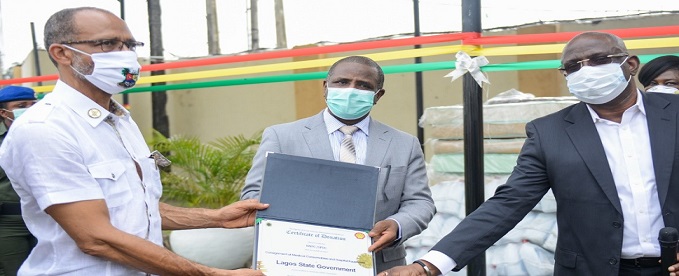
The cutting-edge blood component extractor machine just donated to the Lagos State government has been described as a timely intervention to aid the recovery of novel coronavirus patients.

L-R: Commissioner for Health, Prof. Akin Abayomi; Manager Public Affairs, Nigerian National Petroleum Corporation, Alhaji Aliyu Ja’afaru and Managing Director, Shell Nigeria Exploration and Production Company, Mr Bayo Ojulari at the donation of Covid-19 medical equipment and consumables to the Lagos State Government held at the Infectious Disease Hospital, Yaba… on Friday
Prof. Akin Abayomi, Lagos state commissioner for Health,, said the machine would support passive immunisation of COVID-19 patients with the extraction of antibodies from survivors to be used on those battling with the deadly virus.
Receiving the Terumo Spectria Optia model of the plasma apheresis machine from the Shell Nigeria Exploration and Production Company (SNEPCo) on Friday at the Infectious Disease Hospital, Yaba in Lagos, the commissioner said the donations and support from Shell companies in Nigeria under the oil and gas industry intervention programme were huge and worthy of emulation by other corporate bodies.
The Apheresis machine is used for the collection and automatic separation of donor blood components such as platelets or plasma, as well as for the treatment for certain medical conditions in which a part of the blood that contains disease-provoking elements is removed.
“The friendship, loyalty and support of Shell companies before and during the COVID-19 period are indeed tremendous and have really helped Lagos State in repositioning health care delivery to the people,” said Abayomi, adding: “I’m also impressed by your carbon-sensitive intervention with the provision of renewable solar power for the state’s isolation centre.”
Presenting the items, including PCR testing machines, 150KVA generator, an ambulance, ventilators, a 30KVA solar hybrid solution and loads of medical consumables, Bayo Ojulari, managing director of SNEPCo, described COVID-19 as a global emergency requiring maximum support from corporate and individual entities to help government in the management of the challenges posed by the pandemic.

“Lagos being the epicenter puts an enormous challenge on state resources hence this industry intervention led by the Nigeria National Petroleum Corporation (NNPC) to support as many states as possible to bring the virus under control,” said Ojulari. He commended the state governor and its executive team for rising up early to put in place measures to check the spread of the virus in the state.
Also speaking, Mallam Mele Kolo Kyari, managing director of NNPC, who was represented by Aliu Ja’afaru, manager, Public Affairs Department of the National Petroleum Investment Management Services, noted that but for the timely and unrelenting efforts by the state the infection rates in Nigeria would have been much worse than it was.
Soon after the outbreak of COVID-19 in Nigeria, Shell companies in Nigeria had provided four vehicles, including fueling and maintenance to Lagos State to aid in contact tracing.
The companies had also presented vehicles, ambulances, ventilators, PCR Machines and tons of medical consumables to Rivers, Delta, Bayelsa, Imo and Abia states with plans to extend the donations to more states.


Union Bank of Nigeria has secured certification under the Payment Card Industry Data Security Standard (PCI DSS) version 4.0.1, a global standard for protecting payment card data.

The certification took effect on August 11, 2026, confirming that the bank’s systems for storing, processing and transmitting customers’ credit and debit card information meet stringent international security requirements.
PCI DSS certification is designed to reduce the risk of payment card data breaches and financial fraud while strengthening customer confidence in electronic payment systems.
The assessment covered key areas of Union Bank’s operations, including network infrastructure, card issuance, ATM and POS transactions, payment processing, reconciliation, settlement, chargebacks, dispute resolution and retail banking.
Union Bank was assessed and certified under the Service Provider category.
The certification process lasted a full year and involved quarterly assessments, with support from departmental, business and functional heads across the bank. Digital security firm Digital Encode supported the process, while the final independent audit was conducted by CyberCube, an accredited Qualified Security Assessor.
Yetunde B. Oni, Managing Director and Chief Executive Officer of Union Bank, said the certification demonstrates the bank’s commitment to protecting customer information.
“The security of our customers’ information is central to everything we do at Union Bank. This certification reaffirms that our payment systems and processes meet a rigorous global standard, and it reflects the discipline of colleagues across the Bank who work every day to keep customer data safe.”
The renewal also ensures that Union Bank maintains continuous PCI DSS certification, in line with the Central Bank of Nigeria’s requirement for banks to sustain compliance without interruption.
New data from CFA Society Nigeria is reshaping how the country’s financial sector thinks about talent development, with Access emerging as the single largest source of CFA candidates in Nigeria, distinction industry watchers say signals a deeper shift in how leading institutions are building investment expertise from within.

In its Where Nigeria’s Finance Professionals Work series, published in a national daily, CFA Society Nigeria placed Access first among employers of CFA candidates nationwide, with 82 candidates enrolled in the programme, more than double the 38 recorded at the next-placed institution and well ahead of every other bank or financial services firm on the list.
Access also ranked second among employers of CFA charterholders, with 11 professionals who have completed all three levels of the Programme and met its experience and ethics requirements.
For an industry that has long measured itself by balance sheet size and branch count, the rankings point to a different kind of competition: one over who is building the deepest bench of certified, globally credentialed talent.
CFA Society Nigeria compiled the data from its Salesforce Membership Database as at June 2026, and described the exercise as a way of recognising employers whose people “bring rigour, integrity and global best practices into the workplace every day.”
Analysts following the sector say the outcome is notable less for the ranking itself than for what it suggests about talent strategy across Africa’s financial services industry. A single institution developing more aspiring charterholders than the rest of the market combined raises the floor for professional standards nationally, not just within one balance sheet.
Every candidate who advances through the CFA Programme adds to a shared pool of ethics-trained, analytically rigorous professionals that Nigeria’s capital markets, pension funds and asset managers all eventually draw from.
Access Holdings Group Chief Executive Officer Innocent C. Ike, commenting on the rankings, framed the achievement in terms of institution-building rather than recruitment: “Every candidate on that list represents our commitment to building institutions and professionals that endure.”
The remark echoes a broader thesis increasingly voiced by market observers, that talent depth, not scale alone, is what will determine which African financial institutions earn lasting global credibility.
That distinction sits at the centre of Access’s stated ambition to become the World’s Most Respected African Financial Services Group. If the CFA numbers are any indication, the Group’s route to that goal runs less through square metres of branch network and more through the calibre of the people sitting inside it, a bet that Nigeria’s finance professionals, and the institutions that will one day hire them, are already placing alongside Access.


Nigeria Civil Aviation Authority (NCAA) has announced plans to introduce Radio Frequency Identification (RFID) baggage tracking technology across domestic and international airport terminals to tackle the growing problem of delayed, misrouted and missing luggages

Michael Achimugu, director, Public Affairs and Consumer Protection, NCAA, disclosed this at a stakeholder engagement forum in Lagos.
Achimugu said the RFID-enabled system would replace the traditional barcode-based baggage tracking framework and provide airlines and passengers with real-time visibility of checked luggage from check-in to final collection.
According to him, the technology would improve baggage traceability, reduce mishandling and strengthen accountability across the baggage-handling chain.
Unlike conventional barcode systems, RFID technology allows baggage to be automatically scanned at multiple points without requiring direct line of sight, enabling real-time tracking of luggage throughout its journey.
Achimugu said issues involving short-landed, missing, lost or damaged baggage had remained among the major complaints from air travellers, alongside flight delays.
He said the introduction of RFID technology was therefore aimed at improving baggage-handling standards and restoring passenger confidence in the aviation sector.
The NCAA said the initiative also aligns with IATA Resolution 753, which requires airlines to track baggage at key points during the passenger journey.
The authority expects the technology to provide more accurate information on the location of luggage, facilitate quicker resolution of baggage-related complaints and improve the overall passenger experience.
The NCAA said the initiative would also strengthen accountability among airlines and other stakeholders involved in baggage handling at Nigerian airports.

SEC Clears Blockchain for Accelerated Regulatory Incubation Programme

Union Bank Secures Global Payment Data Security Certification

NLNG, NCDMB Boost Engineering Research with Innovation Centre

Organizations Face New Attacks via Unpatched TrueConf Videoconferencing Servers, Kaspersky Warns

Leadway Unveils Multi-generational Insurance Plan for Nigerian Families

EFCC Busts NIS Visa Overstay Racket, Uncovers N700m in an Account

Fact-Check: Elon Musk’s “Tesla Pi Phone” is Internet Rumor

NBC Tasks Broadcasting Stations over 2028 DSO Global Deadline

NBC Scraps Annual Digital Access Fee on DSO

Glo Sponsored African Voices to Feature Netflix’s “The Polygamist” Stars




 News2 days ago
NCAA to Introduce RFID Technology to Tackle Missing Luggages

 General News2 days ago
Nigeria Not Making Progress in Fiscal Transparency –US

 Telecom2 days ago
GSMA Industry Services Unveils Circularity Services to Help Operators Reduce E-Waste and Unlock Value

 Telecom2 days ago
MTN Nigeria Unveils Y’ello Street Museum to Mark 25 Years of Connectivity

 News2 days ago
Firm Urges MSMEs to Increase Digital Payments Adoption for Growth

 E-Financial2 days ago
SEC Directs Operators to Subscribe to NigSac Alerts, Freeze Terrorists-Linked Funds

 E-Financial2 days ago
AFC Raises $430m in Digital Bond to Deepens Digital Financial Infrastructure

 E-Business2 days ago
Cyber Resilience a Critical Priority for Manufacturing Amid Rapid Digitalization – Report Shows