

E-Financial
Staff, Robbers Steal N12Bn from Banks in 2017- Report

Nigeria Deposit Insurance Company (NDIC) has said that financial institutions in the country lost some N12.01 billion in 2017, representing an increase of 38 per cent increase over the N8.68 billion reported in 2016.

The losses resulted from increasing cases of robbery and fraud involving bank staff.
The Central Bank of Nigeria (CBN) also reported a staggering rise in the reported cases of such incidences from 16,762 in the first half of the financial year of 2017 to 20,768 in the corresponding period of 2018, according to the Sun.
The public domain is awash with reported cases of such fraudulent activities, which include fraudulent transfers/withdrawals, cash suppression, unauthorised credits and fraudulent conversion of cheques, diversion of customer deposits, diversion of bank charges, burglary and presentation of forged or stolen-cheques.
Records show that some bank staff (names withheld), aside documentary fraud, sometimes stage-manage robbery or connive with outsiders to perpetrate such act.
A seven-man syndicate arrested recently by Operatives of the Rapid Response Squad (RRS) over botched transfer of N25 million from a local bank and a $220,000 from an international account confirmed to investigators that they work with bank insiders.
The members of the syndicate still under investigation. Police investigations revealed that the fraudsters scout for obituaries of well- to- do members of the public, use bank insiders to determine the deceased account balance, clone their SIM cards for online transfer. It was learnt that one of the bank insiders was arrested in Lagos while another one based in Benin is on the run after suspecting the gang has been busted and that police are on his trail.
Also recently, the Economic and Financial Crimes Commission (EFCC) Benin zone, arrested a staff of a first generation bank over alleged stealing of N18.9 million from the bank.
The suspect is said to be in charge of the ATM gallery keys.
Unknown to him, according to the report, the CCTV footage captured him walking into the ATM gallery, using a nylon bag to cover the CCTV and disappearing with the money until he was arrested.
Sometime ago, EFCC arraigned a 36-year-old banker (names witheld) before Lagos State High Court, Ikeja, on one count-charge of stealing.
The anti-graft agency counsel, Mr. U.U. Buhari, said : “The defendant dishonestly converted to his use, the sum of $200,000 belonging to Insurance Brokers of Nigeria (IBN), using his position as a bank’s relationship officer to the complainant.”
A customer care officer in a bank connived with robbers to steal N7million from an Automated Teller Machine in the bank. When he was arrested, he confessed to mobilising the criminals, “Thinking it was something I could pull off easily,” he said.
“I simply told them how they should enter the bank, where to find the mobile policeman guarding the bank and how to disconnect the CCTV cameras.”


E-Financial
Iran-Israel-US Conflict and CBN’s FX Gains: A Stress Test for Nigeria’s Monetary Stability

Blaise Udunze
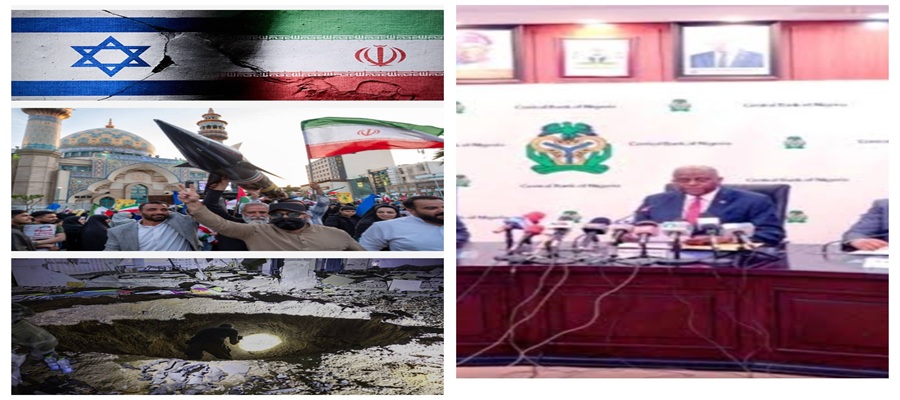
At the 304th policy meeting held on Wednesday, the 25th February, the Central Bank of Nigeria’s (CBN) Monetary Policy Committee cut the rate by 50 basis points to 26.5 percent from 27 percent, which has been widely described as a cautious transition from prolonged tightening to calibrated easing.

CBN
The CBN stated that the decision followed 11 consecutive months of disinflation. The economy witnessed headline inflation easing to 15.10 percent in January 2026, and food inflation falling sharply to 8.89 percent. Foreign reserves are climbing to $50.45 billion, their highest level in 13 years. The Purchasing Managers’ Index is holding at an expansionary 55.7 points.
As reported in the paper, no doubt that the macroeconomic narrative appears encouraging. On a closer scrutiny, the sustainability of these gains is now being tested by forces far beyond the apex bank’s policy corridors. This is as a result of the clear, direct ripple effect of the escalating conflict between Iran and Israel, with direct military involvement from the United States, has triggered one of the most significant geopolitical energy shocks in decades. For Nigeria, the timing is delicate. Just as the CBN signals confidence in disinflation and stability, global volatility threatens to complicate and possibly distort its monetary path.
The rate cut, though welcomed by many analysts, must be understood in context. Nigeria remains in an exceptionally high-rate environment. An MPR of 26.5 per cent is still restrictive by any standard. The Cash Reserve Ratio (CRR) remains elevated at 45 per cent for commercial banks, and this effectively sterilises nearly half of deposits, while liquidity ratios are tight, and lending rates to businesses often exceed 30 per cent once risk premiums are included. The adjustment is therefore incremental, not transformational.
The Director/CEO of the Centre for the Promotion of Private Enterprise (CPPE), Dr. Muda Yusuf, has repeatedly noted that Nigeria’s deeper challenge lies in weak monetary transmission. According to him, even when the benchmark rate falls, structural rigidities, high CRR, elevated deposit costs, macroeconomic uncertainty, and crowding-out from government borrowing prevent meaningful relief from reaching manufacturers, SMEs, agriculture, and other productive sectors. Monetary easing, without structural reform, risks becoming cosmetic. The point is that even before structural reforms take effect, the fact is that an external shock will first reshape the landscape.
The Iran-Israel conflict and US involvement have reignited fears in global energy markets. Joint U.S. and Israeli strikes on Iranian targets and retaliatory missile exchanges across the Gulf have unsettled oil traders. Brent crude, already rising in anticipation of escalation, surged toward $70-$75 per barrel and could climb higher if shipping through the Strait of Hormuz, through which nearly 20 per cent of global oil supplies pass, faces disruption. It is still an irony that a major crude exporter is also an importer of refined petroleum products.
Higher crude prices offer a theoretical windfall. For Nigeria’s economy, it is well known that oil remains its largest source of foreign exchange and accounts for roughly 50 per cent of government revenue. The good thing is that rising prices could boost reserves, improve forex liquidity, strengthen the naira, and ease fiscal pressures. In theory, this external cushion could support macroeconomic stability and reinforce the CBN’s easing posture.
However, the upside is constrained by structural weaknesses. Nigeria’s oil production remains below optimal capacity. A significant portion of crude exports is tied to long-term contracts, limiting immediate gains from spot price surges. As SB Morgen observed in its analysis, Nigeria’s “windfall” is volatile and limited by soft production performance.
More critically, Nigeria’s dependence on imported refined products exposes it to imported inflation. Rising global crude prices increase the cost of petrol, diesel, jet fuel and gas. With fuel subsidies removed, these increases are passed directly to consumers and businesses. Depot pump prices have already adjusted upward amid Middle East tensions.
Energy costs are a primary driver of Nigeria’s inflation and this has remained sacrosanct. When fuel prices rise, transportation, logistics, food distribution, power generation, and manufacturing costs will definitely skyrocket, as well as the inflationary impulse spreads quickly through the economy. This will push households to face higher food and transportation costs. Businesses see shrinking margins. Real incomes erode.
Thus, the same oil shock that boosts government revenue may simultaneously reignite inflationary pressure, precisely at a moment when the CBN has begun cautiously easing policy.
This dynamic introduces a difficult policy dilemma, even as this could be for the fragile gains of the MPC. This is to say that if energy-driven inflation resurges, the CBN may be forced to pause or reverse its easing cycle. It is clearly spelled that high inflation typically compels tighter monetary conditions. As Yusuf warned, geopolitical headwinds that elevate inflation often push central banks toward higher interest rates. A renewed tightening would strain credit conditions further, undermining growth prospects.
There is also the risk of money supply expansion. Increased oil revenues, once monetised, can expand liquidity in the domestic system. Historically, surges in oil receipts have been associated with monetary growth, inflationary pressure, and exchange rate volatility. Without sterilisation discipline, a revenue boost could ironically destabilise macro fundamentals.
The exchange rate dimension compounds the complexity. Heightened geopolitical risk, just as it is currently playing out with the Iran-Israel conflict, often triggers global flight to safety. This will eventually lure investors to retreat to U.S. Treasuries and gold. Emerging markets face capital outflows. If it happens that foreign portfolio investors withdraw from Nigeria’s fixed-income market in response to global uncertainty, pressure on the naira could intensify.
Already, the CBN has demonstrated sensitivity to exchange rate dynamics by intervening to prevent excessive naira appreciation. A sharp rate cut in the midst of global volatility could destabilise carry trades and spur dollar demand. What should be known is that the 50-bps reduction reflects not just domestic disinflation, but global risk management such as geopolitical tensions, oil prices, and foreign investor sentiment.
Beyond macroeconomics, geopolitical implications carry security concerns. Analysts warn that a widening Middle East conflict could embolden extremist narratives across the Sahel and it directly has security consequences for Nigeria and the broader region. Groups such as Boko Haram and ISWAP may exploit anti-Western framing to recruit and mobilise more followers in the Sahel region, thereby giving the extremist groups new propaganda opportunities. The pebble fear is that a diversion of Western security resources away from West Africa could create regional vacuums. What the Nigerian economy will begin to experience is that security instability will disrupt agricultural output, logistics corridors, and investor confidence, feeding back into inflation and slow economic growth and as ripple effects, the economy becomes weaker.
Nigeria’s diplomatic balancing act adds another layer of fragility because it is walking on a tactful tightrope. The country is trying not to upset anyone, but maintains cautious neutrality, urging restraint while preserving ties with Western allies and Middle Eastern partners. Yet rising tensions globally between major powers, including Russia and China, complicate the geopolitical chessboard. Invariably, this will have a direct impact as trade flows, remittances, and investment patterns may change unexpectedly, affecting Nigeria’s economy.
With the current conflict in the Middle East, the prospects for economic growth also face renewed strain or are under increased pressure. The stock markets in developed countries have been fluctuating a lot because people are worried that there will be problems with the energy supply. If the whole world does not grow fast, then people will use less oil over time. This means that the good things that happen to Nigeria because of oil prices will probably not last, and any extra money Nigeria gets from oil prices now will be lost. Nigeria will not get to keep the money from high oil prices for a long time. The oil prices will affect Nigeria. Then the effect will go away. One clear thing is that since Nigeria relies heavily on oil exports, this commodity dependence exposes the country to significant risk.
Meanwhile, Nigeria’s domestic fundamentals remain structurally challenged. The recapitalisation of banks, with 20 of 33 institutions meeting new capital thresholds, strengthens resilience, but does not guarantee credit expansion into productive sectors. Banks continue to prefer risk-free government securities over private lending in uncertain environments.
Fiscal discipline remains essential. Elevated debt service obligations absorb substantial revenue. Election-related spending poses upside inflation risks. This understanding must be adhered to, that without credible deficit reduction and revenue diversification, monetary easing may be undermined by fiscal expansion.
At the moment, given the current global and domestic uncertainties, the 50 percent interest cut rate appears less like a pivot toward growth and more like a signal of cautious optimism under conditional stability. The policy decision is based on several key expectations with the assumptions that disinflation will persist, exchange rate stability will hold, and global conditions will not deteriorate dramatically.
But the Iran-Israel-U.S. conflict introduces uncertainty into all three assumptions, which is wrongly perceived as behind the rate cut that inflation will keep coming down, that the exchange rate will stay stable, and global conditions won’t worsen, are all undermined by the unfolding conflict.
If the global oil prices rise sharply and fuel becomes more expensive locally, overall prices in the economy could increase again, which means inflation could accelerate. Another dangerous trend is that if foreign investors pull capital out of Nigeria, exchange rate stability could weaken, seeing the naira coming under pressure. If global growth slows, export earnings could decline. Each of these scenarios would constrain the CBN’s flexibility.
This is not to dismiss potential upsides. Higher oil prices, if production improves, could bolster reserves and moderate fiscal deficits. Forex liquidity could strengthen the naira. Investment in upstream oil and gas could gain momentum. Historically, crude price increases have correlated with improved GDP performance and stock market optimism in Nigeria.
Yet history also warns of volatility. A good example is during the 2022 Ukraine conflict, oil prices spiked above $100 per barrel, which created a potential revenue windfall oil exporting countries, but Nigeria struggled to translate that temporary advantage into sustained economic improvement. Inflation persisted. In the case of Nigeria, the deep-rooted systemic or structural weaknesses and inefficiency diluted the benefits that should have been gained.
The lesson is clear because temporary external windfalls or short-term luck cannot substitute for structural and deep internal economic reforms.
The point is that sustainable development demands diversification beyond oil, to strengthening multiple parts of its economy at the same time, such as improved refining capacity, infrastructure investment, agricultural security, logistics efficiency, and fiscal consolidation. Monetary policy, as the action taken by the CBN at the MPC meeting by adjusting interest rates or attempting to control money supply, can anchor expectations and moderate volatility, but it cannot build productive capacity; it will only help to reduce short-term economic swings.
The CBN’s decision to cut the interest rate appears cautious. It is not a bold shift but rather a small adjustment. This shows that the bank is being careful and optimistic about the economy. It also knows that there are still problems. The trouble in the Middle East, like the fighting that affects the oil supply, reminds the people in charge that Nigeria’s economy is closely tied to what happens with energy around the world. This includes things like inflation, the value of money, and how fast the economy grows.
Until structural reforms reduce dependence on volatile oil cycles and imported fuel, Nigeria’s monetary policy will remain reactive to external crises. To really make the economy strong and stable, Nigeria needs to make some changes. It requires resilience against geopolitical storms.
The MPC has taken a step. Whether it marks a turning point depends less on 50 basis points and more on how Nigeria navigates a world increasingly defined by conflict-driven volatility.
Blaise, a journalist and PR professional, writes from Lagos and can be reached via: [email protected]


House of Representatives has moved to establish a regulatory commission to regulate fintech in the country.

The regulatory commission is to be established through a bill sponsored by Hon. Fuad Kayode Laguda, titled, “A Bill For An Act To Provide For The Establishment Of Nigerian Fintech Regulatory Commission In Nigeria And For Related Matters, 2025”.
The bill has been passed and referred to the House Committees on Digital and Electronic Banking; Banking Regulations; Science and Technology; Communications; and Capital Market and Institutions.
According to its ‘Explanatory Memorandum’, the bill seeks to establish a legal framework for the Nigerian fintech industry.
It stated, “The Commission, when established, will oversee the licensing, regulation, and supervision of fintech services in Nigeria.”
It added that the Act promotes the implementation of the national fintech policy, establishes regulatory authority, and seeks to protect consumer rights.
The proposed bill further stated that the Commission “is mandated to facilitate investments, ensure fair competition, and develop performance standards for fintech services.”
It further added, “The Commission will be structured into departments with regional offices in all geopolitical zones of Nigeria.
“A Governing Board consisting of 14 members, including a Chairman and commissioners from each geopolitical zone, will manage the Commission.”
On the qualifications for members of the Commission’s governing board, it stated that they must have expertise in finance, public administration, or relevant fields.
It added, “Members must be Nigerian citizens and are barred from holding conflicting interests during their tenure.”
The bill further proposed that the Commission be granted financial authority to establish a fund from various sources, including appropriations by the National Assembly and fees from licensing.
Annual financial reports will also be submitted to the National Assembly for approval.
The Minister of Finance holds responsibility for formulating and monitoring general policies for the fintech sector, but he must consult with the Commission for public input before policy changes.
The National Fintech Management Council is to assist the Minister in international fintech negotiations and data collection.
It further added that, “The Council comprises representatives from various governmental agencies and is tasked with advising on fintech development.
“The Act prohibits operating fintech services without a proper license and outlines penalties for violations.
“The Commission will regulate licensing processes, specifying conditions that promote transparency and fairness.
“The Commission has the authority to resolve disputes within the fintech sector effectively.
“It is empowered to conduct inquiries, publish findings, and maintain registers of licences and agreements related to fintech operations.”
It further informed that the “Act encompasses provisions aimed at protecting consumer interests and ensuring quality of service in fintech transactions.
“It mandates the establishment of consumer codes and addresses complaint resolution processes in alignment with regulatory objectives.”

Mutual Benefits Assurance Plc has allayed concerns arising from recent media reports referencing a sanction previously imposed by the Nigerian Exchange Limited (NGX) over delays in the filing of certain audited and unaudited financial statements.

The leading insurance company clarified that the matter relates to prior reporting periods and was fully resolved in accordance with NGX regulatory procedures at the time.
It confirmed that all outstanding filings have since been regularised and that the company is fully compliant with NGX listing rules and reporting obligations.
According to the company, following the occurrence of the referenced delays, it undertook a comprehensive review of its governance, reporting and compliance frameworks, leading to the implementation of strengthened internal controls and oversight structures.
Among the measures introduced are enhanced financial reporting architecture, including stricter internal timelines, improved cross-functional coordination and strengthened review protocols to ensure timely and accurate disclosures.
Mutual Benefits also reinforced Board oversight through its Audit and Risk Committees, establishing clearer accountability frameworks and structured periodic compliance reviews.
In addition, upgraded compliance monitoring systems were deployed across finance and company secretariat functions to optimise regulatory tracking and reporting processes.
The Management of Mutual Benefits Assurance Plc further noted that investments have been made in technology, human capital and governance processes to support sustained operational transparency and regulatory adherence.
These reforms, the company stated, have significantly improved reporting efficiency and compliance discipline across the organisation, positioning it for continued stability and long-term growth.
Reaffirming its commitment to transparency and stakeholder confidence, Mutual Benefits Assurance Plc stated that it remains dedicated to the highest standards of corporate governance, accountability and regulatory compliance.
The company added that it continues to operate from a position of financial and operational stability, focused on delivering sustainable value to shareholders, policyholders, business partners and the investing public.
The company also expressed appreciation to stakeholders for their continued confidence, while reiterating its unwavering commitment to sound corporate governance practices and full compliance with all regulatory requirements.

Sunil Bharti Mittal Conferred GSMA Lifetime Achievement Award for Transforming Global Telecommunications

Jumia Tech Week 2026 Begins with Tech Deals on Smartphones, Electronics, and Everyday Technology

AfDB Supports Francophone Africa Start-ups with €6.5M

Krishnan Exits Africa Data Centre to Embark on Professional Chapter

House Probes Fintech Regulation via Public Hearing on New Commission Bill

Accidental Billionaire Opts for Jail Instead of Returning Money Credited Him by Mistake

New Horizons Nigeria Breaks Ground: First to Fuse Mandarin into ICT Curriculum

Kaspersky Brings more Transparency to Threat Detection with New Hunt Hub

Dr. Cairo Ojougboh Foundation Bolsters Nigeria’s Education Drive with ₦2.7m Student Support

NDPC Commits to Balancing Data Privacy, Protection Information




 E-Financial2 days ago
Iran-Israel-US Conflict and CBN’s FX Gains: A Stress Test for Nigeria’s Monetary Stability

 E-Financial2 days ago
Mutual Benefits Assurance Reaffirms Full Regulatory Compliance, Enhanced Governance

 General News2 days ago
JAMB Uncovers AI-Driven Fraud Targeting UTME Candidates, Warns Parents

 General News2 days ago
SERAP Asks FCCPC to Investigate Google, Meta, Others over Alleged Rights Abuses

 News2 days ago
FlashChange CEO, Bidemi Oke, Urges Startups to Build Strong Governance Structures Early

 News2 days ago
TeamApt, Awabah Partner to Boost Pension Drive for Nigerians

 General News1 day ago
Leo Stan Ekeh at 70; thanks Tinubu, Obasanjo, Nigerians, Global Tech Community

 General News2 days ago
Capelli Institute Commits to Advancing Trichology in Nigeria