

News
Stolen Credentials Selling on Dark Web for Price of 3 Litres of Fuel – Report


HP has released The Evolution of Cybercrime: Why the Dark Web is Supercharging the Threat Landscape and How to Fight Back – an HP Wolf Security Report.

The findings show cybercrime is being supercharged through “plug and play” malware kits that make it easier than ever to launch attacks. Cyber syndicates are collaborating with amateur attackers to target businesses, putting our online world at risk.
The HP Wolf Security threat team worked with Forensic Pathways, a leading group of global forensic professionals, on a three-month dark web investigation, scraping and analysing over 35 million cybercriminal marketplaces and forum posts to understand how cybercriminals operate, gain trust, and build reputation.
Key findings include:
– Malware is cheap and readily available – Over three quarters (76%) of malware advertisements listed, and 91% of exploits (i.e., code that gives attackers control over systems by taking advantage of software bugs), retail for under ₦4,923.17. The average cost of compromised Remote Desktop Protocol credentials is just ₦2,092.35.
Vendors are selling products in bundles, with plug-and-play malware kits, malware-as-a-service, tutorials, and mentoring services reducing the need for technical skills and experience to conduct complex, targeted attacks – in fact, just 2-3% of threat actors today are advanced coders.
-The irony of ‘honor amongst cyber-thieves’ – Much like the legitimate online retail world, trust and reputation are ironically essential parts of cybercriminal commerce: 77% of cybercriminal marketplaces analysed require a vendor bond – a license to sell – which can cost up to ₦1,230,793.
Eighty-five per cent of these use escrow payments, and 92% have a third-party dispute resolution service. Every marketplace provides vendor feedback scores. Cybercriminals also try to stay a step ahead of law enforcement by transferring reputation between websites – as the average lifespan of a dark net Tor website is only 55 days.
– Popular software is giving cybercriminals a foot in the door – Cybercriminals are focusing on finding gaps in software that will allow them to get a foothold and take control of systems by targeting known bugs and vulnerabilities in popular software.
Examples include the Windows operating system, Microsoft Office, web content management systems, and web and mail servers. Kits that exploit vulnerabilities in niche systems command the highest prices (typically ranging from ₦393,853.76 – ₦1,723,110.20). Zero Days (vulnerabilities that are not yet publicly known) are retailing at tens of thousands of dollars on dark web markets.
“Unfortunately, it’s never been easier to be a cybercriminal. Complex attacks previously required serious skills, knowledge and resource. Now the technology and training is available for the price of 3 litres of fuel.
“And whether it’s having your company and customer data exposed, deliveries delayed or even a hospital appointment cancelled, the explosion in cybercrime affects us all,” comments report author Alex Holland, Senior Malware Analyst at HP Inc.
“At the heart of this is ransomware, which has created a new cybercriminal ecosystem rewarding smaller players with a slice of the profits.
“This is creating a cybercrime factory line, churning out attacks that can be very hard to defend against and putting the businesses we all rely on in the crosshairs,” Holland adds.
HP consulted with a panel of experts from cybersecurity and academia – including ex-black hat hacker Michael ‘Mafia Boy’ Calce and authored criminologist, Dr. Mike McGuire – to understand how cybercrime has evolved and what businesses can do to better protect themselves against the threats of today and tomorrow.
They warned that businesses should prepare for destructive data denial attacks, increasingly targeted cyber campaigns, and cybercriminals using emerging technologies like artificial intelligence to challenge organisations’ data integrity.
To protect against current and future threats, the report offers up the following advice for businesses:
Master the basics to reduce cybercriminals’ chances: Follow best practices, such as multi-factor authentication and patch management; reduce your attack surface from top attack vectors like email, web browsing and file downloads; and prioritise self-healing hardware to boost resilience.
Focus on winning the game: plan for the worst; limit risk posed by your people and partners by putting processes in place to vet supplier security and educate workforces on social engineering; and be process-oriented and rehearse responses to attacks so you can identify problems, make improvements and be better prepared.
Cybercrime is a team sport. Cybersecurity must be too: talk to your peers to share threat information and intelligence in real-time; use threat intelligence and be proactive in horizon scanning by monitoring open discussions on underground forums; and work with third-party security services to uncover weak spots and critical risks that need addressing.
“We all need to do more to fight the growing cybercrime machine,” says Dr. Ian Pratt, Global Head of Security for Personal Systems at HP Inc. “For individuals, this means becoming cyber aware.
Most attacks start with a click of a mouse, so thinking before you click is always important. But giving yourself a safety net by buying technology that can mitigate and recover from the impact of bad clicks is even better.”
“For businesses, it’s important to build resiliency and shut off as many common attack routes as possible,” Pratt continues.
“For example, cybercriminals study patches on release to reverse engineer the vulnerability being patched and can rapidly create exploits to use before organisations have patched. So, speeding up patch management is important.
“Many of the most common categories of threat such as those delivered via email and the web can be fully neutralised through techniques such as threat containment and isolation, greatly reducing an organisation’s attack surface regardless of whether the vulnerabilities are patched or not.”


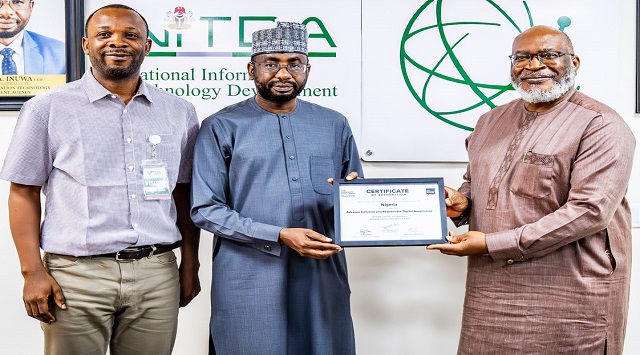
The Director General of the National Information Technology Development Agency (NITDA), Kashifu Inuwa, CCIE, has reaffirmed Nigeria’s commitment to open governance, transparency and inclusive digital development as the Open Government Partnership (OGP) team formally presented the award and certificate received at the OGP Global Summit Spain 2025 to the Agency’s leadership.

Nigeria emerged as the overall global winner in the Digital Governance category in recognition of the country’s excellence in deploying digital tools and policies to strengthen government transparency, accountability, and citizen engagement. In addition, Nigeria received the Regional Award for advancing Open Digital Governance across Africa and the Middle East, reaffirming its leadership role in promoting open government principles and driving digital transformation across the region.
These recognitions were largely attributed to initiatives led by NITDA in collaboration with civil society partners, such as Dataphyte, which showcased innovative and inclusive approaches to digital governance at the summit.
The summit, which was organised in Vitoria-Gasteiz, Spain, brought together more than 1,500 high-level representatives of governments, civil society leaders, and policymakers from around the world to exchange experiences, best practices, and progress on open government initiatives and implementation on key issues.
Receiving the OGP delegation at NITDA, Inuwa described the recognition as a national honour rather than an institutional one, stressing that the award reflects Nigeria’s collective efforts across government, civil society and the private sector in advancing open governance principles through the digital space.
According to him, such global recognition comes with heightened responsibility to deliver on commitments made under the OGP framework.
“This is not just about NITDA. It is a national recognition, and every recognition comes with responsibility,” the DG said.
“If we fail to execute the commitments we have made, it will not only affect our image locally but also at the international stage. This is also not something NITDA can do in isolation,” he added.
Inuwa linked the achievement directly to the Renewed Hope Agenda of President Bola Ahmed Tinubu, noting that digital transformation, transparency, economic diversification, job creation and efficient public service delivery remain central presidential priority areas.
He emphasised that leveraging digital technologies to deepen openness and accountability aligns with national objectives of strengthening institutions, improving governance outcomes and building trust between government and citizens.
Highlighting the importance of collaboration, the NITDA boss underscored the role of the OGP platform as a catalyst for a strong multi-stakeholder approach in Nigeria’s digital ecosystem.
He called on civil society organisations, development partners, the private sector and other government institutions to provide technical expertise, guidance and sustained engagement to ensure effective implementation of agreed commitments.
“We need to leverage the OGP platform. We need your expertise, your guidance, your support and your commitment to hand-hold us in delivering on these commitments,” he said.
He further noted that “a multi-stakeholder approach in the digital space is critical to fostering a resilient ecosystem that delivers real value to citizens.”
Inuwa disclosed that NITDA has already begun internal reviews of its OGP commitments and has tasked its representatives, including Dr Rousseau, to work with colleagues to develop a clear execution strategy.
He proposed the creation of joint work streams with OGP stakeholders to support implementation, ensure accountability and keep all parties on track.
“We are humans. Oversight and collaboration help us stay focused. With commitment, nothing is impossible, and I believe these goals are achievable,” he added, assuring the delegation of NITDA’s readiness and political will to deliver on all agreed commitments.
Inuwa also welcomed the idea of engaging the political leadership of OGP, including the Honourable Minister of Budget and Economic Planning, with a view to briefing President Tinubu on the achievement. He noted that celebrating milestones is important, as it reinforces morale and demonstrates that Nigeria’s efforts in digital governance are gaining global recognition.
“It’s also good when there are wins, we should celebrate, because we too never knew that the little things we are doing are noticed not just within Nigeria, but globally, to the extent of earning us this award,” he asserted.
He concluded by expressing gratitude to the Nigerian National OGP Secretariat and the global OGP leadership, reaffirming NITDA’s commitment to strengthening collaboration and building a more productive working relationship that will translate open governance principles into measurable national impact.
Earlier in his remark, Mr Olusoji Apampa, who led the OGP deelegation, said the honours were earned through a strong partnership between government and civil society, with NITDA playing a critical role, particularly in commitments focused on improving digital governance in Nigeria.
Apampa expressed hope that the awards would serve as added momentum to deepen ongoing commitments under NITDA’s leadership and accelerate the practical implementation of reforms aimed at strengthening digital governance across the country.

PalmPay, Nigeria’s leading digital banking platform, has announced the launch of its ₦400 million festive rewards campaign, designed to reward users with cash prizes and fully sponsored international travel experiences for everyday transactions on the PalmPay app.

The campaign will run from December 17, 2025, to January 8, 2026. The campaign is designed to reward everyday transactions with extraordinary experiences. It runs alongside PalmPay’s Purple December brand campaign, which focuses on wrapping up the company’s key brand and community initiatives for the year.
At the centre of the rewards campaign is the PalmPay World Travel Carnival, an interactive card collection experience that allows users to earn city cards by completing transactions on the app. Users are required to collect five city cards – London, New York, Dubai, Sydney, and Cape Town and combine them into a World Card, which unlocks a share of the prize pool.
The more World Cards a user creates, the larger their share of the cash rewards. Any extra uncombined cards can be swapped with friends and other PalmPay users to help complete additional World Cards.
Beyond cash rewards, the Carnival also offers Free Global Trips. In each round, the top two users with the highest number of eligible transactions (₦100 and above) and at least one World Card will win an all-expense-paid international trip.
The travel grand prize covers:
- Visa fees
- Round-trip international airfare
- 5-day, 4-night hotel accommodation
- Side attraction
- Meal expenses
- Airport pick-up and drop-off
- All transportation for scheduled tour activities during the trip
Winners will be determined through a transparent leaderboard system, with prizes credited automatically at the end of each round on December 25, December 31, and January 8.
Participation is simple:
- Complete tasks on the PalmPay app, such as Airtime, Data, Transfers, and other specific transactions listed in the app, to earn cards.
- Collect all five city cards.
- Swap cards with friends to complete your collection.
- Combine cards to form a World Card and earn cash rewards.
- Perform more transactions to climb the leaderboard for a chance at the global trip prize.
To ensure fairness, PalmPay has instituted strict rules: no cheating, bots, fake accounts, or manipulation. Any violations may lead to disqualification or account bans. Additionally, the Free Travel Prize is limited to one per user throughout the campaign.
Speaking on the launch, Femi Hanson, Head of Marketing & Communication, “This festive rewards campaign is about turning everyday banking into meaningful value for our users. With the World Travel Carnival as the headline activation, we are reinforcing PalmPay’s promise of being the smarter way to bank—where smart financial decisions unlock bigger opportunities.”

The Rural Electrification Agency (REA) and the National Bureau of Statistics (NBS) have signed a Memorandum of Understanding (MoU) to conduct a nationwide energy survey aimed at closing long-standing data gaps in Nigeria’s power sector. The initiative is expected to guide policy, attract investment, and accelerate universal electricity access.

Signed in Abuja, the agreement establishes a National Energy Survey based on the Multi-Tier Tracking Framework (MTF), a globally recognized methodology that measures electricity access not only by grid connection but also by quality, affordability, reliability, and usage of electricity and clean cooking solutions.
The survey will be implemented under the Energy Sector Management Assistance Program (ESMAP) of the World Bank. Dr. Abba Aliyu, REA Managing Director/CEO, said the partnership underscores REA’s commitment to evidence-based rural electrification planning and will generate detailed insights on electricity access and off-grid solutions nationwide.
Prince Adeyemi Adeniran, Statistician-General of the Federation/CEO of NBS, emphasized that reliable statistics are essential for effective policymaking, assuring that NBS will provide technical oversight, sampling expertise, and quality assurance to meet global standards.
The survey will assess energy access, household affordability, expenditure patterns, and the adoption of off-grid technologies such as solar home systems, mini-grids, and clean cooking solutions. REA will provide sector expertise and policy alignment, while NBS manages regulatory approvals, methodology, and technical supervision.
Funded and technically overseen by the World Bank, the exercise will run for 18 months, with the resulting data expected to improve national energy planning, programme targeting, and private sector investment, particularly in underserved and rural communities.
Officials said the collaboration reflects the Federal Government’s commitment to strengthening inter-agency coordination, enhancing energy data availability, and advancing Nigeria’s goal of universal electricity and clean cooking access.

Access Holdings Shareholders Approved to Raise N40bn Capital Through Private Placement

Jumia Kicks Off December Holiday Sale, Bringing Festive Deals to Shoppers Nationwide

Dangote, Monopoly Power, and Political Economy of Failure

OAU, Baptist Day School Oluponna honour Akano with Distinguished Alumnus Awards

NIMC rolls out Pre-Enrolment Portal for seamless NIN registration

Nigeria Records Highest Weekly Cyberattacks in Africa — Report

Cyber Tsunami Hits Nigeria as Breaches Surge 1,047%, esentry Q3 Report Reveals

Jumia’s Data Shows Nigerians Turning to Digital Retail to Navigate Inflation Pressures

GenAI Adoption Among African workers Outpace Global Peers

How Insecurity is Bleeding Nigeria about $15bn Annually and Destroying Its Economic Future




 E-Business2 days ago
Nigeria Police Arrest Okitipi, Nigerian Allegedly Linked to Microsoft 365 Hack

 E-Financial2 days ago
World Bank to Approve $500m Loan for Nigeria Today

 News2 days ago
NITDA Partners OGP to Drive Presidential Digital Goals

 E-Financial2 days ago
Customs Slam 3 Percent Surcharge on Banks over Delayed Revenue Remittance

 Telecom2 days ago
Why Econet Wireless is Switching to VFEX

 E-Financial2 days ago
Fidelity Bank Boosts Maternal, Child Healthcare @ESUTH
 General News1 day ago
Jumia Kicks Off December Holiday Sale, Bringing Festive Deals to Shoppers Nationwide

 General News2 days ago
MTN Graduates 20 Fellows, Expands Media Innovation Programme