

News
Tamaidukka Group Plans $25M Industrial Park in Kaduna


Tamaidukka Group, an indigenous Nigerian Company with interest in Real Estate development, oil and gas is to develop an agro-based industrial park that will use soya beans and cotton seeds to produce vegetable oils for domestic and industrial use with much focus on export.
Speaking at the formal hand over of the site for the park in Kaduna, Chairman of the company, Alhaji Ahmed Suleiman Leda, said the processing plant upon completion, will have a daily processing capacity of 500 tonnes of both soya beans and cotton seeds while also producing 280 tonnes of animal feed.
According to him, the company’s plan is to create indigenous jobs by sourcing raw materials from local farmers within Kaduna and surrounding states.
“This move alone will create up to 500 jobs directly and another five hundred indirectly, and will guarantee a reliable market to at least one hundred thousand farmers in the state and neighbouring states,” he said
Alhaji Leda said the choice of Kaduna was informed by the ease of doing business regime created in the state by the governor Nasir El Rufai which he said has made the state an investor’s haven.
The Industrial park is to be located Sobawa layout Rigachikum, Igabi Local Government, Kaduna State is expected to fully commence operation by January 2019, the Kaduna State Government through its Investment and Promotions Agency, KADIPA, the state’s Urban Planning Development Agency KASUPDA and Environmental Protection Agency (KEPA) have given all required approvals for the project.
The site measuring about 100,000 Square Meters was successfully handed over to the company (TMDK Industries) on Friday, 12th June 2019 as the company has already started deploying workers on-site earnestly for the implementation of the project.



EFCC

The African Development Bank Group last week approved an investment of €6.5 million in the Saviu II fund in order to support technology start-ups through their seed phase and first institutional fundraising, mainly in French-speaking Central and West Africa.

The Bank will invest €4.5 million as equity and €2 million as a first-loss hedging tranche on behalf of the European Commission, under the Boost Africa Programme.
This participation of the Bank Group will enable the Saviu II fund to give priority to companies with a strong technological or digital component.
Saviu II, the second investment vehicle of Saviu Partners, plans to invest between €500,000 and €3 million in about 20 technology or technology-oriented business-to-business start-ups in the seed phase or carrying out first institutional fundraising.
The Saviu II venture capital fund aims to make at least 60% of its commitments in the French-speaking countries of West and Central Africa: Côte d ‘Ivoire, Cameroon, Benin, Senegal, Togo, Burkina Faso and Mali.
The fund can also co-invest in promising technology companies in East Africa that have a strong team and business model, and whose strategy includes entering the market in French-speaking West African countries and establishing a strong presence there.
In addition, the fund will devote a dedicated envelope to pre-seed investments, focusing on minority equity investments, usually in co-investment with studios, incubators or other ecosystem partners.
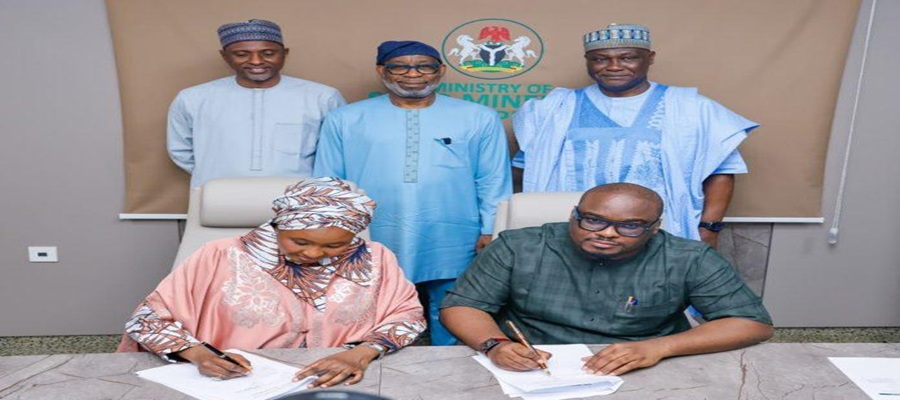
Nigerian Government has signed a $1.3 billion Memorandum of Understanding (MoU) with Africa Finance Corporation (AFC) via the Solid Minerals Development Fund (SMDF) to fund an alumina refinery, national geoscience mapping, and a strategic investment vehicle for mining growth.

Special Assistant to the Minister of Solid Minerals Development, Segun Tomori, said the refinery will process one million tonnes of bauxite yearly using a modern Bayer process, powered by an on-site gas-fired cogeneration plant.
Minister Dele Alake called it a transformative milestone boosting GDP, aligning with reforms that improve investment climate, regulations, and licensing to attract private capital. He directed agencies to fast-track permits.
The 20-year project at 95% utilization eyes 19 million tonnes total output, $1.2 billion annual GDP addition, $25 billion economic impact, and $8 billion forex earnings, per feasibility studies.
SMDF Executive Secretary Fatima Shinkafi termed it the agency’s biggest funding deal, supporting value-addition policy.
The partnership extends to geoscience mapping for mineral data, de-risking exploration, and a joint vehicle for mining assets.
Permanent Secretary Engr. Farouk Yabo praised the reforms. Shinkafi signed for government; AFC’s Franklin Edochie for the corporation, witnessed by AFC CEO Samaila Zubairu.
Tomori positioned it as Nigeria’s largest private mining investment and FDI magnet.

NAICOM Signs MoU with BPP to Deepen Insurance Compliance in Public Procurement

FG Approves GIS-enabled Digital Postcode to Tackle Logistics Gaps, Boost E-commerce

Firm Enhances its Security Awareness Platform with SCORM and PDF Support

GSMA, African Operators, Others to Launch Low-cost 4G Devices

Binance Cuts Illicit Activity Exposure by 96%, Leads Global Crypto Compliance Push
Kaspersky Brings more Transparency to Threat Detection with New Hunt Hub

Dr. Cairo Ojougboh Foundation Bolsters Nigeria’s Education Drive with ₦2.7m Student Support

NDPC Commits to Balancing Data Privacy, Protection Information

OADC Lagos Reinforces Commitment to Local Data Hosting and Digital Transformation @ NDPC’s National Privacy Week Summit

PwC Reveals AI Scaling Gap Slows Africa’s Digital Transformation




 Telecom2 days ago
Sunil Bharti Mittal Conferred GSMA Lifetime Achievement Award for Transforming Global Telecommunications

 Telecom2 days ago
Why Digital Trust Matters: Secure, Responsible AI for African SMEs?

 General News2 days ago
Krishnan Exits Africa Data Centre to Embark on Professional Chapter

 E-Business2 days ago
Jumia Tech Week 2026 Begins with Tech Deals on Smartphones, Electronics, and Everyday Technology

 General News3 days ago
Leo Stan Ekeh at 70; thanks Tinubu, Obasanjo, Nigerians, Global Tech Community

 Broadcasting2 days ago
NCAA Orders Overland Airways to Refund VAT Charged on 2025 Tickets

 Telecom2 days ago
House Probes Fintech Regulation via Public Hearing on New Commission Bill

 News2 days ago
AfDB Supports Francophone Africa Start-ups with €6.5M