

Telecom
Telecom Operators as Socially Responsible Organizations

The impact of telecommunications operators’ business in the country goes beyond service delivery and expansion of telecommunications facilities to giving back to their immediate communities where they are operating. Also referred to as corporate social responsibility (CSR), telecommunications operators have over the past eight years of liberalization of the sector contributed in no small measure in uplifting individuals, communities as well as supporting some government initiatives aside their core business of providing services to Nigerians.
There have been increased demands from employees, customers and government bodies for businesses to be more open about their activities and that they reach and maintain acceptable standards in their business practice. For employers, CSR is now seen as an important way to increase competitive advantage, protect and raise brand awareness and build trust with customers and employees.
It is a form of corporate self-regulation integrated into a business model. Ideally, CSR policy would function as a built-in, self-regulating mechanism whereby business would monitor and ensure its adherence to law, ethical standards, and international norms. Business would embrace responsibility for the impact of their activities on the environment, consumers, employees, communities, stakeholders and all other members of the public sphere. Furthermore, business would proactively promote the public interest by encouraging community growth and development, and voluntarily eliminating practices that harm the public sphere, regardless of legality. Essentially, CSR is the deliberate inclusion of public interest into corporate decision-making, and the honoring of a triple bottom line of People, Planet, and Profit.
The practice of CSR is subject to much debate and criticism. Proponents argue that there is a strong business case for CSR, in that corporations benefit in multiple ways by operating with a perspective broader and longer than their own immediate, short-term profits. Critics argue that CSR distracts from the fundamental economic role of businesses; others argue that it is nothing more than superficial window-dressing; others argue that it is an attempt to pre-empt the role of government as a watchdog over powerful multinational corporations.
In this regard virtually all telecommunications operators be they Global System for Mobile communications (GSM) or Code Division Multiple Access (CDMA) operators have executed or are executing one CSR initiative or the other depending on their ability to do so.
Nigeria CommunicationsWeek investigations have revealed that MTN Nigeria has a broad approach in its corporate social responsibility initiative, expanding over different sphere of human endeavour.
The telecommunications giant having realized the importance of supporting groups and individuals making its business grow in the country established a foundation in 2004 four years after it launched service to focus corporate social responsibility initiative geared towards reducing poverty and foster sustainable development in Nigeria.
The focus of the foundation is to give back to society and impact the quality of lives in the communities where they operate in a meaningful and sustainable fashion.
For MTN, corporate social responsibility is about making a practical, positive impact on the lives of Nigerians. It affords the company the opportunity of understanding clearly the issues that concern the society and to intervene in the most critical areas.
In less than four years, MTNF has launched over 100 projects which are executed in collaboration with 26 partners in 107 sites across 28 of the 36 states in Nigeria. The projects are delivering tangible value to a growing number of beneficiaries where the company operates. At the last count, MTNF’s projects were estimated to have touched and helped uplift the lives of over 1,000,000 people.
The SchoolsConnect project is implemented in collaboration with SchoolNet, a local NGO focused on ICT in education. This award-winning project has delivered digital laboratories that serve over 85,000 students and 3,800 teachers in more than 49 secondary schools in poor inner-city and rural communities across Nigeria.
Working with NetLibrary Nigeria, another NGO, MTNF has linked two top Nigerian universities – with one more on the way – to the world’s largest collection of digital resources from over 5,500 libraries and 300 publishers. A typical online research library is equipped with 125 networked computers, servers, printers, photocopiers, alternative power supply, internet connectivity and a two-year subscription to electronic resources through NetLibrary’s network. Based on the experience of the local environment and the need for sustainability, detailed written rules are pre-agreed and enforced with the institutions regarding the maintenance of the equipment and upkeep of the library premises.
MTNF is also partnering with UNICEF Child Friendly School Initiative (CSFI) to improve the quality of basic education. In the first phase, the project has rehabilitated three schools in three states (Bauchi, Lagos and Delta) – providing water and sanitation, as well as text-books and writing and teaching materials to ensure a decent and conducive learning environment for young primary school children.
The MTNF- Partnership Against Aids in the Community (PAAC) is a private sector led initiative which adopts a multi-faceted approach in addressing the HIV/AIDS pandemic. The project aims to raise awareness and educate approximately 30 million people through mass media and individual contact. It also aims to provide counseling and testing to over 6,000 people, provide mother-to-child prevention to 600 women and provide capacity building for health care providers. In addition, two out of a projected six Voluntary Counseling Centres have been commissioned and 12 HIV/AIDS self-instruction screens have been installed in strategic locations across the country. The self-instruction screens provide information in English and major Nigerian languages. We believe that they are the first of their kind in Africa.
Through these and other projects, MTNF has acted as a catalyst for change in Nigeria’s evolving social and economic development landscape. Elements of the MTNF model are now being studied and replicated by a growing number of corporate organizations in and outside the country.
Another telecommunications company Zain Nigeria, recently commissioned several projects worth $1,000,000.00 (one million USD) in University of Ibadan as part of its Corporate Social Responsibility programmes and its brand philosophy of empowering Nigerians to enjoy a wonderful world.
The commissioned projects including a Solar Energy Centre, renovation of Mellanby Hall and construction of a Basketball Court in the Hall, and construction of Car Parks, convenience and offices on Oduduwa Road, are designed to help improve the lives and health of the University community.
Speaking at the ceremony, Gamaliel Onosode, chairman of Zain Nigeria, said the projects was intended for improvement of infrastructure in the nation’s oldest University as part of the company’s Corporate Social Responsibility programme.
The solar energy centre or Solar Module hub houses a series of photovoltaic panels which are capable of transforming solar radiation directly into electricity. The centre is capable of generating about 4.8 kilowatt-hour of electricity which will supply power the lighting system in a section of the campus including the University gate and Oduduwa Road.
The Gymnasium which is located at the University’s Sports centre is equipped with a vast array of modern exercise and fitness equipment including treadmill, free weight, trampohness, weight benches, walker, and electronic exercise bikes amongst other equipment. Also, the fitness facility house evaluation room where exercise pre-test such as resting and exercise ECG are conducted on those who intend to use the centre, particularly, the elderly, to determine their fitness level/ state of health and the type of exercise their body and heart condition can cope with before they are allowed to use the equipment.
University of Ibadan also emerged overall winner of this year’s edition of the Zain Africa Challenge.
For Globacom, affinity with the society is second nature. It has chosen sport as major focus of its corporate social responsibility initiative as the company wholesomely sponsors the Nigerian league, Super four league and Confederation of African Football Awards.
More so, Globacom partners with Niger Delta Development Commission (NDDC) towards the eradication of poverty in the region. The programme, named Self Employment Business Support provides employment opportunities for youths in the region. The initiative is to empower Nigerians and help them become self reliant.
Visafone on its part is not left out as it flagged off its corporate social responsibility (CSR) initiative early this year with the presentation of some helmets and reflected jackets to some Okada riders. Visafone presented over 200 protective helmets and reflective jackets to Okada riders drawn from Victoria Island – Law school and Eko Hotel Roundabout units.
Working in conjunction with Arrive Alive, an NGO committed to ensuring the safety of motorists and road users across Nigeria, the Visafone official said it launched the initiative as a means of contributing to the safety of road users as well as cushioning the traumatic head injuries suffered by okada drivers who usually drive without helmets while also providing reflective jackets for night time operations.
Speaking at the event, Chike Nwaka, Zonal Commanding Officer, Zone II Head Quarters of the FRSC who was represented by Assistant Corps Commander, M. L Abdullahi commended Visafone for the initiative which he called a “timely and worthwhile venture that will reduce fatalities on our roads and protect the lives of both okada riders and their passengers.”
According to the company, the Bar Beach event is a pilot scheme and will be replicated across the state and country in due course.
Other telecommunications operators such as Etisalat, Zoom Mobile, Starcomms and Multi-Links Telkom have executed some corporate social responsibility projects aside products designed to give telecommunications access to less privilege people in the society. All these have positioned telecommunications operators among organizations that are helping in changing life of Nigerians through corporate social responsibility initiative.


Telecom
Airtel Nigeria Commits to Upgrade of its Network Infrastructure for Improved Quality of Service

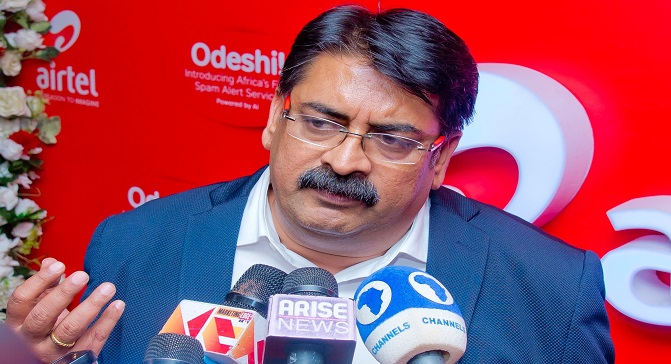
Airtel Nigeria has unveiled a robust update on a range of network, infrastructure and technology advancements that position the company at the forefront of quality of service leadership in Nigeria’s telecommunications industry.

Announced at its first media roundtable of 2026, the updates reflect sustained investments made over the past 12 to 24 months and signal an accelerated push to stay ahead of surging data demand in a rapidly digitising economy.
Speaking to senior editors and industry correspondents, Airtel Nigeria Chief Executive Officer, Dinesh Balsingh, said the company’s strategy is anchored on deliberate scale, depth and resilience.
“Over the last two years, we have invested with discipline and clarity to strengthen our network nationwide. Those investments are now translating into measurable improvements in performance, customer experience and reach, including in underserved and hard to reach communities,” he said. “In 2026, we are accelerating these upgrades because Nigeria’s data appetite is growing, and leadership in this industry will belong to those who plan ahead.”
At the core of Airtel Nigeria’s quality of service drive is the rapid expansion of its network footprint. Since December 2023, the company has increased the number of network sites by 15.5%, adding 2,242 new sites and bringing its total to nearly 16,711 nationwide. Further deployments are planned in 2026 to strengthen coverage, capacity and resilience across urban and rural locations.
Network capacity upgrades have also reached significant scale. In 2025, Airtel completed capacity enhancements on 30% of its sites, covering over 5032 sites nationwide.
Today, 99% of Airtel Nigeria’s sites deliver high-speed 4G mobile broadband, establishing the operator as a full nationwide 4G network. This year, capacity upgrades are being extended to more sites to sustain performance as data usage continues to rise.
According to Harmanpreet Singh Dhillon, Chief Technology Officer, spectrum depth and optimisation remain critical to network quality. “We have increased our 4G spectrum by 10MHz and we are actively optimising our holdings. These actions allow us to support higher data throughput, better speeds and more consistent service, especially in high-traffic areas,” he said.
Airtel Nigeria is also accelerating its 5G rollout. Over the last three months, the company has more than doubled the number of active 5G sites. The accelerated 5G upgrade happening now will connect the top 20 Nigerian cities to high-speed 5G networks, with a significant part of Airtel’s network in these cities becoming 5G-enabled in the coming year.
Beyond terrestrial infrastructure, Airtel is extending connectivity through space-based solutions. The company has established and signed partnerships with satellite providers OneWeb and Starlink, enabling enterprise-grade connectivity for businesses in remote locations, hard to reach areas and operational outposts. Recently, Airtel announced Nigeria’s first Direct-to-Cell partnership with Starlink, a breakthrough that will allow customers to remain connected while travelling through deep remote areas and enable small rural communities to access Airtel’s digital and fintech services.
The backbone supporting these services continues to expand. Airtel Nigeria has built an extensive fibre footprint across almost all states, developed through years of sustained deployment. Following the announcement to double capital expenditure last year, the company committed to expanding its fibre network by 25%, and intensive rollout activity is ongoing across cities and states. Airtel has also confirmed plans to extend its fibre footprint even further, both within major cities and between states.
A pivotal national milestone is also on the horizon. Nigeria currently relies on a single internet submarine cable landing and breakout point in Lagos. Airtel Nigeria has announced that it will launch a second internet breakout from the South of Nigeria, leveraging the 2Africa submarine cable. In partnership with 2Africa, Airtel will shortly begin carrying internet breakout traffic from Kwa Ibo in Akwa Ibom State.
“This will create a faster and alternative path for large parts of the North and South, improve resilience for the entire ecosystem. Airtel is proud to take the lead in making this happen,” Balsingh said.
Underpinning these advances is a robust IT and cloud backbone. Airtel Nigeria operates an enterprise-grade private cloud with thousands of virtual machines, managing massive storage and compute power across locations.
The infrastructure includes large GPU clusters, supporting AI-driven applications such as fraud detection, intelligent network self-healing and advanced customer analytics.
The company recently announced the upcoming launch of its hyperscaler-ready 38 megawatt data centre in Eko Atlantic. This is designed for Nigeria’s next phase of digital growth, powered by AI.
From a customer access perspective, Airtel Nigeria maintains one of the largest retail footprints in the country. Its products and services are available in over 200,000 outlets nationwide, supported by more than 4,000 exclusive shops across all local government areas and 250 flagship stores.
Balsing added that, “Quality of service today is about resilience, redundancy and intelligence, and that is what Airtel is delivering. From fibre to cloud to satellite-enabled connectivity, we are building a platform that allows Nigerian businesses to scale with confidence, regardless of location.”
He reaffirmed Airtel Nigeria’s long-term commitment to the country. “Our focus is consistent investment, disciplined execution and deep confidence in Nigeria’s future,” he said.
Aside from Singh Dhillon, other members of the Airtel Nigeria leadership on hand with subject matter expertise at the roundtable included Director, Airtel Business, Ogo Ofomata; Director, Marketing, Ismail Adeshina; Director, Information Technology, Kemi Ariyo; and Director, Corporate Communications and CSR, Femi Adeniran.


MTN Group, the continent’s telecom behemoth, has plunged into advanced negotiations to acquire the outstanding 75 percent stake in IHS Towers for a staggering $2.76 billion, a seismic move that would hand Africa’s largest mobile operator full reins over one of the world’s premier independent tower companies and redefine infrastructure control across emerging markets.

MTN
The proposed transaction, pegged to IHS’s latest New York Stock Exchange closing price where it trades alongside a Frankfurt listing, builds on MTN’s existing 25 percent holding forged in a landmark 2014 deal that saw the operator offload most tower assets to IHS in exchange for cash and long-term leases.
Sources close to the talks confirm discussions remain fluid with no binding agreement yet inked, and both sides caution that negotiations could shift or stall entirely—MTN has signalled readiness to pivot to alternative value-unlocking strategies for its stake if a full buyout eludes grasp.
Strategically, the power play catapults MTN toward vertical integration in a sector where operators increasingly crave direct grip on passive infrastructure to slash lease bills, streamline upgrades, and rocket-roll 4G/5G amid Africa’s insatiable data deluge.
IHS Towers, MTN’s anchor tenant across swathes of Africa with tens of thousands of masts from Nigeria’s 13,500 tenancies—renewed amid naira-dollar tussles—to South Africa and beyond the Middle East into Latin America, represents a golden infrastructure war chest primed for the operator’s 20-nation blitz.
The saga traces to 2014’s seismic sale that freed MTN capital for spectrum wars while birthing enduring lease pacts, now ripe for reversal as governance dust-ups over shareholder nominations and agendas underscore the buyout’s boardroom chess.
Market tremors rippled through IHS shares post-leak, underscoring the $2.76 billion tag’s gravity as MTN eyes cost efficiencies, network agility, and expansion muscle in oil-volatile economies where tower mastery spells survival.
Should the ink dry, MTN vaults to ownership of a colossus fuelling digital bridges from Lagos megacities to rural frontiers, slashing third-party dependence while supercharging investments in fibre-deep data dreams and 5G horizons.
Analysts buzz that the mega-deal heralds telecom consolidation waves, with operators reclaiming tower turf to fortify against rivals and unlock synergies in a landscape where infrastructure crowns kings.
Neither MTN nor IHS commented officially by press time, but the high-stakes huddle spotlights Africa’s telecom arena hurtling toward an era where owning the poles decides who dominates the digital skies.
Nigerian Communications Commission (NCC) and the Nigeria Security and Civil Defence Corps (NSCDC) have issued a forceful warning to road construction companies, government contractors and civil engineering firms across the country, declaring that the era of unchecked fibre-optic cable damage during excavation works is over, with perpetrators now facing criminal prosecution.

NCC, NSCDC
The two agencies, in a joint statement, highlighted the alarming surge in avoidable fibre cuts caused by negligence, poor planning or outright disregard for infrastructure protection protocols, stressing that such incidents severely disrupt Nigeria’s digital backbone and will attract the full weight of the law moving forward.
They described fibre optic cables as indispensable national assets that fuel the nation’s burgeoning digital economy, ensuring uninterrupted communication services, powering emergency response systems, linking businesses for commerce and trade, and enabling seamless government operations at all levels.
Any destruction of these cables, whether through careless excavation, lack of coordination with telecom operators or deliberate sabotage, directly endangers national security, undermines economic stability and compromises public safety, the organisations warned, painting a grim picture of the cascading effects of even brief network outages on hospitals, financial institutions and security agencies nationwide.
Under the Designation and Protection of Critical National Information Infrastructure (CNII) Order 2024, telecommunication fibre infrastructure has been officially classified as Critical National Information Infrastructure, making any damage from unauthorised digging, construction activities or failure to collaborate with relevant authorities a clear-cut criminal offence punishable under existing statutes.
Individuals, private construction companies and even government contractors found culpable will face immediate prosecution and stiff sanctions as stipulated in the Cybercrimes (Prohibition, Prevention, etc.) Act 2015, with the agencies vowing zero tolerance for what they termed economic sabotage disguised as construction mishaps.
“Future damage to fibre optic infrastructure caused by excavation, road construction or any civil engineering activity conducted without due consultation or collaboration with network operators and relevant regulators will attract strict legal consequences,” the NCC and NSCDC declared categorically, underscoring their resolve to safeguard this vital ecosystem through heightened enforcement.
To forestall further incidents, the agencies implored federal, state and local government bodies, road construction firms, utility service providers and private property developers to adopt proactive measures including thorough pre-construction verification of underground fibre routes using approved mapping tools, early collaboration with the NCC, telecom operators and NSCDC both before and during project execution, strict adherence to national guidelines on excavation procedures and right-of-way management, and prompt reporting of any accidental damage to facilitate swift repairs and minimise downtime.
They emphasised that these steps represent the bare minimum for compliance in an era where digital connectivity is non-negotiable for Nigeria’s progress.
Members of the public have also been enlisted in this protection drive, with calls to report suspected sabotage, vandalism or unintended damage to fibre optic installations at the nearest NSCDC office, via email to [email protected] or [email protected], or by dialling the toll-free line 622 for immediate action.
This collaborative approach, the agencies believe, will not only deter would-be offenders but also foster a culture of accountability among all stakeholders handling earth-moving equipment or infrastructure projects in a country racing towards full digital transformation.

Alawuba Advocates Security, Bankable Projects, Infrastructure Development to Promote South-East Vision

Ecobank Profit Jumps 29 Percent to N950Bn

Trump Says He Made no Mistake Sharing Video Depicting Obamas as Apes

Orya, Ex-NEXIM MD Jailed 490 Years for N2.4Bn Fraud

Airtel Nigeria Commits to Upgrade of its Network Infrastructure for Improved Quality of Service

19 Nigerian Banks Meet CBN Recapitalization Targets Ahead of March Deadline

Nigerian Terra Industries Secures $11.8m for Expansion

US invests $115m in counter-drone tech for World Cup security

Firm Detected a Fivefold Surge in QR Code Phishing Attacks in the Second Half of 2025

Firm Detected a Scam Exploiting OpenAI’s Teamwork Features




 General News2 days ago
Globacom Donates ₦1Bn to Lagos State Security Trust Fund

 Telecom3 days ago
MTN Guns for $2.76bn IHS Towers Buyout in African Telecom Power Grab

 E-Financial3 days ago
Incentives alone won’t win over Africa’s next billion fintech users — Kuda MFB MD
 Telecom2 days ago
Airtel Nigeria Commits to Upgrade of its Network Infrastructure for Improved Quality of Service

 Telecom3 days ago
Google Calls on Africa’s AI Trailblazers for 10th Startup Accelerator Cohort
 E-Business3 days ago
Firm Reviews the Evolution of Phishing Threats in 2025

 E-Business2 days ago
PwC Reveals AI Scaling Gap Slows Africa’s Digital Transformation

 General News3 days ago
EdTech Platform Unveils over 5,000 Self-Paced Courses for Skills, Knowledge, and Literacy