

General News
The Future Points to Integrated Aerospace & Air Transportation


By Andrew Aroh
Note that AERONAUTICS is the science or practice of building and flying aircraft, while AEROSPACE is the industry of building Aircrafts, Vehicles and equipment to be sent to space.

Integrated Aerospace programs includes:
- Aviation safety and security
- Environmental issues
- Workforce education
- Space & space tourism industry
- Mitigating hazards of space travel
Civil Aviation work is aimed at enhancing aviation safety which is perfectly consistent with the NCAA’s regulatory charter as well as the use of faster, more fuel-efficient civil aircraft which is an appropriate job for NCAA.
WORLDWIDE, SATCOM PROFESSIONALS make connections in the most unexpected places.
Satellite services create the links that help people to do the most ordinate and sometimes the most extraordinary things.
We really are part of Fabric of life.
Therefore, space cannot remain the business only of specialist.
It needs to get down to the street level.
- We need to apply spacecraft systems sensors with safety and integration expertise to transform complex ideas into tomorrow reliable systems using space tracking and surveillance systems.
- We need technology that develop and integrate technologies that delivers total mission solutions:
- Software that manages and controls satellites
- Advanced space sensors and Radar Emagery that reveal what you need to know.
- Ground based Networks and processing that transform data into knowledge and intelligence.
- Highest Resolution Commercial Satellite Imagery provides;
- Imagery Intelligence
- Geospatial Mapping applications
- Visualization / Simulation functions
- Operations planning
- Delivering Geospatial Intelligence is needed to create Visual Intelligence, Map accurate, high Resolution satellite imagery that are used to develop up to date maps, build modeling, simulation and mission planning tools, conduct assessment and deliver humanitarian assistance during disaster recovery and emergency management activities.
- But why Radar–Based Imagery?. Signal penetrates:
- Cloud
- Fog
- Rain
- Smoke
- Space Based Radar Systems provides novelty and versatility. According to design study a nine-satellite Radar system would dramatically increase the information available both to the Military forces and strategic decision makers.
- The primary mission of a Space Based Radar Systems detects moving targets in Air, on the Ground or at Sea.
- As envisioned, the system also would collect imagery of selected areas as needed and also provide terrain elevation data that is used to make 3-D maps for planning purposes.
- Space Based Radar Satellites will be equipped with electronically steerable phased arrays that provide broad coverage and therefore will be highly responsive to last-minute requests for surveillance of a particular area.
- With the Radar payload, a nine-satellite constellation would provide nearly constant surveillance of the Earth within 75 degrees of the equator with minimal gaps. It could be arranged to maximize coverage of particular area of interest.
Establishing Imaging Research Center:
- We have seen the Earth observation sector gradually shift from its historic concerns with Meteorology, defense and agriculture towards newer applications such as Risk Assessment, Refugee and Population Movement, Land use and other areas.
- We need to be sure that the huge amount of data coming from tomorrow’s satellites can be made useful for these applications.
- The Global Monitoring for Environment and Security program started by the European Space Agency and the European Commissions has already produced some results.
- With the satellites we have in orbits now and those that are on their way, there will be an overwhelming amount of data coming down that needs to be treated and analyzed.
- The idea of an imaging center is to create algorithms that will extract some of the information automatically.
- With the sharper resolution satellites, you change the analysis from one of area recognition to one of object recognition.
It’s a more complex environment with a wider diversity of images.
What is required is to develop ways that users can find the information they want easily.
- The Imaging center facilities needs to be located at selected Universities and Research centers with equivalent of 10 full time employees, in addition to graduate students specializing in Data Mining and Image Processing.
- Developing ways to digest higher-resolution imagery will be key to developing a market for the product among government and other users.
Contract services for Design and Manufacturers in Aerospace:
- Design and manufacturing in Aerospace is enabled by the following:
Software: machinery; materials; components; subassemblies; electronic Robotics; Testing and contract services.
- To enable Aerospace contract services requires creating Research and Technology solution organizations for Aerospace and Air Transport Industry with facilities for design and manufacture of the required spacecraft components, devices, systems, subsystems, products and solutions.
This could be engineering, research and technology services company with contracts supporting multiple federal agancies.
Its extensive team of MSc./Ph.D Scientists, engineers and professional management personnel stands to allow it to bring real-world experience to meet the growing demand for solutions to some of the most complex problems in Aeronautics, Aviation, IT managements and Earth and space sciences.
- AEROSPACE & AIR TRANSPORTATIONS
As the commercial space industry has begun to grow rapidly, oversight responsibilities have grown as well.
- In addition to the regular work of License and permit evaluations, the mission of commercial space Transportation with the Aviation Administration has expanded into: Federal spacecrafts Launch Ranges and commercial spaceports, and significant partnerships with both the ministry of Defense and the likes of NASRDA, (National Space Research & Development Agency).
- Additionally, the new area of Commercial Human Space flight requires significant efforts to determine how safety oversight should occur.
In order to provide operational safety oversight, timely license evaluations, and near-term development of new requirements, companies need to provide engineering services to support the mission of commercial space transportation.
- RESPONSIBILITIES:
Position will serve as an Aerospace Engineer in the Licensing and Evaluation Division of the office of commercial space Transportation to analyze and conduct safety evaluations of space transportation.
Activities involve the Launch or reentry of expendable and reusable Launch vehicles and operation of Launch and reentry sites.
This position analyzes and evaluates Launch and range safety operations and requirements that involves the design, development, test and evaluation of flight safety and Launch vehicle systems as well as provides technical reviews and analysis submitted by an applicant seeking a Launch License or experimental permit.
Educational, Skills and Ability Requirements:
- Sc in Aerospace Engineering or related field
- Knowledge and experience of with deign, development, test and evaluation of spacecraft or Launch vehicle systems and subsystems such as propulsion, avionics, or electrical systems.
- Knowledge of propulsion in all its form:
- Gas turbine
- Solid–fueled Rocket Motor
- Ion Engines (Xenon-ion thruster)
- Hypersonics
- Nuclear
- Knowledge of Launch and range safety operations and requirements.
- Ability to communicate technical information to diverse audience.
Space Tourism Industry:
- Since 2005, suborbital space flights have been guaranteed and in fact more than 500 people once reserved and paid deposits for the flights. But because of the great interest shown by many people, a number of companies now view it as a money-making proposition and have infact ventured into it.
- Most have been proposing space vehicles that make suborbital flights peaking at an altitude of 100-160kms.
- Passengers would experience three to six minutes of weightlessness, a view of twinkle-free starfield and a vista of the curved Earth below.
- Note that in 2013, Virgin Galactic, completed the first rocket-powered flight of its space vehicles spaceshiptwo (SS2). The test completed by teams from scaled composite LLC (SCL) and Virgin Galactic marked the final phase of vehicle testing prior to commercial service from spaceport America in New Mexico.
- Thus Virgin Galactic became the world’s first commercial spaceline and the first private space tourism company to regularly send civilians into space.
- Virgin Galactic space vehicles were built in Mojave, California USA and can carry six passengers, or the equivalent scientific research payload or satellites on suborbital space flights. The space vehicles will allow an out-of-the-seat, zero-gravity experience with astounding views of the planet Earth from the black sky of space for tourist astronauts and a unique microgravity platform for researchers.
- Recall that the Virgin Galactic spaceship (SpaceshipTwo, VSS Enterprise) and carrier craft or mothership (WhiteknightTwo, VMS Eve) are actually scaled-up versions of SpaceshipOne and WhiteknightOne both developed by Mojave based SCL founded by American aerospace engineer Burt Rutan.
- In 2004, SpaceshipOne claimed the US $10 million Ansari X price when it became the world’s first privately developed manned spacecraft to reach 100kms in altitude twice in a period of two-week period.
- SpaceshipOne completed the feat while having the equivalent of three people onboard and with no more than ten percent of the non-fuel weight of the spacecraft replaced between flights.
- Development costs of SpaceshipOne estimated at US $25 million, were funded by Paul Allen, co-founded with Bill Gates of Microsoft.
Andrew Aroh is President of SSPI Nigeria



In commemoration of Women’s Month, health-tech platform Myitura has released a new white paper addressing the critical gaps in healthcare financing for women in Nigeria.

Titled “Closing the Gap: Healthcare Financing for Women in Nigeria,” the report highlights how high out-of-pocket costs, limited insurance coverage, and socio-economic factors continue to prevent women from accessing timely healthcare.
According to the report, over 70% of healthcare expenses in Nigeria are paid out-of-pocket, disproportionately affecting women who often delay care due to financial and social constraints.
“When women can afford to take care of their health early, we don’t just save lives; we strengthen families, communities, and the economy,” said Chialuka Kelechi, MyItura’s Chief of Staff.
Key Insights from the White Paper:
- Preventable conditions often escalate due to delayed care
- Women are more likely to deprioritize their own health
- Affordable, structured healthcare financing can significantly improve outcomes
Introducing a Women’s Health Initiative
As part of its commitment, Myitura is launching affordable women-focused health packages (powered by Mediloan), starting at ₦58,180, designed to encourage preventive care and early detection.
The package provides access to:
- Fasting/Random Blood Sugar
- Urinalysis
- Electrolytes
- Urea
- Creatinine
- Pap Smear Submitted slides
- HIV I & II Rapid (Qualitative)
- Hepatitis B Surface Antigen Screening (Rapid)
- Hepatitis C Virus Screening (Rapid)
- Abdominopelvic Ultrasound
- Ongoing support via the Myitura platform
Access:
Women can access these packages by downloading the Myitura app, which makes healthcare more accessible and convenient.
Myitura is a health-tech platform focused on improving access to healthcare through financing, technology, and preventive care solutions.
General News
DBI Unveils Nigeria Digital Economy Outlook 2026: Q1 Report Highlights Strategic Trends, Risks


DigitalSENSE Business Intelligence (DBI), powered by ITREALMS Media, has launched the Nigeria Digital Economy Outlook 2026: Q1 Intelligence Report (Executive Edition), delivering vital insights for navigating Nigeria’s fast-paced digital landscape.

This executive summary spotlights trends, risks, and opportunities in telecommunications, fintech, digital infrastructure, policy shifts, and investment flows. It underscores digital transformation’s pivotal role in boosting economic growth, financial inclusion, and nationwide innovation.
DBI Publisher, Ogbuefi Remmy Nweke, emphasized its value for leaders: “This Executive Edition offers a sharp, strategic view of Nigeria’s digital economy during a pivotal moment. As the sector surges ahead, reliable intelligence is key to seizing opportunities and tackling risks.”
Key highlights include:
Broadband infrastructure expansion.
Surge in digital payments adoption.
Evolving regulations.
Investor pivot to sustainable, profitable ventures.
The report urges action on digital financial inclusion, infrastructure funding, skills training, and public sector digitization.
Freely accessible, the Executive Edition complements the premium Full Edition with in-depth analysis for executives and institutions. Stakeholders can request full access or briefings.
Media & Access Contacts:
Email: [email protected]
Website: www.itrealms.com.ng
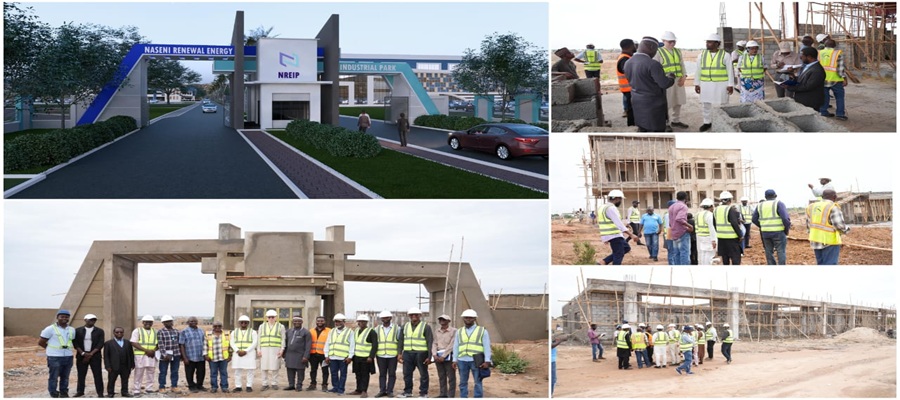
The on-going construction works at the National Agency for Science and Engineering Infrastructure, NASENI’s Renewable Energy Industrial Park, Gora, Nasarawa State is gathering momentum as the project is envisioned to address the country’s energy needs.

NASENI’s Renewable Energy Industrial Park, Gora, Nasarawa State
The project occupying a 40-hectare park designed as a multi-energy hub will help curb capital flight and save foreign exchange expenditure by enabling local production of key renewable energy components such as solar panels, mounting racks, wind systems and biomass technologies.
Speaking during an inspection visit on the project site on Tuesday, March 31, 2026, Special Adviser to the Executive Vice Chairman on Renewable Energy, Engr. Suyud Abdullahi Muhammad, who also serves as the Gora Project Manager, disclosed that the initiative is designed to significantly reduce Nigeria’s dependence on imported renewable energy equipment.
“There will be a wind assembly plant, small hydro power equipment production, and solar panel manufacturing; Renewable energy goes beyond just solar, and this park reflects that broader vision,” he said.
Abdullahi noted that the project aligns with NASENI’s goal of reducing energy poverty in Nigeria, where over 80 million citizens remain off-grid, while many connected to the national grid continue to experience inadequate power supply.
The Special Adviser also emphasised on the project’s industrialisation potential, highlighting its role in job creation and value chain development. The park is expected to generate 2,000 direct jobs, with an additional 50,000 indirect employment opportunities across supporting industries when completed.
“This initiative will localise the renewable energy value chain. Instead of relying on imports, Nigeria will begin to produce and eventually export these technologies, starting with the West African market and scaling up to the rest of the continent,” he added.
On sustainability and long-term viability, he revealed that the project is being executed in collaboration with private sector players, academia and other stakeholders, in line with NASENI’s “3Cs” principle of Creation, Collaboration and Commercialisation.
The ongoing construction is being handled by about 35 contracting firms, each handling specific components at varying levels of execution such as Multipurpose Halls for industrial productions, Research and Development (R&D) Centre, Knowledge Park, Energy Centre, Workshops, Researchers Lodge, Studio Apartments, Clinic, Restaurant, Wellness Centre, Solar Farm, Drivers Lounge, Gate House, Internal roads and drainage system and Fencing.
The Gora Renewable Energy Industrial Energy Park is considered a key component of the Federal Government’s Renewed Hope Agenda, aimed at strengthening local manufacturing, enhancing energy security and positioning Nigeria as a renewable energy hub in Africa.

Nigeria, Others Lose $88bn Yearly to Illicit Flows —Edun

Oracle Sacks 12,000 in India, Begins Shift to AI

CBN Says 33 Banks Raise Fresh N4.65 Trillion in Recapitalisation Exercise

NCC Insists Telcos Must Compensate Subscribers for Poor Quality of Service

NITDA Urges Joint Action to Drive Nigeria’s Digital Innovation

Spotify’s Loud & Clear Report Reveals Over ₦60Bn Revenue for Nigerian Artists in 2025

Madonna University Taps Tech Guru Adote for Strategic Board Role

China Threatens to Shut Nigeria’s Satellite Over $11.44m Unpaid Debt

FCCPC Bans Lagos ‘No Refund’ Policy, Vows Fines and Shutdowns for Traders

EFCC Arraigns Two FSDH Bank Officials Over $307k, €50k Fraud




 E-Financial3 days ago
NGX REGCO Fines 5 Firms N291m for Market Manipulation

 News3 days ago
Dangote Refinery Debunks Speculations on IPO

 E-Financial3 days ago
FG Launches Cross-Border Digital Payments Report

 News3 days ago
Descasio Launches “Give to Gain” Leadership Insights Report, Hosts Executive Brunch for Women in Leadership

 E-Financial3 days ago
Interswitch Deepens Strategic Partnership with KCB Group to Advance Digital Payments and Financial Inclusion

 News3 days ago
World Backup Day: Research Reveals 84% of Users Store Sensitive Data Digitally

 News2 days ago
Microsoft Revamps Copilot in Workplace AI Push

 General News3 days ago
Moniepoint Launches Sixth Edition of Women in Tech Internship with “There Is Space for You” Campaign