

Telecom
Tosin Eniolorunda Advocates for Women-Centric Financial Inclusion

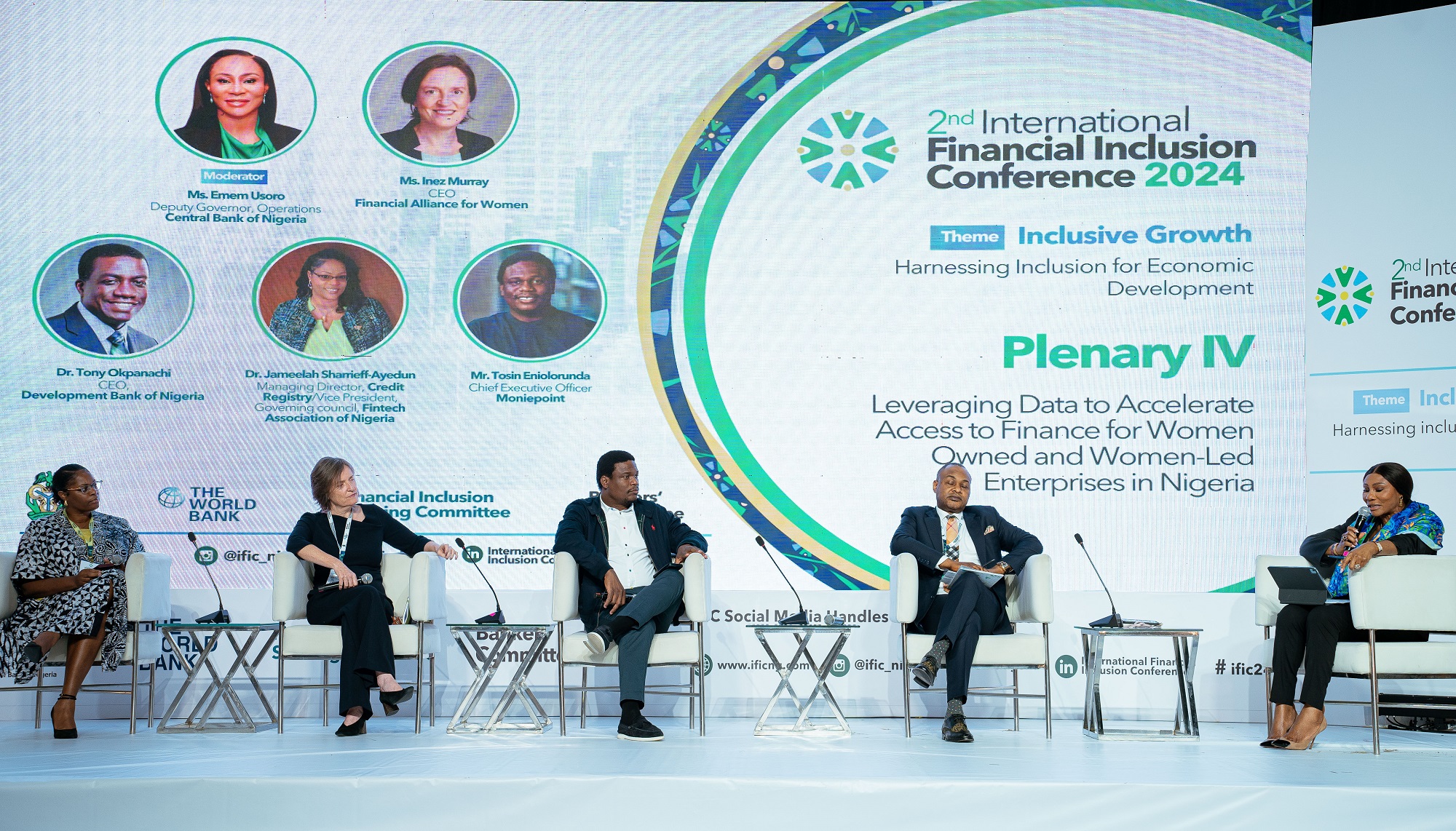
For financial inclusion to be sustainable, especially for women, it must no longer be treated as a buzzword, charitable social activity or a checklist to be marked.

L-R: Dr. Jameelah Sharrieff-Ayedun, Chief Executive Officer, Credit Registry; Inez Murray, Chief Executive Officer, Financial Alliance for Women; Tosin Eniolorunda, Founder and CEO, Moniepoint Inc; Bonaventure Okhaimo, Chief Operating Officer, Development Bank of Nigeria; Emem Usoro, Deputy Governor, Operations, Central Bank of Nigeria (CBN) and Nkiru Balonwu, Founder, Africa Soft Power Group & Advisor to the CBN Governor at the 2nd International Financial Inclusion Conference 2024 which was held at the Landmark Arena, Lagos
It must be rooted in economic and business activities that are well underlined by data considering that it is actually more profitable to serve women.
This was the thrust of an engaging plenary session, Leveraging Data to Accelerate Access to Finance for Woman Owned and Women-Led Enterprises in Nigeria which was moderated by the Deputy Governor, Operations, Central Bank of Nigeria Ms. Emem Usoro, at the second edition of the International Financial Inclusion Conference 2024 organized by the Central Bank of Nigeria and other critical stakeholders with the theme “Inclusive Growth: Harnessing Financial Inclusion for Economic Development.
The conference brought together a rich line-up of global thought leaders, industry practitioners, and key stakeholders to discuss pressing issues around how to accelerate financial inclusion in Nigeria and showcase Nigeria’s progress on gender inclusive financing, spotlight innovative solutions for inclusion, and how to deepen financing and capacity building of Micro, Small and Medium Enterprises (MSMEs) as catalysts of economic growth.
Tosin Eniolorunda, chief executive officer and founder of Moniepoint Inc noted that financial service providers play a vital role in supporting gender-inclusive finance and that by collecting and analyzing data on gender trends in small business performance, they can craft better policies, targeted products, and support services that encourage more women entrepreneurs.
Drawing from data curated from the Moniepoint platform, he averred that “women-owned businesses are more likely to stay active and show higher engagement rates in financial transactions.” In cases where financial support has been extended—through investments, KYC compliance, or the provision of tools like point-of-sale devices—female-led businesses have a 7.2 percent higher activity rate than their male counterparts while looking at the gender relations with credit products, “women-owned businesses have an 87.5 percent lower loan non-performance rate (NPL) than male-owned enterprises.”
Eniolorunda also made a case for the economic potential of investing in women entrepreneurs, who have proven to be diligent and enhance profitability while calling stakeholders to pay attention to the need to drive financial inclusion in the Northern part of the country.
He continued, “Data is the new oil,” and its application in the financial sector could be transformative for women-led businesses.
Echoing similar sentiments, Chief Executive Officer, Credit Registry, Dr. Jameelah Sharrieff-Ayedun said that, ”90% of women’s income that they receive goes back to the communities and their families as such when women have access to credit, the community is enhanced, families are better off which is why it’s important that they can access this funding.”
Other panelists included Chief Executive Officer, Financial Alliance for Women, Inez Murray, and the Chief Operating Officer, Development Bank of Nigeria, Bonaventure Okhaimo who expressed belief that creating an enabling environment, with increased investor participation coupled with the willingness of other stakeholders to sit around the table and have frank conversations will move the needle on financial inclusion for women owned businesses.
In her summation, Deputy Governor, Operations, Central Bank of Nigeria Ms. Emem Usoro acknowledged some of the structural challenges that might require time and resources to be addressed including cultural practices and less systemic ones such as distance to financial services providers that stifle the participation of women owned businesses, while signposting the power of data to serve as a catalyst for inclusive growth and its viability for economic planning .
It will be recalled that the inaugural IFIC which was held in Abuja in November 2022, focused on Nigeria’s achievements since the launch of the National Financial Inclusion Strategy (NFIS) in 2012 even as it highlighted the scaling of innovative digital models in the rapidly evolving financial services landscape.



Federal Executive Council has approved the rollout of a nationwide alphanumeric digital postcode system, a move believe will modernise the country’s addressing framework and support growth in logistics, e-commerce and emergency services.

The approval, granted under president Bola Ahmed Tinubu, paves the way for the introduction of a Geographic Information System (GIS)-enabled postcode platform designed to provide more accurate and standardised location data across Africa’s most populous nation.
Bosun Tijani, the federal minister of Communications and Digital Economy of Nigeria, who disclosed this via X, said the reform, developed in collaboration with Nigerian Postal Service (NIPOST), would replace inconsistent and often manually described addresses with a structured alphanumeric format tied to geospatial coordinates.
Nigeria’s current addressing system has long posed challenges for postal deliveries, emergency response teams and e-commerce operators, particularly in densely populated urban areas and rapidly expanding peri-urban communities where street naming and house numbering remain irregular.
The new system is expected to improve the precision of mail and parcel sorting, reduce failed deliveries and shorten turnaround times for logistics firms serving a fast-growing online retail market.
Tijani affirmed that the digital postcode framework would extend beyond postal operations, describing it as a foundational layer for national planning and public service delivery. By embedding geographic intelligence into address identification, authorities expect better data integration across agencies responsible for health, security, taxation and urban development.
The reform aligns with Nigeria’s broader digital economy strategy, which aims to build core infrastructure to support fintech, e-commerce and government digitisation efforts.
Industry executives have repeatedly cited weak address verification systems as a bottleneck for expanding nationwide logistics coverage, particularly outside major commercial hubs such as Lagos and Abuja.
Under the new framework, each location will be assigned a unique alphanumeric code linked to geospatial data, allowing for machine-readable sorting and integration into mapping systems. Authorities say this will enable faster emergency response deployment and more efficient route planning for both public and private sector operators.
The government did not provide a timeline for full nationwide deployment but indicated that implementation would proceed in partnership with NIPOST and other relevant agencies.
Officials described the approval as part of efforts to create an enabling environment for a modern and inclusive digital economy, positioning accurate addressing as critical infrastructure in the same category as broadband connectivity and data centres.
For businesses and consumers alike, the shift could mark a structural change in how goods, services and public resources are delivered across the country.

A co-ordinated effort between the GSM Association (GSMA), six African operators and original equipment manufacturers (OEMs) will pilot $40 (R654) entry-level 4G smartphones in six African nations this year.

This, as 710 million of Africa’s population live close to a 4G broadband signal, but have never gone online, with a further 68% not owning a device.
On the continent, entry-level smartphones cost 26% of the average person’s income. For the poorest 40%, the cost jumps to 64% of their income, and for the next 20%, the cost reaches 87%, data from the GSMA has shown.
To address the cost-prohibitive hurdles, the industry body has been a strong advocate of bringing down the cost of devices. It believes that affordable 4G smartphones at scale could bring tens of millions of people online, unlocking access to education, healthcare, financial services, e-commerce and artificial intelligence (AI)-powered tools.
Angela Wamola, head of GSMA Africa, said that the pilots will launch in six countries: DRC, Ethiopia, Nigeria, Uganda, Tanzania and Rwanda.
She added that the pilots build on the minimum specifications for low-cost 4G devices unveiled at MWC Kigali in 2025 and represent a step forward in turning industry alignment into tangible, on-the-ground impact.
The specifications focus on screen size, battery life and storage for a meaningful device that creates utility, particularly in the age of AI, Wamola added.
“Affordability and access of the device is critical for us to resolve. At the same time, getting a device is also about a willingness to purchase, which is about utility. Creating utility relevant to people’s lives, be it in manufacturing, agriculture, information, health and education, etc. It’s about bringing that content and government services online.
“The cherry on top is about local languages. People want to consume relevant content, but it must be in their local language.”
“As the devices land in the hands of the people, the languages will be readily available. Our small, medium-sized entrepreneurs, developers, innovators can begin to create content and products for our population. This is the magic that needs to happen to close the usage gap in the shortest time possible.”
The announcement, made in Barcelona, moves a step further from MWC Kigali by solidifying the vendors and operators that responded to the minimum specifications for the $40 device call, according to Wamola.
The marketplace now consists of private sector operators, as well as original equipment manufacturers that are engaging the six countries where the pilots will take place, she stated.
“At the same time, the GSMA is working with the governments of those nations to understand what fiscal policy incentives can be placed for these $40 entry-level devices, so that they land at the hands of the customer at the same price point.”
Wamola also indicated the coalition is taking a page out of the South African government’s book. It removed the 9% ad valorem tax, commonly referred to as luxury tax, on smartphones within the below-R2 500 price range.
Ad valorem duties are taxes levied on commodities as a certain percentage of their value. For smartphones, the duties are charged at a flat rate of 9%, classifying them as luxury goods.
In May, National Treasury confirmed the luxury tax on entry-level smartphones had been removed.
The GSMA saw how the market responded to adopting those devices when the government of South Africa removed the 9% luxury tax, she stated. “For us, it’s about replicating those lessons across Africa, so that governments can also adopt those.”
Vivek Badrinath, director-general of the GSMA, added: “Affordable smartphones are the gateway to digital and financial inclusion, economic opportunity and innovation; 3.1 billion people have mobile coverage but are not connected to the mobile internet.
“Together with the G6 group of leading African operators, we are sending a clear demand signal to bring low-cost 4G devices to market. In a global context of rising memory costs, governments have an important role in bridging the usage gap. Removing taxes and import duties on entry-level 4G smartphones will be critical to achieving scale.”

The future of secure and intelligent networking took centre stage over the weekend, as leading technology distributor, TD Africa, in collaboration with Cisco and Arravo Technology, hosted an exclusive C-level customer engagement focused on strengthening enterprise security and building resilient network infrastructures.

TD Africa
The event brought together senior decision-makers from various organisations to explore how businesses can drive resilience and digital transformation through Cisco’s Enterprise Networking, Meraki, and Security solutions.
The session provided practical insights tailored to the evolving needs of today’s digital enterprises, with discussions centred on enabling smarter, scalable network environments while strengthening cybersecurity frameworks.
Speaking at the event, Abiodun Idowu, Head of Enterprise Business at TD Africa, highlighted the growing need for organisations to adopt integrated networking and security strategies in an increasingly complex digital landscape.
“As businesses accelerate their digital transformation journeys, the need for secure, intelligent, and scalable networking solutions has never been greater.
“Through our collaboration with Cisco and Arravo, we are empowering organisations with the tools and insights required to build resilient infrastructures that support innovation while safeguarding critical operations,” he said.
The session also featured an in-depth technical presentation by Theodore Chukwudi, Cisco Solutions Architect, who led discussions on Cisco Meraki’s Cloud-Managed Networking and its role in simplifying network management while enhancing visibility and security.
“Cisco Meraki enables organisations to deploy and manage networks with greater agility and confidence. By leveraging cloud-managed solutions, businesses can enhance operational efficiency, improve security posture, and respond more effectively to emerging threats,” Chukwudi noted.
Offering further insight, Ayantola Olaayan, Director, Enterprise Business at Arravo, emphasised the importance of collaboration in helping organisations navigate modern networking demands. “Strategic partnerships like this enable us to deliver solutions that are both innovative and practical.
“By combining Arravo’s enterprise expertise with Cisco’s technology and TD Africa’s distribution strength, we are helping businesses simplify complexity and build secure, future-ready networks that support long-term growth,” he noted.
Participants gained valuable perspectives on how Cisco’s enterprise networking and security technologies can help mitigate risks, protect digital assets, and support business continuity in an increasingly connected environment.
TD Africa’s collaboration with Cisco and Arravo on this engagement reinforces its commitment to equipping organisations with the knowledge and solutions needed to navigate modern networking challenges and unlock new opportunities for growth.

NAICOM Signs MoU with BPP to Deepen Insurance Compliance in Public Procurement

FG Approves GIS-enabled Digital Postcode to Tackle Logistics Gaps, Boost E-commerce

Firm Enhances its Security Awareness Platform with SCORM and PDF Support

AfDB Approves €6.5m for Tech Startups

GSMA, African Operators, Others to Launch Low-cost 4G Devices

Dr. Cairo Ojougboh Foundation Bolsters Nigeria’s Education Drive with ₦2.7m Student Support
Kaspersky Brings more Transparency to Threat Detection with New Hunt Hub

NDPC Commits to Balancing Data Privacy, Protection Information

OADC Lagos Reinforces Commitment to Local Data Hosting and Digital Transformation @ NDPC’s National Privacy Week Summit

PwC Reveals AI Scaling Gap Slows Africa’s Digital Transformation




 Telecom3 days ago
Sunil Bharti Mittal Conferred GSMA Lifetime Achievement Award for Transforming Global Telecommunications

 Telecom3 days ago
Why Digital Trust Matters: Secure, Responsible AI for African SMEs?

 E-Business3 days ago
Jumia Tech Week 2026 Begins with Tech Deals on Smartphones, Electronics, and Everyday Technology

 General News3 days ago
Krishnan Exits Africa Data Centre to Embark on Professional Chapter

 E-Financial2 days ago
NRS Targets N40trillion in Tax, Royalty Revenue in 2026
 News3 days ago
AfDB Supports Francophone Africa Start-ups with €6.5M

 Telecom3 days ago
House Probes Fintech Regulation via Public Hearing on New Commission Bill

 E-Business3 days ago
House Queries NDIC: ₦5m Max Payout for Failed Bank Depositors