

General News
TSA Controversy an Unnecessary Distraction – Obaro


Mr. John Obaro, managing director, Systemspecs, the Information Technology firm that manages the Treasury Single Account (TSA) being implemented by the federal government of Nigeria.
Obaro was at Beacon of ICT Awards 2016 held recently where he won Software personality of the Year.
He took time out to speak on the controversy surrounding the TSA with selected journalists, chike onwuegbuchi was there.
The Unspoken Truth on TSA
TSA started very quietly and crept into the nation and by the time people woke up to realise the impact, they found out that very surprising that such a thing could happened. Today the government is in a position to know the total cash position at any point in time.
There was a time government had over 17,000 accounts in different banks that nobody even knew about all of them, so you now have a platform that can bring all of them together for government to say this is our cash position at this point in time.
Two, you are in a position to track all the payments going out of government, who moves what payments and who are the beneficiaries. In addition, everybody making payments to government you have data on the minute of such payment, you are able to keep track of everything on this platform.
Also in addition to that, you have a situation in the past were people will pretend to have made payment to government, and probably forged some receipts and get away with it, now it is no longer possible as every payment is verified online before service is provided. So, in terms of impact, this is a system that has really fundamentally changed many things. Well off-course, you will appreciate that to come in with a system in an environment like this, you do not expect everybody to clap for you, so that is the situation where we are in.
In addition to that many people don’t really understand what TSA is about, they don’t understand what is happening but there are also those people who know what you are doing and are determined to frustrate this TSA by frustrating the technology behind it why pretending to be supporting the noble course of TSA.
Government’s Savings with TSA
As at December 2015, over two trillion naira (N2,000 000 000 000)had come into the coffers of government.
And like our dear president said sometimes ago, in previous years at the end of year, somehow all these monies disappeared in one way or the other that nobody was unable to give proper account of it.
But now government knows they have over two trillion naira (N2,000 000 000) where you can decide how you want to genuinely use the money.
Also, before now all these funds were in commercial banks, government would go to commercial banks borrow money at 15% because they do not really know that these funds were there.
They just go to borrow at commercial banks and end up paying 15%. But now you have these monies in government coffers and you can imagine the type of savings that you are making not only because you don’t pay this kind of interest charges but because you now even have funds you can actually invest.
The Data Generated from TSA
When the TSA project was to start, nobody even understood the scope and nobody could give any form of statistics on the data that would come, saying how many Ministries, Departments and Agencies (MDAs), what type of transaction would come from MDAs?
This was a contentious issue that was debated severally but with TSA now there is a lot of data flowing into government which now move to the next face; economic planning.
And now that you have these data, you can now begin to do a lot of economic planning with these data but unfortunately, unavoidable controversies of the last few months have been unnecessary because it is time to get down to real business and begin to use these data proactively for planning purposes.
Hosting TSA Data Outside the Country
When you talk about data hosting we very much believe in Nigeria and that is something that drives Systemspecs and all those who know who Systemspecs, recognize that we believe in Nigeria.
However, you need to also plan things properly; otherwise you will ride on a motion and crash when the chips are down.
In the first place when we started the TSA project, we did not have data centres in Nigeria. Now, yes, we have data centres in Nigeria and we have a work plan with the CBN that by the end of 2016, this things would have been migrated locally. What we don’t want is a situation where we just move abruptly and then crash the main system.
Cost Effective Way to Transfer TSA Hosting Back to Nigeria
Part of the challenge we have even with the local hosting is reliability and security. Those two things are the main drivers for why organizations host abroad today. Now the infrastructures are being developed locally to be able to develop these two major areas of concerns.
The third area of concern is cost. Cost is still an issue. The figure you get from the Nigeria providers are much significantly higher than what you get abroad.
Having said that, I believe working with government as they are doing, we would get the support to be able to address these concerns significantly such that asking people to host locally will not just be an emotional argument or economic argument but a compelling need.
Challenges
As we speak for instance, you are aware of the controversies on the TSA project, very avoidable controversies over a one percent charge. When this one percent was discussed, nobody had an idea of the scope, no data was available, it was Remita that brought these data to the fore and were now able to see some huge sums and then there came the question that these figures are high. And then we said let’s renegotiate now that we have some data.
Our first letter that we are open to renegotiation was dated September 16, 2015. Instead of focusing on renegotiating a lot of noise eventually came up that one percent is too high.
Meanwhile, incidentally I just came back for Glasglow where I was given an award by the Africa Scotland forum recognising the kind of thing we are doing in Nigeria. The interesting thing is that when I got to the airport, the cab that took me had a bold sign on it; “for this payment channels a convenient charge of 5% be added.”
So, 5% is not an unusual figure in this industry. Here we are talking of 1% and we say we are open to renegotiation and then a lot of avoidable controversies is being made out of that. I want to believe that there is a lot of mischievous going on and one would then expect someone in a position to close this matter and focus on the real issues of benefits from the platform.
Trust in the system
I need to be honest that we were taking by surprise. This is because the worst that we thought would happened was that someone who wake up one day and say he does not want TSA but the beat about saying that there is fraud and abuse of the platform, that was a bit heavy and was sudden on us because for those who know Systemspecs one thing that drives us is our ethics.
The person you may call the doyen of ethics in Nigeria today Dr, Christopher Kolade is our chairman and has been our chairman for nine years. Some years ago, he resigned from all the other companies that he is involved with and he remain only with Systemspec, which should tell you something about the kind of values that we hold. So, for somebody to wake up and beginning to throw those kind of distractive words were demoralizing but soon we will come out of it as we understood these are people who want to bring down the TSA project and that we should not cooperate with them to make it happen.
And that is why not many people know we have been doing these collections without charging since all these controversies started.
Not only did we refund the fees from March last year, but since late October, all the collections on the platform, have not been charged. We are still waiting for government to close this conversation on the fee. The easiest thing for us to have done is to have stopped collecting that would have created an unnecessary crisis but we are collecting and waiting for some matured conversation to close that.


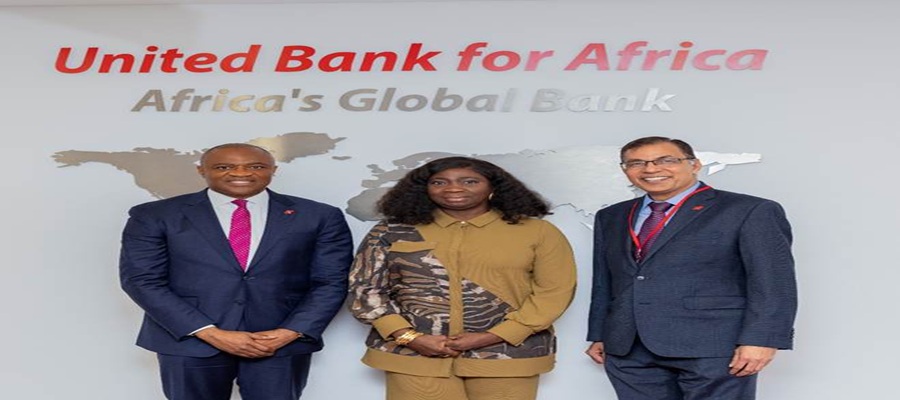
United Bank for Africa (UBA) Plc, Africa’s Global Bank, has reiterated its commitment towards building tangible economic bridges and strengthening diaspora-driven investment into Nigeria.

L-R: Group Managing Director/CEO, United Bank for Africa (UBA) Plc, Oliver Alawuba, Chairman/CEO, Nigerians in Diaspora Commission (NiDCOM, Hon. Abike Dabiri and Chief Executive Officer, UBA UK, Loknath Mishra, during a strategic engagement with the African diaspora at the UBA UK Office, London.
UBA’s Group Managing Director/Chief Executive Officer, Oliver Alawuba, stated this on Monday, while hosting key representatives from the Nigerians in Diaspora Commission (NiDCOM) led by its chairman/CEO, Hon. Abike Dabiri, at the bank’s UK office.
The strategic visit comes on the heels of UBA’s recently launched Diaspora Banking platform, which is designed to provide a seamless, integrated platform for Africans in the diaspora to bank, invest, and manage their financial obligations back home, thus connecting global Africans with investment and wealth opportunities.
The bank launched the platform, with leading ecosystem partners representing a major step in redefining diaspora banking beyond remittances toward structured wealth creation and long-term investment.
During the strategic meeting with the NIDCOM officials at the UBA UK office on Monday, Alawuba underscored the diaspora’s critical role as a powerful economic force and a generation of builders shaping new narratives for the continent.
While emphasising UBA’s role as a trusted partner for Nigerians at home and abroad, he said, “With UBA, you have a financial partner that is with you, that understands what you are going through, and that can support you to make sure you realise your aspirations, both here and in the country.”
Alawuba further encouraged the diaspora to leverage the opportunities within Africa’s economic landscape, stating: “You are not limited here; you have opportunities on the continent, and we want you to make good use of them. That is where banking, and we at UBA, become the connecting point that you need to access the opportunities back home. Whether you like it or not, the returns are high in Africa, and we are here to help you navigate that space.”
He also took time to reiterate the Bank’s readiness to leverage its global network and innovative financial solutions to support diaspora engagement.
The Chairman/CEO, NiDCOM, Hon. Abike Dabiri-Erewa, who commended UBA for being a trusted financial partner over the years, especially with the recent launch of its diaspora platform, praised the resilience and success of Nigerians abroad while calling for a stronger focus on constructive narratives.
She said, “Many of you here are the real game-changers. “For years, it has been wonderful engaging Nigerians all over the world. When I started, it felt like we only heard the bad stories, not the good ones. What we have tried to do internationally is to tell and celebrate the good stories. We have Nigerians doing well all over the world, and they are in this room. We must continue to celebrate you.”
While remarking that the meeting demonstrates a significant step in aligning public and private sector efforts to deepen diaspora inclusion and accelerate Nigeria’s development agenda, she pledged closer collaboration in driving policies and initiatives that encourage Nigerians abroad to actively participate in the country’s economic growth.
The discussions further highlighted UBA’s unique position to facilitate cross-border payments, unlock high-yield investment opportunities, and connect diaspora enterprises to markets across the continent.
With a robust global footprint and an unrivalled African presence, UBA continues to serve as the critical link for those looking to engage with the continent’s growing economy.
United Bank for Africa is one of the largest employers in the financial sector on the African continent, with 25,000 employees group-wide and serving over 45 million customers globally. Operating in twenty African countries, the United Kingdom, the United States of America, France and the United Arab Emirates, UBA provides retail, commercial and institutional banking services, leading financial inclusion and implementing cutting-edge technology.


Federal government said that it is adopting technology and innovation to speed up eradication of tuberculosis and other infectious diseases.

It also said $54 million had been approved for the procurement of drugs, especially for treatment of tuberculosis and HIV, to prevent stock-outs of life-saving medicines.
Speaking at the 2026 Pre-World Tuberculosis Day briefing in Abuja, organised by Stop TB Partnership Nigeria, Dr. Charles Nzelu, director, Public Health at the Federal Ministry of Health and Social Welfare, said the present government was making giant strides in addressing challenges in the health sector.
Nzelu said the ministry, under the leadership of Professor Muhammad Pate, had prioritised TB as a major pillar of the health agenda.
As part of the implementation of National Strategic Plan (2021-2026), Nzelu, said the ministry had adopted technology to help achieve the target of stopping tuberculosis from constituting a public health risk in the Nigeria.
He stated, “To bridge the gap, we are leading with innovation. Specifically, this year, the National Tuberculosis and Leprosy Control Programme (NTBLCP) is spearheading the national rollout of the Pluslife Mini Dock diagnostic platform.
“This near-point-of-care technology is a game-changer, allowing us to bring molecular-grade testing to the most remote communities, ensuring that no Nigerian is left behind due to geography.
“Nigeria is rolling out over a thousand of this diagnostic equipment. But technology is only as strong as the systems that support it.
“We are currently focused on strengthening our electronic reporting systems to ensure real-time data flow from the facility level to the national dashboard.”
Nzelu said transparency allowed the ministry to manage the supply chain effectively and prevent stock-outs of life-saving medicines.
In her remarks, Dr. Queen Ogbuji-Ladipo, board chair, Stop TB Partnership Nigeria, said the country had witnessed remarkable milestones in the fight against tuberculosis.
They included the mobilisation and engagement of high-level TB champions at the national, state, and local levels; strengthened collaboration with government and private-sector actors; increased advocacy for domestic financing; and expanded public awareness of TB prevention and care, Ogbuji-Ladipo said.
She, however, said there were challenges in funding to be addressed with the changing global health financing landscape and dwindling donor support.
According to her, “This reality makes domestic resource mobilization for TB more important than ever before. Sustainable financing from government budgets, private sector contributions, and innovative financing mechanisms will be critical to sustaining TB programs.”
In its presentation, Dr. Temitope Adetiba, TB Programme Lead – Institute of Human Virology (IHVN and Global Fund Project, said under the Global Fund Grant Cycle 7 for TB and HIV response, Nigeria had recorded over 300,000 TB case detection across the country.
In addition, IHVN said more than 3,000 drug-resistant TB cases were identified and linked to care, while over 2.3 million pregnant women were screened for TB and HIV across 2024 and 2025.
It also said Nigeria was increasingly taking TB and HIV services to the people within communities, households, and the private sector.
Dr. Mayowa Joel, executive secretary of Stop TB Partnership Nigeria, said the theme, “Yes We Can End TB”, was action oriented.
Joel said the theme challenged all stakeholders to move beyond discussions and commitments toward practical action.
He said, “This means ensuring that TB diagnostic services, treatment, and care reach everyone who needs them, especially through Primary Health Care, where most people first access health services.”
Dr. Mya Ngom, representative of Country Director of World Health Organisation (WHO), said Nigeria had made tremendous progress in responding to the epidemic.
According to Ngom, “In 2024, Nigeria reported 405,324 TB cases having increased from 106,533 cases in 2018, while 335,003 TB cases were reported in the three quarters of 2025.”
He said, “Expectantly, eighty percent (80 percent) of the estimated 510,000 incident TB cases will be detected and notified when the entire 2025 TB notification report is received. While this progress is encouraging, the fight against TB is far from over.
“The number of undetected TB cases averaging 175,000 cases constitutes a pool of reservoir that fuels on-going transmission of TB in the community as one undetected infectious TB case can infest between 12-15 persons per year.
“The emergence of Multi-Drug-Resistant TB (MDR-TB) and the high number of HIV further complicates the burden of TB in the country.”


Luno, an Africa-founded global exchange, has launched a structured Crypto Prediction Market, ushering in a new chapter for Nigeria’s cryptocurrency market.

This platform enables users to forecast short-term price fluctuations of key cryptocurrencies, such as Bitcoin , Ethereum , Solana, Dogecoin, Ripple, and earn USDC payments when when their predictions are accurate.
Powered by Limitless, the platform rewards right forecasts with USDC, a fully supported stablecoin.
This launch reflects shifting investment trends in Africa’s largest cryptocurrency market. Previously focused on long-term holding or spot trading, retail traders are now looking for tools that allow them to act on market information in a structured, short-term framework.
“We are seeing a clear shift in how Nigerians want to engage with crypto assets,” said Ayotunde Alabi, CEO of Luno Nigeria.
“Many already follow price movements closely and form strong market views; we want to lead with education as well as provide a safe and secure platform to help them apply that knowledge. This feature is designed to be a natural extension for those who enjoy forecasting.”
To mitigate risks, the platform integrates educational resources, dedicated prediction wallets, mandatory risk acknowledgements, and mechanisms preventing users from taking both sides of a market.
Unlike conventional derivatives or open-ended speculation, binary prediction markets are strictly outcome-based. Participants wager on whether an asset will close above or below a specific price target.
While this opens opportunities, it also carries high risk, as incorrect predictions result in total loss of the committed capital.
The launch could influence broader trends in African fintech. By introducing regulated, outcome-based products, exchanges can cater to a more informed investor base while promoting financial literacy.
For Nigeria, this could mark a turning point moving the market from passive participation to data-driven trading, providing a framework for responsible engagement in increasingly complex digital asset markets.

UBA, NiDCOM Deepen Collaboration to Unlock Diaspora Capital for Nigeria’s Growth

Vitel Wireless Lures Subscribers with “Data that Never Expires” Campaign

FG Deploys Technology, Approves $54m Drugs to Tackle Tuberculosis

BoI, MTN Foundation Launch N1Bn Fund for Women Entrepreneurs

Luno Launches First Crypto Prediction Market in Nigeria

Kaspersky Discovers New Phishing Campaign Exploiting Google Tasks Notifications to Steal Corporate Credentials

esentry 2025 Report Shows Healthcare, Financial Services and Telecoms as Staging Grounds for Increased Cyberattacks in Africa

AfDB, UNDP Launch $10Bn AI Initiative for Africa

Mutual Benefits Assurance Settles ₦5.9bn Claims in January 2026

MultiChoice Suspends Yearly DStv Price Hike as Canal+ Pushes Growth




 Broadcasting3 days ago
Spotify’s Loud & Clear Report Reveals Over ₦60Bn Revenue for Nigerian Artists in 2025

 E-Financial3 days ago
CBN Relaxes Dormant Account Rules with Removal of Affidavit Requirement

 News3 days ago
Elumelu Tags Elon Musk, Disowns AI-Generated Scam Video

 Telecom3 days ago
PwC Warns Nigeria Telcos of AI Fraud Risks

 E-Financial3 days ago
Crypto Transactions Hit $96Bn in Nigeria -SEC

 E-Financial21 hours ago
Kuda MFB Increases Kuda for Her Business Grants to ₦10 Million

 E-Business3 days ago
FG Determined to Protect Rights, Privacy Online- NITDA

 E-Business3 days ago
Firm Warns of Malware Aiming to Steal Data from Individuals, Organisations in Nigeria