

E-Financial
UBA Wins Big at The Bankers Award, the Oscars of the Financial Industry

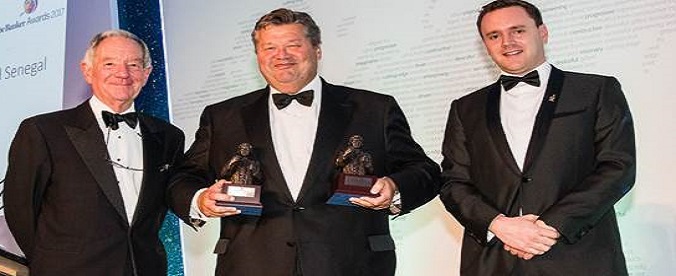
United Bank for Africa (UBA) Plc, Pan-African financial institution, has once again proven its leadership on the continent, as the Banker Magazine crowned UBA the “African Bank of the Year 2017”.
This Banker Award is premier for Nigeria, as it marks the first time a Nigerian-headquartered bank will be wining the prestigious and highly coveted regional award.

To further demonstrate the group’s strength and dominance in the financial sector on the continent, four of UBA Group’s operations in Africa also led contenders in their respective countries to emerge the Best Bank of the Year 2017 in their respective markets.
UBA Congo, UBA Tchad, UBA Gabon and UBA Senegal emerged the Best Bank of the Year in Congo, Tchad, Gabon and Senegal, reinforcing the strong franchise of the Group across its chosen markets in Africa.
Notably, UBA Gabon and UBA Senegal won the same awards in 2016, as both subsidiaries of UBA Group remain the Banks to beat in Gabon and Senegal.
A publication of the Financial Times Newspaper, The Banker Magazine is a global financial intelligence magazine that provides global bank ratings/analysis and it is the definitive reference in international banking for high level decision makers globally.
According to the magazine, the aim of the award “is to highlight industry wide excellence within the global banking community.
The winner is selected from participating banks in each of the 120 countries from which entries are received for the competition.”
Explaining the rationale behind UBA carting multiple categories in its December issue, the Banker’s Magazine noted that Africa’s economic landscape has been unpredictable in recent times which resulted in recession in some of Africa’s best performing economies, while the region as a whole only expanded by about 1.3% in 2016.
“In these conditions only the most diversified and innovative of regional banks can prosper. And this is precisely why the United Bank for Africa (UBA) has scooped the 2017 regional winner award. For one, the lender registered impressive top- and bottom-line growth over the review period,” it noted.
The magazine went further to enumerate the various achievements recorded by UBA group during the period, noting that earnings for the year reached N384bn ($1.07bn) signalling 22% growth from its 2015 performance while profit before tax also grew, by 32%, to reach N91bn.
According to the organisers, “Equally impressive is UBA’s capital adequacy ratio which, at the end of 2016, stood at 20%, while its nonperforming loan ratio was a healthy 3.9%. Operating across 19 markets in Africa, the bank serves more than 14 million customers.”
It added that the Pan-African bank’s foray into various ventures in Africa also helped to clinch its activities in the year under consideration, stating, “Beyond the numbers, the bank has won and acted on a number of headline deals. These include the financing a new stadium in Douala, Cameroon, for the 2019 Africa Cup of Nations for $285m. In Senegal, more than $250m of trade finance was provided to the state oil company, while the lender acted as arranger and bank agent in the raising of $160m to finance road infrastructure. The bank’s digital tax collection solutions are also helping regional governments in Senegal and Burkina Faso.”
The organisers noted that UBA is making impressive strides in the digital space, adding that in terms of internet banking, the organisation processed 7 million transactions valued at more than N600bn in 2016.
Mobile banking processed transactions valued at N70bn over the same period. UBA has also launched eMailMoni, a service that lets customers transfer funds via e-mail, while Chat Banking allows clients to perform basic transactions through social media platforms. “For these reasons, and others, UBA is the winner of our 2017 African Bank of the Year award,” the Magazine stated.
Mr. Kennedy Uzoka, group managing director/chief executive officer, UBA Plc, who was delighted by the recognition from The Bankers said; “These awards mark another milestone for UBA Group and is a testament of the diligent execution of the bank’s strategic initiatives on customer service. Being recognized as Africa’s best bank complements positive feedback from customers and is a recognition of our improving efficiencies, service quality and innovation. I therefore dedicate it to our growing loyal corporate and retail customers, who are our essence. Given our heritage commitment to Africa’s development, we continue to impact lives through our service as well as funding to individuals, businesses and government.”
Uzoka added; “The bank remains focused on its goal of democratizing banking in Africa, leveraging on new technologies and our rich pool of talent. It is satisfying that our efforts towards leadership are yielding great results. We continue to gain market share across our chosen markets, as we deepen financial inclusion, meeting basic and complex financial service needs of the growing African population. We are Africans and determined to change the narrative of financial services in Africa and this is just the beginning,” he noted.
On his part, Mr. Emeke Iweriebor, regional CEO, UBA Francophone Africa, described the awards as exciting, stating that the bank’s great work in Africa is increasingly being recognized.
Iweriebor who dedicated the awards to the bank’s esteemed customers, said “Our pioneering innovations in the African banking sector are undoubtedly critical to the growth and development of the continent. Africa’s banking sector has come a long way but we still have a lot to do. We at UBA Group are dedicated to being a critical part of this transformation.”
He added that the bank will continue to leverage its local knowledge, global exposure as well as presence to drive positive change in Africa, working actively with the government, local businesses, regulators and other stakeholders in deepening financial services.
The Banker award’s “Bank of the Year Awards” are widely regarded as the Oscars of the Banking Industry. For 90 years, The Banker has been the world’s leading monthly journal of record for the banking industry. The organisers note that the aim of the awards programme is to highlight industry wide excellence within the global banking community.
The Banker selects one winning bank for each of the 120 countries that are covered. Over 1,000 applications are entered and judges select winning banks based on the ones that have made most progress over the past 12 months.
UBA was incorporated in Nigeria as a limited liability company after taking over the assets of the British and French Bank Limited who had been operating in Nigeria since 1949.
The United Bank for Africa (UBA) Plc merged with Standard Trust Bank in 2005 and from a single country operation founded in 1949 in Nigeria – Africa’s largest economy – UBA has become one of the leading providers of banking and other financial services on the African continent.
The Bank provides services to over 14 million customers globally, through one of the most diverse service channels in sub-Saharan Africa, with over 1,000 branches and customer touch points and robust online and mobile banking platforms.
UBA was the first Nigerian bank to make an Initial Public Offering, following its listing on the NSE in1970. It was also the first Nigerian bank to issue Global Depository Receipts.
The shares of UBA are publicly traded on the Nigerian Stock Exchange and the Bank has a well-diversified shareholder base, which includes foreign and local institutional investors, as well as individual shareholders.



When people and businesses gain genuine access to financial services, they gain the ability to transact securely, build savings, and access credit. That access creates the conditions for progress: more stable revenues, better business decisions, and the capacity to grow. Progress, sustained over time, is what produces financial happiness. This framework is how Moniepoint measures its impact.

According to Moniepoint 2025 Impact Report, titled creating financial happiness; “Financial happiness is the feeling of confidence and ease that comes with financial freedom and well-being. It is a condition that develops over time and requires a specific set of enablers to take hold.
For millions of people and businesses across Nigeria, those enablers, like tools and solutions to manage their finances, have historically been out of reach. Moniepoint was built to change that, and this change, for us, begins with inclusion”.
Across the world, access to digital tools is a key driver of financial inclusion. The World Bank’s Global Findex 2025 report finds that more than 60% of adults in low- and middle income economies now make or receive digital payments. In Nigeria, this figure is around 54%. Moniepoint has been a key driver in expanding this access with its POS terminals. “Our terminals also drive financial inclusion for individuals.
The report stated that, in 2025, Moniepoint enabled 100 million people to make payments via their POS terminals across the country. For customers in communities where bank branches are scarce or non-existent, a Moniepoint terminal at their local shop, market stall, or fuel station provides reliable access to digital financial services.
They can make purchases, withdraw cash, and manage their money without travelling long distances or depending solely on physical currency. Critically, customers without cards can complete transactions through direct bank transfers to the terminal’s account.
Beyond practical benefits, Moniepoint terminals have also introduced a new layer of trust to everyday commerce. “When network issues make it unclear if a payment went through, the Moniepoint terminal’s loud beep provides instant confirmation for everyone, building trust in digital payments with every transaction”.
Moniepoint POS terminals operate across all 774 local governments in Nigeria, ensuring that small sellers and large stores can accept payments reliably, regardless of location.
In 2025, millions of Nigerians, businesses and individuals alike, accessed Moniepoint services through its mobile app. Top among them are groups like women and low-income earners, who have historically been excluded from formal banking. Inclusion of women is particularly important, as they typically manage household spending and informal savings but are frequently left out of structured financial systems. “Through our app, they are gaining financial independence and greater control over their economic decisions,” the report added.
For millions of Nigerians, debit cards represent a move away from the limits of cash transactions. They enable safer, more reliable everyday payments, particularly as more local businesses begin to accept digital payments.
Moniepoint debit cards are designed to meet this need. In 2025, Moniepoint customers completed over 300 million card transactions at physical locations, largely driven by essential, food-related purchases. Most of this spending took place at neighbourhood provision shops where households buy everyday items such as rice, cooking oil, and soap.
“We’ve made access to our cards intentionally simple. Customers can get a Moniepoint debit card by requesting it within their mobile app or from neighbourhood agents, without lengthy paperwork or waiting periods. By lowering these barriers, more people are able to access financial tools and participate in the formal financial system.
“Our cards also safeguard our customers’ financial information. They don’t carry special markings or any identifiers that could expose our customers or put their financial security at risk. In the event of loss, this reduces the likelihood of targeted fraud or misuse.
“When people can pay with their debit cards at their neighbourhood stores, they can manage their spending, reduce cash handling, and transact more securely. Merchants also benefit, recording higher transaction volumes and more consistent customer activity.
“Moniepoint helps millions of businesses and individuals across Nigeria access seamless payments and banking, every day. The widespread adoption of our tools and services, as highlighted, demonstrates our critical role in expanding financial access, supporting everyday commerce, and enabling more Nigerians to participate safely and consistently in the digital economy,” the report noted.

ChatPay has launched Africa’s conversational banking platform, enabling individuals and businesses to access financial services through WhatsApp.

The Lagos-based fintech startup, is in controlled rollout, connecting WhatsApp to linked-bank management, airtime and supported electricity payments through simple conversations.
The company said the platform is designed to enable users to send money, pay bills, buy airtime and manage business transactions within WhatsApp conversations, subject to the completion of regulatory approvals and integration with licensed banking partners.
According to ChatPay, the platform is operated by CP Technology Limited and is currently undergoing a phased rollout ahead of its planned public launch.
The company said the initiative is intended to simplify access to financial services by leveraging WhatsApp, which it estimates is used by more than 50 million Nigerians monthly.
Speaking on the idea behind the platform, Adeoluwasubomi Odebunmi, product lead and co-founder, said the concept emerged while she was studying Software Engineering at Babcock University.
“I saw the gap while I was still in school—how much friction there was just to move money. I didn’t want to just study the problem. I wanted to help fix it,” she said.
Odebunmi said she had previously worked on software solutions spanning e-commerce, real estate management, school administration and artificial intelligence applications before co-founding ChatPay.
Aseoluwa Siyanbola, growth lead and co-founder, said his experience managing Nigerian bank accounts while studying abroad highlighted some of the challenges users face with digital banking services.
According to him, difficulties such as one-time password (OTP) failures and inconsistent banking applications inspired the team to explore conversational banking solutions.
“We each encountered similar challenges and came together to build a solution that simplifies everyday financial transactions,” he said.
cAbraham William, tech lead and co-founder, said the company is focused on improving access to financial services through a platform that many Nigerians already use daily.
“We want to make financial services easier to access by allowing people to carry out transactions through a familiar messaging platform,” he said.
William said he oversees the company’s engineering, technology strategy and system architecture.
ChatPay said its services will be introduced in phases as regulatory requirements are met and integrations with banking partners are completed.
The company added that its newly launched “Founding 2,500” programme will enable selected early users to test features, provide feedback and participate in product development before the platform’s wider rollout.
According to the company, interested users can register for the waitlist and the Founding 2,500 programme through its website.
Founded by Odebunmi, Siyanbola and William, ChatPay said its long-term goal is to expand conversational banking services beyond Nigeria into other African markets after its domestic rollout.


United Bank for Africa (UBA) Plc has been named Nigeria’s Best Bank for Retail Banking and Best Bank for Sustainability Leadership (ESG) at the 2026 Euromoney Awards for Excellence, reinforcing its position as one of Africa’s leading financial institutions.

The awards were presented on July 17 at The Peninsula London in the United Kingdom, recognising financial institutions that have demonstrated outstanding performance, innovation, customer impact and sustainable banking practices.
The double recognition highlights UBA’s growing influence in retail banking and its commitment to advancing environmental, social and governance (ESG) principles across its operations.
According to Euromoney, UBA distinguished itself through a series of sustainability initiatives, including the introduction of a Green Financing Facility designed to support households and businesses transitioning to renewable energy.
The publication also cited the bank’s ₦5 billion financing programme, implemented in partnership with the Bank of Industry (BOI), to provide funding for women-owned businesses.
Euromoney further recognised UBA’s commitment to achieving net-zero carbon emissions by 2050, describing it as a demonstration of the bank’s long-term sustainability strategy.
The publication also highlighted the bank’s efforts to integrate sustainability into its operations through the deployment of solar-powered energy solutions across 50 branches and comprehensive ESG capacity-building programmes that have trained more than 16,000 employees across the UBA Group.
In the retail banking category, Euromoney noted that UBA continued to consolidate its position as one of Africa’s largest retail banking institutions.
According to the publication, the bank expanded its customer base to more than 37 million by the end of 2025, while retail banking revenue increased more than fourfold to ₦429.5 billion.
The awards also recognised UBA’s continued investment in digital banking innovation, particularly enhancements to its artificial intelligence-powered chatbot, LEO.
Euromoney noted that LEO became Africa’s first AI-powered banking platform to facilitate cross-border money transfers in local currencies through the Pan-African Payment and Settlement System (PAPSS).
Commenting on the awards, UBA’s Group Managing Director and Chief Executive Officer, Mr Oliver Alawuba, described the recognition as a validation of the bank’s commitment to delivering value to customers while promoting sustainable development across Africa.
“To be recognised as Nigeria’s Best Bank for both ESG and Retail Banking in the same year sends a powerful message that sustainable banking and commercial success are mutually reinforcing.
“At UBA, we are committed to financing Africa’s future, supporting businesses and communities, promoting financial inclusion, and delivering innovative banking solutions that improve lives.
“These awards belong to our customers for their confidence in us and to every member of the UBA family whose dedication continues to make our vision a reality,” he said.
Also speaking, UBA’s Group Head, Marketing, Brand and Corporate Communications, Mrs Alero Ladipo, said the awards reflected the bank’s unwavering commitment to putting customers at the centre of its operations.
According to her, every innovation, investment and banking solution introduced by UBA is aimed at creating exceptional value for customers while expanding access to financial services.
“These awards are a powerful affirmation of our Customer First philosophy.
“Whether it is supporting entrepreneurs with access to finance, enabling seamless digital payments, advancing clean energy financing or expanding financial inclusion across Africa, UBA remains focused on delivering meaningful impact.
“We are honoured that one of the world’s most respected financial publications has recognised these efforts,” she said.
UBA currently operates in 20 African countries, as well as the United Kingdom, United States, France and the United Arab Emirates, serving more than 45 million customers through a combination of digital banking platforms and physical branch networks.
The bank said it remains committed to strengthening financial inclusion, driving innovation and supporting sustainable economic development across Africa and beyond.

HURIWA, CLO Protests Bill Asking Social Media Firms’ to Open Shops Nigeria

Anambra Govt Bans Graduation Ceremonies in Anambra Schools

Airtel Secures Another 10-year Spectrum Renewal in Nigeria

Moniepoint as a Key Driver in Expanding Financial Access for Businesses in Nigeria

Nigeria, Israel Strengthen Research, Technology Collaboration

NRC, Ponzi Scheme Collapses Resulting Loss of Billions of Naira

NASENI Moves to Digitize CCB’s 5m Assets Declaration and Operations

Tokenization, Blockchain Technology will Transform Financial Institutions – IMF

EFCC Busts NIS Visa Overstay Racket, Uncovers N700m in an Account

From Scarcity to Scale: What Africa Can Learn from India’s Agricultural Transformation




 E-Financial2 days ago
FG Says Rumours, Fear, Can Crash Banks

 Telecom2 days ago
Court Dismisses Pan African Towers’ Bid to Halt Ex-CEO’s Suit, Awards ₦500,000 Costs

 E-Business2 days ago
Kaspersky Warns of a Phishing Campaign Abusing Microsoft Authentication Mechanism

 Telecom2 days ago
Telcos Seek Clear Regulatory Framework on Airtime Credit Services

 Telecom2 days ago
MTN Nigeria Announces 2026 mPulse Spelling Bee, Opens Entries for Students Nationwide

 Telecom2 days ago
MTN Warns Customers against Fake Promo

 News2 days ago
IMF Sees 4% AI Growth Boost for Africa

 E-Financial2 days ago
EU Debunks Fake Compensation Scheme Targeting West African Bank Customers