

General News
Why Paid Media Is Losing Its Edge: The Rise of Earned Media in 2025


By Reuben Kalu
In the evolving digital marketing landscape, 2025 is shaping up to be a transformative year. Traditional paid media, once the backbone of marketing strategies, is becoming increasingly irrelevant. Instead, earned media and owned media are taking center stage, offering unparalleled opportunities for brands to connect authentically with their audiences. In this article, we’ll explore how earned media has disrupted the dominance of paid media and how you can leverage your owned media assets to turbocharge your marketing efforts.

The Rise of Earned Media
Earned media refers to the organic exposure a brand receives through word-of-mouth, media coverage, social shares, reviews, and recommendations. Unlike paid media, which requires financial investment for visibility, earned media is driven by trust and authenticity—two critical factors that modern consumers prioritize when making purchasing decisions.
According to a Nielsen report, 92% of consumers trust earned media more than any form of advertising. This trust stems from the fact that earned media is unsolicited and unbiased, making it far more credible than paid advertisements. As a result, brands that focus on generating earned media are seeing higher engagement rates and improved customer loyalty.
Why Paid Media Is Losing Relevance
Paid media isn’t entirely obsolete, but its efficacy is waning. Here are some reasons why:
1. Ad Fatigue: Consumers are bombarded with ads every day, leading to desensitization and ad fatigue. Many now use ad blockers, making it harder for brands to reach their target audience through paid media.
2. Rising Costs: The cost of digital advertising has skyrocketed, especially on platforms like Google and Facebook. Small businesses often find it difficult to compete with larger corporations with bigger budgets.
3. Declining Trust: Modern consumers are skeptical of paid ads, often viewing them as intrusive or misleading. This lack of trust significantly diminishes the ROI of paid campaigns.
4. Algorithm Changes: Social media algorithms are increasingly favoring organic content over paid promotions. This means brands that rely solely on paid media are at a disadvantage.
The Power of Owned Media
While earned media’s authenticity is its strength, owned media provides the platform to control and amplify your brand’s voice. Owned media includes channels you control, such as your website, blog, email newsletters, and social media profiles. By strategically optimizing these assets, you can create a robust marketing ecosystem that works harmoniously with earned media.
Strategies to Maximize Your Own Media Opportunities in 2025
1. Create High-Value Content
Content remains king in 2025, but not just any content will do. Focus on producing high-value, shareable content that solves real problems for your audience. This could be in the form of:
• Educational Blog Posts: Address common pain points in your industry with actionable solutions.
• Interactive Media: Infographics, videos, and quizzes can significantly increase engagement.
• Case Studies: Showcase your expertise by highlighting success stories that resonate with your audience.
2. Leverage SEO and Content Optimization
Your owned media is only as effective as its discoverability. Search engine optimization (SEO) ensures your content ranks high on search engine results pages (SERPs). Key tactics include:
• Conducting keyword research to understand what your audience is searching for.
• Optimizing on-page elements like meta descriptions, headers, and image alt texts.
• Building backlinks to establish authority and credibility.
3. Develop a Strong Email Marketing Strategy
Email marketing remains one of the highest-ROI channels for owned media. Personalize your emails to cater to the unique needs of your audience segments. Use tools like automation and A/B testing to refine your campaigns and drive higher engagement rates.
4. Engage Authentically on Social Media
Social media platforms are an extension of your owned media. Rather than treating them as one-way communication tools, use them to foster genuine engagement. Respond to comments, participate in discussions, and share user-generated content to build trust and loyalty.
5. Build an Online Community
Communities foster loyalty and provide a platform for earned media to thrive. Create forums, Facebook groups, or Slack channels where your audience can engage with your brand and each other. Encourage discussions, host Q&A sessions, and reward active participants to keep the community vibrant.
6. Integrate Data Analytics
Use data analytics to measure the effectiveness of your owned media strategies. Tools like Google Analytics, HubSpot, and SEMrush can help you track metrics such as website traffic, bounce rates, and conversion rates. Data-driven insights enable you to fine-tune your approach and maximize ROI.
How Earned Media Complements Owned Media
Earned and owned media work best when integrated effectively. Here’s how:
• Amplification: Use your owned media channels to amplify positive earned media, such as reviews, testimonials, and media mentions.
• Engagement: Encourage your audience to share your owned media content, turning it into earned media.
• Credibility: Highlight earned media on your owned channels to build trust and authority.
For instance, if your brand receives a glowing review in a reputable publication, feature it prominently on your website and share it across your social media platforms.
Examples of Successful Earned and Owned Media Strategies
1. Glossier: This beauty brand leveraged user-generated content (earned media) on social platforms and amplified it through its owned media channels, including email newsletters and blog posts.
2. Spotify Wrapped: Spotify’s year-end feature encourages users to share their listening habits on social media (earned media), driving massive organic reach. The feature’s landing page on Spotify’s website (owned media) further strengthens engagement.
3. Apple’s “Shot on iPhone”: Apple’s campaign used customer-generated photos (earned media) and showcased them on its website and billboards (owned media), creating a seamless synergy between the two.
The Risks of Overlooking Earned and Owned Media
Brands that fail to adapt to the shift from paid to earned and owned media risk falling behind their competitors. Over-reliance on paid media can result in:
• High Costs with Low Returns: Diminishing ROI makes paid media an unsustainable long-term strategy.
• Missed Opportunities: Authentic engagement and trust-building opportunities are often lost.
• Decreased Credibility: Consumers may perceive your brand as overly promotional and inauthentic.
Conclusion: Turbocharge Your Marketing in 2025
In 2025, the most successful brands will be those that prioritize earned and owned media over traditional paid strategies. By focusing on authenticity, value, and engagement, you can build trust, foster loyalty, and drive sustainable growth.
Take the first step by optimizing your owned media assets and crafting a strategy to generate earned media. The result? A marketing approach that not only keeps pace with the times but also positions your brand as a trusted leader in your industry.
Call to Action:
Ready to elevate your marketing game? Partner with us to unlock the full potential of earned and owned media. Contact [Your Company Name] today for tailored strategies that deliver real results.



Justice Mojisola Dada of the Lagos State Special Offences Court in Ikeja has remanded, Andrew Odekina, an alleged hacker, who is part of a fraud syndicate that stole N3.09 billion from First City Monument Bank (FCMB).

Justice Dada ordered that Odekina be kept behind bars after he was arraigned before her by the Economic and Financial Crimes Commission (EFCC).
The EFCC informed the judge that the defendant was among the suspects who allegedly carried out a major cyber-enabled fraud that resulted in over N3 billion being siphoned from the bank’s customer accounts.
The anti-graft agency also accused the defendant of retaining proceeds linked to the large-scale hacking operation that targeted some FCMB customers.
The Commission stated that its investigation found cybercriminals had unlawfully accessed the bank’s applications, allowing them to transfer N3.09 billion from various accounts.
Odekina was specifically charged with receiving and retaining N9.87 million, believed to be part of the stolen N3.09 billion, in his FCMB account in 2025.
The offence, according to the EFCC, contravenes the provisions of the EFCC (Establishment) Act, 2004.
The charge states that the defendant, alongside accomplices still at large, knowingly retained control of funds traced to fraudulent digital transactions carried out on the bank’s platform.
The defendant, however, pleaded not guilty to the charge.
Based on his plea, Babatunde Sonoiki, prosecutor, urged the court to fix a trial date and remand the defendant in the custody of the Nigerian Correctional Service pending the conclusion of the trial.
The defendant appeared in court without legal representation.
After listening to the lawyer, Justice Dada adjourned the case to May 11 for trial and ordered that Odekina be remanded to the Kirikiri Correctional Facility.
South East Development Commission (SEDC) has launched the South East Venture Capital Programme (SEVCP), to expand access to capital for startups and strengthen Nigeria’s investment landscape.

The Commission said the programme represents a direct institutional response to the federal government’s commitment to expand access to local funding and attract sustained investment into high- growth sectors across South East Nigeria.
It also said that it is part of the developmental initiative by the SEDC as contained in the road map for the region that was presented to the House of Representatives Committee on South East Development.
A statement issued by the commission says the SEVCP is a funded, coordinated, and time- bound intervention designed to catalyse the region’s digital, innovation, and technology ecosystem.
“As part of its initial rollout, the first phase of the program, the South East Pitch Competition, is now officially open for applications. At the core of the program is the South East Venture Capital Fund, a blended finance vehicle designed to mobilise up to $50 million in public, institutional, development finance, diaspora, and private capital into the region.
“SEDC anchors the Fund through the South East Investment Company, its wholly owned investment vehicle, which participates as a Limited Partner. This structure ensures professional fund management, institutional accountability, and alignment with global investment standards,” the statement said.
The commission also said that SEVCP is built as an integrated platform comprising five interlinked workstreams: fund operationalisation, a flagship Pitch Competition, a structured incubation and acceleration programme, a financing partnerships strategy to complete the fund raise, and a network of implementing partners across the region.
“Each component is designed to reinforce the others and ensure continuity from deal sourcing to investment and growth.The South East Pitch Competition serves as the primary entry point into the Fund’s investment pipeline. Thirty startups will be selected across the five states, with twenty placed in the Accelerator Track and ten in the Incubation Track.
“These startups will receive SAFE investments totalling 450,000 dollars in the first cohort. Accelerator participants will receive 20,000 dollars each, while incubation participants will receive 5,000 dollars each. Investments will be milestone-based and structured to balance founder flexibility with investor protection.
“The Pitch Competition Finals is scheduled to take place on 13 May 2026, followed by an Investment Ceremony on 14 May 2026. Selected startups will participate in a structured hybrid incubation and acceleration programme delivered across key locations in the region.
“The South East has long demonstrated strong entrepreneurial capacity, commercial depth, and human capital, the statement indicated. It noted that what has been missing is a coordinated system to channel capital into that capacity at scale, with the structure and governance required by serious investors. The SEVCP provides that system, and the Pitch Competition establishes the first layer of access,” it said.
According the tstatement, applications opened on 13 March 2026 and were originally scheduled to close on 27 March 2026.
“It indicated that the deadline has now been extended to 3 April 2026 to enable broader participation across the region, adding that this will be the final extension.
“The Accelerator Track is open to startups with demonstrable product market fit, active users, and revenue traction. The Incubation Track is open to founders with validated ideas and a minimum viable product. Eligible startups must be based in, operating in, or delivering clear impact within the South East, or be founded by individuals of South East origin with a defined regional focus. All applications must demonstrate a meaningful technology component,” it said.
The commission said that SEVCP represents a long-term commitment to building a structured and investable startup ecosystem in the South East.
“The inaugural cohort will form the foundation of a pipeline that the Commission intends to scale over successive cycles. Founders building within the region, and those looking to build within it, are encouraged to apply before the deadline,” the statement added.
General News
PIAFo Drives Urgent Call for National Dig-Once Policy to Boost Nigeria’s 125,000km Fibre Network
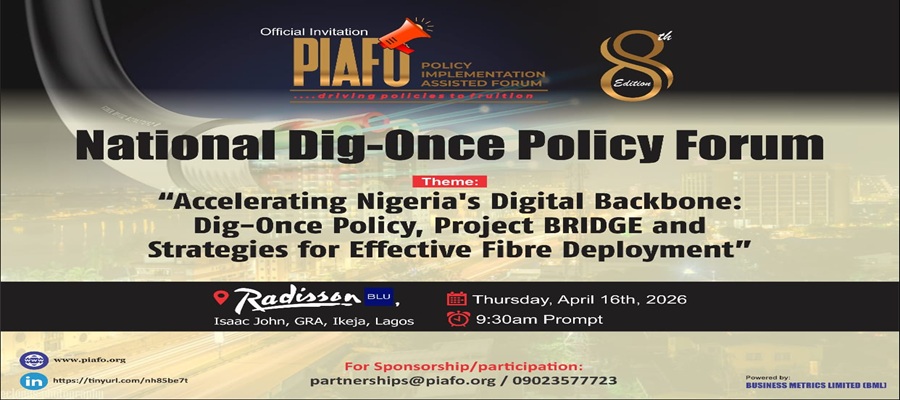
Key players across Nigeria’s digital economy, telecommunications, and infrastructure ecosystem are set for the National Dig-Once Policy Forum to champion a new course towards increasing Nigeria’s digital backbone network to 125,000km of fibre-optic infrastructure.

PIAFo
The event, which marks the 8th edition of Policy Implementation Assisted Forum (PIAFo), is a high-level industry dialogue aimed at accelerating the formulation and adoption of a National Dig-Once Policy as a critical enabler of safe, coordinated and cost-effective fibre infrastructure deployment in the country.
The forum, themed “Accelerating Nigeria’s Digital Backbone: Dig Once Policy, Project BRIDGE and Strategies for Effective Fibre Deployment,” is slated for Thursday April 16, 2026 at Radisson Blu Hotel, Ikeja GRA, Lagos.
According to the organisers, Business Metrics Limited (BML), the introduction of $2 billion Project BRIDGE initiative by the Federal Government to expand fibre infrastructure by additional 90,000km from 35,000km to 125,000km by 2030 requires some new measures to ensure successful implementation of the ambitious target and avoid mistakes of the past.
Industry stakeholders have identified that the success of a national connectivity backbone rollout depends largely on institutionalising a Dig Once Policy framework, which encourages the installation of fibre ducts and conduits whenever roads, railways, and other major public infrastructure are being constructed or rehabilitated.
According to industry data shared by the Nigerian Communications Commission, lack of such a framework is taking a toll on the telecoms sector and broadband drive as operators recorded over 50,000 fibre cut incidents across the country in 2024, with more than 60 per cent occurring during road construction and rehabilitation activities. These disruptions have resulted in billions of naira in repair costs, network outages, and service degradation.
Telecom operators in Lagos State alone said they spent over N5 billion in 2024 to repair and replace damaged fibre infrastructure in the state, while lamenting that the development continues to slow down network upgrade and expansion drive.
Beyond infrastructure damage, telecom operators also face challenges such as high Right of Way (RoW) charges, uncoordinated civil works, and repeated excavation of roads for fibre deployment.
PIAFo 8.0 aims to address these challenges by fostering collaboration among stakeholders responsible for planning, financing, constructing, and maintaining Nigeria’s digital infrastructure.
Specifically, the forum seeks to align federal, state, and local infrastructure planning around a unified Dig-Once framework; strengthen collaboration between telecom operators, infrastructure companies, and public works authorities; translate policy intentions into actionable guidelines and implementation timelines; and build stakeholder support for Project BRIDGE and complementary national fibre initiatives.
Speaking about the event, Team Lead at Business Metrics Limited, Omobayo Azeez, said Nigeria is being denied access to robust connectivity it should derive from up to eight high-capacity undersea cable networks landed on its shores because of difficulties around terrestrial fibre infrastructure expansion.
“The Project BRIDGE initiative should excite everyone because of ambitious targets. But for those who understand the operating terrain, and why it took the industry over 20 years to achieve around 35,000km of fibre network that the country currently operates for broadband connectivity, the project calls for a major shift in execution approach with the adoption of a National Dig-Once Policy as the starting point.
“PIAFo, now in its 8th edition, is again serving as the viable platform for representatives from government ministries and agencies, senior telecom executives, infrastructure companies, data centre operators, equipment manufacturers, state governments, and industry associations to chart the way forward.”
The forum will feature keynote addresses, expert panel discussions, and strategic networking sessions designed to drive pragmatic outcomes that will accelerate Nigeria’s journey toward a resilient and inclusive digital economy.

Court Remands Hacker for Allegedly Stealing N3.09Bn from FCMB

CBN Directs IMTOs to Open Naira Settlement Accounts

Nigerians Lose N12.5Bn to AI-Driven Scams- PwC

SEDC Launches SEVCP to Expand Access to Capital for Startups

Kaspersky, AFRIPOL Conduct Joint Cybersecurity Training for African law Enforcement

Kaspersky Discovers New Phishing Campaign Exploiting Google Tasks Notifications to Steal Corporate Credentials

esentry 2025 Report Shows Healthcare, Financial Services and Telecoms as Staging Grounds for Increased Cyberattacks in Africa

AfDB, UNDP Launch $10Bn AI Initiative for Africa

MultiChoice Suspends Yearly DStv Price Hike as Canal+ Pushes Growth

MTN Nigeria Posts Record N1.70 Trillion Pre‑Tax Profit, Declares N20 Dividend for 2025




 E-Financial2 days ago
DLM SPV PLC Lists ₦9.00bn AAA-Rated Medium-Term Notes on FMDQ Exchange, Sets Benchmark in Corporate Bond Market

 E-Financial3 days ago
CBN Wins Central Bank of the Year Title @13th Global Awards

 General News3 days ago
Tech Firms Sack over 45,000 so Far in 2026

 News2 days ago
Metaverse Collapses, Horizon Worlds Shuts Down on Quest

 News3 days ago
Morney Launches in Nigeria as E-invoicing Drives Finance Digitisation

 Telecom3 days ago
FG Taps Quest Merchant Bank for Advisory on 90,000km Fibre Project

 General News3 days ago
Jury Finds Elon Musk Liable for Misleading Twitter Investors

 News3 days ago
TEF-Backed Entrepreneurs Generate $4.2Bn, Create 1.5m Jobs across Africa