

General News
World Bank Announces $800m Support for Nigeria’s CCT Initiative


The World Bank on Tuesday disclosed plans to support Nigeria with $800 million to boost the Conditional Cash Transfer (CCT) initiative of the present administration.

Mr. Ousmane Diagana, Vice President of World Bank in Western and Central Africa, stated this in Abuja, during a meeting with Professor Nentawe Yilwatda, minister of Humanitarian Affairs and Poverty Reduction; Hon. Yusuf Tanko Sununu, minister of State for Humanitarian Affairs and Poverty Reduction; and Dr. Yakubu Kofamarta, permanent secretary.
While giving update on the initiative, Mr. Diagana said the delegation is Nigeria’s assess to the level of progress and challenges of social investment programme in the Ministry and pledged to support the initiative to meet the desired objective of reducing poverty in Nigeria.
While stressing the Bank’s support for Nigeria as a developing country to provide quality services by continuing to create jobs among others for the Citizens, he disclosed that World Bank has “a very large programme here in Nigeria worth more than $17 billion.”
Yilwatda, minister of Humanitarian Affairs and Poverty Reduction, described the World Bank as a dependable partner and maintained that the Ministry would continue to collaborate with relevant agencies including the United Nations with a view to ensure that more funds are provided to reduce poverty in the country with a target of 15 million households.
While applauding the clear leadership being provided by President Bola Tinubu for the success of the social investment programmes in the country, the Minister explained that “everybody who is going to benefit from this conditional cash transfer will be given a digital identity, so you have digital trust.
“And that is not just identity, but it’s a social inclusion and financial inclusion to hundreds and thousands of Nigerians who before now were not socially inclusive. They were not also financially included in Nigeria.
“You know, having over 70 million of Nigerians who before now have no account numbers, have no identity, you cannot trace their homes; you can’t trace their addresses.
“And today, while you’re taking all their homes, we also give digital identity, and we’re paying them conditional cash transfer.
“This the largest financial inclusion ever the history of Nigeria, and this is a bold step by Mr. President to ensure that the effect of the reforms that the government is doing is also being cushioned by this social investment that we’re having in the country.
Professor Yilwatda disclosed that the administration is “targeting 15 million households. Nigeria has roughly about we have roughly about 41 to 42 million households, the total number of household that we have in the country. So we are targeting 15 million households out of these 42 million households.
“So, if you look at the numbers, it means we are doing roughly about the neighborhood. Over 30% of the households that will benefit from this conditional cash transfer.
“Multiply that number by five, we’re taking off roughly about 60 million people will benefit from this conditional cash transfer, that’s targeting about 60 million people.
“15 million households, targeting about 60 million individuals within the households.
“Now if you look at these numbers, because the numbers are saying that roughly about 42% of Nigerians are living in poverty, those numbers simply shows that roughly about 90 million people, which means this cash transfer alone is targeting almost over 70% but people who are living under poverty in Nigeria by this conditional cash transfer, which is the largest ever in the history.”
According to him, each of the CCT beneficiaries is to receive the sum of N75,000.
“Already we’ve paid almost 6 million people, almost 6 million households, targeting about 30 million people have already been paid, and there are already evidences.
“We are going to even do a media talk for the to see the communities, because we are covering about 230,000 communities, cutting across all the 774 Local Governments, which means that, averagely almost every community in Nigeria has been captured under that is on this programme, and every village in Nigeria has been captured under this programme, and every village has a beneficiary. Every committee has beneficiaries across the entire country.
“I think this one of the most extensive program that has covered the entire country, you know, and effectively also, because the people that were targeting this program, we actually community based.
“So each village selected people that they are poor in the village, the women, the youths and the men, independently selected people that they feel they are poor, and they brought the name together.
“It is a community that signed off the name and sent to us. So they are not names from us, but their names from the communities that came up to us.
“And that’s why is the best way of targeting people when the village itself feel they can select the people that are poor within themselves, and they should be supported.
“So it is the communities that are telling us that these are people that you can support. So, we are supporting people that have been given to us by individual communities.”



Kaspersky has detected a wave of phishing attacks preying on former customers of the bankrupt crypto lending platform BlockFi.

These scams leverage the ongoing distribution of customer assets following BlockFi’s 2022 bankruptcy, tricking victims into surrendering cryptocurrency wallet seed phrases, potentially leading to financial losses.
BlockFi, once a prominent provider of high-yield interest accounts and crypto-backed loans, announced bankruptcy in November 2022. The company began disbursing repayments to affected clients in 2024 as part of its restructuring plan.
Kaspersky has detected fraudulent emails mimicking BlockFi’s official branding, which falsely invite recipients to “claim the payment” they are “entitled to.” After clicking on the link, users land on a phishing page and are prompted to “connect their wallet”.
The attackers suggest that users import their existing wallet by typing in the secret phrase – this grants attackers direct access to the funds in the victim’s wallet.
“Phishing attacks like this are widespread, capitalising on real-world events to build trust and urgency. Victims who fall for these scams risk exposing their crypto wallets to theft. It’s critical for individuals to verify any communications directly through official channels and to check the address from where the email originates for legitimacy,” comments Roman Dedenok, anti-spam expert at Kaspersky.
The phishing emails feature convincing logos, colour schemes, and language, making them difficult to spot at first glance. Kaspersky recommends the following steps to avoid falling victim to this or similar scams:
- Do not click on links or respond to unsolicited emails.
- Protect Sensitive Information: Never share banking credentials, wallet seed phrases, or other private keys in response to an email or online form.
- Use Security Tools: Enable two-factor authentication (2FA) on all financial accounts, employ reputable security software like Kaspersky Premium, and consider using a password manager to safeguard credentials.

Universal Insurance Plc has secured the approval of its shareholders to raise additional capital of N15 billion through a proposed recapitalisation exercise, as the insurer intensifies efforts to strengthen its balance sheet and position the company for long-term sustainability.

The approval will be granted at an Extraordinary General Meeting (EGM) scheduled for February 5, 2026 in Lagos.
Currently, Universal Insurance’s share capital stands at N8 billion, with 16 billion ordinary shares held by existing shareholders on the NGX. The board is seeking to revalidate, authorise, and regularise 14 billion unissued ordinary shares for the planned capital raise and also secure approval to list and admit the new shares for trading
Following resolutions passed at the Extraordinary General Meeting (EGM), Universal Insurance Plc is moving forward with a comprehensive recapitalisation programme aimed at reinforcing its capital base and improving its capacity to underwrite larger and more diversified risks.
Shareholders approved the plan to raise new equity through a combination of capital market instruments, subject to regulatory approvals, as part of efforts to meet industry capital requirements and support future growth.
Gross premium written rose to N18.59 billion, up from N12.29 billion a year earlier, driven by increased underwriting activity across key insurance segments. Insurance revenue also grew to N14.68 billion, compared with N9.85 billion in the prior period, reflecting stronger risk acceptance and improved pricing discipline.
Despite higher insurance service expenses, the company posted an insurance service result of N1.13 billion, while net investment income surged to N2.79 billion, supported largely by fair value gains on financial assets. As a result, net insurance and investment income increased to N5.18 billion, nearly double the N2.61 billion recorded in the same period of 2024.
On the balance sheet, total assets expanded to N21.82 billion as at September 30, 2025, from N18.14 billion a year earlier, supported by growth in financial assets and investment properties. Shareholders’ funds rose to N14.38 billion, up from N12.33 billion, reflecting improved profitability and reserve accumulation.
Investors have also responded positively to Universal Insurance’s performance, with its stock delivering an 83.33 percent return in 2025, rising from N0.66 to N1.21 per share, and trading volumes exceeding 6 billion shares.
The recapitalisation initiative, combined with the improving financial performance recorded in Q3’25, underscores Universal Insurance Plc’s determination to reposition itself as a more resilient and competitive player in Nigeria’s insurance industry.
The company aims to deliver improved value to policyholders, investors, and partners, while supporting broader economic activity and generating sustainable returns for shareholders.

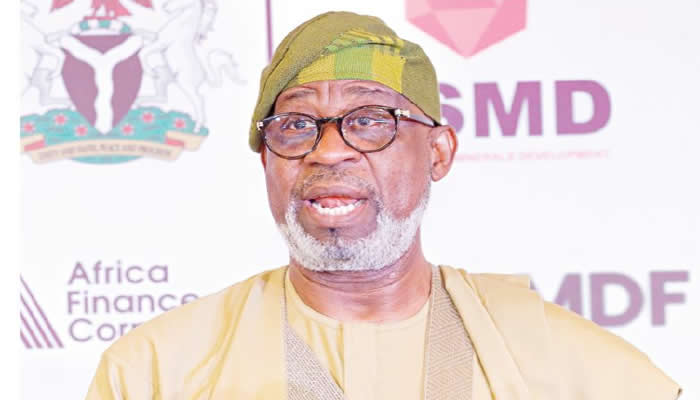
Federal Ministry of Solid Minerals Development has debunked allegations by the Northern Elders Forum that the Federal Government sited a gold refinery in Lagos, breaching the federal character principle.

Minister Dele Alake
In a statement from Abuja, Special Assistant to Minister Dele Alake, Segun Tomori, described the claim by the forum’s spokesperson, Prof. Abubakar Jiddere, as “false and misleading.” He clarified that the minister never announced any government-owned gold refinery in Lagos or elsewhere.
Mr Tomori stressed that Minister Alake explicitly described the refinery as a private initiative by Kian Smith, one of several such projects nationwide. “The Federal Government does not compel private companies to site operations in specific regions,” he added, crediting founder Nere Emiko’s leadership.
The project supports the government’s value-addition policy to curb raw mineral exports and boost local processing. Reforms over two years have spurred investments like a $600 million lithium plant in Nasarawa, a $400 million rare earth facility there, and a $200 million ASBA lithium plant in Abuja.
Tomori highlighted the policy’s role in attracting foreign capital and creating jobs, describing the Lagos refinery as proof of successful reforms. He urged the Northern Elders Forum to back efforts for a stronger Nigerian economy rather than spreading misinformation.

NGX Gives Securties Firm 10 Days to Resolve Theft, Forgery Allegations

KongaPay K-Save Users Save over N3.2Bn

NCC Gives Amazon’s Kuiper, BeetleSat Nod to Provide Satellite Broadband Services in Nigeria

Cybersecurity Firm Detects a Wave of Crypto Phishing Following BlockFi Bankruptcy
NCC Unveils Spectrum Roadmap to Power Nigeria’s $1tr Digital Economy

Banks quietly move to enforce new ₦50 transfer levy from Jan. 1

FIRS says NIN, CAC Numbers to Serve as Tax IDs from 2026

FIRS Declares NIN, CAC Numbers as Tax IDs from 2026

US Begins Partial Visa Ban on Nigerians January 1

Galaxy Backbone Tops FG’s Website Performance Ranking




 E-Financial2 days ago
Here Are Nigerian Banks That Have Secured Their Licences

 Telecom2 days ago
MTN CEO Toriola Hails Nigeria’s Telecom Transformation at MIPAD

 E-Financial2 days ago
Zenith Bank Top Nigerian Bank Pick Ahead of GTCO, AccessCorp

 News2 days ago
ICPC Charges Ozekhome with Forgery, Corruption Over London Property

 E-Financial2 days ago
Nigeria Processed $92.1Bn Crypto Transactions in 12 Months — PwC

 E-Financial2 days ago
How Crypto Criminals Stole $700m from People – often Using Age-Old Tricks

 Telecom2 days ago
Lebara Launches Agent Registration Portal

 E-Business2 days ago
Elon Musk Seeks $134Bn from OpenAI, Microsoft for ‘Wrongful Gains’