

General News
Nigeria’s App Downloads Grew 320%. Here Are 7 Ways Marketers Can Capitalize


By Olumide BalogunThe digital pulse of Nigeria beats fastest on mobile. With $1 billion projected in app usage and purchases for 2025 across the continent, marketers in Nigeria cannot afford to ignore this wave. At Google’s recent “Appcelerate” summit, top industry voices explored the central role of mobile apps in today’s marketing strategies.

Olumide Balogun
The takeaway was unmistakable: Nigerians spend over 4 hours daily on mobile, with 80% of that time in apps. Apps have moved from being optional extras to becoming the core of customer engagement, business efficiency, and innovation.
Smartphone access is set to reach 880 million across Africa by 2030. Monthly mobile data use is expected to triple. Nigeria is leading this digital surge, ranking 6th globally for app downloads, with a 320% rise in just two years. This growth signals more than user numbers—it shows a market with deeper engagement, higher loyalty, and richer opportunities for businesses that tap into the app-driven economy.
For marketers and business owners, apps are now a key growth driver. The path forward is clear: understand what makes apps work and how to maximize their impact. Here are seven ways Nigerian marketers can make the most of this app-led shift.
1. Treat the Customer Journey as Unified
Forget dividing your audience into “web customers” and “app customers.” Nigerian consumers move seamlessly from browser to app and back again, often in a single purchase journey. For example, someone might discover your brand via Google Search, browse your site, get distracted, then see your ad again. If they have your app, a click can bring them right back to their cart inside the app, ready to buy. Your marketing needs to reflect this reality, ensuring that the brand experience is integrated across all digital touchpoints, making it easier to convert potential customers wherever they start or finish.

2. Focus on Profitable App Engagement
App users are your most valuable customers. They engage more, show higher loyalty, and tend to spend more than those who stick to your website. The numbers back this up—app purchasers often buy beyond their original intent. By making it a priority to acquire and retain app users, you are building a strong foundation for business growth. Think of a local food delivery app: regular users order more, try out new offers, and use app-exclusive deals, all of which drives up their lifetime value.
3. Use Apps as a Goldmine for First-Party Data
With digital privacy in sharper focus, apps give marketers a chance to collect direct, consented customer data. People are more likely to share information in trusted apps, giving you deeper insight into their habits and preferences. This data is critical for building profiles and running personalized campaigns. For example, a fintech app can track user spending, preferred services, and savings goals, then use these insights to suggest relevant products and build stronger relationships.
4. Measure Holistically Across Web and App
You can’t improve what you don’t measure. Marketers need to see the whole picture—not just fragments—so a cross-platform measurement strategy is a must. Tools like Google Analytics 4 (GA4) let you track engagement and conversions across both web and app, tying user behavior together for a complete view of the journey. For example, a travel company can see when a customer searches for flights on their website and later books a trip through their app. This full-path insight helps marketers optimize spend and improve results.
5. Turn Web Campaigns into App Conversions
When your analytics are set, guide your web users to your app. For those with the app installed, deep links can take them from a web ad right into the app, straight to the content they want. Google’s Web to App Connect in Google Ads makes this easy. If a user searches for “affordable smartphones” and clicks your ad, they can be taken directly to that section in your app, making the buying process smooth and fast. This frictionless experience boosts conversion rates and increases satisfaction.
6. Drive Growth with Google Ads and App Campaigns
Growing your app’s user base takes more than organic buzz. Google Ads offers App Campaigns designed for this moment, reaching billions of users across Google Search, Play, Gmail, YouTube, and more than 2 million sites and apps on the Display Network. App Campaigns use machine learning to find the right people for your app at the right time, helping you not only drive installs but also meaningful engagement. To date, these ads have delivered over 10 billion installs worldwide—proof of their scale and effectiveness. Nigerian developers and marketers can use this approach to efficiently build a high-value audience, whether launching a fintech app or driving engagement for a new delivery service.
7. Make YouTube Your Discovery Engine
When it comes to discovering new apps and products, few platforms rival YouTube. With nearly 2 billion logged-in users every month, YouTube reaches audiences at scale, and it’s where people spend more than a billion hours each day watching video. Importantly, over 70% of YouTube’s watch time is on mobile, which fits perfectly with Nigeria’s mobile-first population. YouTube is a go-to destination for Gen Z—especially gamers and creators—looking to connect with communities and discover new apps. In Nigeria, YouTube watch time grew by 55% in the past year, signaling a prime opportunity for app marketers to reach engaged, mobile-first audiences and boost visibility.
For Nigerian businesses, the path to sustained digital growth and profitability is now closely tied to leveraging platforms like Google Ads and YouTube. By adopting an integrated digital strategy that measures comprehensively with GA4, optimizes with Web to App Connect, and grows through AI-powered App Campaigns and video discovery on YouTube, marketers can unlock new levels of value and engagement. The opportunity is wide open for any brand ready to meet customers where they are—on their phones, in their apps, and in their favorite videos.



Nigeria is experiencing a complex cybersecurity landscape where reported fraud incidents have decreased by nearly 46 percent over the past four years, yet financial losses from cybercrime are on the rise, according to Check Point Software.

This trend is attributed to sophisticated schemes developed by cybercriminals who are increasingly targeting the nation’s rapidly digitizing economy, with further coverage provided by Dark Reading.
Nigeria’s digital transformation has made it a prime target for cybercriminals.
In June 2026, organizations in the country faced an average of 4,361 attempted attacks weekly, ranking it second in Africa for cyber threats.
While the volume of detected threats fluctuates, it consistently remains elevated, often double the global average.
The Nigerian government is developing a new cybersecurity framework, expected later this year, which will mandate incident reporting, set minimum cybersecurity investment levels, and foster public-private collaboration.
Despite a decrease in the number of reported fraud incidents, financial losses have escalated, with digital payment fraud reaching ₦25.85 billion (US$18.7 million) in 2025.
Insider threats, including SIM swap fraud and account compromise, are significant contributors to these losses. Many organizations, particularly smaller businesses, lack adequate training and resources, making them more vulnerable.
The country’s cybersecurity maturity is ranked at a moderate level, and effective enforcement of existing regulations, such as the Data Protection Act, will be crucial to combatting the growing financial impact of cyberattacks.
TotalEnergies, together with its partners Hydra Storage Holding and Reatile Renewables, inaugurates Hydra project, the largest hybrid renewable energy project in Africa, located in South Africa’s Northern Cape province.

The project combines a 216 MW solar photovoltaic plant with a 500 MWh battery energy storage system, marking a significant contribution to the country’s Just Energy Transition program that aims to decarbonise the economy thanks to renewable energy sources.
The facility will supply 75 MW of dispatchable renewable electricity to the national grid continuously between 5:00 a.m. and 9:30 p.m., under a 20-year power purchase agreement signed with Eskom. This represents more than 400 GWh of electricity per year, equivalent to the consumption of approximately 200,000 South African households.
“We are delighted, together with our partners Reatile Renewables and Hydra Storage Holding, to bring the Hydra project into operation. It enables us to supply dispatchable renewable power to the South African grid, thereby strengthening the country’s energy security while decarbonising its electricity generation.
This project reinforces our renewable production capacity in South Africa, the continent’s largest power market in terms of electricity consumption”, said Magali Pailhé, Managing Director of TotalEnergies Southern Africa.
Hydra project has been developed by a consortium composed of TotalEnergies (35%), Hydra Storage Holding (35%) and Reatile Renewables (30%). It is part of the South Africa’s Risk Mitigation Independent Power Producer Procurement Programme launched by the Department of Mineral Resources and Energy.
General News
BOI Pledges to Drive Nigeria’s Cocoa and Dairy Sectors with 70% of its €85m EIB Facility

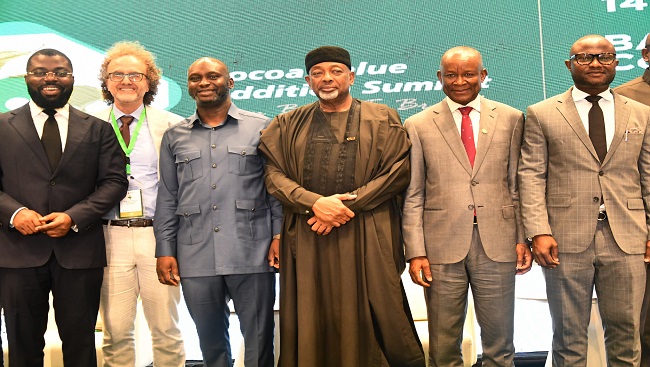
Bank of Industry (BOI) has secured a €60 million credit facility from the European Investment Bank to fund Nigeria’s cocoa and dairy value addition drive, with a focus on processing, ingredients and chocolate manufacturing.

Dr. Olasupo Olusi, Managing Director/CEO of BOI, disclosed this on Tuesday, during the Africa Cocoa Summit convened in Abuja by the Federal Ministry of Industry, Trade and Investment with the aim of transitioning Africa from exporting raw beans to local processing and branding.
Also known as the Cocoa Value Addition Summit with the theme: ‘From Bean to Brand,’ it was attended by leaders and stakeholders from Nigeria, Ghana, Côte d’Ivoire, and Cameroon who signed the Abuja Declaration to establish the Cocoa Value Addition Alliance (CVAA).
According to Olusi, the €60 million forms part of the €85 million EIB–BOI facility, backed by the European Union under the Global Gateway initiative, and designed specifically to strengthen these critical sectors in Nigeria.
“This agreement reinforces the Bank of Industry’s commitment to unlocking long-term, affordable finance for priority sectors that drive inclusive growth. Approximately 70% of the €85 million financing facility will be channeled to Nigeria’s cocoa and dairy sectors, which BOI considers among the industries with the greatest potential to create jobs and retain foreign exchange earnings.”
“We are particularly focused on cocoa value chains, which provide livelihoods for thousands of Nigerians. Through this initiative, we aim to enhance productivity, value addition, and market linkages that will directly improve the incomes of farmers and processors,” he said.
The BOI MD said that the bank would prioritise lending to processors, cooperatives, and MSMEs that add value locally, rather than only to traders exporting raw beans, adding that the era of celebrating volume of raw exports must end, as Nigeria loses billions by shipping beans and importing finished chocolate. According to him, the goal is to create factories around cocoa communities so that value, jobs, and taxes remain in Nigeria.
However, Olusi noted that financing alone is not enough, and as such, BOI will complement the loans with technical assistance on compliance, climate standards, and access to the EU market. BOI, he said, will also support farmers and processors to meet the EU Deforestation Regulation and other international environmental and social standards.
Citing BOI’s track record, Olusi said the bank disbursed over ₦164 billion in 2025 to more than 3,500 agro and food-processing businesses. The support financed factories, mills, packhouses, and cold chains, and linked nearly 48,000 smallholder farmers into industrial value chains.
He said the new financing would target the entire ecosystem, from nurseries and farmer cooperatives to grinding plants, ingredient factories, packaging lines, and chocolate manufacturers.
Speaking also at the summit, President Bola Tinubu called for a decisive shift from Africa’s long-standing dependence on exporting raw cocoa beans, urging producing countries to prioritise value addition and capture a larger share of the global chocolate industry’s wealth.
The President who was represented by the Minister of Agriculture and Food Security, Senator Abubakar Kyari, noted that although Africa accounts for about 70 per cent of global cocoa production, the continent retains only six cents of every dollar generated by the global chocolate industry.
He stressed that Nigeria was committed to processing more of its cocoa locally, expanding chocolate manufacturing, building indigenous brands and competing more effectively in international markets, rather than continuing to export raw cocoa beans.
According to the President, cocoa value addition remains a key component of the Renewed Hope Agenda and the country’s broader industrialisation strategy, and disclosed that investors are developing a 70,000-tonne cocoa processing facility in Shagamu, Ogun State, while Nigeria’s cocoa grinding capacity has already surpassed 120,000 tonnes annually.
Earlier, the Minister of Industry, Trade and Investment, Dr. Jumoke Oduwole, said the summit aligns with the Federal Government’s ambition of building a one-trillion-dollar economy by 2030.
She observed that despite Nigeria’s significant contribution to global cocoa production, the country continues to earn only a small fraction of the value created across the cocoa value chain.
According to Oduwole, the Federal Government is promoting greater value addition through manufacturing incentives, investment promotion and stronger collaboration among relevant institutions.
She added that the government would also deepen market access by leveraging existing trade partnerships and opportunities under the African Continental Free Trade Area (AfCFTA), while encouraging investors to take advantage of regional and global value chains to unlock the sector’s full economic potential.
Also speaking, the Minister of State for Industry, Senator John Owan Enoh, described the summit as another milestone in implementing Nigeria’s Industrial Policy, and announced plans for the establishment of the Cocoa Value Addition Alliance, bringing together Nigeria, Ghana, Côte d’Ivoire and Cameroon, countries that collectively account for about 75 percent of global cocoa production.
According to Enoh, the alliance is designed to strengthen regional cooperation, promote local processing, and enable producing countries to capture greater value from the global cocoa market.
“We are not here to disrupt existing partnerships but to expand them,” he said.
Enoh urged African cocoa-producing nations to move beyond exporting raw beans and instead focus on developing branded cocoa products capable of competing successfully in global markets.
On his part, the Chief Executive of the Ghana Cocoa Board (COCOBOD), Dr. Ransford Abbey, urged African cocoa-producing countries to deepen domestic processing.
“I am here to support the effort and commit to a joint effort towards increasing value for our hardworking cocoa farmers and our respective economies,” Abbey said.
He said Africa produced about 75 per cent of the world’s cocoa but earned less than 10 per cent of the global chocolate industry’s wealth.
“This system cannot continue. We must shift the paradigm from exporting raw poverty to creating refined wealth right here on the African continent,” he said, adding that stronger regional collaboration, investment and technology transfer will help African countries capture greater value from the global cocoa economy.
The Head of Cooperation of the European Union Delegation to Nigeria and ECOWAS, Mr. Massimo De Luca, reiterated the importance of value addition in the cocoa value chain. While expressing the support of the EU, he called on governments of the various countries to ensure they play their part in ensuring that proper framework necessary for the success of the initiative was established and clarified.

FAAN to Replace Physical ID Check with V-Pass Biometric Verification

World Bank Says 79 Percent of Nigerians Still Trapped in Poverty despite Reforms

SEC Begins Drive to Recover Unclaimed Dividends

ntel Plays Down Calls and Data Services, Moves to BET Agenda

Nigeria Facing Rising Cybercrime Losses – Report

NRC, Ponzi Scheme Collapses Resulting Loss of Billions of Naira

Nigeria Launches FreeTV Nationwide

NASENI Moves to Digitize CCB’s 5m Assets Declaration and Operations

Lebara Nigeria Launches Lebara Play, Africa’s First Telecom-Owned Micro-Drama Platform

CANAL+ Partners Samsung to Pre-Load DStv Stream on New Samsung TVs In Nigeria, Other African Countries




 E-Business3 days ago
TD Africa Sponsors Check Point Secure 360 Summit to Boost Cybersecurity in Nigeria

 Telecom3 days ago
MTN Foundation, MUSON Celebrate Emerging Music Talents at 2026 Graduation Ceremony

 Telecom3 days ago
NITDA Calls for Digital Infrastructure Expansion to Drive Nigeria’s Industrialisation

 News3 days ago
Guinness Rolls Out Nationwide Consumer Rewards Promotion

 E-Financial3 days ago
Next Currency Crisis May Turn $300Bn in Stablecoins into National Currencies

 General News3 days ago
First Trustees Advocates Estate Planning as an Essential Tool in Every Wealth Creation Strategy

 E-Financial3 days ago
Gigbanc Nigerian Fintech Startup Closes Shop after 3 Years

 Broadcasting3 days ago
Mbunabo, Nigerian Filmmaker Accuses Ghana TV Stations of Pirating Nollywood Films