

E-Financial
UBA Group Launches Full Banking Operations in the UK

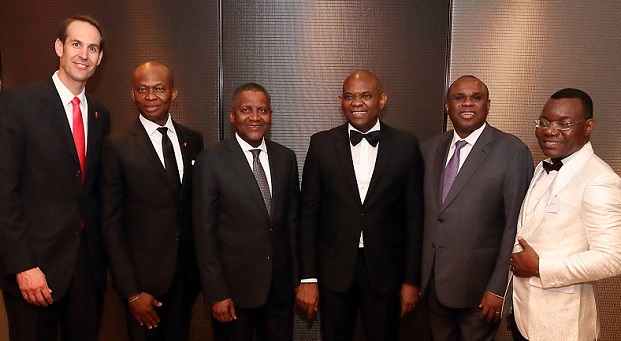
UBA group the global financial city of London has hosted a high level gathering of business and public sector leaders last week as the new UBA franchise, UBA UK was formally birthed in the United Kingdom amidst high expectations.
This is coming three weeks after the bank launched its operations in Mali.
At the upscale ceremony which held at The Prestigious Shard in the city of London, UBA UK was formerly introduced to business leaders across Europe and Africa with a commitment from the UBA Group of its readiness to galvanise trade and commerce between Europe and Africa.
The formal launch is sequel to the authorization of the Prudential Regulation Authority(PRA) and the Financial Conduct Authority(FCA) for UBA UK Limited to carry out full scale wholesale banking across the United Kingdom.
With this launch, UBA Group further consolidates its unique positioning as the first and only Sub-Saharan African financial institution with banking operations in both the United Kingdom and the United States, thus reinforcing its strong franchise as Africa’s Global Bank, facilitating trade and capital flows between Africa and the world.
Speaking at the event, Mr. Tony Elumelu, group chairman, said the Group is excited by the authorization of the relevant regulatory authorities in the United Kingdom for UBA to upgrade its operation and further fulfil its aspiration of deepening trade and investments flows between Africa and Europe.
“The enhancement of our business in the United Kingdom is very timely and mutually beneficial for African and European corporates as well as respective governments. With the British and other European governments seeking new and improved measures to grow trade relations with Africa, we are enthusiastic on our positioning and capabilities in supporting corporates and government institutions to fulfil these lofty aspirations, which we believe are pertinent for the sustainable growth of both continents.”
Elumelu expressed that he is extremely pleased as UBA is living up to its mantra of being Africa’s global bank and positioning itself to support investors in key financial centres across the world.
Also speaking at the event, Mr. Kennedy Uzoka, group managing director/CEO, noted that, “UBA Group is the most efficient gateway for European corporates and institutions to access Africa, given the bank’s expansive network across most impact markets on the continent and its deep knowledge of the business terrains in Africa. According to him, “Simultaneously, we are serving the trade and capital needs of our African customers, who are seeking exposure to the European markets. With the upgrade of UBA UK Limited, we are excited to deepen our support to existing customers whilst also providing the leverage for new customers to effectively fulfil their cross-border transactions through UBA Group’s network.”
On his part, Mr. Patrick Gutmann, CEO, UBA UK, said; “We are now on a stronger footing, as the authorization of the PRA and FCA for an enhanced business model affords us the opportunity to swell our capital and balance sheet as well as the broader UBA Group’s network across Africa. We welcome our existing and new customers to this new world of borderless opportunities, as we creatively serve our customers in meeting their international transaction needs.”
Some of the guests In attendance at the event were the President of Dangote Group, Alhaji Aliko Dangote; President, Afreximbank, Dr. Benedict Oramah; Former Prime Minister of Pakistan, H.E Shaukat Aziz; Member of the British House of Lords and Executive Committee Member of the All Party Africa Group, Rt. Hon Lord Anthony Tudor St. John amongst many others.
The event was not short on entertainment as one of Africa’s leading entertainer,s Dbanj performed to the admiration of guests including Star boy, Whiz Kid.
United Bank for Africa (UK) Limited, previously named UBA Capital (Europe) Limited offers a full suite of treasury services, cash management, correspondent banking, corporate lending and wholesale deposit products to professionals and eligible counterparties. In addition, UBA (UK) Limited offers all aspects of structured and trade finance; issuance, acceptance, confirmation and refinancing of Letters of Credit of different variations, including SBLCs.


Zenith Bank, Nigeria’s second biggest lender by market value, has received approval from the Competition Authority of Kenya (CAK) to acquire 100 percent of Paramount Bank Limited, clearing a key regulatory hurdle in its East African expansion drive.

In a statement on Thursday, CAK said the transaction is “unlikely to lead to a substantial prevention or lessening of competition in the market for the provision of banking services in Kenya” and would strengthen Paramount’s financial position, helping it meet enhanced core capital requirements over the long term.
The Kenyan regulator noted that the deal poses no risk of reduced competition in the country’s banking sector. Zenith currently has no banking operations in Kenya, while Paramount is a Tier III lender with a modest 0.2 percent market share.
“The approval is based on the Authority’s determination that the transaction is unlikely to harm competition, while any negative public interest concerns regarding employment can be addressed through mitigating remedies,” CAK added.
Paramount met the Central Bank of Kenya’s KSh3.0 billion core capital requirement in November last year, reporting KSh3.118 billion after raising KSh332 million from shareholders, according to Mwango Capital, a Nairobi-based research firm.
The deal reflects a broader shift among banks in East Africa’s largest economy as lenders seek growth opportunities beyond increasingly saturated home markets marked by weak credit expansion, rising regulatory costs, and intense competition.
While several global banks — including Standard Chartered and HSBC — have scaled back African operations over the past decade, Zenith’s move signals confidence in selective regional expansion, particularly in East Africa, where economic growth and financial inclusion trends remain supportive.
The banking group is also widening its continental footprint. Last month, the lender disclosed plans to expand into Ethiopia, Africa’s second most populous country, as it targets generating up to half of its profits outside Nigeria over the medium term.
Historically, Nigeria, the continent most populous nation contributed as much as 90 percent of the bank’s earnings, a dominance that is now gradually easing.
Data cited by The Africa Report show that profit contributions from foreign subsidiaries rose to 27 percent in the first nine months of 2025, up from 14 percent in 2024.
Nigeria’s banking recapitalisation drive is also pushing large lenders such as Zenith to deploy capital beyond their home market. In January 2025, Zenith — which holds an international banking licence — raised N350.4 billion ($242 million), lifting its paid-up capital to N614.6 billion ($425 million).
With higher capital buffers in place, banks are reassessing how best to deploy fresh funds as domestic earnings normalise following two years of windfall gains.
As part of the approval, Zenith has been required to retain Paramount’s 78 employees for at least 12 months after the transaction is completed.
The bank is listed on the Nigerian and London stock exchanges and operates across corporate, commercial, retail, and investment banking. Its international subsidiaries span the United Kingdom, Ghana, Sierra Leone, Gambia, the UAE, and China.


Victor Ogiemwonyi, a Lagos stockbroker, and Partnership Securities Limited, his company, have been convicted for allegedly stealing shares worth N953 million and $80,000 belonging to one Mr. Arnold Onyekwere Ekpe, a former managing director of Ecobank Transnational Incorporated (ETI).

Ogiemwonyi was convicted after he was found guilty of two-count charges bordering on stealing, contrary to Section 285(1), (9) (b) and (c) of the Criminal Law of Lagos State, 2011 slammed on him by the Economic and Financial Crimes Commission (EFCC).
Ekpe, through Messrs Margaret Onyema, his counsel, has sometimes in October 2016 in a petition to the EFCC alleged that he instructed the defendants to sell his 96,077,872 units of Ecobank Transnational Incorporated (ETI) shares, which were sold at the rate of N1,296,885,311.02.
But he said out of the proceeds of the sale, the stock broker paid only N300,000,000.00 to him while he dishonestly diverted the balance for personal use.
Following investigations, the defendants were charged with two counts of stealing.
Count one reads:
”Victor Ogiemwonyi and Partnership Securities Limited between the months of June, 2016 and September, 2016 at Lagos within the jurisdiction of this honourable court dishonestly stole the sum of N953, 535,861.57 (Nine Hundred and Fifty Three Million, Five Hundred and Thirty Five Thousand, Eight Hundred and Sixty one Naira Fifty Seven Kobo) being part of the proceeds of sale of 96, 077, 872 Ecobank Transnational Incorporated Shares, property of Mr. Arnold Onyekwere Ekpe”.
Count Two reads:
“Victor Qgiemwonyi and Partnership Securities Limited sometime between June, 2016 and July, 2016 at Lagos within the jurisdiction of this honourable court dishonestly stole the sum of USD$80,000.00 (Eighty Thousand United States of America Dollars) which formed part of the accrued dividends on 96, 077,872 Ecobank Transnational incorporated Shares, property of Mr. Anold Onyekwere Ekpe”.
At trial, the prosecution, led by Ola Sesan, called five witnesses and tendered 67 exhibits, all of which were admitted and marked by the court.
The defence, on its part, called three witnesses, including the first defendant.
Delivering judgment on Wednesday, Justice Modupe Nicole-Clay of the Lagos State High Court sitting in Ikeja, Lagos convicted Ogiemwonyi and his company, Partnership Securities Limited, guilty on all counts.
The court sentenced the first convict to pay a fine of N10 million, while the second convict was ordered to pay a fine of N20 million.
Also, the court directed the convicts to pay back the entire money stolen from the petitioner, both in naira and dollars.
Recall that Securities and Exchange Commission, SEC, had in 2017 banned Victor Ogiemwonyi, from operating in the capital market for life over alleged unprofessional conduct in the Nigerian capital market.
He was also banned for life from holding directorship position in any public company in Nigeria.
He was also ordered to pay a penalty of N100,000.
SEC said Ogiemwonyi was banned after he was found guilty of breaching Rule 1(iii) of the Code of Conduct for Capital Market Operators and Their Employees as contained in its Rules and Regulations made pursuant to the Investments and Securities Act 2007.
The ban also followed petition by EFCC to SEC accusing Ogiewonyi of misappropriation of about N1.24 billion, $80,000.00, stealing and dishonest conversion of proceeds of share sale belonging to an investor.
It was alleged that he used his company to dupe over 300 investors over N4.8 billion with Arnold Ekpe a former Managing Director of Ecobank Transnational Incorporated, ETI, being one of his victims.

Federal Competition and Consumer Protection Commission (FCCPC) has commenced enforcement actions against Digital Money Lending (DML) operators that failed to regularise their operations under the Digital, Electronic, Online and Non-Traditional Consumer Lending Regulations, 2025 (DEON Regulations).

FCCPC
The commission withdrew the conditionally approved status of non-compliant DML firms and removed them from its official register of approved digital lenders, effective immediately after the January 5 compliance deadline.
FCCPC Executive Vice Chairman and Chief Executive Officer, Mr Tunji Bello, announced the measures on Wednesday, emphasising their role in upholding regulatory standards and ensuring certainty in Nigeria’s digital lending sector.
Mr Bello stated that the compliance window provided under the DEON Regulations, which took effect on July 21, 2025, had closed, paving the way for fair, orderly and due process-driven enforcement.
He noted that the actions target persistent issues such as exploitative loan recovery tactics, data privacy breaches, harassment of borrowers and anti-competitive practices that have plagued the sector.
The DEON Regulations, issued on September 3, 2025, under the Federal Competition and Consumer Protection Act 2018, mandate all non-bank digital lenders to register, adhere to fair interest rates, ethical debt recovery and robust data protection measures.
Non-compliance now attracts severe penalties, including fines up to N100 million or one per cent of annual turnover, operational restrictions, app store delistings and potential director disqualifications for up to five years.
As of late 2025, the FCCPC had granted full approval to 438 digital lending companies, with recent data indicating over 521 firms now under regulatory scrutiny post-deadline.
The commission’s phased crackdown involves collaboration with the Central Bank of Nigeria, Google and Apple for account freezes and global app removals targeting unregistered platforms.
Industry watchers described the enforcement as a landmark move to sanitise Nigeria’s fast-expanding digital credit market, which has seen rising borrower complaints despite earlier 2022 interim guidelines.
The FCCPC reiterated its commitment to balancing innovation with consumer protection, urging affected operators to swiftly meet requirements for reinstatement.

PalmPay User Shares Experience on Fintech Apps to Trust in Nigeria

Stakeholders Demand Stronger Governance and Infrastructure to Drive Tech Adoption @ Lagos AI Summit

Nigerians Target Self-Improvement, Business Startups in 2026 Google Data

35 Million Nigerians Face Acute Hunger in 2026, UN Warns

How Inside Jobs and Policy Shocks Trigger Nigeria’s Rising Loan Crisis

Banks quietly move to enforce new ₦50 transfer levy from Jan. 1

Jumia CEO says Black Friday Signals Nigeria’s E-Commerce Maturity

Galaxy Backbone Celebrates the Federal Government’s Paperless Civil Service Milestone

19 Nigerian Banks Meet CBN Recapitalization Targets Ahead of March Deadline

Nigeria’s Internet Usage Hits 1.24m Terabytes – NCC




 E-Business2 days ago
Firm Detected a Scam Exploiting OpenAI’s Teamwork Features

 Broadcasting2 days ago
DG NCC Tasks University Dons on Research Commercialization, IP Management to Build Global Competitive Ecosystems

 E-Financial2 days ago
MoMo PSB Expands Cross-Border Transfers Across Africa

 E-Financial2 days ago
Banks to Cut Fraud Response Times to Under 30 Minutes

 Telecom2 days ago
FG Expands 3MTT Programme Across the Country

 News2 days ago
Firms Face Gaps Between AI Ambition and Execution

 Telecom2 days ago
MTN Foundation Trains 2,000+ Young Nigerians in ICT for SME Growth

 General News2 days ago
Kuda Unlocks Instant Online Accounts for NGOs and Religious Bodies