

News
Africa’s Richest Men and their Mantras

Power and drive are two things business leaders seem to have in common.
Add an uncommon determination to succeed, and the extraordinary that pushes them to surpass expectations and do things others have not thought, or found the wit to do then you might might probably have all the ingredients that these geniuses embody.
The veritable Ventures Africa, Pan-African business magazine and news service, across the globe, entrepreneurs and business leaders are marked by their enviable managerial skills and intellectual capacity which they demonstrate.
According to Ventures Africa, no wonder when they as much as cough everyone pays apt attention: that split-second action of opening their lips could be some kind of code unlocking the next billion dollar opportunity.
In the Africa, the story is the same. From Cape to Cairo via Nairobi and the busy ports of Lagos, African has it fair share of dynamic business leaders who have not just built world-class businesses, but have positioned the continent’s economies for unprecedented growth and development. Ventures Africa takes a look at 21 ‘words of wisdom’ from some of Africa’s billionaire businessmen.
Johann Rupert, South Africa
Johann Rupert is one of South Africa’s richest people with an approximate net worth of $6.6 billion. Johann serves as Chairman of Richemont, Swiss -based luxury-goods company, as well as of Remgro, South Africa-based company.
However, Rupert’s wealth has grown an astonishing 30% recently, after he upgraded fortunes of his Swiss-based luxury goods outfit, Compagnie Financiere Richemont.
Quote: ‘‘I just want to be master of my own time. It is ironic that someone in the watch business should not be in control of his own time.’’
Christoffel Wiese, South Africa
Christoffel Wiese is a veteran business leader from South Africa with a net worth of $3.5 billion. Wiese is one of the richest people in South Africa.
Christoeffel Wiese serves as Chairman and the largest single shareholder of Shoprite, Africa’s biggest retailer, low-priced supermarket chain.
He is also the Executive Chairman of Pepkor, a chain of discount clothes, shoes and textiles, where he holds a large stake.
Quote: ‘‘Who else could have built a company we bought for R1 million into a company worth more than R100 billion today. To run a company with more than 100,000 employees in 17 countries, you have to be able to think on your feet.’’
Mike Adenuga, Nigeria
Mike Adenuga is a Nigerian business magnate whose net worth is estimated at $4.7 billion according to Forbes. Some quarters believe he is worth more than that. In 2006, he founded Globacom, the second largest mobile phone network in Nigeria.
With over 24 million customers in Nigeria, the company also operates in the Republic of Benin, where it recently acquired licenses to start businesses in Ghana and the Ivory Coast.
Adenuga’s Conoil Producing is considered to be one of the largest independent exploration companies in Nigeria, with a production capacity of 100,000 barrels of oil per day
Quote: ‘‘The harder you work, the luckier you get’’.
Mohammed Ibrahim, Sudan
Mohammed Ibrahim is a mobile communications entrepreneur. He is a respected international philanthropist, who is credited with ‘transforming the continent’ and is thought to be the ‘most powerful black man in Britain’.
In 2007, he launched the Mo Ibrahim Prize for Achievement in African Leadership, which awards an initial prize of $5 million and an annual life payment of $200,000 to African Heads-of-State awardees. Past recipients of the award include Nelson Mandela and Olusegun Obasanjo.
Quote: ‘‘What do you do if you are an executive who resigns? You declare yourself a consultant’’.
Aliko Dangote, Nigeria
Nigeria’s Aliko Dangote is an industrialist currently worth $20 billion. He founded the Dangote Group which controls much of Nigeria’s commodities trade.
This business magnate and philanthropist referred to as ‘‘the golden child of Nigerian business circle’’ once drove a taxi cab on the streets of London to fund his education, three decades later, his consortium now spans across many sectors of the Nigerian economy and is expanding to the rest of Africa. He has retained his position as Africa’s richest man for the 3rd year in a row.
Quote: ‘‘If you give me $5 billion today, I will invest everything here in Nigeria. Let us put our heads together and work’’.
Naguib Sawiris, Egypt
Sawiris is a business man and politician. He was the executive chairman of the telecommunications companies Wind Telecom and Orascom Telecom Holding (OTH) before turning to politics in May 2017. OTH launched the first mobile operator in Egypt, Mobnil in 1998.
Quote: ‘‘I can tell you that I won’t sell Mobnil, they think because of this boycott, that I will get fed up and sell, it’s not in my character… I am not a quitter’’.
Stephen Saad, South Africa
Stephen Saad is a South African billionaire whose net worth is estimated at $1 billion. He is the co-founder of Aspen Pharmacare, South Africa’s leading publicly-traded drug manufacturer on the Johannesburg Stock Exchange
Quote: ‘‘In Life, you don’t get anywhere or do anything you hope to without some sort of sacrifice’’.
Isabel Dos Santos, Angola
Isabel dos Santos is Angolan businesswoman who has a net worth of $2 billion. Isabel who best known as the oldest daughter of Angola’s President José Eduardo dos Santos, was named Angola’s first billionaire and the richest woman in Africa as of March 2013. In 1977, 24 year old Isabel started her first business, i.e., a restaurant called Miami Beach in Luanda, the country’s capital.
Quote: ‘‘I think there are a lot of people with family connections but who are actually nowhere. If you are hardworking and determined, you will make it and that’s the bottom line. I don’t believe in an easy way through’’.
Patrice Motsepe, South Africa
Patrice Motsepe is a South African mining magnate who has a net worth of $2.9 billion. Motsepe founded and now chairs African Rainbow Minerals (ARM), a publicly traded mining conglomerate with interests in platinum, nickel, chrome, iron, manganese, coal, copper and gold.
Quote: ‘‘One has to set high standards… I can never be happy with mediocre performance’’.
Miloud Chaabi, Morocco
Miloud Chaabi is a business tycoon with an estimated net worth of $2.1 billion placing him as the richest person in Morocco.
Chaabi began working as a farmer and goat herder in his early teens. He eventually saved up enough money to move to Kenitra.
He launched his first construction company, Ynna Holdings, in the late 40s. He grew Ynna Holdings from a construction firm into the ownership firm of hotels, supermarkets, and renewable energy, among other holdings. He owns the Riad Mogador hotel chain and the Aswak Assalam chain of supermarkets.
He also runs one of Morocco’s most prolific charity groups, the Miloud Chaabi Foundation
Quote: ‘‘Bribe seekers know who to look for and my company’s reputation for integrity means I never get hassled into bribery’’.
Cyril Ramaphosa, South Africa
Ramaphosa is a South African business mogul, philanthropist and owner of the Shanduka Group. Cyril is wildly respected as a skilful and formidable negotiator and strategist, and also best known for building up the biggest and most powerful trade union in South Africa, the National Union of Mine Workers (NUM).
Quote: ‘‘No action is too small when it comes to changing the world… I’m inspired every time I meet an entrepreneur who is succeeding against all odds’’.
Naushad Merali, Kenya
Merali is a Kenyan inventor, and business magnate, best known as the founder of the Kenyan mobile service provider Kencell along with French media giant Vivendi.
As one of Kenya’s leading industrialist, Merali has brought commercial development in Kenya for more than 30 years and is currently expanding his business throughout East Africa. In 2004, he made a $20 million dollar profit in a deal at a record 1 hour.
Quote: ‘‘We need to arrest the widening disparities in incomes between the rich and poor’’.
Anas Sefrioui, Morroco
Sefrioui is a Moroccan businessman and visionary leader. According to reports, he is worth about $1.3 billion.
He founded Groupe Addoha back in 1988, but he made a big break ten years later after he got a contract to build a chunk of government-subsidized housing under the patronage of Morocco’s late King Hassan II.
His wealth continued to swell as he won a $1 billion state contract to build more housing units in 2005.
Currently, Anas is the General President and 61.7% owner of the corporate enterprise also known as Douja Promotion Groupe Addoha. Anas Sefrioui is the third richest person in Morocco and the 16th in Africa.
Quote: ‘‘The potential of the African market is huge’’
Nicky Oppenheimer, South Africa
Nicky Oppenheimer’s net worth is estimated at $6.5 billion dollars which makes him one of the richest people in South Africa. In addition to his work with De Beers, he also helms Greene and Partners Investments, a venture capital firm which focuses on building business in South Africa, and surrounding areas. In 2011, he sold his family’s 40% stake in De Beers to Anglo American, a company his grandfather started in 1917.
Quote: ‘‘I am a great believer that if you know how to operate in Africa, there are unbelievable opportunities’’.
Nathan Kirsh, Swaziland
Nathan Kirsh is a South African business mogul whose net worth of $3.1 billion. Kirsh owns a property empire that spans across the United Kingdom, Swaziland and Australia.
Kirsh has started his corn milling business in1958. The business expanded and became a variety wholesale food distribution.
Quote: ‘‘Real estate is the only sector where ‘stupid people’ can make money’’.
Desmond Sacco, South Africa,
Sacco is a business magnate and billionaire whose net worth is about $1.5 billion.
He is one of the richest and most influential South Africans. He got into mining in 1928 when he established Gloucester Manganese Mines.
He later inherited and further developed his father’s business. As of January 2012, Desmond’s Assore Group’s shares have almost doubled.
Quote: ‘‘Money is not my objective’’.
Sudhir Ruparelia, Uganda
Sudhir is a businessman and entrepreneur in Uganda. He is the Chairman and majority shareholder in the companies owned by the Ruparelia Group.
He has investments in banking, insurance, education, broadcasting etc. In 2012, he was reported to be the wealthiest individual in East Africa with an estimated net worth of $900 million.
Quote: ‘‘I own quite a lot and I have worked very hard for it’’.
Othman Benjelloun, Morocco
Benjelloun was listed as the richest person in Morocco with a net worth of $3.1 billion. He took over his family’s insurance company and turned it into the leading RMA Watanya insurer.
Then he expanded to the banking sector.
The banking aspect of Benjelloun’s business career alone is worth $4 billion. His holding company, FinanceCom holds interests in telecommunications, airlines and information technology.
Quote: ‘‘I have done industry, banking, insurance and telecommunications, and but helping children and adults is the project of my life’’.
Mr. Jim Ovia, Nigeria
Jim Ovia founded Zenith Bank Group in 1990. The bank has grown into West Africa’s second largest financial services provider by market capitalization and asset base.
His stake with Zenith is worth about $300 million. An equally large chunk of his wealth comes from a portfolio of prime real estate in Victoria Island and Ikoyi, some of Nigeria’s priciest neighborhoods.
Ovia devotes majority of his time to managing Visafone, a telecom outfit he founded in 2007. He also owns Quantum, a private equity fund focused on Africa.
Quote: “I will continue to empower the youths. That is my passion. The youths are the leaders of tomorrow. We must continue to support them’’
Ashish Thakkar, Uganda
Ashish is referred to as the youngest billionaire in Africa. He is founder of the pan-African multi-sector business conglomerate, Mara Group.
A serial entrepreneur who started his first company at the age of 15, Ashish built a conglomerate of real estate, information technology and manufacturing with operations in over 26 companies and employing 7,000 people worldwide in less than two decades.
Quote: ‘‘Money should never be a measurement for anything’’.
Said Salim Bakhresa, Tanzania
Bakhresa is described as extremely reclusive business tycoon and richest man in Tanzania. He is the founder and chairman of the Bakhresa Group of Companies.
The genius is a well known industrialist in the mainland of Tanzania and Island of Zanzibar.
With a small beginning as a small restaurateur in the 70’s, he created the business empire with a span of three decades. He is the mastermind behind the success of all the business within the group.
Quote: …
This man hardly reveals his mind… he keeps people guessing of what his next moves are.


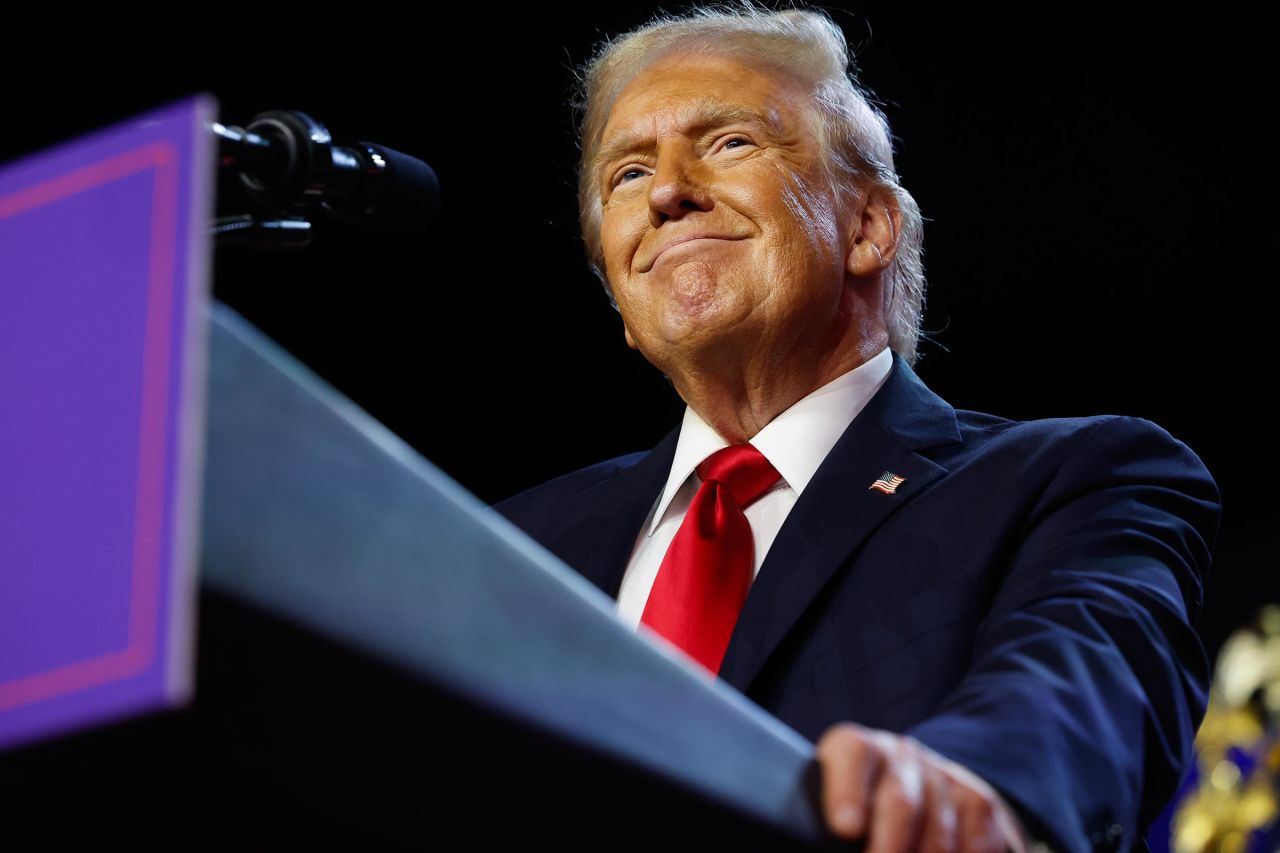
The United States has signed a five-year agreement with Nigeria to strengthen its health system, with a strong emphasis on promoting Christian faith-based health care providers.

The Department of State, in collaboration with Congress, will commit nearly $2.1 billion to expand essential preventative and curative services for HIV, TB, malaria, polio, and maternal and child health.
Under the bilateral agreement signed at the weekend, the Nigerian government will increase its domestic health expenditures by nearly $3 billion during the five-year term.
The Memorandum of Understanding is the largest co-investment any country has made to date under the America First Global Health Strategy, said Thomas Pigott, State Department spokesperson.
The MOU was negotiated within the context of Nigeria’s reforms to protect Christian populations from violence and includes significant dedicated funding to support Christian healthcare facilities.
The investments were approved to complement the efforts of Nigeria’s 900 faith-based clinics and hospitals, currently serving millions of people, and strengthen the country’s health infrastructure.
The U.S. government stressed that the President and Secretary of State retain the right to pause or terminate any programs which fails to align with the national interest.
“The Trump Administration expects Nigeria to continue to make progress ensuring that it combats extremist religious violence against vulnerable Christian populations,” Pigott added.
The MOU was signed despite the U.S. designation of Nigeria as a Country of Particular Concern and its recent inclusion in the travel ban list, which President Donald Trump premised on terrorism and visa overstay rate.
The America First Global Health Strategy, released in September 2025, covers dozens of countries. It shifts the focus of U.S. health aid to self-reliance, data security, HIV, TB, malaria, and maternal and child health services.

Socio-Economic Rights and Accountability Project (SERAP) has urged President Bola Tinubu to “urgently direct Mr Lateef Fagbemi, SAN, the Attorney General of the Federation and Minister of Justice to widely publish a certified true copy of the version of the tax bills received from the National Assembly and a certified true copy of the tax laws signed by you.”

SERAP
The documents requested by SERAP are the National Revenue Service (Establishment) Act, Joint Revenue Board of Nigeria (Establishment) Act, Nigeria Tax Administration Act; and Nigeria Tax Act.
SERAP urged Tinubu “to direct Mr Lateef Fagbemi to clarify whether the version of the tax bills received from the National Assembly are exactly the same contents as the bills that were signed into law by you and the version ultimately gazetted.”
The body made the demand of President Tinubu in a Freedom of Information request dated December 20, 2025.
It was signed by its Deputy Director, Kolawole Oluwadare.
The organisation said in the FOI request: “The law-making processes including the passing of any bills and signing them into laws, as well as gazetting the laws must meet the requirements of the Nigerian Constitution, the rule of law and separation of powers.
“This means that any passed bills and signed laws must be accessible, authentic, intelligible, clear, legitimate, and predictable so that people can know and comply with them.
“Clarifying whether the version of the tax bills received from the National Assembly are exactly the same contents as the bills that were signed into laws by the President and tax laws ultimately gazetted would promote transparency and accountability, and help to address any threats to Nigerians’ human rights.
“We would be grateful if the recommended measures are taken within 7 days of the receipt and/or publication of this letter. If we have not heard from you by then, SERAP shall take all appropriate legal actions to compel your government and the Attorney General to comply with our request in the public interest.
“Widely publishing the certified true copies of the tax bills passed by the National Assembly and the tax laws signed by the President and the gazetted versions would also allow Nigerians to identify if the provisions of the laws are consistent with their human rights, and seek effective remedies to challenge any infractions of the rights.
“Your government has the obligations under the Nigerian Constitution and the human rights treaties to which the country is a state party to promptly, independently, impartially, transparently and effectively investigate the alleged unlawful allegations of the tax laws and to ensure full accountability in this case.
“Our requests are brought in the public interest, and in keeping with the requirements of the Nigerian Constitution, the Freedom of Information Act, and the International Covenant on Civil and Political Rights and the African Charter on Human and Peoples’ Rights to Nigeria is a state party.
“According to our information, the National Assembly recently alleged that there are unlawful alterations and some material differences between the tax bills passed by the legislative body and the tax laws gazetted by the Federal Government.
“A Sokoto lawmaker, Abdussamad Dasuki, raised the issue under a matter of privilege, drawing the attention of the House to the alleged discrepancies between the harmonised versions of the tax bills passed by both chambers of the National Assembly and the copies gazetted by the Federal Government.
“The National Assembly said the alterations contained in the gazetted copies did not receive legislative approval. These alleged unlawful alterations raise questions over the legality and legitimacy of both the law-making processes and the versions of the tax laws currently being circulated by the Federal Ministry of Information.
“The National Assembly established that substantive provisions were inserted, deleted, or modified after passage by both chambers. Several oversight, accountability, and reporting mechanisms approved by parliament were reportedly removed in the final Acts. New coercive and fiscal powers (e.g., arrest powers, garnish without court order, compulsory USD computation, appeal security deposits) were also reportedly inserted in the final Acts without legislative approval.
“Section 39 of the Nigerian Constitution, article 9 of the African Charter on Human and Peoples’ Rights and article 19 of the International Covenant on Civil and Political Rights guarantee the right to seek, receive and impart information.
“The Nigerian Constitution, the African Charter on Human and Peoples’ Rights and the International Covenant on Civil and Political Rights impose duties on your government to ensure transparency and accountability in lawmaking processes.
“By the combined reading of the provisions of the Nigerian Constitution, the Freedom of Information Act, the International Covenant on Civil and Political Rights, and the African Charter on Human and Peoples’ Rights, there are transparency obligations imposed on your government to widely publish the certified true copies of the version of the tax bills received from the National Assembly and the tax laws signed by you.
“The Nigerian Constitution, Freedom of Information Act, and the human rights treaties rest on the principle that citizens should have access to information regarding their government’s activities.”

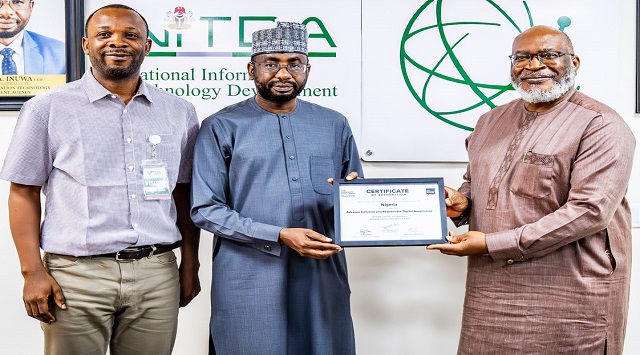
The Director General of the National Information Technology Development Agency (NITDA), Kashifu Inuwa, CCIE, has reaffirmed Nigeria’s commitment to open governance, transparency and inclusive digital development as the Open Government Partnership (OGP) team formally presented the award and certificate received at the OGP Global Summit Spain 2025 to the Agency’s leadership.

Nigeria emerged as the overall global winner in the Digital Governance category in recognition of the country’s excellence in deploying digital tools and policies to strengthen government transparency, accountability, and citizen engagement. In addition, Nigeria received the Regional Award for advancing Open Digital Governance across Africa and the Middle East, reaffirming its leadership role in promoting open government principles and driving digital transformation across the region.
These recognitions were largely attributed to initiatives led by NITDA in collaboration with civil society partners, such as Dataphyte, which showcased innovative and inclusive approaches to digital governance at the summit.
The summit, which was organised in Vitoria-Gasteiz, Spain, brought together more than 1,500 high-level representatives of governments, civil society leaders, and policymakers from around the world to exchange experiences, best practices, and progress on open government initiatives and implementation on key issues.
Receiving the OGP delegation at NITDA, Inuwa described the recognition as a national honour rather than an institutional one, stressing that the award reflects Nigeria’s collective efforts across government, civil society and the private sector in advancing open governance principles through the digital space.
According to him, such global recognition comes with heightened responsibility to deliver on commitments made under the OGP framework.
“This is not just about NITDA. It is a national recognition, and every recognition comes with responsibility,” the DG said.
“If we fail to execute the commitments we have made, it will not only affect our image locally but also at the international stage. This is also not something NITDA can do in isolation,” he added.
Inuwa linked the achievement directly to the Renewed Hope Agenda of President Bola Ahmed Tinubu, noting that digital transformation, transparency, economic diversification, job creation and efficient public service delivery remain central presidential priority areas.
He emphasised that leveraging digital technologies to deepen openness and accountability aligns with national objectives of strengthening institutions, improving governance outcomes and building trust between government and citizens.
Highlighting the importance of collaboration, the NITDA boss underscored the role of the OGP platform as a catalyst for a strong multi-stakeholder approach in Nigeria’s digital ecosystem.
He called on civil society organisations, development partners, the private sector and other government institutions to provide technical expertise, guidance and sustained engagement to ensure effective implementation of agreed commitments.
“We need to leverage the OGP platform. We need your expertise, your guidance, your support and your commitment to hand-hold us in delivering on these commitments,” he said.
He further noted that “a multi-stakeholder approach in the digital space is critical to fostering a resilient ecosystem that delivers real value to citizens.”
Inuwa disclosed that NITDA has already begun internal reviews of its OGP commitments and has tasked its representatives, including Dr Rousseau, to work with colleagues to develop a clear execution strategy.
He proposed the creation of joint work streams with OGP stakeholders to support implementation, ensure accountability and keep all parties on track.
“We are humans. Oversight and collaboration help us stay focused. With commitment, nothing is impossible, and I believe these goals are achievable,” he added, assuring the delegation of NITDA’s readiness and political will to deliver on all agreed commitments.
Inuwa also welcomed the idea of engaging the political leadership of OGP, including the Honourable Minister of Budget and Economic Planning, with a view to briefing President Tinubu on the achievement. He noted that celebrating milestones is important, as it reinforces morale and demonstrates that Nigeria’s efforts in digital governance are gaining global recognition.
“It’s also good when there are wins, we should celebrate, because we too never knew that the little things we are doing are noticed not just within Nigeria, but globally, to the extent of earning us this award,” he asserted.
He concluded by expressing gratitude to the Nigerian National OGP Secretariat and the global OGP leadership, reaffirming NITDA’s commitment to strengthening collaboration and building a more productive working relationship that will translate open governance principles into measurable national impact.
Earlier in his remark, Mr Olusoji Apampa, who led the OGP deelegation, said the honours were earned through a strong partnership between government and civil society, with NITDA playing a critical role, particularly in commitments focused on improving digital governance in Nigeria.
Apampa expressed hope that the awards would serve as added momentum to deepen ongoing commitments under NITDA’s leadership and accelerate the practical implementation of reforms aimed at strengthening digital governance across the country.

US Okays $2.1Bn for Christian Healthcare in Nigeria

Leo Stan Ekeh: A “Rare Avis”, an Unconquerable Entrepreneur

SERAP Asks Tinubu to Release CTC of Tax Bill

Tim Akano Recounts 20-Year Growth, Media Support at NITRA End-of-Year Meet

Sterling Bank, Water.org, Sterling One Foundation Partner on WASH Loan for Millions

Nigeria Records Highest Weekly Cyberattacks in Africa — Report

Cyber Tsunami Hits Nigeria as Breaches Surge 1,047%, esentry Q3 Report Reveals

GenAI Adoption Among African workers Outpace Global Peers

Jumia’s Data Shows Nigerians Turning to Digital Retail to Navigate Inflation Pressures

Minister Claims Bandits Exploit Poor Network, Bounce Calls Off Multiple Towers




 General News3 days ago
Jumia Kicks Off December Holiday Sale, Bringing Festive Deals to Shoppers Nationwide

 E-Financial3 days ago
Access Holdings Shareholders Approved to Raise N40bn Capital Through Private Placement

 Broadcasting3 days ago
NIMC rolls out Pre-Enrolment Portal for seamless NIN registration

 General News3 days ago
Dangote, Monopoly Power, and Political Economy of Failure

 General News3 days ago
OAU, Baptist Day School Oluponna honour Akano with Distinguished Alumnus Awards

 General News1 day ago
The Mood Market to Light Up Lagos with a Rooftop Gifting, Food & Lifestyle Fair this Christmas
 News19 hours ago
US Okays $2.1Bn for Christian Healthcare in Nigeria
 Broadcasting19 hours ago
Tim Akano Recounts 20-Year Growth, Media Support at NITRA End-of-Year Meet