

General News
Angry Soldiers Shoot @ GOC in Maiduguri

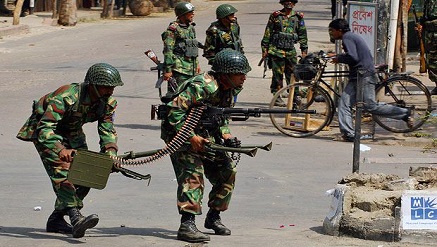
Ahmadu Mohammed, major general who is the general officer commanding (GOC) 7 Division, Nigerian Army, narrowly escaped death on Wednesday when aggrieved soldiers opened fire on his official vehicle, as he arrived to address them at the Maimalari Military Barracks in Maiduguri, Borno State capital.
Sources close to the military barracks disclosed that some troops who went to Chibok Local Government area for an operation where over 234 schoolgirls were recently abducted by suspected Boko Haram terrorists carried out the mutiny against their boss after returning to Maiduguri.
One of the sources spoke of how they were on their way back to Maiduguri when they realised that the Maiduguri-Damboa road was not safe, as darkness had set in, and then requested the GOC to allow them spend the night in one of the villages considered to be safe for them.
The GOC was said to have insisted that the soldiers must come back to Maiduguri the same night.
However, on their way back to Maiduguri, according to investigation, the soldiers were ambushed by suspected terrorists, and many of them (soldiers) were killed.
Military sources further said when the GOC tried to address troops on the ongoing operation against the insurgents, the soldiers on sighting the arrival of corpses of their deceased colleagues got angry and started shooting sporadically.
Some of them were said to have indeed intentionally opened fire on the GOC’s vehicle but that he narrowly escaped.
“What angered the soldiers most is the unnecessary deduction of their allowances and subjecting them to harsh working conditions without proper equipment to carry out their rules of engagement.
“As a result of this, many of them were being killed like rats by the insurgents,” a source noted.
A statement later last night from the Defence Headquarters said the 7 Division of the Nigerian Army is to institute a military board of inquiry into the circumstances surrounding the conduct of the soldiers who fired some shots while the GOC was addressing the troops.
The statement issued by a Major General Chris Olukolade, director, Defence Information/Coordinator, said the incident occurred when the corpses of four soldiers who died in an ambush while returning from patrol duties in Chibok was being conveyed to the morgue.
He said there is now calm in the cantonment and that all normal operations activities are ongoing .
Another report said residents of Kalabalge village also in Borno State took their destiny in their hands on Tuesday when they fought off gun-wielding Boko Haram insurgents who invaded the village in an early morning attack.
The villagers succeeded in killing several of the invaders and arrested about 10 of them alive.
The insurgents had repeatedly attempted to attack Kalabalge, an agro-nomad community near the Cameroon borders, but failed to gain entry into the village on each attempt.
Eyewitnesses said the villagers had made security preparations around the village and this has made it impossible for the Boko Haram terrorist to launch successful attacks.
The village is the headquarters of Kalabalge Local Government area of Borno State.
“We have told them (Boko Haram) that they cannot take their attacks to our village because, we have taken measures both security wise and spiritually to prevent them,” said a vigilance member in the community who did not give his name when he spoke to a news agency on phone.
“They wanted to attack us just the way they did in Bama, Konduga and Damboa, but we got the wind of it and all of us laid ambush for them; when they neared the village, we opened fire using our dane guns, double barrel rifles and bows and arrows.
“Most of them who were shocked took to their heels, but many of them died, some that were injured have been caught alive and are with the security people as I am talking to you”, said the vigilance member.
An official of the State Security Service (SSS) who pleads anonymity confirmed the incident to reporters on phone.
“The insurgents tried to attack the village as at 5.00 a.m. (on Tuesday) but the vigilante and some members of the village who got the hint of the attack laid ambush and were able to kill as many of them as possible, while about ten of them were caught alive; they also recovered two trucks from the insurgents,” the security source said.
The Boko Haram has raided several villages in Borno State, killing thousands of people and destroying countless property.
Meanwhile, security has been beefed up along some strategic roads and institutions in Akwa Ibom State following widespread suspicion that Boko Haram may launch attack.
In the last few weeks, there has been unusual heavy military presence within the University of Uyo (UNIUYO), some major roads, especially the IBB Way and some Hausa-Fulani locations, including Eka Street, Iba Oku village where the Nasarawa Livestock Market is located and other settlements.
The unusual military surveillance on Uyo was said to be informed by alleged seizure recently of large consignment of arms brought into the state in a truck loaded with cows and suspected to the sponsored by Boko Haram.
State Police Public Relations Officer (PPRO), Etim Dickson, in a telephone interview said it was the practice for Northerners doing business in the state to be escorted by securities agents.
“Intelligence reports received at this Department indicate that the University has been earmarked as one of the major targets in the event of an attack in Akwa Ibom State.
“Consequently, every member of the University community is urged to please be security conscious, observant and report any suspicious movement or thing to the security officer nearest to him or her.
“As a pre-emptive measure to safeguard the University from attack, all small gates leading into both Annex and Town campuses would be closed to all between 12 noon and 3.00 p.m. every Friday.
“Members of the University community are pleased advised to use the main gates during the period as other measures deemed necessary for the safety of the community will be communicated to you from time to time.”
—



For many Nigerians, fintech apps are judged by one simple question: Can I trust the platform? For Happiness, a young Nigerian entrepreneur, the answer manifested in the most defining moments of her life.

Trust Built Through Everyday Use
In 2025, Happiness relied on PalmPay to run her business, from receiving customer payments, paying vendors, and managing daily transactions. During PalmPay’s Hustle Grant Campaign, she joined thousands of small business owners hoping to win the N500,000 funding.
While she didn’t make the shortlist, the campaign gave her business something just as valuable: visibility. New customers discovered her brand, enquiries increased, and sales followed.
PalmPay didn’t just host a campaign; it created an ecosystem where small businesses could be seen and supported.
Just days later, Happiness’ life changed. On August 30, 2025, she lost her father. With this loss came challenges, especially payments. They tried transferring money through regular banks but were met with declined transactions. Happiness suggested using her PalmPay account and it was successful.
In a moment defined by loss and urgency, PalmPay cut through the chaos, proving that reliability isn’t a feature, it’s a lifeline. Happiness’ relationship with PalmPay didn’t stop at transactions. Through other management tools on the app, she learned to build discipline around her finances.
More Than an App, a Financial Partner
Beyond transactions, PalmPay’s tools helped Happiness build better money habits and financial discipline. Today, the brand continues to reward reliability through initiatives like its ongoing Premier Cool campaign, reinforcing a simple message: consistency should come with value.
The idea is simple: Purchase a bar of soap and stand a chance to get ₦10,000cash and other cash benefits.
It’s PalmPay’s way of saying that smart money habits deserve real value in return.
Why PalmPay Earns Trust
Life doesn’t give warnings before it tests you. When it does, you need a platform that doesn’t just usually work but always works.
For many users, PalmPay proves to be more than a payment app. It is a trusted partner powering ambitions, supporting users through defining life moments, while helping them bank smartly.
When it mattered most, PalmPay worked. To watch the full testimonial visit: @palmpayapp_ng


Google Search data from the first two weeks of 2026 reveals Nigerians are prioritising ambition, self-growth, and entrepreneurial ventures as they embrace the new year with renewed drive for personal and professional excellence.

The data shows a 40 per cent spike in searches related to self-improvement and “becoming better”, reflecting a nationwide shift from mere resolutions to actionable plans across boardrooms, classrooms, and homes. Entrepreneurship leads the charge, with “how to start a business” topping “how to start” queries after an 80 per cent surge, alongside rising interest in blogging, podcasting, and YouTube channels to foster economic opportunities.
Personal development dominates, as searches for “how to be a better person” rose 20 per cent, extending to relationships with queries on becoming better lovers, partners, husbands, wives, and listeners. Health resolutions gain traction, with 40 per cent increases in “how to eat healthy”, “healthy diet”, and “how to meditate” underscoring commitments to physical vitality and mental wellness.
Skill mastery captivates diverse audiences, from “how to improve English” and communication skills to enhancing memory, credit scores, and even handwriting, while leisure pursuits spike in “how to get better at” chess, singing, running, Fortnite, and soccer. Top searches include “how to improve communication skills”, “how to be a better listener”, and entrepreneurial starters like “how to start a podcast”, painting a portrait of a nation honing edges for success.
Taiwo Kola-Ogunlade, Communications and Public Affairs Manager for West Africa at Google, described the trends as a “powerful reflection of Nigeria’s collective ambition”, affirming the company’s dedication to tools like Search and Gemini for guiding Nigerians toward prosperity
By Blaise Udunze
The latest in the Nigerian banking sector, as banks grapple with the recapitalization compliance deadline, is confronted with a familiar yet unsettling problem that stems from rising loan defaults amid expanding credit. Data from the Central Bank of Nigeria’s (CBN’s) latest macroeconomic outlook of 2025 showed that the banking industry’s Non-Performing Loans ratio climbed to an estimated 7 percent, pushing the sector above the prudential ceiling of 5 percent.

This deterioration has occurred even as banks report improved credit availability and strong loan demand across households and corporates. At first glance of the development, the narrative seems to defy logic in a real sense. However, below this lies a deeper story of macroeconomic strain, policy-induced shocks, and, most worryingly, persistent corporate governance abuses that continue to erode asset quality from within.
To be clear, Nigeria’s current wave of loan defaults cannot be blamed on reckless borrowers alone. The operating environment has become unusually hostile. Inflation, as reported by the National Bureau of Statistics (NBS), recently suggests that headline inflation is cooling and growth indicators show tentative improvement; regrettably, more Nigerians are slipping below the poverty line, eroding household purchasing power and raising operating costs for businesses.
Especially in the small and medium-sized enterprises, though, the economic growth appears positive, but has been uneven and insufficient to offset cost pressures in this space. This has heralded weak consumer demand that has squeezed revenues across retail, manufacturing and services, causing shrinking cash flows and also loan obligations remain fixed or, in many cases, rise. In such conditions, repayment stress is inevitable.
Tight monetary policy has compounded the problem. The CBN’s aggressive rate hikes, aimed at restoring price and exchange-rate stability, have significantly raised lending rates. Variable-rate loans have become more expensive mid-tenure, and businesses that borrowed under lower-rate assumptions now face repayment shocks. Even otherwise viable firms have found themselves pushed into distress as interest expenses consume a growing share of income. Going by the official survey for the last quarter of 2025, it shows that financial pressure on borrowers has intensified as more borrowers are failing to repay loans across all major categories for both secured loans, unsecured loans and corporate loans.
Exchange-rate volatility has delivered another blow. The naira’s depreciation and FX reforms have sharply increased the burden on borrowers with dollar-denominated loans but naira income. Import-dependent businesses have seen costs surge, while FX scarcity continues to disrupt production and trade cycles. For many firms, the problem is not poor management but currency mismatch. Loans that were sustainable under a more stable exchange regime have become unserviceable almost overnight.
Layered onto these macro pressures is Nigeria’s weak business environment, which has further worsened the situation, alongside chronic power shortages forcing firms to rely on costly alternatives, logistics challenges and insecurity disrupting supply chains, and regulatory uncertainty complicates planning. More on the burner that has continued to heighten the challenges is the multiple taxation and compliance burdens, further compressing margins. In survival mode, businesses naturally prioritise payrolls, energy, and raw materials over debt service. Defaults, in this context, are often a symptom rather than the disease.
Yet while these systemic pressures explain much of the stress, they do not tell the whole story. A critical and often underemphasised driver of rising loan defaults lies within the banks themselves, most especially corporate governance abuse, which emanates particularly from insider-related lending. This is the uncomfortable truth that Nigeria’s banking sector has struggled to confront decisively.
Corporate governance, at its core, is about discipline, accountability, and oversight. In the banking context, it determines how credit decisions are made, how risks are assessed, and how early warning signs are addressed. Where governance is weak, loan quality inevitably suffers. Nigeria’s history offers painful lessons, especially the banking failures of the 1990s to the post-2009 crisis clean-up, insider lending and boardroom abuses have repeatedly emerged as central culprits.
Recent evidence suggests that the problem has not disappeared. Industry estimates indicate that a significant portion of bad loans remains linked to insider and related-party exposures. Former NDIC officials have disclosed that, historically, directors and insiders accounted for as much as 40 per cent of bad loans in deposit money banks, with a handful of institutions holding the majority of insider-related NPLs. It would be said that governance frameworks have improved since then, but enforcement gaps still persist.
Insider abuse manifests in several ways. Loans are extended to directors, executives, or connected parties with inadequate due diligence. Credit decisions are influenced by relationships rather than repayment capacity, and this has been one of the critical problems as collateral is overvalued, covenants are weak, and stress testing is often superficial. When early signs of distress emerge, enforcement is delayed, restructuring is repeated without fundamental improvement, and recoveries are treated with undue caution to avoid internal embarrassment or exposure.
The result is predictable. These loans default faster and are harder to recover. Worse still, they distort bank balance sheets by crowding out credit to productive sectors. When insiders default, the signal to the wider market is corrosive. Here, credit discipline is optional, and accountability is selective, and it further fuels moral hazard, encouraging strategic defaults even among borrowers who could otherwise repay.
Governance failures also weaken loan recovery processes. Poorly empowered risk and audit committees miss warning signs or fail to act decisively because the system has been built to fail. Legal remedies are pursued slowly, if at all. In an environment where judicial delays already undermine contract enforcement, such reluctance turns manageable problem loans into fully impaired assets. Over time, NPLs accumulate not because recovery is impossible, but because it is poorly pursued.
Compounding these internal weaknesses are government policy shifts and fiscal stress, which have become major external shock absorbers for bank balance sheets. Policy inconsistency has made cash flow planning increasingly difficult for borrowers. For instance, the sudden tax changes or aggressive enforcement drives will definitely alter cost structures overnight. Delays in government payments to contractors starve businesses of liquidity, and this will surely push otherwise solvent firms into default. In theory, although removing fuel subsidies, while economically justified, have often occurred without adequate transition buffers, transmitting immediate cost shocks across energy, transport, and consumer goods sectors.
The banking sector, heavily exposed to government-linked projects and regulated industries, absorbs these shocks directly. Loans tied to this sector showed that the banks are hugely exposed to oil and gas, power, and infrastructure; they are particularly vulnerable when fiscal pressures delay receivables or alter contract economics. For instance, a total of 9 banks’ exposure to the Oil & gas sector increased to N15. 6 trillion in 2024, representing about 94.4per cent increase from N10. 17 trillion reported in 2023 financial year. It is therefore no coincidence that NPL concentrations remain high in these sectors. In effect, fiscal stress is being intermediated through bank balance sheets.
When the CBN ended the special leniency measures known as forbearance in 2025, the real extent of loan stress in the banking industry became much clearer. For a longer time, pandemic-era reliefs allowed banks to renegotiate stressed loans without immediately classifying them as non-performing. While this helped preserve surface stability, it also masked underlying vulnerabilities. With the end of forbearance, many restructured facilities have crystallised as bad loans, pushing the industry NPL ratio above the prudential ceiling. This does not mean risk suddenly increased; it means it is now being recognised.
To the CBN’s credit, transparency has improved as the industry witnessed stricter classification rules and reduced forbearance have forced banks to confront economic truth rather than regulatory convenience. And, despite the challenges, the financial system appears to be generally sound because banks have enough cash to meet obligations and sufficient capital buffers that still exceed regulatory floors, while these buffers are under pressure. Though the ongoing recapitalisation efforts are expected to provide additional buffers.
However, stability should not be confused with health. Rising NPLs, even in a liquid system, carry real consequences. Banks must set aside provisions, eroding profitability and capital. Credit supply tightens as lenders grow cautious, starving the real economy of funding. One known fact is that the moment governance and transparency concerns grow, investors, particularly foreign ones, become less willing to commit capital and this loss of confidence eventually slows down overall economic growth.
The policy response, therefore, must go beyond macroeconomic management. While stabilising inflation and the exchange rate is essential, it is not sufficient. Governance reform within banks must be treated as a systemic priority, not a compliance exercise. Insider lending rules must be enforced rigorously, with real consequences for violations. Boards must be strengthened, not merely in composition but in independence and courage. Risk and audit committees must be empowered to challenge management and act early.
Equally important is addressing the fiscal-banking nexus. The government must recognise that policy volatility and payment delays are not costless. They translate directly into higher credit risk and weaker financial intermediation. A more predictable policy environment, timely settlement of obligations, and credible transition frameworks for major reforms would significantly reduce default risk without a single naira of direct intervention.
The Global Standing Instruction framework, which the CBN continues to promote, can help improve retail and MSME recoveries. But frameworks cannot substitute for culture. Credit discipline begins at the top. When banks lend to themselves without consequence, the entire system pays the price.
Nigeria’s rising loan defaults are not merely an economic statistic; they are a governance signal. They reflect a system under stress, yes, but also one still wrestling with old habits. If recapitalisation is to be meaningful, it must be accompanied by recapitalisation of trust, through transparency, accountability, and consistent policy. Otherwise, the cycle will repeat the same strong balance sheets on paper, weak loans underneath, and another reckoning deferred, but not avoided.
Blaise, a journalist and PR professional, writes from Lagos and can be reached via: [email protected]

PalmPay User Shares Experience on Fintech Apps to Trust in Nigeria

Stakeholders Demand Stronger Governance and Infrastructure to Drive Tech Adoption @ Lagos AI Summit

Nigerians Target Self-Improvement, Business Startups in 2026 Google Data

35 Million Nigerians Face Acute Hunger in 2026, UN Warns

How Inside Jobs and Policy Shocks Trigger Nigeria’s Rising Loan Crisis

Banks quietly move to enforce new ₦50 transfer levy from Jan. 1

Jumia CEO says Black Friday Signals Nigeria’s E-Commerce Maturity

Galaxy Backbone Celebrates the Federal Government’s Paperless Civil Service Milestone

19 Nigerian Banks Meet CBN Recapitalization Targets Ahead of March Deadline

DStv Offers Instant Package Upgrade for Customers from January to February




 E-Financial2 days ago
Zenith Bank Gets Regulatory Approval for Full Takeover of Paramount Bank

 Telecom2 days ago
MTN Nigeria Suffers 9,218 Fibre Cuts in 2025 as Vandalism, Theft Cripple Network

 E-Business2 days ago
Firm Detected a Fivefold Surge in QR Code Phishing Attacks in the Second Half of 2025

 Telecom2 days ago
New Investment Fund Targets Acceleration of Emerging Technology in Nigeria

 News2 days ago
NITDA Commits to Digital Inclusion for Persons with Disabilities

 Telecom2 days ago
NCC Licences Six New ISPs to Challenge Telcos, Satellite Giants

 E-Financial2 days ago
FCCPC Delists Non-Compliant Digital Lenders Post-January 5 Deadline

 E-Business2 days ago
JustMarkets Unveils Top 5 Trading Assets for 2026 Profits