

Telecom
Coderina, Unilag Ink MoU to Empower Undergraduates with Entrepreneurship Skills

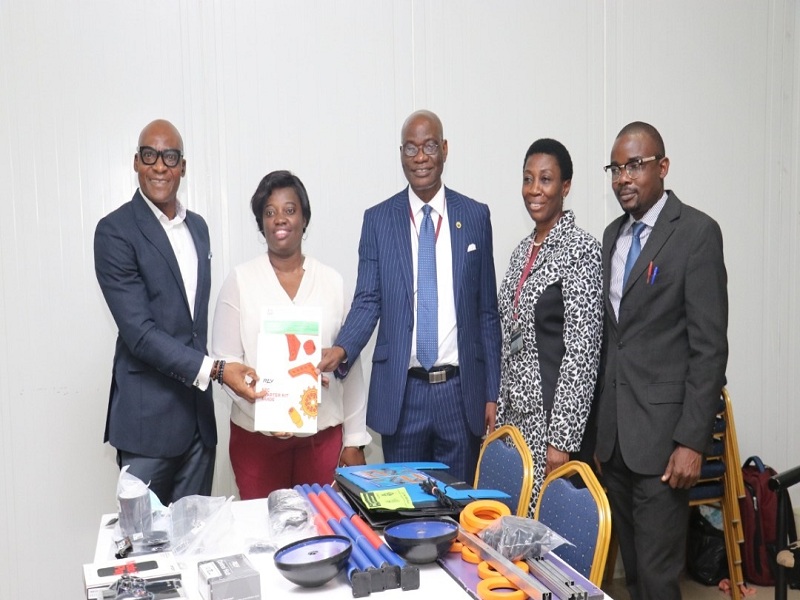
University of Lagos has partnered with Coderina; one of Africa’s top EdTech not-for-profit organizations that leverage technology as an enabler for social, economic, and gender inclusion.

Coderina lowers the barriers to entry for Africa’s youth to acquire skills and prepare them adequately for the future of work and entrepreneurship.
This partnership model promises to be successful in many areas than robotics, AI, ML Programs such as COUCH (Coderina University Challenge) will help students hone their creativity and entrepreneurial skills.
At the same time, the Coderina Project Fair will also ensure that students and researchers approach their university dissertations and research work to provide solutions to social and economic problems.
Workforce readiness and skills mismatch are issues of great national and societal importance. These need to be tackled headlong. Through this partnership, Coderina plan to democratize access to practical, experiential skills while also helping students gain competencies and lifelong skills
In signing the MOU, Professor Oluwatoyin Ogundipe, vice-chancellor of the University of Lagos, reaffirmed his confidence in this relationship as what can build enduring skills in our young adult in preparation for the future of work.
He also extolled the quality of work that Coderina is doing in partnership with the Federal Ministry of Education, introducing coding and robotics to all 104 Federal Unity Colleges.
The VC stated that “Addressing Africa’s skills gap in the age of technology would require bold steps to be taken in the area of capacity building”
Ogundipe stressed further quoting the World Economic Forum, “The root of unemployment is not only a lack of jobs; a key underlying issue is also the inadequately educated workforce. And this challenge is likely to be amplified in the coming years due to the Fourth Industrial Revolution, characterized by fast-paced technological progress combined with other socio-economic and demographic changes, which will further transform labor markets.” Hence the time to start to address skills shortages is now.”
Speaking at the event, Dr. Chika Yinka-Banjo, lead/coordinator of the University of Lagos AI & Robotics Lab (AiRoL), enthused at the prospect and potential of the collaboration.
She stated that the benefits of the relationship are already far-reaching. Coderina has donated some robotics kits to the lab, provided training, and has already prepared young learners for the FIRST Lego League Championship, a World Robotics Challenge, and now put together a UNILAG team for FIRST Tech Challenge. This partner will not only benefit the University, but it will also help create an outreach program for youth in the neighboring underserved communities.”
On his part, Dr Sunday Adebisi, Director of the Entrepreneurship and Skills Development Centre (ESDC), welcomed the University of Lagos’s relationship with CODERINA through the AI-Robotic Lab and ESDC as a development that will enable the students build rare and competitive skills of the future for decent jobs.
He said given that this generation will have to change careers more than ten times in their lifetime, as a result of many jobs that will go into extinction and other ones that will be birth, there is no better time than now that this quality relationship that supports students to build AI skills should be consummated.
The director said: “I am optimistic that our students with the present training arrangement will become globally competitive in employability opportunities, job creation, and entrepreneurship development.”
According to the Founder of Coderina, Mr. Ajayi, “This partnership brings a unique dimension to academia-third sector collaboration where both organizations mutually benefit through research, knowledge-sharing and practical execution on research findings in the field of robotics, drones technology, AI, entrepreneurship, solve practical problems and unlock vast potential for impact at scale.”



Association of Licensed Telecommunications Operators of Nigeria (ALTON) has declared support for the Nigerian Communications Commission (NCC’s) push to promote local smartphone manufacturing in the country.

Gbenga Adebayo, chairman, ALTON,
The News Agency of Nigeria reported that ALTON described the move as a practical measure capable of accelerating broadband adoption and expanding digital inclusion across the country.
Gbenga Adebayo, chairman, ALTON, made the remarks to newsmen on Saturday while reacting to comments by Idris Olorunnimbe, chairman, NCC Board, who had earlier called for local smartphone production and innovative financing models to address Nigeria’s digital inclusion gap.
Adebayo said Nigeria must intentionally transition from being predominantly a technology consumer to becoming an innovator, designer and manufacturer of digital technologies, pointing to the country’s large telecommunications market and youthful population as the scale and human capital needed to support world-class manufacturing.
He said Nigeria’s ambition in local manufacturing should extend well beyond simply assembling imported components into finished devices.
“Our ambition should extend beyond assembling devices. We must pursue genuine knowledge transfer, research and development, product engineering, software development, semiconductor capabilities and large-scale manufacturing,” he said, adding that the goal should be producing devices and digital technologies for Nigeria, Africa and the global market.
Adebayo explained that the emergence of artificial intelligence has further strengthened Nigeria’s opportunity to become a competitive technology manufacturing hub, noting that AI is transforming product design, manufacturing, quality assurance, supply chain management, customer experience and software innovation.
He said investing in AI-enabled manufacturing would improve productivity, create high-value jobs and strengthen Nigeria’s competitiveness across Africa.
On tackling counterfeit and non-type-approved devices, Adebayo described the grey market as a major challenge affecting consumers, original equipment manufacturers and the wider telecommunications ecosystem.
He said robust local manufacturing backed by strong quality standards would provide credible alternatives to grey-market imports.
“This will strengthen consumer protection, improve network performance, retain greater value within our economy, and stimulate industrial growth,” he said, while also endorsing innovative smartphone financing, stronger device management systems and identity-enabled credit frameworks to help more Nigerians afford quality smartphones.
Adebayo said telecom operators remain ready to partner with government, manufacturers, financiers, academia, investors and development partners to build sustainable local manufacturing capacity in Nigeria.


Ayotunde Coker, managing director, Open Access Data Centres has reiterated availability of abundant capacity and world-class infrastructure in key data centres in Nigeria.

This is coming against the backdrop of the Central Bank of Nigeria (CBN) directive to banks, fintechs, mobile money operators, and other payment service providers to host their payment transaction data generated within Nigeria on local servers from January 1st, 2027.
Mr. Coker made the assertion at a media interactive session on readiness of major data centres in the country such as Open Access Data centres to effectively host financial sector data.
“As far as readiness is concerned, we have the co-location base, the co-infrastructure basis, and interconnection capability. Indigenous cloud companies are building out, such companies like Unicloud Africa, Layer 3 within the data centres, adding cloud capability, and providing cloud solutions to local companies.
“The other key thing with the directive is that it sends a signal to the world that data sovereignty localization is key. And will also trigger the global providers to bring their own scale of cloud in here in time, which is good for building our digital infrastructure scale”.
The CBN directive signed by the Director of the Payments System Supervision Department, Rakiya Yusuf, also introduced new market structure rules, beneficial ownership disclosure requirements and systemic oversight measures for payment service operators.
According to the apex bank, the reforms became necessary following the rapid expansion of electronic payments and digital financial services across the country.
The CBN said it had observed “significant structural developments within the Nigerian Payments ecosystem, characterized by rapid growth in electronic payments, increasing adoption of digital financial services, and the emergence of operators with substantial market presence across key payment activities.”
It noted that while the growth had improved innovation, efficiency and financial inclusion, it had also created concerns around market concentration, operational dependence, ownership transparency and the storage of critical payments data.
To address these concerns, the regulator ordered all financial institutions facilitating payments in Nigeria to ensure that transaction data generated within the country are stored domestically.
The circular stated, “All Financial Institutions and participants facilitating payments within Nigeria shall ensure that payments transaction data generated within Nigeria are stored and managed in Nigeria in accordance with data protection laws and regulations applicable in Nigeria.”
It added that “all affected Financial Institutions shall fully comply with this requirement effective January 1, 2027.”
The move is expected to strengthen regulatory oversight, enhance data sovereignty and ensure that sensitive payment information remains within Nigeria’s jurisdiction.
It also aligns with broader efforts by regulators globally to localise critical financial data and reduce reliance on offshore infrastructure.

Nigeria’s telecommunications sector recorded further growth in April 2026 as active mobile subscriptions increased to 188.01 million, while broadband penetration rose to 55.67 per cent, according to the Nigerian Communications Commission (NCC).

The latest industry statistics released by the commission showed that active telephony subscriptions rose to 188,009,171 in April from the previous month’s figure, raising the country’s teledensity to 86.73 per cent from 85.67 per cent recorded in March.
The report indicated sustained expansion in access to telecommunications services, driven by increasing demand for mobile voice and data services across the country.
According to the NCC, MTN Nigeria retained its position as the largest operator with 96,391,419 active subscribers, accounting for more than half of the country’s total mobile subscriptions.
Airtel Nigeria followed with 64,670,018 subscribers, while Globacom recorded 23,178,597 subscribers.
9mobile had 3,538,021 active subscribers during the period.
The commission’s data also showed continued migration by consumers to faster broadband technologies.
It said fourth-generation (4G) technology remained the dominant mobile network platform, accounting for 54.41 per cent of total network connections in April, up from 53.76 per cent in March.
Similarly, fifth-generation (5G) technology continued its steady growth, with market share increasing from 4.20 per cent in March to 4.34 per cent in April.
However, the share of second-generation (2G) subscriptions declined to 35.93 per cent from 36.74 per cent, reflecting a gradual shift away from legacy networks to higher-speed broadband services.
The report added that the third-generation (3G) segment remained relatively stable, accounting for 5.32 per cent of total connections compared with 5.30 per cent recorded in March.
It further showed that of the total subscriptions, 154,347,260 were on mobile GSM networks, while fixed wired internet subscriptions stood at 156,662.
Voice over Internet Protocol (VoIP) services accounted for 220,166 subscriptions.
The NCC also reported significant growth in broadband subscriptions, which increased to 120,684,625 in April from 117,710,397 in March.
Consequently, broadband penetration improved to 55.67 per cent from 54.30 per cent recorded in the previous month.
The commission attributed the increase to continued investment in broadband infrastructure and growing adoption of high-speed internet services by households and businesses.
Despite the growth in broadband subscriptions, total internet data consumption declined slightly during the month.
According to the report, internet usage fell marginally to 1,414,848.70 terabytes (TB) in April from 1,422,764.54TB recorded in March.
The report suggested that while more Nigerians were gaining internet access, overall data consumption remained relatively stable.
The NCC noted that the telecommunications sector continued to play a critical role in the nation’s economy, contributing 9.19 per cent to Nigeria’s Gross Domestic Product (GDP) in the first quarter of 2026.
It added that sustained investment in broadband infrastructure, wider deployment of 5G networks and improved quality of service would further accelerate digital inclusion, innovation and economic growth in the country.

FCCPC Dismisses Report Claiming Approval of 48 New Loan Apps

ALTON Backs NCC’s Local Smartphone Manufacturing Drive to Widen Digital Access

LASTMA Launches 3367 Toll-Free Hotline for Emergency Response, Traffic Management

PalmPay Calls for Trust, Infrastructure and Responsible AI to Drive Payment Ecosystem Innovation

OADC Reaffirms Abundant Capacity in Data Centres in Nigeria to Host Financial Data

London Strengthens Global Investment Ties with Africa @ First Ever London-Africa Business Summit

Mobile Internet Gender Gap Widest in Africa – GSMA

FG Targets Alleged N3tn Capital Flight, Opens Airtime Credit Market to Nigerian Fintechs

Japan, UNESCO Boost Digital Learning in 15 CoEs with Donation of ICT Equipment

African Electric Vehicle Platform Raises $215m to Scale Electric Mobility in Nigeria, Others




 General News3 days ago
Tinubu appoints Adigwe to head National Health Technology, Data Analytics Office

 E-Financial3 days ago
Paystack Unveils AI-powered Payments Tools

 E-Financial3 days ago
Fidelity Bank Wins DBN Award for Expanding First-Time Credit Access to MSMEs

 E-Financial3 days ago
NRS, CITN Deepen Partnership to Strengthen Tax Awareness

 General News3 days ago
PalmPay Strengthens Data Protection Culture with Employee Privacy Workshop and Privacy Champions Programme

 E-Financial3 days ago
FCMB Turns Normal Banking into Rewards with New Mobile App Upgrade

 Telecom3 days ago
Meta, FG Unveil New Safety Measures to Protect Nigerian Teens Online

 E-Financial3 days ago
Despite Warnings, FG Draws Down $1.5Bn as First Tranche of FAB $5Bn Loan Deal