

General News
Cost of Broadband to Crash in 2014-Aladekomo

Benjamin Ademola Aladekomo is immediate past president, Nigeria Computer Society (NCS); and group managing director, Chams Plc: a company he established immediately after his MBA program in 1985 with next to nothing, in terms of finance.
Chams pioneered and currently dominates Identification and payment technologies for governments, financial institutions and corporate Nigeria and owns famous Digital Mall: biggest ID/Payment Card personalization plant in the world. It produced the first successful one million national ID cards where foreign companies and multinationals have failed over decades.
His company also produced 70 million voters ID cards for INEC and created the largest database towards solving the country’s election Voter ID database.
Aladekomo, spoke to peter ugwu on national IT related programmes and sundry issues.
Driving Force behind Chams Plc
What has been driving us is our faith in God; believe in ourselves and our country. Our vision calls from that and our core value “Faith in God”.
Chams become a household name in computer hardware and maintenance services. The company went through the processes of networking, identification, systems repairs; and today it is highly regarded in identity management and payment systems.
We service practically all the sectors of the economy and we have a lot of companies passing through us.
Like we have always maintained, our envisioned future depends on being extremely influential and highly visible in global technology as our trusted cutting edge technology will enhance the quality of lives in a manner that glorifies God.
Cards and e-Payments Campaign
Long before CBN started, we have been campaigning for the use of PoS terminals and other electronic devices in transacting businesses.
Chams was the first company to deploy about 2, 000 PoS terminals as way back as 2002-3.
We were the first to have a large concentration of cards production; bring in kiosks into the market; and in several areas.
In terms of identity management, we are the leading indigenous company in Nigeria.
Even in e-Commerce, we have tried to stabilize our stand in that area.
Value card added platform was done by the Chams and deployed to the banks for use.
They are quite a lot we have done in popularizing e-commerce and e-payment in the country. The first call fund transfer company was formed and implemented by Chams. The first ATM in Nigeria was printed Chams.
Is Government doing enough in E-Payment?
I believe the government is doing its very best in formulating policies and implementing them, especially from the CBN’s perspective.
They have done a great job by coming up with policies that will reduce the volume of cash and improve on the way business is done in the country.
Although someone may ask, is that the best they can do; possibly not. We should not forget that they are leapfrogging; jumping several levels of technology, and is not easy to implement.
One thing about Nigerians is that we are a nation in a hurry. We want a policy introduced today to meet 100% request the same day.
For us in Chams Plc we do not expect a miracle to happen overnight. Nations are built to last for centuries, likewise companies.
Policies should be there to last for a while before they are changed. If you assess the cashless policy from that perspective it cannot cover the whole country from day one, not all devices will work form that date, not all the ATMs, cards, PoS will work at kick off period, but if you stay at it, keep a healthy perception, attitude towards the events they will determine how far you can reach. With the right attitude towards the scheme it is going to succeed.
Cashless Policy Succeeding
We have improved dramatically in the number of ATMs, Cards, PoS terminals and volume of transaction.
I can authoritatively tell you that before the cashless economy started we had about 20,000 PoS terminals.
Currently, we have more than 170,000. And that is the kind of percentage increase; if you look at the volume of transactions by e-channels, they have increased by 100%. Mobile banking has also received a boost; likewise the e-commerce is becoming a germane on its own.
Challenges with the Implementation
The basic challenge is communication-broadband access or universal access; yes, voice communication is stabilizing now, but data communication is not doing very well.
And that has affected the cashless programme in the sense that a lot of PoS machines are not working as expected.
In any case, we have witnessed tremendous changes in all the areas. Also, a lot of people are not using the channels like the PoS, what I said earlier about technologies coming to particular environment is that literacy, affordability and need should be considered.
If you take the issue of literacy and need, a fruit seller along the road may not see the need or benefit. So, cashless or no cashless at the level, the need is not there, the volume of trade is still is quite low. If we look at Cards users, banks customers across the country are about 45 million.
Minus that from 160 million, the rest are without cards. That is basically the issue and reason the PoS terminals will take some years to become permissive.
Literacy, I must highlight is in two levels. There is literacy in terms of communication to (educating or informing) the people, that they can adopt PoS even for a business that involves N20. But that means the operators have to reduce the charges.
Other hand, there is literacy that involves people going to school, studying and becoming educated. The processes will take time, but we shall get there as a nation.
And technology adoption also take a while, like the ATM, it took a while for people to buy into it. Now a lot of people are comfortable with it. But the number is still far-fetched as regards people with bank accounts.
As a Member of the National Broadband Committee
The Committee was inaugurated recently and the terms of references are to lead in the measure to deploy broadband to all the nooks and crannies of the country.
The Committee will first ensure we have backbones to facilitate the implementation; by getting Right of Way (RoW), the incentives from government to aid the operators, and reliefs, invite investors as well.
When those things are done combined with patronage and support to investors, the next step would be massive literacy campaign for the usage.
There will be road-shows to all the states in the country. There will be communication to corporate bodies, private sector, and anybody that needs to embrace the technology.
In saying this, I must commend the Mrs. Omobola Johnson, minister of Communication Technology for all the work that she is doing, especially in the area of broadband policy.
Estimating That Penetration Would Crash Prices
We have close to 10000 terabyte of bandwidth at the shores of Lagos, out of which 10% has been distributed.
There are lots being implemented now. With this committee coming up, the processes are going to be accelerated.
I see that towards the end of 2014, there would have been substantial broadband penetration into the rest of the country; where some State capitals would have major bandwidth delivered to them to the extent it will affect the price.
Meanwhile, I cannot bet that it will get to the rural dweller, who may not have the need for it. The most important thing is to spot out the need and affordability.
Because of the huge bandwidth coming I see prices crash in 2014 affecting the voice tariffs also. In 2014, we are going to witness enormous crash of those tariffs.
From 2015 we are going to be seeing a lot of hotspots that will even be free in certain areas. These are as result of the implementation of the national broadband plan.
I like sharing the progression: two-three years back when you go to some hotels, just a handful of then had access to data communications.
And how many offices had access to it? Now it is becoming more democratized. Also, in the past for you to have access you need a big modem to get connected, but now it is becoming more wide spread.
The broadband council is now focusing connecting all major cities in the country targeting 2015. The plan includes the 774 local governments’ headquarters.
Once you have gotten to that level, it implied that the 1000 terabytes would have been deployed. So, as supply outweighs the demand, the prices will crash.
Financing the Deployment
Mainly, 91% funding of the project will come from the private sector, while the government provides the rest.
And the government has started working by developing a National Integrated Projects Master plan. Making broadband available is one of the objects driving the plan.
Foreign Direct Investments (FDIs) or Locally Driven
Most FDIs have local counterparts and funding. Nobody brings 100% funds into a country. They may invest as high as 80%, but the local complement must be there. The local investors have the first right of refusal; they are the ones preparing the policies, know the pulses. For instance, the telecos in Nigeria have Nigerians as their chairmen, meaning they are investors in the business. So, they are going to benefit.
Criticism of FG’s Decision to Involve MasterCard in the National ID Scheme
I must say that Chams Plc is fully involved with the National ID project. We have a company called Chams Consortium Limited; one of the two potent parties in the project.
The Consortium is made up of three companies that came together to implement the scheme. However, Chams Plc is the technical operator within the consortium, providing 95% of the technologies used by the group for the project.
Our functions range from enrollment, cards personalization, payments and verification services.
These are called potent services. We have the back up where the data are kept.
In 21 States of Nigeria, Chams Plc will be doing enrollment. 50% of the Cards will be issues by Chams consortium.
The payment mechanism on the cards will also be operated by Chams Plc.
With regards to federal government’s partnership with the MasterCard, which several people have criticized, we do not believe such agreement would have been signed.
MasterCard signed an agreement with Chams, we took them to the federal government and government went and signed another agreement with them.
That is called tautology; it is uncalled for. We already have the concession agreement signed between us and the federal government and between us and MasterCard.
We do not know what the agreement between the federal government and MasterCard is all about.
We are going ahead to deploy as designed by us and accepted by the Government. Our design is what the government is implementing.
I have a feeling that the government because they have a problem with the first consortium they want to become potent processor themselves.
Government has no business in business. We should use PPP to fund national infrastructure restoration.
Look at the beautiful thing happening among the telcos; where is NITEL? Now the government wants to toe the line of NITEL.
They should leave the national ID to the private sector to implement, while playing supervisory role.


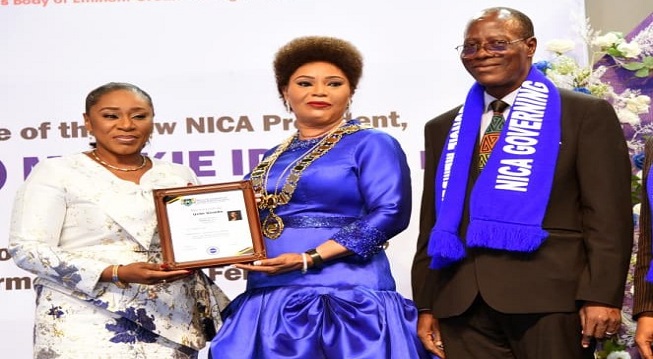
The National Institute of Credit Administration (NICA) has conferred its Professional Fellowship on Mrs. Uche Uzoebo, Managing Director of Shared Agent Network Expansion Facilities (SANEF).

The recognition was announced in Lagos during the investiture of Dr. (Mrs.) Markie Idowu as the Institute’s new President.
In his welcome address, Prof. Chris Onalo, Registrar/CEO of NICA, noted that the National Institute of Credit Administration distinguishes itself from other professional bodies through its unwavering commitment to advancing credit management, promoting professionalism, and empowering Nigerians with credit literacy.
“Unlike many other institutes, NICA recognizes that credit management is a lifeline of commerce, influencing every aspect of business, social, and economic life. Through this commitment, the Institute continues to shape Nigeria’s economic future towards sustainable growth,” he stated.
The Fellowship represents the Institute’s highest professional distinction and is conferred on individuals whose leadership has significantly strengthened Nigeria’s credit environment, institutional governance frameworks, and the integrity of the financial system.
This recognition also comes at a significant moment globally as the world commemorates International Women’s Day, underscoring the growing recognition of women’s leadership and contributions across industries, particularly in finance, governance, and economic development.
The ceremony brought together senior financial sector executives, policymakers, regulators, and distinguished guests to celebrate excellence in credit administration and professional practice.
The Institute described Mrs. Uche Uzoebo as a seasoned business executive and financial services leader with over two decades of professional experience spanning banking, digital payments, and financial services.
A proven change agent, she brings deep expertise across digital payments, financial inclusion, agency banking, product and business development, merchant acquiring, as well as corporate, commercial, and retail banking.
Her leadership has been instrumental in advancing secure and inclusive digital financial services, strengthening payment systems, and expanding last-mile access to financial services across underserved communities in Nigeria.
Through SANEF and related initiatives, she has supported economic empowerment and financial inclusion by expanding agent networks, promoting financial literacy, and championing innovative technology-enabled solutions.
Passionate about gender inclusion and women’s economic empowerment, Uzoebo is also a gender specialist and advocate with a strong focus on supporting women entrepreneurs and breaking structural economic barriers.
As a certified trainer, she designs and delivers high-impact capacity-building programmes for individuals, youth, women, and organizations, enabling sustainable growth and improved performance.


Zedvance Finance Limited, a leading provider of consumer and business financing solutions in Nigeria, has disbursed over ₦96 billion in funding to support commercial businesses across the country, establishing its strong positioning beyond retail lending and reinforcing its commitment to bridging the gap between enterprise growth and access to timely financing solutions.

Zedvance
Leveraging its 11-year legacy, Zedvance’s Commercial Solutions business, launched in 2025, has in just one year become a major driver of credit expansion, achieving one of the highest loan disbursement rates among financial institutions, empowering thousands of local enterprises and boosting economic growth.
The business has consistently supported enterprises across key sectors of the economy, including oil & gas, automotive, logistics, renewable energy, fintech, e-commerce, trade distribution value chains, agri-businesses and others.
Through offerings such as working capital, invoice/PO financing, equipment and trade finance, and ecosystem-based solutions, Zedvance enables access to liquidity for buy-now-pay-later providers, asset acquisition, and cross-border credit lines for imports & exports, aiding business expansion and strengthening operational resilience in a dynamic economic environment.
Speaking on the importance of flexible and tailored financing, Group Managing Director of Zedcrest Group, Adedayo Amzat, CFA, noted that Zedvance Finance, operates a model that is specifically purpose-built to bridge financing gaps and support business growth.
“We are proud of our accomplishments so far, especially the impact we’ve made in sectors that are critical to economic development. For instance, through solar and asset on-lending, we have helped to expand energy access and improve income opportunities for gig workers by financing mobility asset platforms across Nigeria.
“Because our customers are at the heart of our business, we were intentional about designing our flagship product, ‘Liquidity Solutions’ to allow businesses unlock faster credit delivery across all high-growth sectors. This has proven impactful as we continue to witness our clients record great successes,” Amzat said.
Highlighting the unique value of the offering, Amzat added that Liquidity Solutions provides tailored financing structures such as inventory purchase, invoice financing, and import financing, which empower businesses to optimise cash flow, accelerate turnover, and scale with confidence.
Commenting, Ayooluwa Oladimeji, Ag. Executive Director, Commercial Solutions, explained that Zedvance leverages technology, product innovation, deep sector expertise and risk-moderated structures to deploy diverse funding solutions, including multi-currency credit lines, BNPL facilities, and equipment financing across automotive, renewable energy, manufacturing, fintech, and trade distribution sectors.
“In 2025 alone, Zedvance Commercial Solution business recorded tremendous growth, driven by strong partnerships and a rapidly expanding portfolio.
“We are proud to have supported a range of businesses including; Shekel Mobility, Tradegrid, Sapphire, CredPal and other ecosystem partners.
“Beyond these successes, our focus remains on strengthening credit access across Africa’s commercial ecosystems to enable businesses scale with confidence and resilience”, he said
Building on its strong momentum, Zedvance is poised to expand its reach further in 2026, targeting over ₦250 billion in funding across key economic sectors including off-grid power, smart devices and home equipment, vehicle dealerships and mobility platforms, agribusiness and manufacturing, consumer and industrial goods distribution and hospitality.
This expansion reinforces its mission to accelerate enterprise growth by providing faster and broader access to credit across Africa.

As the world marks International Women’s Day, Mojisola Sayo-Kazeem, Head of Finance, Jumia Nigeria & Ghana, reflects on how giving opportunity, mentorship, and support helps women thrive and strengthens organisations.

The future of work is digital, and for women it presents immense opportunities to innovate, lead, and shape the global economy. Yet thriving in a fast-paced, data-driven environment requires more than ambition or technical expertise. It requires opportunity and leadership that intentionally creates space for people to grow.
Reflecting on my own journey, I am reminded of how powerful those opportunities can be. I joined Jumia in 2012 as an accountant and, over time, grew into my current role as Head of Finance for Nigeria and Ghana.
Each stage of that journey came with new responsibilities and lessons that shaped my leadership perspective. One thing has become clear: growth rarely happens in isolation. It flourishes in environments where people are trusted, challenged, and supported to reach their full potential.
One of the most defining pillars of my career has been working within an organisation that invests in talent and encourages merit-based growth. At Jumia, a guiding principle is simple: let the best people and ideas grow. When organisations prioritise capability and innovation rather than bias, they create environments where individuals can thrive, and leadership potential can emerge naturally.
Leadership plays a crucial role in making this possible. Good leadership sharpens growth and experience, not only for the leader but for the teams they support. I have benefitted from leaders who shared knowledge, offered guidance, and entrusted me with meaningful responsibilities. Those opportunities challenged me to expand my skills, strengthen my judgement, and grow into larger leadership roles.
One experience that stands out was leading my team through the launch of a new business line under the guidance of our CFO. It demanded greater accountability, transparency, and strategic thinking. Looking back, it was more than a professional milestone, it was an opportunity to deepen my expertise and strengthen my leadership capacity.
Moments like these remind me that opportunity is one of the most powerful investments leaders can make in people. I also recognise and commend the many leaders who are already creating pathways for women to grow, lead, and contribute meaningfully. Their commitment to fairness, mentorship, and inclusion continues to open doors for others.
But there is still more to be done. As we mark International Women’s Day, this year’s theme, “Give to Gain,” invites leaders to reflect and to act. It challenges us to go beyond good intentions and intentionally create opportunities for women to grow and thrive based on merit, not favouritism or bias. This means sharing knowledge, investing in development, offering mentorship, and trusting capable women with meaningful responsibilities.
When we do this, we strengthen the people and institutions around us. Teams become more confident and capable, organisations become more resilient, and leadership pipelines become stronger and more diverse.
This year’s International Women’s Day theme, Give to Gain, reminds us that generosity is not subtraction, it is multiplication. When people, organisations, and communities give time, knowledge, visibility, advocacy, and support, opportunities for women expand. And when women thrive, industries, economies, and societies thrive with them.
When we give, we gain. The question for all of us is simple: What will you give to gain gender equality?

Africa Startups Raised $272m in Funding in February

First Asset Management Secures Ratings Upgrade

NICA Confers Professional Fellowship on Uche Uzoebo

Starlink Rolls Out V2 Satellites for Direct 5G Connectivity to Smartphones, Eyes Nigeria’s Rural Gaps

Madonna University Taps Tech Guru Adote for Strategic Board Role

Dr. Cairo Ojougboh Foundation Bolsters Nigeria’s Education Drive with ₦2.7m Student Support

Kaspersky Brings more Transparency to Threat Detection with New Hunt Hub

Kaspersky Discovers New Phishing Campaign Exploiting Google Tasks Notifications to Steal Corporate Credentials

esentry 2025 Report Shows Healthcare, Financial Services and Telecoms as Staging Grounds for Increased Cyberattacks in Africa

AfDB, UNDP Launch $10Bn AI Initiative for Africa




 Telecom2 days ago
Dimension Data Nigeria Seals N20bn Bond Deal to Bridge Digital Infrastructure Gap

 Telecom2 days ago
First Batch of Nigerian Undergraduates Emerged in Airtel Africa Foundation Scholarships Programme

 E-Business2 days ago
CBN Affirms Alpha Morgan Bank’s Capitalisation

 E-Financial2 days ago
Polaris Bank Marks IWD2026 with Renewed Pledge to Women’s Empowerment

 General News2 days ago
Mojisola Sayo-Kazeem Reflects on Leadership, Opportunity, Women in Tech @ IWD

 General News22 hours ago
Zedvance Hits ₦96bn Lending Milestone, Eyes ₦250bn Target in 2026

 General News2 days ago
Experts Weigh Blockchain Option for Nigeria’s Elections Process

 News2 days ago
EFCC Seals Anti-Corruption Alliance with Anambra Security Chiefs, Traditional Rulers