

General News
Courier Service is Capital Intensive -Chinekezi

Mr. Larry Chinekezi, is managing /CEO of Tradeways Express, the largest indigenous independent courier company in Nigeria today
He is a recipient of many awards for outstanding contributions to the growth of the communications industry and has demonstrated high sense of accountability, integrity and transparency in his public and private life. Chinekezi has over 21 years experience in the courier industry and was once the managing director of TNT/IAS Express before leaving for Tradeways Express.
Independent Regulator for the Sector
So much has been said in that direction in the last three years. We have presented papers and have met with the Minister of Information and Communications and other stakeholders on that. We have presented papers to them and the Bureau of Public Enterprises (BPE) had in few occasions called stakeholders meeting where we dialogued over this issue and papers presented to the problem were harmonized. BPE is anchoring the process and I do know as I speak that the matter is in the National Assembly now. It is left for them to go on with their legislative function. We have been expecting that the public forum would have been called by now by the National Assembly so that people can defend their proposals and have the opportunity to say their minds. I can tell you right now that all the stakeholders have agreed that it is desirable but when it will actualize, I cannot tell.
Document Favouring Nipost
We are talking about privatization here and we do believe that the BPE people are well informed just as you said they are partnering with an international consultancy firm who knows what to do and even the publications we made gave our own input into the matter. We expect that when the document comes out, it is a document that will take care of every input made by all the stakeholders. So it is not going to be something for Nipost alone because we have said very clearly that it should not be something that will give birth to monopoly. it should not turn a public institution into a private monopoly. It has to be something that will take care of the interests of Nigerians. Just like when the telecom sector was liberalized, every body saw the system open up and nobody had any negative thing to say about it. So we expect to go the same way. We have no fear at the back of our mind that BPE will do the right thing.
Involvement in Illegal Drugs Business
No licensed courier company worth its salt will want to mingle with fraudsters. But looking at the other way round, it is human being that carry drugs and they must use the normal channel of movement and you see them being caught more often than not trying to board one international flight or the other. The owners of the airlines on their own wouldn’t want to accommodate the drug traffickers but for the fact that they do it without the airliners knowing makes it difficult for the airliners. The security operatives at the airport now know how to catch them in their game in the past if somebody has used a courier firm to move drugs, it does not mean courier companies have started to partner with drug barons or 419 people. It does not happen that somebody can use the system without the knowledge of the operator. That is why you have the NDLEA operatives manning major courier companies here especially those that have international consignments. They are also at the airport to ensure that every export material is screened. So that way, I am sure they will be able to catch anybody who abuses the system.
Areas of Reform by Tradeways
Well, there have been challenges with the economy going up and down. The reform is geared towards ensuring that we can absorb shocks arising from negative turn around in the economy. If you look at the existing infrastructure in the country, sometime ago Nepa was almost nonexistent and we had to rely solely on our own electric power generation because we needed to use energy to power our computers and reach our customers on line. The roads are also very bad and the airlines are not working as they used to. Courier service is synonymous with all services. Then, 95 percent of courier materials used to move by air but now the reverse is the case. About 5 per cent of courier materials are moving by air while 95 per cent are moving by road. That is why you have to look at that area and ensure you have seamless operation, which is the area we have focused on to ensure that we don’t only have the right system but also the customers. We initially focused on courier but as our business began to expand, we felt the need to invest more into cargo and international freight and that means having more cars, more professional staff coming in. Our staff strength has increased and as we continue to expand, it will keep increasing. The cost of doing business has gone up so much that we no longer talk about bottom-line, we are talking about survival in the face of difficulties. We are eventually doing everything by ourselves. The ones government used to do before, they are no longer doing them. So we have to employ staff and train them regularly. That is part of our expansion programme.
Level of Investment in Courier
Level of investment in courier is very poor compared with level of investment in the telecommunications sector. That is why we are hoping that the new regulator that is being expected will look more into professionalism rather the ability to issue licenses. Paying one million naira to acquire the license does not mean that somebody is ready to offer courier service as it should be. There is high level of investment required. Courier service requires enormous amount of money to run and when somebody does not have such huge amount of money to run the business, he can hardly create awareness. Over there, as it should be, supply chain management has improved so much. Companies no longer own warehouses where they stock their goods as they produce, courier companies, logistics companies go to the production line to pick up these goods as they come out and move them to places where they are needed in the distribution channel, and even warehouse for them so that when the goods are needed as required by their distributors, wholesalers and consumers, they can distribute from those end points. It is no longer the situation where for instance, you have Cadbury moving their goods from Lagos to all parts of the country. This will require Cadbury having large fleet of trucks to be able to do that . but you now have a logistics company that is supporting them. As these goods are coming out, they are picking them and distributing them. Manufacturing companies don’t have to buy trucks and opening warehouses all over the country. They rely on our logistics and then have the opportunity to focus on core business of production and it reduces a lot of cost for them. The kind of investment we are making is geared towards ensuring that we have what it takes to undertake such logistics services to the manufacturing sector and other sectors that require it.
Any Plans for Franchising
Oh yes and that‘s an area we are looking at. At the moment, we are still in the drawing board, we have not finalized arrangements. It’s an area we are looking at to be able to get the business closer to the people, even those in the hinterland/ we don’t have to go opening up offices and equipping them when there is somebody there ( a local person ) that can run it successfully. All we need do is to give him the backbone, the professional support and know how and ensure that standard is available there and service is seamless. So we are looking into that and that is part of how we want to achieve our goal of becoming the leading logistics courier company in Nigeria
Ensuring Quality in the Arrangement
It is just like having an agency of a telecom company. They provide the backbone. On your own, you don’t have to switch a network and all that, you are just an outlet. You have the manpower and the location. In every other thing, you still work through them. In the same way, you will just have an outlet there and our network is extended to that place. So we can still pick up and deliver.
Competition in the Industry
In every business, there are always market leaders. It so happened that the so called foreign courier companies are part of the market leaders. So market leaders always determine the way market is done in a particular sector. Again, I said something about investment, if you have what it takes to compete with these people, of course, you can , but if you don’t have, you cannot be like them. When we started in 2002, we said we wanted to compete with the biggest in the industry and we set out and opened 37 offices in all the thirty six states of the federation the same day plus Abuja. So, on day one we opened, we had branches in all the states. We never gave anybody to deliver for us. The same also across the country. We also secured our international relationship so that our mails outside the country can be delivered using our own network without using anybody within the country and I can tell you that the first mail we handled when we started was an international mail that went to Bangkok, Thailand and it was delivered in three days and that gave us the impetus that we had a good future. It was a test case just like when a telecom company comes up and they do their test run.. In fact our feat brought about change in the courier service. We came with a bang and sold the idea to courier companies that operated that time that things could be done in a better way and you can see what has happened in the last six years.



Kaspersky has detected a wave of phishing attacks preying on former customers of the bankrupt crypto lending platform BlockFi.

These scams leverage the ongoing distribution of customer assets following BlockFi’s 2022 bankruptcy, tricking victims into surrendering cryptocurrency wallet seed phrases, potentially leading to financial losses.
BlockFi, once a prominent provider of high-yield interest accounts and crypto-backed loans, announced bankruptcy in November 2022. The company began disbursing repayments to affected clients in 2024 as part of its restructuring plan.
Kaspersky has detected fraudulent emails mimicking BlockFi’s official branding, which falsely invite recipients to “claim the payment” they are “entitled to.” After clicking on the link, users land on a phishing page and are prompted to “connect their wallet”.
The attackers suggest that users import their existing wallet by typing in the secret phrase – this grants attackers direct access to the funds in the victim’s wallet.
“Phishing attacks like this are widespread, capitalising on real-world events to build trust and urgency. Victims who fall for these scams risk exposing their crypto wallets to theft. It’s critical for individuals to verify any communications directly through official channels and to check the address from where the email originates for legitimacy,” comments Roman Dedenok, anti-spam expert at Kaspersky.
The phishing emails feature convincing logos, colour schemes, and language, making them difficult to spot at first glance. Kaspersky recommends the following steps to avoid falling victim to this or similar scams:
- Do not click on links or respond to unsolicited emails.
- Protect Sensitive Information: Never share banking credentials, wallet seed phrases, or other private keys in response to an email or online form.
- Use Security Tools: Enable two-factor authentication (2FA) on all financial accounts, employ reputable security software like Kaspersky Premium, and consider using a password manager to safeguard credentials.

Universal Insurance Plc has secured the approval of its shareholders to raise additional capital of N15 billion through a proposed recapitalisation exercise, as the insurer intensifies efforts to strengthen its balance sheet and position the company for long-term sustainability.

The approval will be granted at an Extraordinary General Meeting (EGM) scheduled for February 5, 2026 in Lagos.
Currently, Universal Insurance’s share capital stands at N8 billion, with 16 billion ordinary shares held by existing shareholders on the NGX. The board is seeking to revalidate, authorise, and regularise 14 billion unissued ordinary shares for the planned capital raise and also secure approval to list and admit the new shares for trading
Following resolutions passed at the Extraordinary General Meeting (EGM), Universal Insurance Plc is moving forward with a comprehensive recapitalisation programme aimed at reinforcing its capital base and improving its capacity to underwrite larger and more diversified risks.
Shareholders approved the plan to raise new equity through a combination of capital market instruments, subject to regulatory approvals, as part of efforts to meet industry capital requirements and support future growth.
Gross premium written rose to N18.59 billion, up from N12.29 billion a year earlier, driven by increased underwriting activity across key insurance segments. Insurance revenue also grew to N14.68 billion, compared with N9.85 billion in the prior period, reflecting stronger risk acceptance and improved pricing discipline.
Despite higher insurance service expenses, the company posted an insurance service result of N1.13 billion, while net investment income surged to N2.79 billion, supported largely by fair value gains on financial assets. As a result, net insurance and investment income increased to N5.18 billion, nearly double the N2.61 billion recorded in the same period of 2024.
On the balance sheet, total assets expanded to N21.82 billion as at September 30, 2025, from N18.14 billion a year earlier, supported by growth in financial assets and investment properties. Shareholders’ funds rose to N14.38 billion, up from N12.33 billion, reflecting improved profitability and reserve accumulation.
Investors have also responded positively to Universal Insurance’s performance, with its stock delivering an 83.33 percent return in 2025, rising from N0.66 to N1.21 per share, and trading volumes exceeding 6 billion shares.
The recapitalisation initiative, combined with the improving financial performance recorded in Q3’25, underscores Universal Insurance Plc’s determination to reposition itself as a more resilient and competitive player in Nigeria’s insurance industry.
The company aims to deliver improved value to policyholders, investors, and partners, while supporting broader economic activity and generating sustainable returns for shareholders.

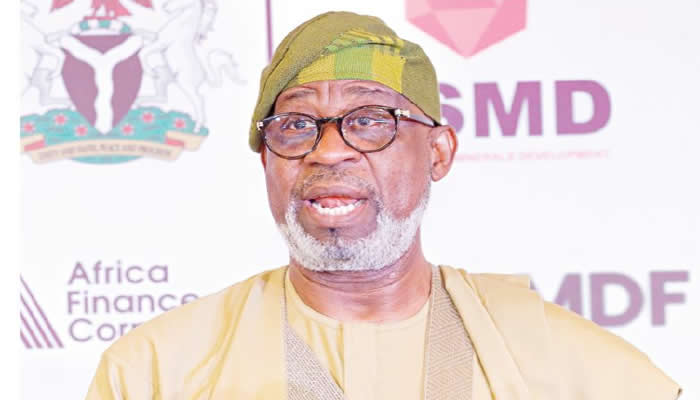
Federal Ministry of Solid Minerals Development has debunked allegations by the Northern Elders Forum that the Federal Government sited a gold refinery in Lagos, breaching the federal character principle.

Minister Dele Alake
In a statement from Abuja, Special Assistant to Minister Dele Alake, Segun Tomori, described the claim by the forum’s spokesperson, Prof. Abubakar Jiddere, as “false and misleading.” He clarified that the minister never announced any government-owned gold refinery in Lagos or elsewhere.
Mr Tomori stressed that Minister Alake explicitly described the refinery as a private initiative by Kian Smith, one of several such projects nationwide. “The Federal Government does not compel private companies to site operations in specific regions,” he added, crediting founder Nere Emiko’s leadership.
The project supports the government’s value-addition policy to curb raw mineral exports and boost local processing. Reforms over two years have spurred investments like a $600 million lithium plant in Nasarawa, a $400 million rare earth facility there, and a $200 million ASBA lithium plant in Abuja.
Tomori highlighted the policy’s role in attracting foreign capital and creating jobs, describing the Lagos refinery as proof of successful reforms. He urged the Northern Elders Forum to back efforts for a stronger Nigerian economy rather than spreading misinformation.

NGX Gives Securties Firm 10 Days to Resolve Theft, Forgery Allegations

KongaPay K-Save Users Save over N3.2Bn

NCC Gives Amazon’s Kuiper, BeetleSat Nod to Provide Satellite Broadband Services in Nigeria

Cybersecurity Firm Detects a Wave of Crypto Phishing Following BlockFi Bankruptcy
NCC Unveils Spectrum Roadmap to Power Nigeria’s $1tr Digital Economy

Banks quietly move to enforce new ₦50 transfer levy from Jan. 1

FIRS says NIN, CAC Numbers to Serve as Tax IDs from 2026

FIRS Declares NIN, CAC Numbers as Tax IDs from 2026

US Begins Partial Visa Ban on Nigerians January 1

Galaxy Backbone Tops FG’s Website Performance Ranking




 E-Financial2 days ago
Here Are Nigerian Banks That Have Secured Their Licences

 Telecom2 days ago
MTN CEO Toriola Hails Nigeria’s Telecom Transformation at MIPAD

 E-Financial2 days ago
Zenith Bank Top Nigerian Bank Pick Ahead of GTCO, AccessCorp

 News2 days ago
ICPC Charges Ozekhome with Forgery, Corruption Over London Property

 E-Financial2 days ago
Nigeria Processed $92.1Bn Crypto Transactions in 12 Months — PwC

 Telecom2 days ago
Lebara Launches Agent Registration Portal

 E-Financial2 days ago
How Crypto Criminals Stole $700m from People – often Using Age-Old Tricks

 E-Business2 days ago
Elon Musk Seeks $134Bn from OpenAI, Microsoft for ‘Wrongful Gains’