

E-Financial
EFCC Arraigns Polaris Bank Staff for Allegedly Stealing Customer’s N12.6m


Economic and Financial Crimes Commission (EFCC) on Tuesday arraigned Babatunde Keshinro, a staff of Polaris Bank, formerly Skye Bank Plc, in an Ikeja Special Offences Court for allegedly stealing N12.6 million belonging to a customer.

The EFCC charged Keshinro with nine counts bordering on theft, forgery and fraudulent use of account.
Mrs Bilikisu Buhari, EFCC counsel, said that the Polaris Bank staff committed the offence from 2016 to 2018 in Lagos.
Buhari alleged that Keshinro stole funds belonging to one Alhaji Ganiyu Oseni, whose account he managed.
“The defendant knowingly forged Baritos Nigeria Ltd’s document titled “Part Termination of Fixed Deposit – 1770522625 dated Dec. 12, 2016, and purported to have been signed and issued by Oseni.
“Sometime in August 2018, Keshinro forged a Skye bank cheque number 47423262 dated Aug. 16, 2018, in the sum of N340,000 which was purportedly signed and issued by Oseni.
“In May 2017, he forged a Skye bank cheque with number 35744848 dated May 22, 2017, for the sum of N303,000 also purportedly issued by Oseni.
“Another Skye bank cheque with number 35744834 in the sum of N971,000 also purportedly issued by the complainant,” she said.
According to the EFCC prosecutor, the defendant also forged three more Skye bank cheques which he fraudulently claimed were signed by Oseni.
The anti-graft agency alleged that on June 2018 Keshinro forged a cheque 47423247 dated June 12, 2018 for the sum of N410,000.
In April 2018 he allegedly a cheque with number 47423248 dated April 20, 2018 in the sum of N225,000.
Keshinro on July 2018 also allegedly forged a cheque with number 47423256 dated July 20, 2018, in the sum of N370,000.
“On Dec. 14, 2016 while being in the employment of Polaris Bank Plc, forged account number 1770522625 which was in the possession of his employer by making a debit of N10 million in favour of Hillcrest Solicitors.
“The debit was purported to have been ordered by Baristos Nigeria Ltd,” the prosecutor said.
The offence, she said, contravened the provisions of sections 287, 365, 337 and 411 of the Criminal Law of Lagos 2015.
Following the arraignment, the defence counsel, M. S. Ehizoge via a bail application dated Feb. 10, prayed the court to grant Keshinro bail on liberal terms.
“The applicant is not a flight risk, he has no prior criminal record. When he was granted administrative bail by the EFCC he always came to their office.
“He has been in custody since Dec. 17, 2019, I humbly pray that he be granted bail in the most liberal terms to enable counsel to have proper access to him,” Ehizoge said.
Buhari, however, opposed the bail application and asked that the defendant be remanded at the correctional centre due to the overwhelming evidence against him.



Central Bank of Nigeria (CBN) has asked commercial banks to restrict loan defaulters, specifically large-ticket obligors, from accessing credit facilities.

A large ticket obligor is a borrower (an individual or company) that owes a very large amount of money to a bank.
The directive is coming a week after the CBN asked financial institutions to stress test.
It is uncertain if the two directives are connected or what may have triggered the loan-related instruction, but the apex bank said it furthers its mandate to protect Nigeria’s financial system.
“In furtherance of its mandate to promote a sound financial system, protect depositors, and enhance prudential compliance within the banking sector, the Central Bank of Nigeria (CBN) hereby directs all banks to restrict non-performing large ticket obligors, whose activities pose systemic risk to the financial system, from accessing specified banking services,” the circular reads in part.
“Any large-ticket obligor with a non-performing facility recorded in the CRMS and/or any licensed private credit bureau shall not be granted additional credit facilities. For the purpose of this restriction, credit facilities include loans and other forms of direct credit.
“In addition, such obligors shall not be granted banking facilities or contingent liabilities such as bankers’ confirmations, letters of credit, performance bonds, or advance payment guarantees.”
On strengthening collateral coverage, the CBN asked financial institutions to obtain additional realisable collateral from such obligors to adequately secure existing exposures.
The CBN said large ticket obligors are borrowers whose exposures are as defined under Clause 3.2 (d) of the prudential guidelines for deposit money banks in Nigeria 2010, or a customer with a combined exposure across banks, as shown in the credit risk management system (CRMS), and/or as shown in the reports of a licensed private credit bureau, “that exceed the Single Obligor Limit (SOL), which materially affect a bank’s Capital Adequacy Ratio (CAR) or otherwise pose a systemic risk to the financial system”.
“This directive reinforces earlier measures, particularly the circular titled “Prohibition of Loan Defaulters from Further Access to Credit Facilities in the Banking System” issued on June 30, 2014 (Ref: BSD/DIR/GEN/LAB/07/015). This is to ensure consistency and effectiveness in curbing credit abuse by large-ticket obligors,” the circular further reads.
The regulator said it will monitor compliance with the directive to ensure consistent implementation across the banking industry.
The CBN warned that noncompliance would attract appropriate regulatory sanctions in line with the provisions of the Banks and Other Financial Institutions Act (BOFIA) 2020.
Nigerian banks are undergoing a recapitalisation programme, slated to end by March 31.
So far, about 30 banks have met the minimum capital requirements announced in March 2024.
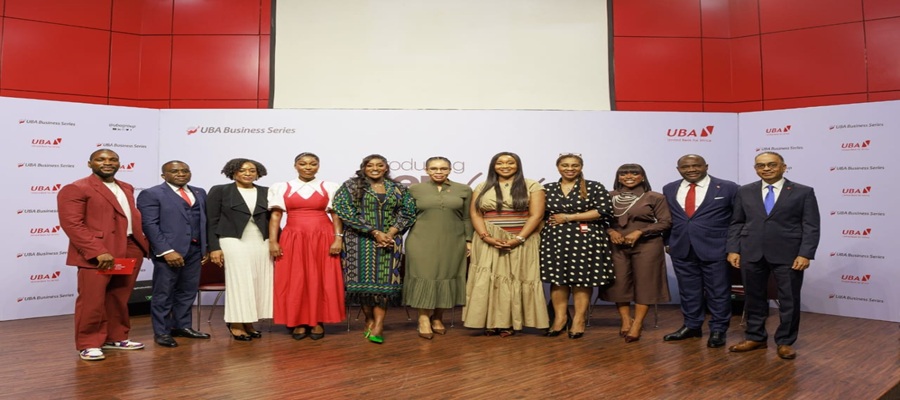
United Bank for Africa (UBA) Plc, Africa’s Global Bank, on Thursday, hosted a captivating edition of its quarterly Business Series, bringing together accomplished female leaders and entrepreneurs to discuss the theme “Gen.W: The Evolved Woman.”

L-r: Media Personality, Tobi Bakre; Head, Retail Products, United Bank for Africa (UBA), Tomiwa Sotiloye; Group Head, Customer Experience, UBA, Michelle Nwoga; Entrepreneur, Fine Funky, Olufunke Davies(fine Funky); Founder, ORIKI, Joycee Awosika; Group Head, Brands, Marketing & Corporation, UBA, Alero Ladipo; Renowned broadcaster, Arise TV, Ayo Mairo-Ese; Head, Remittances, UBA, Uzoamaka Oyeka, Media Personality, Tomike Adeoye, and Executive Director Designate, Digital Banking, UBA, Emmanuel Lamptey, during the UBA Business Series, themed, “Introducing gen.w – The Evolved Woman,” which was held at the UBA House in Lagos, on Thursday.
The hybrid session which was held at the UBA House in Marina Lagos and also transmitted live to participants across the globe, is part of activities to mark the International Women’s Month and focused on the evolving role of women in leadership, business, and innovation, highlighting how African women are redefining success while also creating sustainable impact across their various spheres of operation.
UBA’s Group Head, Customer Experience, Michelle Nwoga, who gave the opening remarks at the event, explained that the evolved woman is one who is taking charge, volunteering and making their voice heard above the noise.
The event was moderated by popular media personality and actor, Tobi Bakre; who said, “When I think about the evolved woman, I personally do not see a checklist or a finish point. In my own opinion, it is a woman who is grounded in her own self-worth and gives room for other women to be grounded in theirs, choosing herself daily and ultimately letting other women around her know and believe that they belong here too.”
The event featured panel conversations with leading entrepreneur and founder of ORÍKÌ Group, Joycee Awosika; celebrated media personality and digital entrepreneur Tomike Adeoye; founder of Fine-Funky, Olufunke Davies, and award-winning broadcaster, Ayo Mario-Ese who shared experiences around their struggles and eventual evolution as female business owners.
From her point of view, Joycee Awosika, an energy economist who has been focused on promoting the African heritage, the evolved woman is one who has awareness of who she is. “That woman does not need to ask to sit at the table, she is creating her own table and adding value. As your company is growing, you must grow too, and always do an audit of where you need to become a better leader” she stated.
To Tomike Adeoye, the question of what a woman is bringing to the table has now become obsolete, as the evolved woman is now bringing their own table. “She is now more vocal about their struggles, setting the standards and she is not ready to give up on her dreams,” she added.
Ayo Mario-Ese expressed worry about females who are usually laidback about speaking up and sharing their achievements, and said that women need to own their own stories: “A lot of women are doing phenomenal work and are sometimes afraid of showcasing what they are doing. As an evolved woman, you have to find out what you are comfortable doing, and create your own unique offering, and also be open to collaboration.”
“Creating unique designs that are affordable remains my driving force and something that has helped me grow as an evolved woman,” remarked Olufunke Davies, who confessed to having ventured into a lot of businesses before finding her niche. “It is important to do your research, streamline and think about relatability. But the important thing I will say is start where you are as it is a progression.”
The Group Head, Brand, Marketing and Corporate Communications, Alero Ladipo, who commended the panellists and the attendees for taking their time to join the event said, “Raising each woman up is actually not that hard; because, everyone has their community as well as their story; and so as women, we need to take position so that you can give to others.”
Ladipo took time to speak about the Gen W platform, put together by the bank, as she explained that it is a lifestyle platform dedicated to the evolved woman, adding, “Through expert insights, real stories, and practical resources, the platform connects women who are building brands, creating businesses, growing careers, and leading across industries.
“They also have access to a plethora of discounted products and loans. The best part: it is open to every woman. No UBA account needed. This is Gen W, for the evolved woman,” she said.
UBA continues to reaffirm its commitment to empowering women and entrepreneurs through platforms such as the Business Series, which continues to serve as a hub for mentorship, knowledge exchange, and thought leadership. By convening influential voices and sharing practical experiences, the bank aims to inspire a new generation of women leaders and innovators across Africa and beyond.
E-Financial
#IWD2026: Kuda MFB Offers Millions In Grants To Women-Led Food And Hospitality Businesses


As part of its Kuda for Her campaign for this year’s Women’s Month, Kuda Microfinance Bank (MFB) is inviting Lagos-based women entrepreneurs in the food and hospitality sector to pitch their businesses for a chance to receive ₦1 million in funding.

Kuda MFB
The Kuda for Her Pitch Challenge, which launched on March 10, 2026, will award ₦1 million each to four women-led businesses, giving them capital to scale.
According to the Small and Medium Enterprises Development Agency of Nigeria (SMEDAN) and the National Bureau of Statistics (NBS), women own about 43% of micro and small enterprises in Nigeria, many of which are in the food, catering, and hospitality sectors. Yet, women entrepreneurs continue to face barriers to growth, particularly in accessing capital, with only about 23% of women-owned businesses in Nigeria currently having access to formal credit.
Women who run food or hospitality businesses can submit a pitch outlining their business and how the funding will help them grow. Applications are open until March 15, 2026.
The four grant recipients will be announced on March 27, 2026.
Emmanuel Femi-Adejobi, Senior Brand Manager at Kuda, mentioned that the campaign is designed to recognise and support women whose businesses shape everyday life in Nigerian cities.
“Many of the food and hospitality businesses that Nigerians rely on every day are built and run by women,” he said. “Through Kuda for Her, we’re supporting these hardworking entrepreneurs directly while also shining a light on the ambition and creativity behind the businesses they’ve built”
Women entrepreneurs who run food or hospitality businesses in Lagos can submit their pitches before March 15, 2026, at kuda.com/kuda-for-her/.

CBN Orders Banks to Restrict Access to Banking Services for Loan Defaulters

NLNG Advances Media Excellence with Change Your Story Workshop
Interswitch Advocates Trust-Driven Infrastructure as Cornerstones of Africa’s Cross-Border Capital Future

Why JustMarkets Is a Strong Choice for Gold Trading

UBA Business Series Celebrates ‘Gen.W: The Evolved Woman’ in Push for Female Empowerment

Kaspersky Discovers New Phishing Campaign Exploiting Google Tasks Notifications to Steal Corporate Credentials

esentry 2025 Report Shows Healthcare, Financial Services and Telecoms as Staging Grounds for Increased Cyberattacks in Africa

AfDB, UNDP Launch $10Bn AI Initiative for Africa

Pheelz Shares His Journey on Glo-Sponsored African Voices

Mutual Benefits Assurance Settles ₦5.9bn Claims in January 2026




 E-Business2 days ago
FG Moves to Strengthen Children’s Online Safety

 E-Financial2 days ago
CBN Directs Banks to Activate Anti-Money Laundering Systems

 Telecom2 days ago
Canal+ Unveils €100m Rescue Plan to Revive MultiChoice after Subscriber Slump

 General News1 day ago
Court Freezes Bank Accounts of Petrocam, Founder over Alleged N9Bn Zenith Bank Debt

 General News1 day ago
FCCPC Says Telcos, Energy Firms Lead Consumer Complaints in Nigeria

 E-Business2 days ago
How Africa Can Turn the AI Wave into Inclusive Growth

 E-Business2 days ago
Nigeria’s Non-Oil Exports Hit N12.36trn in 2025 – NBS

 E-Financial2 days ago
Fintechs Gear up to Combat Fraud as CBN Issues Directive on Fraud Detection Solution