

News
From Brazil to Nigeria, a Trail of Samsung’s Graft Inclination

Samsung Heavy Industries, SHI, the South Korean ship builder, has been in the news in Nigeria, since January this year following the arrival into the country of the multi-billion dollar Egina Floating Production Storage and Offloading, FPSO, vessel, built by it for Total and partners in the Egina oilfield project.
The arrival of the vessel at the Ladol shipyard in Lagos for the integration of its topsides was ceremonious being that the vessel is regarded as one of the biggest in the world and also because it would be the first time the nation would be witnessing the integration of the topsides of an FPSO locally.
Samsung’s good deed in delivering the vessel is however over-shadowed by its corruption history, which has become well-known in Brazil as in Nigeria. Indeed, in Nigeria, like in Brazil, Samsung Heavy Industries has its name etched in a history of graft.
Samsung’s graft story in Brazil is represented by the drillerships, Petrobras 10000 and Vitoria 10000. In Nigeria, its corrupt inclination blew open with the award of the Egina FPSO contract and the company’s manipulation of the government and NNPC officials to land the multi-billion dollar deal.
Organised bribery
In Brazil. a judge had in 2015 sentenced Nestor Cervero, former international chief of state-run oil firm Petrobras, to over 12 years in prison on charges of corruption and money laundering related to a bribe allegedly paid to the speaker of Brazil’s lower house of Congress.
Cervero and two other defendants were accused of organising bribes from Samsung Heavy Industries in exchange for two drillship contracts, the Petrobras 10000, which was leased jointly by Petrobras and Mitsui in 2006, and the Vitoria 10000, hired by Petrobras in 2007.
Consultant Julio Camargo, who said in a plea bargain testimony that the then speaker of Brazil’s lower house of Congress, Eduardo Cunha, asked him for a $5 million bribe, was given a 14-year sentence that was reduced to reporting to police twice monthly and doing community service because he collaborated.
Lobbyist Fernando Soares, accused of funneling bribes to Cunha’s Brazilian Democratic Movement Party, PMDB, was sentenced to over 16 years in jail.
Cunha, who quitted former Brazilian President, economist and politician Dilma Rousseff’s ruling coalition a few years back, had accused her government of framing him in the broadening scandal focused on Petroleo Brasileiro SA or Petrobras.
He was not a defendant, but the sentences handed down by federal judge, Sergio Moro, gave federal prosecutors in Brasilia more ammunition to bring charges against Cunha and other politicians thought to have benefited from the price-fixing and political kickback scheme.
Cervero’s 12 years and three-month sentence was the second he had received from Moro.
In May 2015, he was sentenced to five years in prison for using a front company to launder money stolen from Petrobras and buy a luxury apartment in Rio de Janeiro. He was fired from Petrobras in 2014 and arrested in January as he stepped off a plane from Europe.
Despite the degree of graft uncovered in the case, executives at Samsung Heavy Industries were not charged, neither were they investigated in the corruption and bribery case. Its officials, therefore, walked away unscathed.
Corruption at home
Prior to the Brazil event, a corruption scandal broke out at the Samsung Group in 2007, leading prosecutors to open a formal investigation into charges that its chairman, Lee Kun Hee, masterminded a broad scheme of bribery and illegal transactions.
Prosecutors had investigated three major accusations of criminal behaviour: the creation of a slush fund; the bribery of prosecutors and government officials; and an effort by the chairman, and his aide to illegally help his son take over control of Samsung.
“We are ready to unveil the truth through a stern, fair and thorough probe,” The New York Times had reported, quoting Kim Kyong Soo, a prosecution spokesman, then as saying.
In previous scandals that have plagued Samsung, several executives were convicted of illegally trying to help Mr. Lee’s son, Jae Yong, take control of management, and of bribing politicians. But Mr. Lee’s family had escaped largely unscathed. This had led critics to charge that Samsung runs a vast network of bribery and influence-peddling through the government, the judicial branch and the media, making the Lee family untouchable — a claim vehemently rejected by Samsung.
A whistle-blower: Kim Yong Chul, Samsung’s former chief lawyer, had also confessed to having been personally involved in bribing and fabricating court evidence on behalf of Mr. Lee and Samsung.
*Again, Samsung denied all of Mr. Kim’s allegations Tuesday, saying that he was turning against Samsung out of “personal grudges.”
However, in a legal complaint filed with prosecutors Mr. Kim, who worked as an internal lawyer for Samsung for seven years until 2004, said that Mr. Lee and his top aides illegally ordered transactions that allowed his son to acquire Samsung shares from Samsung affiliates at unfairly low prices.
When prosecutors investigated one transaction in 2003, Mr. Kim said lawyers in his legal division at Samsung trained Samsung executives to serve as scapegoats to protect Mr. Lee, even though those executives were not involved.
Two of the executives were found guilty in a court ruling in October 2005.
In interviews with South Korean media, Mr. Kim said he was “sidelined” by Samsung after he refused to pay 3 billion won, or $3.3 million, in a bribe to the judge presiding over the case.
Mr. Kim’s accusations later took on a new drama when he gave a nationally televised news conference in a Catholic church in Seoul.
“Samsung instructed me to commit crimes,” he said at the news conference. “A basic responsibility for all Samsung executives is to do illegal lobbying, buying people with money.”
Samsung later issued a 25-page rebuttal denying all major accounts of Mr. Kim’s allegations. It noted that Mr. Kim did not provide evidence to support his claims.
Samsung in Nigeria
An independent investigation by the leading energy publication SweetcrudeReports in 2013 and this month had uncovered how Samsung Heavy Industries was handed over the Egina FPSO project after heavy bribing of corrupt government officials, who have also promised it other juicy upcoming contracts such as Shell’s Bonga and Zaba-Zaba led by Agip.
SweetcrudeReports gathered that Samsung bribed its way to land the Egina FPSO contract award, as another South Korean company which participated in the bids tender processes, Hyundai Heavy Industries, HHI, emerged preferred bidder, and was subsequently recommended by the National Petroleum Investment Management Services, NAPIMS, the investment arm of the Nigerian National Petroleum Corporation, NNPC, making the circumstances in which Samsung was selected appear inexplicable.
Checks revealed that Samsung had entered into a partnership with Intels for execution of the Egina FPSO packages and that the Nigerian company had deployed its immense political clout to pressure the NNPC management into breaking its own tendering processes, and rules of engagement.
It was gathered that at a meeting which took place after a Group Executive Committee meeting, held a few days before 2013 Christmas, Mr. Andy Yakubu, the NNPC group managing director, Abiye Membere, the NNPC group executive director and Mr. Tony Madichie, the NNPC secretary and legal adviser, decided to select Samsung for the FPSO package.
The Group Executive Committee, GEC, of the NNPC at the time explained that the rationale behind the award to Samsung Heavy Industries was that the company gave a 5 percent discount on the bid advanced by HHI for the Egina FPSO package. Strangely, HHI was neither invited by the GEC nor afforded the same opportunity to match or best the SHI offer lending credence to talk of bribery.
Subverting Nigerian Content scope
The selection of SHI for the Egina FPSO award ran against the grain of due process, the Nigerian Content scope was completely muddled up, putting in jeopardy the possible gains derivable thereof, and the aspirations of the federal government.
Before the Egina FPSO award, Samsung had never executed any project in Nigeria neither did it have any presence in the country.
An NNPC staff who pleaded anonymity had told SweetcrudeReports as far back as 2013, that “Obviously, no aspect of the FPSO package will be executed in Nigeria if Samsung gets the endorsement of the NNPC Board”.
Continuing efforts to obtain a reaction from executives of Samsung have so far proved abortive.



TeamApt Ltd., a subsidiary of Moniepoint Inc. and a leading financial infrastructure provider, has partnered with Awabah, the National Pension Commission’s first licensed Accredited Pension Agent, to expand pension access for millions of Nigerians in the informal economy.

The partnership was unveiled in Abuja at the launch of Awabah’s agent licence, themed “Building Financial Resilience: Securing the Future with Personal Pensions.”
At the event, PenCom Director-General Omolola Oloworaran underscored a major imbalance in Nigeria’s pension system, noting that while pension assets have grown to over ₦27 trillion, the benefits remain largely concentrated among formal-sector workers. She observed that most informal-sector workers—who make up the majority of Nigeria’s workforce—still retire without any form of savings.
This challenge is further highlighted in Moniepoint’s 2025 Informal Economy Report, which reveals that although 65 per cent of informal businesses recorded revenue growth, most lack the structural resilience required for long-term sustainability and succession.
Through the partnership, TeamApt—a Central Bank of Nigeria–licensed switching and processing company—will enable seamless pension registration and contributions for Awabah users via its Direct Debit service on Point of Sale (POS) terminals nationwide. Informal workers can enrol for personal pensions, tokenize their cards, and automate periodic contributions in just a few steps.
The initiative simplifies pension savings by turning what was once a complex, bureaucratic process into a routine transaction, enabling business owners and workers to build financial security beyond their productive years.
“When we started Awabah, we were driven by one core belief—that no African worker should be one accident or crisis away from poverty,” said Tunji Andrews, Chief Executive Officer of Awabah.
“This partnership with TeamApt allows us to scale that vision. By leveraging their Direct Debit service and extensive POS network, we are meeting informal workers where they already operate—markets, workshops, kiosks, and roadside businesses. With small, regular contributions, workers can now access personal pensions bundled with health, accident, and life insurance,” he added.
TeamApt CEO Dennis Ajalie said the collaboration aligns with the company’s long-standing mission to power Nigeria’s informal economy.
“At TeamApt and Moniepoint Inc., our focus has always been on enabling the informal sector,” Ajalie said. “Today, working within our licence framework and alongside our co-subsidiary, Moniepoint Microfinance Bank, we operate across all 774 local government areas, serving millions of Nigerians who drive economic activity.”
He described the partnership as a critical step toward pension inclusion, adding that it demonstrates how financial infrastructure can deliver real, long-term value to everyday Nigerians.
Ajalie also praised PenCom’s leadership for creating an enabling environment for innovation, noting that Oloworaran’s reforms have opened the door for partnerships capable of delivering sustainable pension coverage for informal workers.
The initiative is powered by TeamApt’s robust financial technology ecosystem, which has supported banks, fintechs, and financial institutions for more than a decade. Its omni-channel Direct Debit service allows automated recurring collections—such as pension contributions, subscriptions, and repayments—directly from customers’ bank accounts with their consent.
Beyond pensions, the platform enables informal workers to automate investments in the capital market, access healthcare through HMOs, and secure insurance coverage for themselves and their families—extending financial security far beyond retirement.
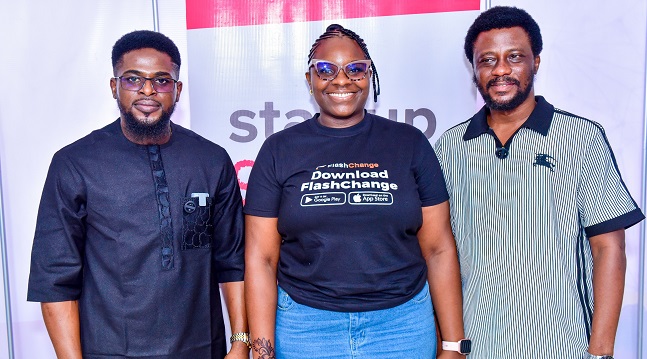
FlashChange, Africa’s fast-rising digital asset management and cross-border payment platform, had its Chief Executive Officer, Bidemi Oke, featured as a speaker at the latest edition of Startup Grind Lagos, one of the largest global communities for entrepreneurs and innovators.

Held on Saturday, February 28, 2026 in Lagos, the event convened founders, investors, developers, and ecosystem builders for a candid conversation on innovation, resilience, and scaling technology ventures in emerging markets. Oke shared insights from FlashChange’s journey building a trusted digital finance brand in Nigeria’s evolving fintech and crypto landscape.
During the fireside chat, Oke shared practical lessons from scaling FlashChange in a highly regulated and fast-changing environment. He emphasized the need for startups to build strong governance structures early, maintain open communication with regulators, and design solutions that solve real economic pain points, particularly around remittances, foreign exchange access, and digital asset utility.
“In markets like Nigeria, trust is not a marketing slogan, it is the product,” Oke said: “For us at FlashChange, growth has always been tied to transparency, compliance, and delivering consistent value to users navigating cross-border payments and digital assets.”
He also addressed the broader opportunity within Africa’s fintech ecosystem, noting that innovation on the continent must balance speed with responsibility.
“The next phase of African fintech will be defined not just by who grows fastest, but by who earns and keeps user confidence. Founders must think beyond valuation headlines and focus on building institutions, he added”
“Innovation is important, but sustainability is critical. At FlashChange, we are building for the long term” Oke noted.”
The session featured an interactive Q&A session where participants engaged him on several topical issues. He underscored the importance of proactive communication, especially in industries where misinformation and volatility can quickly erode public confidence.
Startup Grind Lagos Director, Mayokun Adeoti while commending Oke for offering practical, founder-focused insights, he said, “His experience provides valuable lessons for startups building in complex regulatory environments.”
FlashChange has continued to position itself as a reputable voice within Nigeria’s fintech and digital asset ecosystem, advocating for regulatory clarity, financial literacy, and secure transaction infrastructure. The company’s participation in Startup Grind Lagos reflects its commitment to contributing meaningfully to conversations shaping the future of innovation in Nigeria.
The Startup Grind Lagos appearance marks another milestone in FlashChange’s thought leadership journey and reinforces its growing role in Nigeria’s digital finance ecosystem.
News
Galaxy Backbone Confirms Over 150,000 Active Official Government Email Accounts, Clarifies Status of GOVMAIL


Galaxy Backbone Limited (GBB), Nigeria’s foremost ICT infrastructure and shared services provider to the Federal Government, wishes to reiterate and clarify the availability, maturity, and ongoing expansion of the Federal Government’s official email infrastructure, widely known as GOVMAIL.

GOVMAIL is a secure and centralized official email platform established for use by Ministries, Departments, and Agencies (MDAs) to facilitate professional, auditable, and efficient communication across all arms of government.
The platform was launched by the Office of the Head of the Civil Service of the Federation, Mrs, Didi Esther Walson-Jack as part of a broader digital transformation agenda aimed at modernizing public service workflows and reducing reliance on paper-based correspondence and fragmented, external email services.
Recent statements by the Head of the Civil Service of the Federation, Mrs. Didi Esther Walson-Jack, underscore the strategic importance of GOVMAIL in the wider push towards a paperless civil service.
In late 2025, she announced that over 100,000 official GOVMAIL accounts had been created for civil servants across federal MDAs under an expanding paperless policy and that the transformation reflects a clear shift away from traditional paper correspondence to secure digital communication at scale. Today, that number has grown to over 150,000 Official government email accounts, current in use by government workers across MDAs.
Galaxy Backbone also affirms that these email accounts operate within a protected sovereign government domain environment hosted on secure local infrastructure, supported by enterprise-grade cybersecurity architecture.
The platform underpins centralized identity management and ensures compliance with national data protection standards, reinforcing accountability, audit-trail visibility, and overall digital governance efficiency.
In addition to GOVMAIL, Galaxy Backbone operates secure national Tier III and Tier IV Data Centres, a robust National Fibre Backbone, a Security Operations Centre (SOC), and a Network Operations Centre (NOC) that jointly power mission-critical government digital services. This infrastructure is closely aligned with the Federal Government’s digital economy strategy and its efforts to deepen digital service delivery, transparency, and efficiency across MDAs.
To accelerate adoption and ensure that every government worker who is expected to have an official email has one, GBB is working collaboratively with MDAs to close existing gaps and onboard remaining staff within the shortest possible time. These coordinated efforts reflect the shared objective of equipping public servants with the digital tools necessary for responsive, efficient, and secure inter-agency communication.
Galaxy Backbone remains committed to working with stakeholders across the different arms of government to sustain and build on this progress. The company appreciates the emphasis placed on strengthening digital governance and remains ready to provide technical clarifications and support collaborative engagements that further advance Nigeria’s digital public service ecosystem.

Leo Stan Ekeh at 70; thanks Tinubu, Obasanjo, Nigerians, Global Tech Community

Iran-Israel-US Conflict and CBN’s FX Gains: A Stress Test for Nigeria’s Monetary Stability

JAMB Uncovers AI-Driven Fraud Targeting UTME Candidates, Warns Parents

SERAP Asks FCCPC to Investigate Google, Meta, Others over Alleged Rights Abuses

Reps Mull Commission to Regulate Fintech Operations

Accidental Billionaire Opts for Jail Instead of Returning Money Credited Him by Mistake

New Horizons Nigeria Breaks Ground: First to Fuse Mandarin into ICT Curriculum

Kaspersky Brings more Transparency to Threat Detection with New Hunt Hub

NDPC Commits to Balancing Data Privacy, Protection Information

OADC Lagos Reinforces Commitment to Local Data Hosting and Digital Transformation @ NDPC’s National Privacy Week Summit




 General News3 days ago
More 14m Farmers to Benefit from AfDB-backed Initiative

 Telecom3 days ago
MTN Nigeria Posts Record N1.70 Trillion Pre‑Tax Profit, Declares N20 Dividend for 2025

 Telecom3 days ago
Dimension Data Nigeria Secures ₦20Billion Funding to Strengthen Digital Infrastructure

 News3 days ago
Galaxy Backbone Confirms Over 150,000 Active Official Government Email Accounts, Clarifies Status of GOVMAIL

 Telecom3 days ago
Alerzo Liquidates Delivery Fleet as N4.38bn Moniepoint Loan Row Deepens

 General News3 days ago
Newmark Webinar Explores How AI Could Transform Healthcare in Africa
 E-Financial20 hours ago
Iran-Israel-US Conflict and CBN’s FX Gains: A Stress Test for Nigeria’s Monetary Stability
 General News20 hours ago
SERAP Asks FCCPC to Investigate Google, Meta, Others over Alleged Rights Abuses