

General News
Great things Await Africa, Says DHL Express


Last week as he was driving through Johannesburg, a board member of a multi-billion Euro multinational made a rather bold statement, “Africa is not only the last frontier but possibly the biggest frontier for business”. That comment was made by Ken Allen, Global CEO for DHL Express.
This probably highlights how serious Africa is being taken in the global boardrooms of large corporations.
Charles Brewer, Managing Director for DHL Express Sub-Saharan Africa shares his sentiment and added, “More than ever, companies are now looking to expand into Africa. More than ever, companies are looking to invest in its diverse markets. More than ever, commercial opportunities abound across the continent. It’s clearly time for Africa…”
This week Deutsche Post DHL, the world’s leading postal and express group announced its full year results.
The group posted revenues of more than EUR 55 billion with boosted profitability once again in 2013.
These improvements have been particularly attributed to the company’s exceptional market position in the world’s emerging markets, including Africa.
Brewer added, “DHL Express is the market leader across Africa, and our unparalleled footprint and continued investment in the continent is testament to that. During 2013, we continued with our expansion plans throughout Sub-Saharan Africa, investing heavily in facilities and increasing our vehicle and aviation fleet. We have continued to showcase our commitment to Africa and have a firm belief and vested interest in Africa delivering on its obvious promise.”
Brewer points to the recent International Air Transport Association (IATA) Airline Industry Forecast 2013-2017 report, which revealed that Africa is estimated to be the fastest growing region globally over the forecast period, with an expected five-year compound annual growth rate (CAGR) of 4.0%, while a growth rate of 3.2% (CAGR) is expected for international freight volumes.
“The International Monetary Fund (IMF) has forecasted economic growth of 2.8% in 2014 for South Africa, and 6.1% for the sub-Saharan African (SSA) region, and with the continued growth from intra-Africa and international trade, the outlook for the SSA logistics industry is extremely positive,” said Brewer.
He said that the routes expected to experience the most significant growth in Africa in 2014 are linked to the fastest growing markets which include Ethiopia, Ghana and Nigeria.
Brewer attributed DHL’s positive trade forecast to more than just the economic statistics, and added “Africa is an unbelievably entrepreneurial and dynamic continent and I firmly believe that the SMEs will be the engine of growth for the years ahead”.
He said that it is difficult to ignore e-commerce on the continent as it has become a way of life. “Buying and selling online is growing year on year in Africa, which includes a big shift towards e-commerce in South Africa. More than R4 billion of goods were traded through e-commerce in 2013 in South Africa as consumers realise the safety, convenience and time saving benefits of shopping online. Other factors that will likely influence trade are developments in technology, healthcare, construction and services, as well as the increase in manufacturing in Africa.”
Brewer said that this year, the company has various planned investments into Sub-Saharan Africa, including the opening of a number of new facilitates, and planned expansion in Ethiopia, Kenya, Nigeria, South Africa, Ghana and Angola. DHL Express SSA, will also be expanding its dedicated air fleet adding a number of new planes to the West Africa region, including a Boeing 737.
“The introduction of these new facilities and planes reflect the continuation of our expansion strategy for 2014. This allows us to serve our customers better, who in turn, can process, sell or assemble their products faster and more securely. This value chain extends to the end customer who receives a quality product, at the right price and at the right time.”
Brewer says that whilst there are continued challenges, DHL is confident about trade forecasts for the year ahead. “The key to continue driving growth will be smart, innovative and, above all, customer centric people, processes and solutions, as well as a continued focus and investment in market leading infrastructure”, concluded Brewer.


NigComSat-1R, a Nigerian geostationary communications satellite will outlive its usefulness this year, meaning that the satellite will expire anytime now.

NigComSat-1R was launched by China Great Wall Industry Corporation (CGWIC) for Nigeria on December 19, 2011, as a replacement for the failed NigComSat-1.
NigComSat-1 which was put in the orbit in May 2007, was de-orbited in November 2008 following the development of power fault.
It was replaced with NigComSat-1R by the same company and has a lifespan of 15 years.
Positioned at 42.5°E, it provides C, Ku, Ka, and L-band services across Africa, Europe, and parts of Asia for broadcasting and internet.
Should the satellite fail, support for television broadcasting, internet connectivity, and secure communications for government and private sectors, may be affected.
The satellite is currently been controlled from China since 2019 following technical issues with the Abuja control station.
NigComSat-1R is currently the only active communications satellite managed by NIGCOMSAT Limited, though it operates alongside other Nigerian observation satellites.

Federal government has declared Thursday, March 19, and Friday, March 20, as public holidays to mark this year’s Eid-ul-Fitr celebration.

Consequently, banks, schools and offices nationwide will be shut for the two days.
The declaration was made by Olubunmi Tunji-Ojo, minister of Interior, on behalf of the government, according to a statement issued on Tuesday, by Magdalene Ajani, permanent secretary of the ministry.
Eid-el-Fitr, meaning ‘festival of breaking the fast,’ is one of the most important feasts in Islam.
The festival marks the end of Ramadan, a sacred month of fasting, prayer, and spiritual reflection observed by Muslims worldwide.
During Ramadan, Muslims fast from dawn to sunset, abstaining from food, drink, and other physical needs as an act of devotion to Allah.
Eid-el-Fitr is a time of joy and gratitude, beginning with a special congregational prayer at mosques and open prayer grounds.
It is also marked by feasting, gift-giving, and charitable acts, particularly the giving of Zakat al-Fitr, a mandatory charity given to the less privileged before the Eid prayer.
Congratulating Muslim faithful on the successful completion of Ramadan, Tunji-Ojo urged them to sustain the virtues of love, generosity, peace, tolerance, and sacrifice imbibed during the period.
He also called on Nigerians to use the festive season to pray for the peace, unity, and continued development of the country.
The minister further encouraged citizens to celebrate responsibly and extend acts of kindness to the less privileged, in line with the spirit of the season.
He reiterated the Federal Government’s commitment to promoting national unity and peaceful coexistence among all Nigerians.

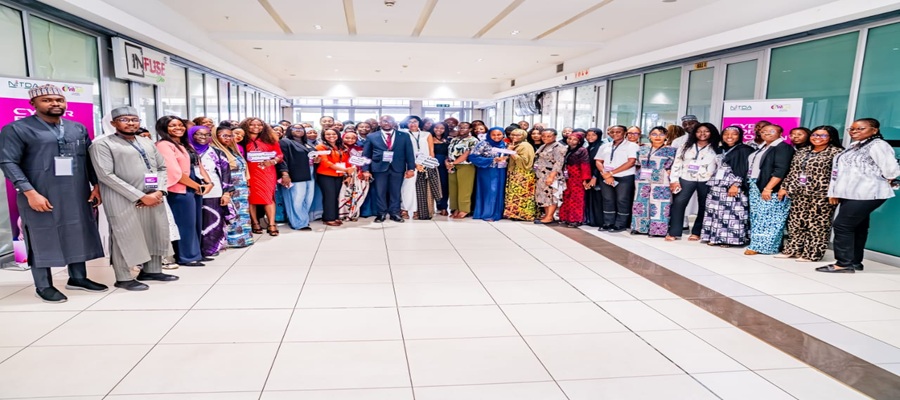
National Information Technology Development Agency (NITDA) has launched a specialised training programme aimed at empowering Nigerian women with cybersecurity skills and increasing their participation in the country’s growing digital security workforce.

NITDA
The training, tagged “Cyber for Women”, was organised by NITDA in collaboration with Women in Cybersecurity and held on Tuesday, March 10, 2026 in Abuja.
Speaking at the event, NITDA’s Director of Cybersecurity, Mohammed Lawan Ahmed, represented by Ayodele Bakare, described the programme as a deliberate effort to position Nigerian women at the forefront of the country’s digital security ecosystem.
Ahmed said the initiative was designed not merely as a training session but as a strategic investment in Nigeria’s digital future and global cybersecurity resilience.
“Today’s programme is not just another training but a strategic investment in the future of Nigeria’s digital security landscape and the world at large, and this time women are intentionally positioned at the centre of the approach,” he said.
According to him, the programme underscores the growing role of women in the global digital revolution and highlights the need to equip them with the necessary skills to contribute meaningfully to cybersecurity.
“Today is a declaration that the women of Nigeria are not bystanders in the digital revolution; they are its architects,” he added.
Ahmed noted that cybersecurity has become a critical pillar for digital transformation in an increasingly technology-driven world.
He pointed out that while global demand for cybersecurity professionals continues to rise, women remain significantly underrepresented in the field.
To address this gap, he said the training aims to provide participants with knowledge, practical tools and collaboration opportunities necessary to thrive in the cybersecurity space.
“Our objective is clear: to empower Nigerian women in cybersecurity with knowledge, tools and collaboration opportunities,” he said.
He added that the participation of women in the training reflects their readiness to tackle emerging cyber threats and contribute to safeguarding Nigeria’s digital ecosystem.
“Your presence here today signifies commitment and readiness for the ever-evolving digital age and its evolving cybersecurity risks,” he said.
The Cyber for Women training forms part of NITDA’s broader efforts to build local capacity, promote digital inclusion and strengthen Nigeria’s cybersecurity workforce.

SEC Shuts Over 400 Fraudulent Investment Schemes, Arrests Operators

NigComSat-1R, Nigeria’s Only Satellite to Expire this Year

Nigeria, Ghana Trigger Stunning 45 Percent Surge in MTN Dividends

Banks, Offices to Close for Thursday and Friday for Eid-el-Fitr

ATCIS Urges FG to Ensure Safety of Consumers Data

Kaspersky Discovers New Phishing Campaign Exploiting Google Tasks Notifications to Steal Corporate Credentials

esentry 2025 Report Shows Healthcare, Financial Services and Telecoms as Staging Grounds for Increased Cyberattacks in Africa

AfDB, UNDP Launch $10Bn AI Initiative for Africa

Mutual Benefits Assurance Settles ₦5.9bn Claims in January 2026

MultiChoice Suspends Yearly DStv Price Hike as Canal+ Pushes Growth




 E-Financial2 days ago
CBN Rolls Out New Rules for Safer Instant Payments, More Customer Control

 News2 days ago
NIMMME Inaugurates Engr. Michael Orekyeh as 13th National Chairman in Abuja

 Telecom2 days ago
MTN Nigeria Races Ahead in Fibre Broadband Market

 E-Financial2 days ago
CBN Tightens BVN Rules to Curb Fraudulent Banking Transactions

 E-Financial2 days ago
Nova Bank Appoints Jude Anele as Managing Director/CEO

 E-Business2 days ago
Tech Expert Unveils BAT-BOT AI App to Curb Fake News ahead of 2027 Elections

 Broadcasting1 day ago
Spotify’s Loud & Clear Report Reveals Over ₦60Bn Revenue for Nigerian Artists in 2025

 Telecom1 day ago
PwC Warns Nigeria Telcos of AI Fraud Risks