

Broadcasting
How desirable is 5% Excise Duty on Telecom Services?

By Ibrahim Dan Halilu
The Minister of Finance, Budget and National Planning, Mrs. Zainab Ahmed has thrown Nigeria into another controversy amidst plans to launch the 5G network, which is expected to transform every sector and sphere of life of the citizenry.

Coming at a time when Nigeria warming up to launch the largest high speed mobile network technology (5G) in Africa, the 5% excise duty on telecom services being implemented by the Federal Ministry of Finance and the Nigeria Customs Service, is not only a negation of the laudable gains of the Buhari administration in the telecom sector but another incontrovertible proof of the administration’s poor policy coordination.
The expectation of most Nigerians is that the Finance Minister and the Controller General of the Nigeria Customs Service who are the prime advocates of the 5% excise duty will engage with the Ministry of Communications and Digital Economy under whose purview the telecom sector presides, and the Nigerian Communications Commission (NCC) which is the telecom sector regulator, to create a synergy before rolling out the new tax regime.
It is no brainer to understand the imperative of engaging with these two government institutions whose role is central to all that the administration has achieved in that sector.

The NCC has over the years implemented various initiatives and programmes that have stabilized the telecom sector and created a very healthy environment for the industry to thrive and offer quality and affordable service to Nigerians.
The commission’s declaration of 2016 as the Year of the Telecom Consumers has placed premium on the consumer as king who should be treated with respect and offered value for money.
Conversely for the mobile network operators who enjoyed massive support of the Commission disputes resolution, protection of critical telecom infrastructures, and restoration of operational facilities that enhance better performance of the industry.
The Commission has played a very strategic role in resisting arbitrary hike in tariffs and other charges for telecom services which can impose additional burden on the consumers. Instead, the NCC envisions a new tariff regime that has not only reduced the cost of data by more than 100% but further increased access to telecom services in Nigeria.
Its robust National Broadband Policy 2020-2025 is aimed at achieving a new landmark in telecom operations in Nigeria as it rolls out the 5G technology that will change the way of doing almost everything.
Similarly, the Ministry of Communications and Digital Economy through its indefatigable minister, Prof. Isa Ali Pantami has launched Nigeria on the world map of countries that are transiting from analogue to digital economy with the unveiling of a robust policy on 5G Network and Digital Economy.
These are commendable efforts that should be complimented by the Federal Ministry of Finance and Nigeria Customs Service (NCS) through advocacy for a downward review or complete removal of some of the tariffs imposed on the MNOs and other service providers.
The presidential inauguration of a 27-person committee charged with the teak of exploring ways of improving Nigeria’s ranking on the Ease of Doing Business, should have been followed by an aggressive drive of the Federal Ministry of Finance to streamline some of the regulatory measures that hinder the effective performance of the industry such as multiple taxation, and promote policies that will remove barriers to consumer adoption of the new technology.
It is on this note that one wishes to appeal to the Minister of Finance to exercise the power conferred on her by the Finance Act 2020 with caution and empathy to the Nigerian consumers who are already overburdened by new series of taxes introduced by the Buhari Administration.
The Minster needs to find equilibrium between government’s desires to raise more funds and citizen’s expectations for better welfare as the destabilizing effects of the new tax regime outweigh its monetary benefits both to the economy and the citizens.
Firstly, the policy will reverse the gains recorded by the NCC in reducing the cost of telecom services to the consumer and efficient service by the Mobile Network operators (MNOs) who have to contend with multiple taxations and increased operation costs.
Secondly, the new policy may further have adverse effect on the flow of both foreign and local investment in the broadband infrastructure that is needed to scale up the deployment of 5G network to other cities across the country. The MNOs are already groaning under an indiscriminate multiple taxation policy that make is harming their business.
The greatest damage the new tariff will do to Nigeria’s telecom sector is derailing the rollout and total adoption of the 5G network that is being test run by the major telecom service network, the MTN whose competitor, Mafab has already announced an extension of the 5G launch to end of the year due to unforeseen challenges.
The Federal Government’s policy on 5G Spectrum for Digital Economy driven by the Ministry of Communication and Digital Economy may suffer a setback under the new harsh tax regime that targets the telecom sector as a major revenue earner for government.
The imposition of the 5% excise duty will be an additional burden on small businesses and individuals who wish to take advantage of the benefits and opportunities offered by the 5G network to expand and improve their businesses as they may face a new tariff regime.
Another possible consequence of the new tax regime is retarding the progress made in launching Nigeria into the open governance platform that promotes transparency and accountability, while enhancing citizens’ participation in governance as any increase in tariff will lead to low patronage of the telecom services.
It is my candid view therefore that the introduction of 5% excise duty on telecom services is both untimely and undesirable for Nigeria whose majority citizens are living below poverty margin, and have no visible source of income.
The Federal Ministry of Finance and the Nigeria Customs Service should dissipate more energy on initiating people-centred policies that will support the NCC in performing its regulatory functions instead of frustrating the laudable efforts of the commission to promote affordable and efficient telecom services in Nigeria.
The duo should regard themselves as a part of the same government that enunciated the policy of promoting digital economy through universal access to telecom services for Nigerians instead of a separate entity that competes for space or attention.
In her search for new avenues to improve government revenue, the Finance Minister should look beyond imposing excise duty on telecom services, and engage with the public and other stake holders to explore other options that are richly available.
The government can tilt the scale towards diversifying its revenue generation to imports for luxury items, luxury life-styles, and reducing the cost of governance at different levels. There are many wasteful spending that can be scaled down to save money for government to meet its financial obligations which is the main thrust of the Minster’s argument.
These include the purchase of exotic vehicles for public office holders, foreign travels, high duty allowances, and foreign trainings for public officials. Others are blocking the conduit pipes and confronting corruption head on.
These and many others will spare a huge sum that can be channeled to more productive projects that will impact on the lives of the people.
The rush to impose new tax regime on consumers of telecom services will be self-defeating, if at the end of the day the only benefit it accrues to the government is more money to spend instead of better welfare for citizens.
The telecom services are no longer a luxury but necessary tools that Nigerians need to connect with the rest of the word, share their ideas, knowledge, and information for a much better society.
The government should not shut out Nigerians or make it impossible for them to reach out to the rest of the world to market their skills, talents, and products in return for the much needed foreign exchange which is the essence of the digital economy which is the fulcrum of the administration’s |economic policy.
Nigerians deserve efficient and affordable telecom services to conduct their business activities on a global scale, which the controversial 5% excise duty seems to negate. It is a right, not privilege!
Ibrahim Dan Halilu is an Abuja based media consultant and communication expert. He can be reached via email at [email protected] or mobile 08101064449 9SMS only).


National Broadcasting Commission (NBC) and the Independent National Electoral Commission (INEC) are set to introduce a joint broadcast monitoring framework ahead of the 2027 general elections as part of efforts to curb unethical broadcasting and promote responsible election coverage.

Charles Ebuebu, director-general, NBC, who disclosed the plan recently, said the collaboration would strengthen election monitoring through the deployment of advanced technology and closer coordination between regulatory agencies.
According to him, the increasing influence of digital and online platforms has made it imperative for regulators to work together rather than operate independently.
“We have written to INEC, and we are going to have a joint monitoring outlook over the elections. Gone are the days when agencies work in silos. When we coordinate, we’re able to monitor more effectively,” Ebuebu said.
He explained that the partnership would enable both agencies to jointly identify and address violations of broadcasting regulations during the election period instead of handling such issues separately.
Beyond INEC, Ebuebu said the NBC is also partnering with other key regulators to strengthen oversight of election-related content across digital platforms.
According to him, the commission is finalising agreements with the Nigerian Communications Commission (NCC) and the National Information Technology Development Agency (NITDA) ahead of the polls to reinforce its monitoring capabilities.
“We are calling in other stakeholders to reinforce the election monitoring. We are signing agreements with the Nigerian Communications Commission and the National Information Technology Development Agency before the elections,” he said.
Ebuebu also revealed that the NBC is upgrading its monitoring infrastructure with artificial intelligence (AI)-powered tools to keep pace with the rapidly expanding media landscape.
He noted that the proliferation of online platforms has made traditional monitoring methods inadequate.
“With online platforms, there are thousands of them. You need more than staff; you need AI monitoring facilities,” he said.
The NBC chief added that the commission has significantly improved its monitoring capacity and can currently track nearly 50 broadcast channels from its monitoring centre in Abuja.
He said additional monitoring facilities would be established across the country in line with evolving broadcasting technologies.As part of preparations for the 2027 elections, Ebuebu announced plans for a sensitisation workshop in Ibadan that will bring together broadcasters, INEC officials, security agencies and other stakeholders.
He said the engagement had become necessary as political discussions surrounding elections continue to grow more heated, including on television, stressing the need for broadcasters to adhere to professional standards.
Ebuebu noted that the commission has had to issue several warnings to broadcast stations for violating the broadcasting code during election periods.
“We have had to write several of them because they simply forget what the code says,” he said

Mrs. Clementine Wamba, head, Digital Switch Over (DSO) at the National Broadcasting Commission (NBC), has stressed the need for broadcasting stations and practitioners nationwide to work towards meeting the 2028 global deadline for the switch over.

She made the call in her presentation titled, “DSO Big Picture: Free TV Audience Measurement and the Evolving Media Landscape”, at the 2026 NBC South West Summit held in Ibadan.
Wamba harped on the need for practitioners to adopt DSO in the transmission of news and other programmes in order to meet future challenges, stating that any country that fail to align with the DSO by 2028 will be shut out of practice.
This development, according to her, may result in job losses and other consequences that could hinder the growth of the industry in Nigeria, noting that Free TV is tailored towards the DSO, with provision for many channels in contrast to the age-long analogue system.
According to her, “The Digital Switch Over is a technological improvement on the age-long analogue style of broadcasting in the country. With the adoption of the DSO, practitioners will be in tune with global practice of broadcast journalism.
“Also, its benefits include efficient use of spectrum, changing of industry landscape, more access to national development programmes and better viewing experience.”
National Broadcasting Commission (NBC) has said that Nigerians will no longer pay annual Digital Access Fees under the renewed Digital Switch Over (DSO) project.

Charles Ebuebu, director-general, NBC, disclosed this in an exclusive interview with the News Agency of Nigeria (NAN) on Wednesday in Abuja,
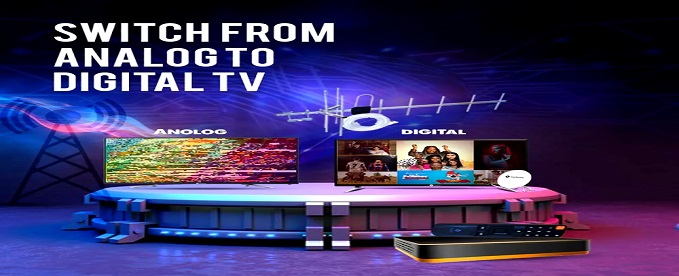
Ebuebu said viewers only need to purchase an approved decoder and satellite dish which cost below N20,000 to enjoy free television permanently.
“Previously, users paid an annual digital access fee of about N1,500, described as an administrative charge.
“The new system removes that annual fee. It provides free access to free-to-air television channels without any payment.
“Premium channels will be introduced later. Viewers who want those additional channels will be able to access them through paid services.
“Nigerian content on free-to-air channels remains free to watch. Unlike Pay TV, this platform does not require monthly subscriptions for its basic service,” he said
Ebuebu said approved decoders for the FreeTV will cost less than N20,000 and authorised sales outlets will soon be announced.
He urged Nigerians to wait for official information on approved dealers for the DSO decoders, warning that unauthorised sellers are exploiting growing public demand.
He reiterated that people only need a free-to-air decoder, along with a satellite dish instead of the old antenna system to receive the DSO signal.
“Once the equipment is installed, viewers can access all available channels across the country without paying any subscription fees,” he stressed
The DG dismissed claims by some retailers that there are different categories of decoders sold at varying prices, stressing that such sellers are not authorised by the commission.
According to him, the NBC will soon publish the list of approved dealers, official prices, and locations where genuine decoder boxes and accessories can be purchased.
The NBC boss said the DSO project is designed not only to improve television broadcasting but also to stimulate economic growth by creating jobs, attracting investment, and opening up opportunities for businesses that support the broadcasting industry.
Ebuebu noted that content producers and broadcasters stand to benefit significantly from the nationwide reach of the DSO platform.
Unlike the previous system, where many stations had limited regional audiences, he said the new platform will make their channels available to viewers across Nigeria.
He added that the introduction of audience measurement technology will provide scientific and reliable data on television viewership.
Ebuebu added that audience measurement technology will give advertisers greater confidence in placing adverts and enable broadcasters to demonstrate the true size and reach of their audiences nationwide.

YEDC Warns Customers, Says 20 Percent Electricity Bonus is Scam

FG to Support 12 Tech Startups with N482m under iDICE

NBC, INEC, Plan Joint Broadcast Monitoring Framework ahead of 2027 Elections

No Going Back on July 31 Deadline for Insurance Firms’ Recapitalisation – NAICOM

Court Affirms FCCPC’s Power to Regulate Digital Lending

NRC, Ponzi Scheme Collapses Resulting Loss of Billions of Naira

NASENI Moves to Digitize CCB’s 5m Assets Declaration and Operations

Lebara Nigeria Launches Lebara Play, Africa’s First Telecom-Owned Micro-Drama Platform

CANAL+ Partners Samsung to Pre-Load DStv Stream on New Samsung TVs In Nigeria, Other African Countries

Tokenization, Blockchain Technology will Transform Financial Institutions – IMF




 E-Financial2 days ago
Access Holdings Sells 7.44% Stake in Ghana Unit

 News2 days ago
Adebutu, PDP Chieftain Accuses Nigerian Governors of Embezzling LG Allocations

 E-Financial2 days ago
NDIC Urges Youths to Shun Ponzi Schemes, Embrace Savings

 News2 days ago
NIMASA Unveils Accelerator Scheme to Drive Innovation, Sustainable Growth

 E-Financial2 days ago
NRS Issues July 31 Deadline for e-Invoicing Compliance

 E-Business2 days ago
SERAP to Sue NASS over Bill Empowering NDPC to Regulate Social Media

 News2 days ago
ICPC Secures Final Forfeiture of N941m Linked to IPPIS Fraud

 News2 days ago
eBusinessLife Advocates Greater Support for Girls in ICT as Students Showcase AI Innovations