

Telecom
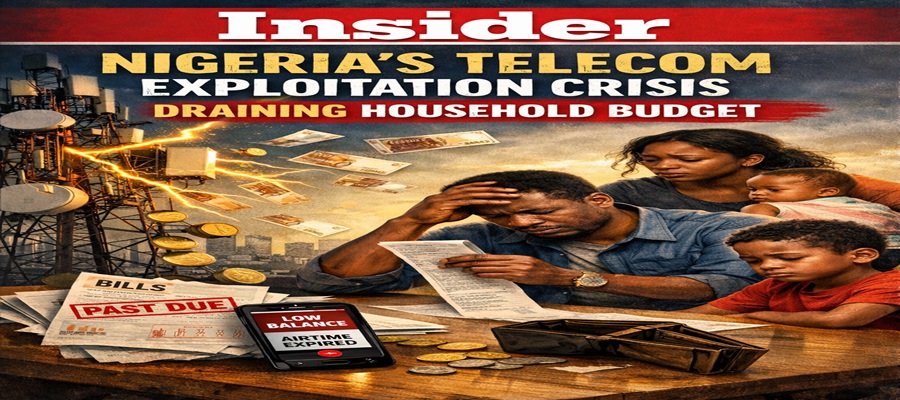
Inside Nigeria’s Telecom Exploitation Crisis Draining Household Budgets

By Blaise Udunze
For about a year now, millions of Nigerians relying on the internet to make a living have been groaning over the manipulation of airtime and data consumption that has turned into a relentless drain on household budgets. Painfully, individuals and businesses buying airtime or data increasingly feel less like paying for a service and more like entering a wager whose odds are permanently stacked against the consumer. Around the nooks and crannies of the country, across cities and rural communities alike, subscribers tell the same weary story of data that evaporates mysteriously, airtime consumed faster than reason allows, and customer care responses that sound rehearsed rather than responsive.

Inside Nigeria’s Telecom Exploitation Crisis Draining Household Budgets
The majority will agree that this collective frustration is not a coincidence, nor is it merely the product of careless smartphone use, because others might argue that there are several technical factors inducing rapid mobile data usage. Leave it or take it, it is the outcome of a broken ecosystem where multinational telecom companies wield immense power in an environment marked by weak institutional checks, limited transparency, and a population stretched thin by economic hardship.
The recent 50 per cent upward adjustment of telecom tariffs, later revised in policy conversations to 35 per cent, has intensified this tension, though it is not justifiable as exploitation. For millions of Nigerians already battling inflation, currency volatility, and shrinking purchasing power, the hike landed not as an economic necessity but as an additional burden. When communication costs begin to claim up to 15 per cent or, in some cases, nearly 30 percent of the national minimum wage, something fundamental has gone wrong. Access to communication is no longer a luxury; it is the infrastructure of modern survival. Yet the price Nigerians are now paying for this access is becoming socially and economically unsustainable.
A published report showed that as of January 2025, statistics from the Nigerian Communications Commission (NCC) disclosed that there were 141 million Internet users via the narrowband (GSM), while broadband penetration stood at 45 per cent. Data consumption has increased to 1,000,930.6 terabytes.
A review of the multinational telecom companies indicated that the new tariff for MTN’s revised data prices showed the 1.8GB monthly plan now goes for N1,500, against the previous 1.5GB plan priced at N1,000. The 20GB plan has been adjusted to N7,500, up from N5,500, while the 15GB plan now costs N6,500, rising from N4,500.
Under this new pricing regime, the same would be said of Airtel as it has replaced its cheapest monthly data plan of 1.2GB plan for N1,000 with 2GB plan for N1,500. For 3GB for N2, 000 (from 1.5GB at N1, 200), 4GB for N2, 500, formerly 3GB at N1, 500, and 8GB for N3, 000 (formerly 4.5GB at N2, 000). Other adjustments include 10GB for N4, 000 (formerly 6GB at N2, 500), 13GB for N5, 000 (from 10GB at N3, 000), 18GB for N6, 000 (formerly 15GB at N4, 000) and 25GB for N8, 000 as this replaces 18GB at N5, 000.
Further, the 75GB monthly bundle, which costs N16, 000 has been renamed as plan, costing N20, 000; 100GB for two months, costing N20, 000 have been upgraded to 150GB to cost N40, 000, while 400GB for three months, which cost N50,000 is now upgraded to 480GB to cost N120,000.
The bubble burst was further complicated tariff increase, which is the resurgence of widespread complaints about rapid data depletion. The issue is that businesses, students, families, and professionals are now raising alarms that data bundles, which previously lasted weeks, now disappear in days or even hours, which is questionable. Another critical area affected is small and medium-sized enterprises that rely on cloud services, digital marketing, logistics platforms, and online payments are finding their operating costs spiraling without any justification. For many, the crux of the matter is that profitability is being quietly eroded, not by poor business decisions, but by the rising cost and unpredictability of connectivity.
The telecom operators, backed by the regulator, have responded with familiar explanations that have always favoured their unscrupulous and illicit activities, with the explanation that data, they say, depletes faster because of background applications, automatic updates, high-definition streaming, malware, faster networks, and users’ failure to manage device settings. Technically, these explanations are not false because modern smartphones are indeed data-hungry, and digital behaviour has evolved. But this defence, repeated endlessly, misses the deeper issue, as the fact is that the problem Nigerians are confronting is not simply that data is consumed; it is that the system governing how data is measured, billed, and explained is not transparent, hard to understand, unaccountable, and tilted entirely in favour of the service providers.
In Nigeria’s telecom market, operators are both the umpires and the players. They measure usage, bill customers, interpret anomalies, and adjudicate complaints, which does not create ground for fair play. Subscribers, on the other hand, are expected to accept consumption figures hook, line, and sinker, which they cannot independently verify. An unacceptable fact is that there are no universally accessible, third-party audited data meters that allow users to confirm what they have truly consumed in real time. Customers and service providers do not have equal access to information; this asymmetry creates fertile ground for silent overbilling, whether intentional or structural, and it erodes trust in a sector that should be built on transparency not obscurity.
One critical aspect that must be addressed squarely is that the regulatory weakness compounds the problem. While the Nigerian Communications Commission possesses statutory authority, enforcement has often appeared slow, reactive, and insufficiently punitive. Penalties imposed on multinational firms with billion-dollar balance sheets rarely feel consequential. Investigations drag on, public disclosures are limited, and even when infractions are established, consumers seldom receive refunds. In such an environment, corporate restraint becomes optional. Where regulators lack teeth, corporations inevitably test boundaries.
The market structure itself offers little relief as the market setup does not protect consumers. Nigeria’s telecom sector is effectively oligopolistic, dominated by a few large powerful players with similar pricing models and limited incentive to compete on fairness. Tariff structures are deliberately complicated and complex, with multiple conditions and layered with bonuses, rollover conditions, expiry clauses, and promotional data that behaves differently from paid data. For the average subscriber, understanding these distinctions is exhausting. Complexity becomes a strategy, not an accident, reducing accountability while increasing revenue certainty for operators.
Though economic pressure on the telecom companies is real, and it must be acknowledged, knowing fully well that exchange rate volatility, energy costs, vandalism, and inflation have hurt profitability. Airtel’s revenue decline and MTN’s reported losses underscore the financial strain facing operators in Nigeria’s macroeconomic climate. It must be understood that corporate hardship does not justify consumer exploitation. The risk arises because multinational firms are subjected to pressure to meet global revenue targets and repatriate profits, adopt aggressive monetisation strategies in markets where regulation is weak and consumer resistance is fragmented.
From experiences thus far, the human cost of this imbalance is becoming impossible to ignore. From students like Abiodun Yusuf, who spends most of his allowance on data that barely supports his academic needs, and also to small business owners like Cynthia Jude, whose online shop struggles to stay viable, the stories repeat themselves with unsettling consistency and outcomes. Families ration children’s screen time not out of discipline, but out of financial desperation. The adverse part that has continued is the widening of an already dangerous digital divide, as rural communities withdraw from digital platforms altogether because of exploitation.
Perhaps most telling is how quickly exploitation has been normalized in Nigeria. Many Nigerians now shrug and say, “That’s how it is.” This resignation is the greatest victory for an unfair system and when people stop believing that fairness is possible, for this reason, exploitation becomes invisible, and abuse thrives without resistance.
Consumer advocacy groups like NATCOMS have begun to signal a shift in posture, including the possibility of court action. Labour unions have threatened boycotts. Civil society organisations warn of social and economic repercussions. These responses indicate that public patience is wearing thin. If left unaddressed, subscription apathy, however gradual, could ultimately undermine the very growth the telecom sector seeks to protect.
For a better understanding of what Nigeria faces is not merely a dispute over megabytes and tariffs, for clarity, it is a governance challenge that cuts across corporate ethics, regulatory independence, consumer empowerment and economic justice. A digital economy cannot thrive on distrust. Transparency and easily understandable data billing must become mandatory, not an aspirational goodwill promise. Independent audits should be public, regular, and credible. Complaint resolution mechanisms must be simplified, fast, and binding. Regulators must act not as mediators between equals, but as defenders of the public interest in an asymmetrical power relationship.
Equally important is consumer education, but awareness campaigns alone cannot substitute for structural reform. Digital literacy must go hand in hand with corporate accountability because the better it is understood that teaching users how to conserve data does not absolve operators from the responsibility to bill fairly and transparently.
At its core, the telecom debate reflects a large Nigerian dilemma, if not a broader problem in Nigeria, as corporate power has grown faster than institutional strength. Until regulators are truly independent and totally free from corporate and political influence, transparency is enforced by law, and consumers are recognized and treated not as passive revenue streams but as stakeholders with rights, exploitation will remain systemic rather than accidental or a series of isolated mistakes.
Communication is the bloodstream of modern society. When access to it becomes exploitative, the cost is paid not only in naira but in opportunity, dignity, and trust. Nigeria must decide whether its digital future will be built on fairness that respects consumers or allow it to rest on fatigue, frustration, and exploitation of users. The choice Nigeria makes will make more impact and the answer will shape not just the telecom sector, but the credibility of governance in an increasingly connected nation.
Blaise, a journalist and PR professional, writes from Lagos and can be reached via: [email protected]


Sunil Mittal led Bharti Airtel has crossed the 650-million customer mark globally, fortifying its position as the world’s second-largest telecom operator by mobile subscriber base, as per a regulatory filing by the telecom operator.

“According to GSMA Intelligence, Bharti Airtel is ranked second globally by mobile customer base, with operations spread across India and Africa,” the filing said.
Commenting on this milestone, Gopal Vittal, executive vice chairman, Bharti Airtel, said: “Achieving the milestone of 650 million customers to be the second largest operator globally is a great responsibility for us to serve our customers better every day,”
He added that the telco strives to raise the bar on innovation, reliability, and experience so that every customer interaction is an opportunity to earn trust and deliver value connection.
Currently, Airtel India serves around 368 million mobile customers, meanwhile over 179 million users have been plugged into its subsidiary Airtel Africa spread across 14 countries.
Its mobile money platform, Airtel Money reached more than 52 million customers.
Additionally, the telco serves around 13 million homes with high-speed internet services and over 15 million through its Digital TV offering.
With operations spanning 15 countries and network coverage reaching over two billion people, analysts say that the latest milestone is a testimony to the natural curve of evolving from a telecom operator into a broader digital services provider.

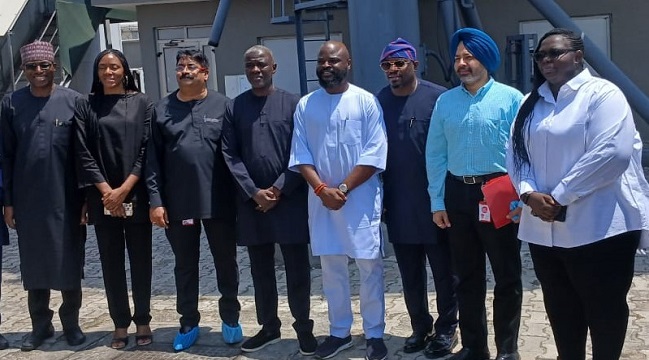
Dr. Aminu Maida, executive vice chairman, Nigerian Communications Commission (NCC), has insisted that telecommunications operators must compensate subscriber for poor quality of service after a facility tour of major telecommunications operators in Lagos yesterday.

The team comprises of Chief Idris Olorunnimbe the Chairman of the Governing Board of the Nigerian Communications Commission (NCC), EVC, Engr. Gbenga Adebayo, chairman, Association of Licensed Telecommunications Operators of Nigeria (ALTON) and other stakeholders visited MTN Nigeria, Globacom and Airtel Nigeria.
Earlier this week, the commission directed Mobile Network Operators (MNOs) to provide compensation to subscribers whose network quality of service experience is below specified targets within certain locations.
In a statement signed by Nnenna Ukoha, head, Public Affairs Department, NCC, the commission noted that its position is that subscribers should not be made to bear the full burden of service disruptions where operators fail to meet prescribed standards of service delivery.
Speaking after the facility tour the EVC, said: “We are in a situation where Nigerians are yearning for better service, but better service requires infrastructure. We are not where we want to be or where we need to be, but from what I’ve seen today, I am reassured that the operators are continuing to invest. I urge Nigerians to be a little bit patient while these investments are made, so that we can address the infrastructure deficit that is required to improve service for Nigerians.
“I wasn’t expecting that a tour like this would change that directive. We looked at it and we said the fairest thing to do was for subscribers to be compensated. This is not to say that the operators have not tried. Service has improved. The data shows that our demand is also increasing at a rate faster than the infrastructure is being built. So Nigerians have to be a little bit patient. From what I’ve seen today and all the work that has been done, I’m confident that gap will be close shortly”.
Chief Idris Olorunnimbe, chairman of the Governing Board of the Nigerian Communications Commission (NCC), added: “From what we have seen, and what has been done. We have been told in detail what is to come. And I mean, just like the EVC said, all we need is a bit more patience, better service, deeper penetration is assured based on everything that we’ve seen, and everything we have heard.
“It’s also important to commend our operators. The infrastructure that we’ve seen is comparable with any infrastructure from any telecom operator anywhere in the world, and Nigeria is not behind, and based on what we’ve also seen in terms of their plans for expansion, Nigeria will always be able to compete with any other country in the world.
” More so, drop calls are not deliberate. They are caused by a few things. One of it is fiber cut and attacks or vandalization of towers and other infrastructure. But now, it has reduced. We have seen they’ve shown us data today that shows a significant reduction. It will continue to reduce. As the critical national infrastructure program deepens and we’re also about to introduce an accountability framework of “when fiber is damaged, you must fix it”. That way we think that people will be more responsible with their constructions that breach telecom infrastructure. Then we can keep those incidents to the barest minimum, drop calls would also reduce.
“However, when calls drop, the networks also lose so it’s not in their interest for your calls to drop or for you to experience frustration when you use the service, because the more reliable it is, the longer you spend on it, the longer you spend on it, the more money they’re able to make. So, they are also doing their best in terms of ensuring that these incidents are reduced to the barest minimum”.
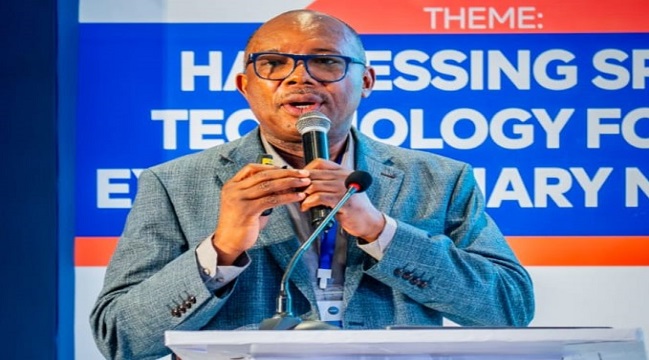
Kashifu Inuwa, the Director General of the National Information Technology Development Agency (NITDA), has underscored the importance of collaboration between government institutions and emerging startups as a catalyst for Nigeria’s digital transformation and national development.

Speaking at the Nigerian Satellite Week 2026 in Abuja, themed “Harnessing Space Technology for an Extraordinary Nigeria,” Inuwa urged stakeholders to embrace partnerships as a pathway to innovation and impact.
“Take a good step, and you can make a difference,” he said, emphasizing the need to translate ideas into tangible outcomes through collective effort.
The NITDA boss, represented by the Director of Stakeholder Management and Partnerships, Aristotle Onumo, during his presentation on “Enhancing collaboration between government agencies and emerging start-ups”, outlined four guiding principles for driving transformation: enabling the ecosystem rather than controlling it; prioritising networks over institutions; developing talent while supporting innovation and adopting practical solutions; and focusing on platforms rather than isolated projects.
To illustrate the power of digital innovation, Inuwa shared the story of a rural farmer whose productivity challenges ranging from unstable rents to failed loans were overcome through access to digital tools and networks. He explained that such incremental interventions can scale into broader economic gains, ultimately contributing to national infrastructure like satellite systems.
“This is the power of space technology, and it shows why events like this are so important,” he noted.
Highlighting the evolving role of space technology, Inuwa observed that startups are increasingly driving innovation across telecommunications, navigation, security, and cloud services. Once dominated by global superpowers, the sector is now emerging as a key economic driver, with Nigeria’s “Sunrise Packet” projected to contribute over $1.5 billion to the economy by 2030.
“Innovation without adoption is wasted,” he added, stressing the critical role of government in enabling start-ups to scale through supportive policies, infrastructure, and incentives.
According to him, developmental regulation should focus on creating markets, orchestrating ecosystems, and delivering public value rather than stifling innovation. He pointed to several initiatives supporting the growth of Nigeria’s innovation ecosystem, including the Digital Start-Up Act, Idea Hatch, and the National Digital Leadership Programme, all designed to empower young innovators and connect them to global opportunities.
He further highlighted platforms such as GITEX Africa, GITEX Nigeria, and Digital Nigeria, which provide visibility for start-ups and attract investment, partnerships, and mentorship.
Inuwa concluded with a strong call for collaboration among government, start-ups, non-governmental organisations, and investors, describing Nigeria’s youth as the country’s greatest asset.
“If we are going to create a digital Nigeria, we must collaborate,” he said.
Also speaking at the event, the Minister of Communications, Innovation and Digital Economy, Tijani, described Nigeria’s satellite infrastructure as central to the nation’s digital future.
“Nigeria is the only West African country with its own satellite. NigComSat provides critical connectivity and resilience, benefiting not just Nigeria but the entire region,” he said.
Tijani disclosed that President Bola Ahmed Tinubu has approved the acquisition of NigComSat-2A and NigComSat-2B, a move expected to significantly enhance the country’s space capabilities.
He stressed, however, that infrastructure alone is not sufficient.
“What truly matters is how we leverage this technology to improve agriculture, education, security, and business operations,” he said.
The Minister also highlighted key government investments, including a ₦12 billion digital economy research cluster fund under Project Bridge, which will support academics and researchers nationwide. He added that Nigeria is expanding its digital backbone through 90,000 kilometres of fibre optic cables, nearly 4,000 telecom towers in underserved communities, and new satellite deployments to strengthen regional connectivity across countries such as Cameroon, Niger, Chad, Burkina Faso, and the Republic of Benin.
“The talent, ideas, and energy are all here in Nigeria. It is up to us to turn them into real outcomes for our people and the economy,” Tijani added.
The Nigerian Satellite Week continues to provide a strategic platform for collaboration among government, start-ups, academia, and the private sector, fostering innovation and reinforcing Nigeria’s leadership in Africa’s digital and space economy.
Welcoming participants, the Managing Director of Nigerian Communications Satellite Limited (NIGCOMSAT), Jane Nkechi Egerton-Ideyen, said Nigeria’s space programme is entering a new phase marked by deliberate and focused growth.
She pointed to strengthened institutional capacity, expanding partnerships, and clear economic gains, noting that the agency’s revenue grew from less than $650 million in 2023 to over $2 billion in 2025. She attributed this surge to key reforms, new commercial deals, and increasing demand for satellite broadband services across the African continent.
Egerton-Ideyen also disclosed that Nigeria has launched seven space assets in just over two decades, adding that the country is shifting its focus from prestige-driven initiatives to practical outcomes—enhancing connectivity, improving livelihoods, and promoting inclusive development.
She further revealed that more than 500 young Nigerians received training in satellite technology within the past year, while over 50 startups have benefited from NIGCOMSAT’s accelerator programme.

Union Bank Looted: How Former Directors Gambled with Billions and Nearly Destroyed a National Bank

N4.65 Trillion in the Vault, but is the Real Economy Locked Out?

FG, Others Say Nigeria Wastes 38m Tonnes of Food Annually

Ecobank Assures of Seamless Easter Banking Services

Anchor Gets Nigerian, Canadian Licences as Transactions Crosses $2.5Bn

Spotify’s Loud & Clear Report Reveals Over ₦60Bn Revenue for Nigerian Artists in 2025

Madonna University Taps Tech Guru Adote for Strategic Board Role

China Threatens to Shut Nigeria’s Satellite Over $11.44m Unpaid Debt

FCCPC Bans Lagos ‘No Refund’ Policy, Vows Fines and Shutdowns for Traders

Healthcare Under Attack: Why Cybersecurity is Now Critical Care




 E-Financial3 days ago
CBN Says 33 Banks Raise Fresh N4.65 Trillion in Recapitalisation Exercise

 Telecom3 days ago
NITDA Urges Joint Action to Drive Nigeria’s Digital Innovation

 E-Business3 days ago
Cybersecurity Firm Uncovers CrystalX RAT which Steals Data, Mocks its Victims

 Telecom3 days ago
NCC Insists Telcos Must Compensate Subscribers for Poor Quality of Service

 E-Business3 days ago
Oracle Sacks 12,000 in India, Begins Shift to AI

 Telecom3 days ago
Oracle Corporation Axes 30,000 Workers in Brutal AI Shake-Up

 E-Financial3 days ago
Nigeria, Others Lose $88bn Yearly to Illicit Flows —Edun

 E-Financial2 days ago
UBA Beefs Up Mobile App Security to Stop Fraudulent Debits, Withdrawals