

News
Like China and Japan: NASENI is Pathway to Nigeria’s Industrial Economy

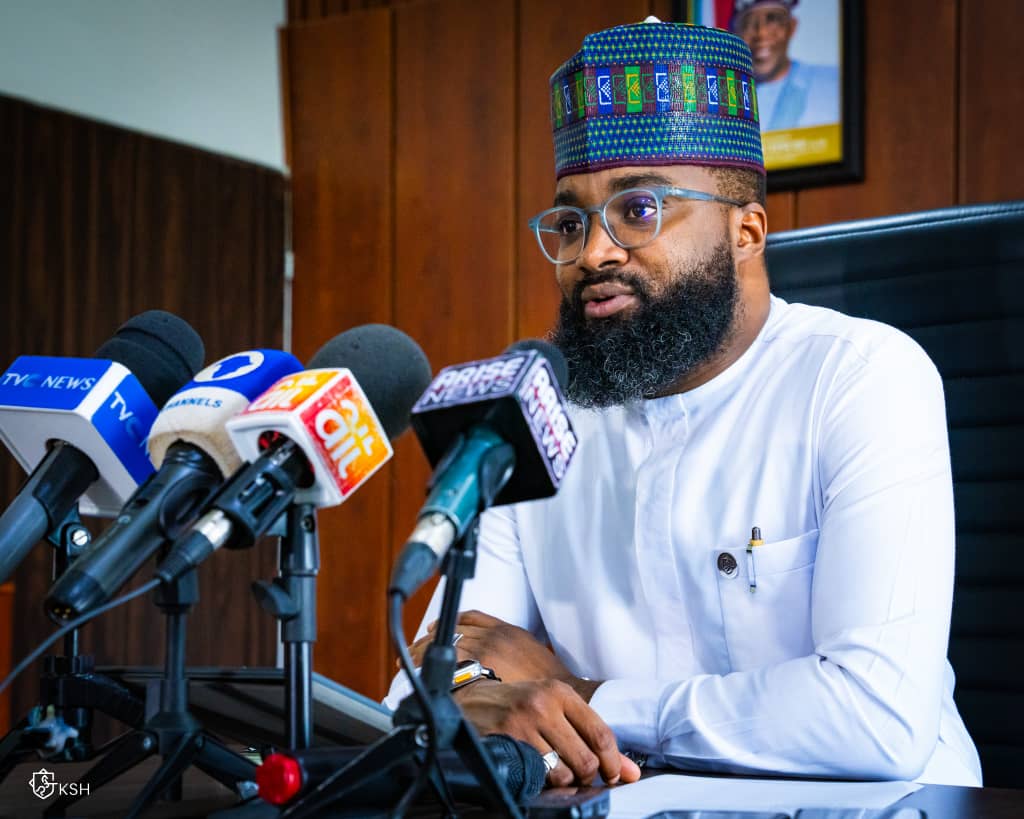
By Mr. Olusegun S. Ayeoyenikan
Nigeria cannot have real development without a sustainable industrial growth and manufacturing capacity which is the solution to poverty, unemployment and insecurity.

No doubt having an industrial goods production base and or a competitive industrial economy is the only remedy to Nigeria’s dependence on importation of goods, technologies and services from other nations.
What is an industrial economy? Simply put, it is the prevalent use of machines, equipment or technologies in industry and all business concerns which combine other factors of innovation, production, facilities, supplies, work and knowledge to produce material goods or services intended for the market.
The complex and functional nature of infrastructures and investments in science, technology and innovation system put in place by a nation to drive own’s industrial production and manufacturing techniques determine the relative presence or lack of apparent competitiveness in the production of processed and manufactured goods that are being connected between industrial activity and the activity in the primary sector, local or international trade and service activity.
When a nation significantly lacks the above-mentioned factors for economic efficiency, it faces industrial underdevelopment with all the associated deplorable social and economic conditions.
Countries like Japan and China who initially were not among European nations which experienced the first and second industrial revolutions in the 17th, 18th to 19th centuries respectively had rapidly advanced to join the league of industrialized nations of the West because those nations overtime deliberately invested in research and development (R&D), innovation, science and technology.
“Similarly, the newcomers to the global industrial arena, known as the Asian Tigers—Malaysia, Singapore, Thailand, and others—discovered the secret of substantial investments in science and innovation much earlier than many African nations, including Nigeria”
Science and technology, engineering research and innovation are the essential bedrocks for any meaningful industrialization endeavour to take place. The implication for Nigeria is that if engineering, science, technology and Innovation are not given due priority in our nation’s economic recovery and growth plans, any success expected to be achieved will soon be short-lived or unsustainable. Countries like Japan, U.S.A, China, Germany, Indonesia others had overtime gained their reputation as “Economic Giants” due to the priority which the leaders gave previously to R&D investments, earmarking 5-6 per cent of their gross domestic products (GDP) for the development of science, technology and innovation (STI). Investment in STI is a core factor of development and therein lies the secret of advanced nations’ leadership, pursuit and commitment.
The founding fathers of the National Agency for Science and Engineering Infrastructure(Presidency) in 1992 established the agency with the aim of establishing and nurturing an appropriate and dynamic Science and Engineering Infrastructure base for achieving home-initiated and home-sustained industrialization process through the development of relevant processes, appropriate local machine design and machine building capabilities for capital goods and equipment manufacture to guarantee job creation, national economic well-being and progress.
Previous R&D efforts and other activities within NASENI’s mandate areas had translated into various technology interventions leading to attainment of capacities and capabilities in local mass production of capital goods, tools and equipment in critical sectors of the economy like agriculture, power, water resources, automotive industry, ICT, health, aviation, education, transportation, scientific equipment and manufacturing, chemical and other engineering materials. The list is boundless.
NASENI was strategically established to produce relevant technologies, set up industrial plants and stimulate knowledge-based entrepreneurship for the socio-economic advancement of the country. Its major challenge in the past were lack of patronage of its products and technologies by local entrepreneurs or businesses, exacerbated by low commercialization attempts of its R&D results, leaving most of them wasting away on the shelves.
However, with the coming on board of a new chief executive, Mr. Khalil Suleiman Halilu, a techpreneur and businessman, there has been a dramatic change of focus toward full commercialization of NASENI’s resources, making them available in the market to end users of its R&D products, machines and other equipment to boost the economy. NASENI today stands as a beacon of indigenous technological advancement, aligning with its core mission of fostering dynamic Science and Engineering Infrastructure for national progress.
The agency under the leadership of Halilu has articulated a bold vision to fuel Nigeria’s innovation for a sustainable future through the 3Cs principle of Collaboration, Creation and Commercialization which have indeed opened more doors to result-based partnerships with national and international communities.
According to Halilu, “our new model at NASENI is to do everything to conserve resources, avoid duplication of efforts, and shorten go-to-market time. What this means is that wherever we find serious partners who are already operating in our areas of interest, we will work with them to improve our products and take these products to the market. As a government agency, we are not out to compete with the private sector. Instead, we are here as partners and enablers, helping with everything from design to testing, or helping companies in scaling-up production capacity and to seek out new markets.”
The agency recently unveiled to the general public some branded technological products manufactured in collaboration with its partners. They included solar irrigation systems, electric vehicles (ranging from tricycles to motorcycles), NASENI home solar system, animal feed milling machines, laptop, smartphone, solar streetlamp and lithium battery. All these efforts were geared towards creating jobs and to reduce import bills.
NASENI is not only promoting the development of digital technologies such as mobile financial transaction platforms to bring more people into the formal economy, the agency is also carrying out additive manufacturing, using 3D printing and other advanced manufacturing technologies to produce goods locally. NASENI has developed an electronic voting solution to help reduce electoral malpractices during elections. The organization is also working on other projects such as smart prepaid meter and unmanned aerial vehicles (UAVs) to promote economic development in Nigeria.
In addition, there will be concerted efforts to increase the inputs of locally-sourced materials in all product components. NASENI will also work to ensure full transfers of all required Intellectual Property (IP) and technology elements including licensing for domestication and adaptations.
Halilu has pledged to keep the public updated about the progress in the industrial transformational journey of Nigeria, which is a direct manifestation of the Agency’s triple principle of Collaboration, Creation and Commercialization. “As the only purpose-built agency of the Federal Government in Nigeria with a technology transfer mandate, NASENI will always focus on progressively scaling-up local-content sourcing, and strengthening domestic technical and production capacities,” says Halilu.
Going forward, the agency will continue to play crucial roles in Nigeria’s economic transformation not only now, but also serve as leader in the promotion of science and technology, developing indigenous solutions to foster economic growth, provide capital goods and services based on sound engineering practices, support infrastructure development that are essential for manufacturing and economic growth, including driving technological advancement through R&D amongst other initiatives.
Let all hands be on deck at this critical time in the life of our nation as the agency and its team of stakeholders, partners and collaborators continue to assist in pulling Nigeria out of her socio-economic difficulties through STI. According to recent statistics by National Bureau of Statistics (NBS), Nigeria’s investment in science and technology has led to significant growth in sectors like telecommunications, IT, and e-commerce, contributing around 10-15 per cent to gross domestic product (GDP). However, compared to other developed nations whose economic growth is dependent on STI, Nigeria is still lagging behind. China’s investment in STI contributes around 30-40% to its GDP; UK’s investment contributes around 20-25%; USA’s investment contributes 30-40% to its GDP while Indonesia’s STI contributes around 10-15 percent.
The lasting solution to our country’s economic dilemma now is for us to turn determinedly toward a continuous investment in science, technology and innovations as we journey toward industrialization, and regarding this particular endeavour for Nigeria, the National Agency for Science and Engineering Infrastructure (NASENI) is on the driver’s seat.
Mr. Olusegun S. Ayeoyenikan is the Director Information, National Agency for Science and Engineering Infrastructure (NASENI) Headquarters, Abuja



EFCC


The African Development Bank Group last week approved an investment of €6.5 million in the Saviu II fund in order to support technology start-ups through their seed phase and first institutional fundraising, mainly in French-speaking Central and West Africa.

The Bank will invest €4.5 million as equity and €2 million as a first-loss hedging tranche on behalf of the European Commission, under the Boost Africa Programme.
This participation of the Bank Group will enable the Saviu II fund to give priority to companies with a strong technological or digital component.
Saviu II, the second investment vehicle of Saviu Partners, plans to invest between €500,000 and €3 million in about 20 technology or technology-oriented business-to-business start-ups in the seed phase or carrying out first institutional fundraising.
The Saviu II venture capital fund aims to make at least 60% of its commitments in the French-speaking countries of West and Central Africa: Côte d ‘Ivoire, Cameroon, Benin, Senegal, Togo, Burkina Faso and Mali.
The fund can also co-invest in promising technology companies in East Africa that have a strong team and business model, and whose strategy includes entering the market in French-speaking West African countries and establishing a strong presence there.
In addition, the fund will devote a dedicated envelope to pre-seed investments, focusing on minority equity investments, usually in co-investment with studios, incubators or other ecosystem partners.
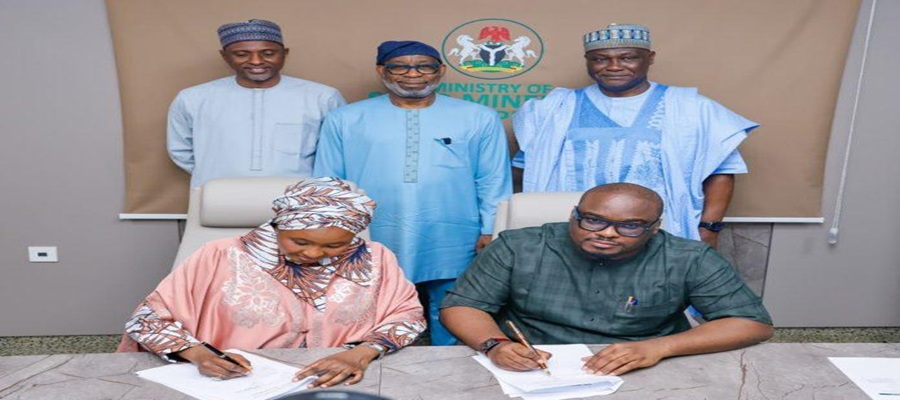
Nigerian Government has signed a $1.3 billion Memorandum of Understanding (MoU) with Africa Finance Corporation (AFC) via the Solid Minerals Development Fund (SMDF) to fund an alumina refinery, national geoscience mapping, and a strategic investment vehicle for mining growth.

Special Assistant to the Minister of Solid Minerals Development, Segun Tomori, said the refinery will process one million tonnes of bauxite yearly using a modern Bayer process, powered by an on-site gas-fired cogeneration plant.
Minister Dele Alake called it a transformative milestone boosting GDP, aligning with reforms that improve investment climate, regulations, and licensing to attract private capital. He directed agencies to fast-track permits.
The 20-year project at 95% utilization eyes 19 million tonnes total output, $1.2 billion annual GDP addition, $25 billion economic impact, and $8 billion forex earnings, per feasibility studies.
SMDF Executive Secretary Fatima Shinkafi termed it the agency’s biggest funding deal, supporting value-addition policy.
The partnership extends to geoscience mapping for mineral data, de-risking exploration, and a joint vehicle for mining assets.
Permanent Secretary Engr. Farouk Yabo praised the reforms. Shinkafi signed for government; AFC’s Franklin Edochie for the corporation, witnessed by AFC CEO Samaila Zubairu.
Tomori positioned it as Nigeria’s largest private mining investment and FDI magnet.

NAICOM Signs MoU with BPP to Deepen Insurance Compliance in Public Procurement

FG Approves GIS-enabled Digital Postcode to Tackle Logistics Gaps, Boost E-commerce

Firm Enhances its Security Awareness Platform with SCORM and PDF Support

GSMA, African Operators, Others to Launch Low-cost 4G Devices

Binance Cuts Illicit Activity Exposure by 96%, Leads Global Crypto Compliance Push
Kaspersky Brings more Transparency to Threat Detection with New Hunt Hub

Dr. Cairo Ojougboh Foundation Bolsters Nigeria’s Education Drive with ₦2.7m Student Support

NDPC Commits to Balancing Data Privacy, Protection Information

OADC Lagos Reinforces Commitment to Local Data Hosting and Digital Transformation @ NDPC’s National Privacy Week Summit

PwC Reveals AI Scaling Gap Slows Africa’s Digital Transformation




 Telecom2 days ago
Sunil Bharti Mittal Conferred GSMA Lifetime Achievement Award for Transforming Global Telecommunications

 Telecom2 days ago
Why Digital Trust Matters: Secure, Responsible AI for African SMEs?

 General News2 days ago
Krishnan Exits Africa Data Centre to Embark on Professional Chapter

 E-Business2 days ago
Jumia Tech Week 2026 Begins with Tech Deals on Smartphones, Electronics, and Everyday Technology

 General News3 days ago
Leo Stan Ekeh at 70; thanks Tinubu, Obasanjo, Nigerians, Global Tech Community

 Broadcasting2 days ago
NCAA Orders Overland Airways to Refund VAT Charged on 2025 Tickets

 Telecom2 days ago
House Probes Fintech Regulation via Public Hearing on New Commission Bill

 News2 days ago
AfDB Supports Francophone Africa Start-ups with €6.5M