

E-Financial
Osinbajo Tasks Banks on Transformation Projects

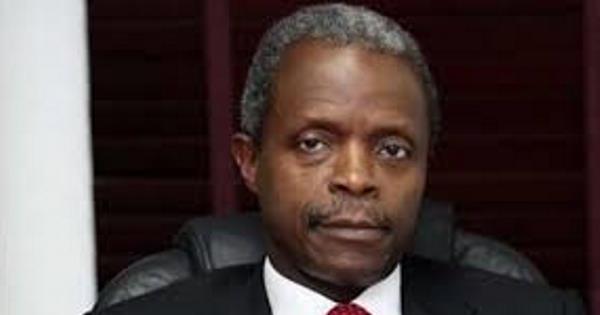
Vice President Yemi Osinbajo yesterday tasked the banking and finance sector to take on more transformative projects such as housing and renewable energy, among others, in ways that will significantly impact job creation and poverty reduction.

Prof Osinbajo stated this at the opening session of the 14th Annual Banking and Finance Conference themed “Economic Recovery, Inclusion, and Transformation, the role of Banking and Finance”,
He noted that the banking and finance sector has over the years played significant roles in the economy.
President Muhammadu Buhari had earlier declared the conference opened and his Rwandan counterpart, Paul Kagame also delivered the keynote address.
According to the Vice President, “it is time for the sector to take on some of the transformative big-ticket items that would fundamentally transform our economy. Such matters include consumer finance but housing finance in particular.”
He noted that a focus on how to finance housing is critical.
Referencing an African Development Bank (AfDB) survey, Prof. Osinbajo said “the housing sector may support poverty reduction and inclusive growth in two general ways. First, housing construction contributes to economic output, creates employment, and generates a demand for materials and related services. Second, improved housing raises the standard of living of occupants.
“That study (AfDB survey) says for example that the benefits of housing for individuals accrue in large part through better health and sanitation, and of course this improves the overall human capacity of our citizens who are able to own these houses. Housing also generates large multiplier effects in terms of employment and output. Employment is created for both skilled and poorer, unskilled workers.
“The evidence also suggests that there is a symbiotic relationship between housing finance and financial sector development. Housing finance helps to develop the financial sector itself and helps to contribute to economic growth. So, these were the justifications that we also advanced for our mass housing initiative in the Economic Sustainability Plan.”
Challenging the banking sector on participating in the Federal Government’s Mass Housing programme, the VP noted that “the finance sector appears shy or simply has not found the right housing finance model that will work.”
On renewable energy and mitigating the impact of climate change, Prof. Osinbajo said “one of the chief considerations especially for developing countries is how to pay for the massive transition to renewable energy. How do we pay for moving from where we are especially fossil fuel-based power sources to renewable energy? This is a significant challenge but it is also an enormous opportunity.”
Citing the example of the Federal Government’s solar power initiative, Prof. Osinbajo decried the low interest shown by Commercial Banks to catalyze installations or manufacturing for the Solar Power Naija programme.
He explained that “the challenge of under-electrification of the rural and poor and its associated impacts on our economic well-being and security cannot be overstated. The climate change challenge is a massive one in more ways than we can imagine.
“I would like to encourage the Bankers Committee to refocus on supporting the Solar Power Naija to ensure that in the next few months we can catalyze access to the N140 billion and create 5 million connections that can multiply to eliminating our electricity access deficit and creating jobs.”
While commending the sector for its efforts in improving service delivery over the years, the VP noted that “going forward, the banking and finance sector must take advantage of the new opportunities that are opening up and also adapt to domestic and international developments.
“The rapid changes in the technology sector mean that financial technology companies and payment service companies are now an inescapable part of the banking and financial landscape.”
Prof Osinbajo also suggested that financial inclusion being critical to the objectives of recovery, inclusion and transformation, should be prioritized “especially in this COVID era, for the poor and more vulnerable sections of society so that they can keep their micro-businesses alive and handle risks and uncertainty.”
Other dignitaries who spoke at the event include Governor Babajide Sanwo-Olu of Lagos State; Governor of the Central Bank of Nigeria, Godwin Emefiele, and President of the Chartered Institute of Bankers (CIBN), Mr Bayo Olugbemi, among other bank executives across the country with several participants also joining virtually.



Kuda Technologies Limited, a Nigerian digital bank backed by global investors, has laid off employees across several departments as it restructures its operations, even as the company says its financial position has been improving.

The job cuts affected multiple departments.
The firm however said that the decision to cut job is not driven by financial pressure, but part of the natural evolution of a company at our stage, aligning with industry benchmarks.
On Wednesday, March 25, staff were invited to a company-wide video call with senior executives.
Before the meeting ended, hundreds of employees were informed that their roles had been terminated as part of a broader restructuring.
The cuts affected multiple teams, including marketing, where 19 of the unit’s 40 employees were impacted, two affected workers said.
In a statement emailed on Friday, a Kuda spokesperson said the move followed a strategic review of the business and was meant to prepare the company for its next phase of growth.
“Kuda is evolving how the organisation is structured to support the next phase of our growth and scale,” the spokesperson said. The company added that the decision was not driven by financial pressure or employee performance but by changes in operational priorities.
Employees received notices explaining that the company had reviewed its future direction and industry benchmarks before deciding to reorganise some departments.
The process, according to the company, was aimed at aligning its workforce with long-term goals.
Still, the way the layoffs were communicated unsettled some staff.
An unusual company-wide meeting was scheduled earlier in the day, and several employees initially struggled to access the call link, according to a former employee. When the meeting began, senior leaders confirmed the job cuts.
Some workers also questioned the timing of the restructuring, pointing to recent hiring decisions, including senior-level recruits.
Kuda said it is offering affected employees severance packages that vary depending on role and length of service.
According to a person familiar with the terms, some staff may receive up to seven months of pay. The company has also proposed enhanced exit packages tied to settlement agreements.
The layoffs come at a time when many African fintech companies are shifting focus from rapid expansion to profitability and operational efficiency after years of venture-backed growth.
Kuda, which has about seven million registered customers, has been narrowing its losses in recent years. The company reduced its losses to about $5.83 million in 2024 from $35.11 million a year earlier, helped by stronger performance from its Nigerian business and lower operating expenses.
Its Nigerian unit nearly doubled revenue in local currency to about N21.2 billion during the period.
The fintech has also reported strong growth in transaction activity. In its last public update, Kuda said it had processed more than 300 million transactions worth roughly N14.3 trillion and issued N16.4 billion in overdrafts, up 43 percent from the previous quarter.
Babs Ogundeyi, chief executive officer said the company’s net margin has ranged between three percent and seven percent per month. If that pace continues through the year, the digital bank could process more transactions in 2025 than it did in its first five years combined.
Kuda last raised external funding in 2024, securing $20 million in equity at a valuation of about $500 million. The fundraising came after the company recorded nearly $45 million in losses over the two years leading up to the round.
The restructuring suggests the startup is now adjusting its cost base and internal structure as competition intensifies in Nigeria’s fast-growing digital banking market and investors push fintech firms to show clearer paths to sustainable growth.

Central Bank of Nigeria (CBN) has assured Nigerians that the ongoing banking sector recapitalisation exercise will not affect customer deposits, insisting that the financial system remains stable and fully secure.

The apex bank gave the reassurance amid growing public anxiety and misinformation ahead of the March 31, 2026, deadline set for banks to meet new capital requirements.
In a series of advisories issued via its official communication channels, the CBN emphasised that the deadline applies strictly to banks and not to customers, stressing that there is no cause for panic.
“The deadline is a timeline for banks, not customers,” the bank stated, adding that routine banking activities would continue without disruption.
Addressing widespread fears over the safety of deposits, the CBN said all customer funds remain protected, urging Nigerians not to engage in panic withdrawals or close their accounts.
“Your accounts and funds are unaffected. Banking products and services continue as normal,” the bank said, reiterating that recapitalisation is designed to strengthen, not weaken, financial institutions.
The regulator further dismissed claims circulating on social media suggesting that banks could freeze accounts as part of the exercise, describing such reports as false and misleading.
“No, this is false. Banks will not freeze customer accounts. Please ignore unverified social media rumours,” the CBN said.
The recapitalisation programme, according to the apex bank, is a routine regulatory measure aimed at increasing banks’ capital base to enhance resilience, improve risk absorption capacity, and position the sector to better support economic growth.
On concerns that recapitalisation could lead to higher banking charges or reduced access to services, the CBN maintained that there would be no adverse impact on customers.

Federal government has announced that it is ramping up efforts with the 36 state governments to participate in the $500 million World Bank-assisted loan facility under the HOPE Governance Programme.

This was disclosed in a statement on Thursday by Joe Mutah, spokesperson for the scheme.
Commenting on the program, Dr Deborah Odoh, permanent secretary of the Federal Ministry of Budget and Economic Planning, stated that the ministry is collaborating closely with the Federal Ministry of Finance to ensure that all 36 states of the Federation sign the Subsidiary Loan Agreement that would enable them to participate in and benefit from the World Bank-assisted HOPE Governance Program.
Odoh made these remarks in Abuja on Wednesday when she received the HOPE Governance Team from the World Bank on a courtesy visit to her office.
“We have been strategizing with the Federal Ministry of Finance with the involvement of our Honourable Minister Sen. Abubakar Atiku Bagudu. We will put in extra efforts to make it happen even faster given the time constraints. We have a timeline drawn up recently to achieve this,” she said.
The permanent secretary pledged to provide all the necessary institutional support to ensure that HOPE Governance delivers significant impact across the country.
“I’m glad we are having this meeting, which is long overdue, and certainly we are here all the time. We expect to see more tangible results and impact shortly,” she said.
Ikechukwu Nweje, leader, World Bank Task Team, HOPE Governance Programme, had earlier appealed to the permanent secretary to utilize all available channels within the Ministry to engage state governments and secure the signing of the Agreement, thereby enabling them to access funds under the Program upon verification of the Disbursement-Linked Results.
“However you can help us to fast track these processes, this will really be appreciated to get this program up and running in terms of disbursement,” he said.
He stressed that governance remains a key challenge to improved service delivery in the basic education and primary healthcare sectors, which is why the federal government, in collaboration with the World Bank, has initiated the HOPE Governance Program to address the issue.
“If the governance part fails, we will continue to have the same problems we are having on the sectoral side. That is why the ministers prioritized governance because they found out that governance is the issue in the two sectors that will help to unlock the ability to deliver results,” he stated.
Earlier, Dr. Assad Hassan, national coordinator of the HOPE Governance Programme, stated that the meeting was convened with the World Bank to apprise the Permanent Secretary of the milestones recorded and the challenges encountered in the implementation of the program so far.

Breaking…..Kuda Lays Off Many Employees in Broad Restructuring

NCC to Curb SIM Fraud, Strengthen Digital Security with New Platform

NBC Boss Urges Content Ceators to Participate in DSO

Kidnappers Now Use Banks to Collect Ransoms — Expert

CBN Says Bank Customers Won’t Lose Deposits because of Recapitalisation

Kaspersky Discovers New Phishing Campaign Exploiting Google Tasks Notifications to Steal Corporate Credentials

esentry 2025 Report Shows Healthcare, Financial Services and Telecoms as Staging Grounds for Increased Cyberattacks in Africa

Spotify’s Loud & Clear Report Reveals Over ₦60Bn Revenue for Nigerian Artists in 2025

China Threatens to Shut Nigeria’s Satellite Over $11.44m Unpaid Debt

MTN Nigeria Posts Record N1.70 Trillion Pre‑Tax Profit, Declares N20 Dividend for 2025




 E-Financial3 days ago
CBN Directs IMTOs to Open Naira Settlement Accounts

 Telecom3 days ago
Nigerians Lose N12.5Bn to AI-Driven Scams- PwC

 General News3 days ago
Court Remands Hacker for Allegedly Stealing N3.09Bn from FCMB

 Telecom3 days ago
Airtel Africa, Starlink Mobile Data and Messaging Testing Take off in Kenya

 E-Financial3 days ago
DLM Capital Group’s AAA-Rated Sovereign Bond-Backed Composite Notes (“SBCNS”) Strengthens Investor Confidence with Successful First Principal & Interest Payment

 E-Business3 days ago
AU Sees AI Adoption Evolving to Boost Economic Growth in Africa

 Telecom3 days ago
GATEWAY Programme Opens Doors for 340,000 Nigerian Youths to Tap into $1.85trn Global Gig Economy

 News3 days ago
Kaspersky, AFRIPOL Conduct Joint Cybersecurity Training for African law Enforcement