

Telecom
PAFON: Digital Encode, Cybervergent, Payble Sign Up for Payments Forum Nigeria 1.0

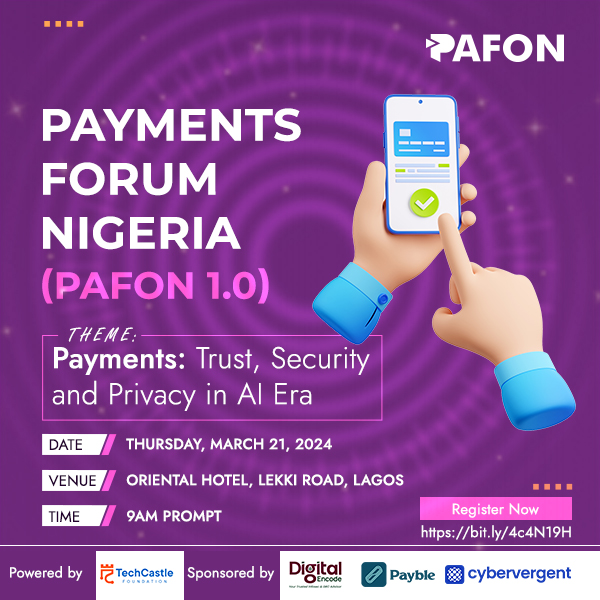
Payments Forum Nigeria (PAFON), the cross-industry platform focused on addressing issues that require broad cooperation and coordination across many constituents in the payments industry, has attracted sponsorships from Digital Encode Limited, Cybervergent and Payble.

Financial industry experts are warming up for the first edition of PAFON, scheduled to take place at Oriental Hotel, Lekki Road, Lagos on Thursday March 21, 2024, by 9am.
The Forum aims at providing an inside-look at the industry, offering perspectives from key stakeholders, including payment networks, technology innovators, leading merchants, issuers, acquirers and payment processors.
Throughout the years, the finance world has shifted into something much more than just banking and big corporations.
Speaking ahead of the star-studded PAFON 1.0, with the theme: “Payments: Trust, Security and Privacy in AI Era”, Dr. Adewale Peter Obadare, the Chief Visionary Officer [CVO], Digital Encode Limited, said that customers want to be assured that their sensitive information, such as credit card numbers and personal details, is treated with utmost care hence security has become paramount in the payments industry.
“Secure payment processing ensures that data breaches are minimized, instilling confidence in customers to keep coming back. Nigerian financial institutions reported ₦159 billion ($201.5 million) lost to fraud cases since 2020, according to the Financial Institutions Training Centre (FITC). This is what the experts must tackle and customer awareness is key too”, he said.
Based on a report by Gartner, by 2024, 40% of privacy compliance technology will rely on AI, up from 5% in 2019, and by 2025, 60% of large organizations will use at least one privacy-enhancing computation technique in analytics, business intelligence, or cloud computing, and financial services industry is no exempted.
On the other hand, Roosevelt Elias, the co-founder of Payble, described PAFON as a ‘must-attend’ Forum due to the ‘issues listed to be discussed are germane and require critical attention. For instance, building financial inclusive products requires a mix of technology and illiteracy. The industry can’t achieve this by working in silos; we just have to unite to achieve the set target on financial inclusion, particularly for the rural dwellers.
Digital Encode (a leading consulting and integration that specializes in the design, management, and security of business-critical architecture); Cybervergent (a company dedicated to helping protect business sensitive data from cyber-attacks, including customer information, financial records and intellectual property); Payble (a fintech startup that modernises local government payments such as creating citizen-centric payment experiences, delivering flexible billing and simplified rate collection, will be joined at PAFON 1.0 by Inlaks, an IT company that offers core banking, fraud management, cybersecurity, cloud, data center, enterprise risk management, amongst other industry players.
“Our goal is to enable information exchange and knowledge sharing on key industry insights issues amongst key stakeholders, with the objective of ensuring a collaborative and proactive approach to push for policies that enable growth, tackling/mitigating fraud and limiting occurrences and losses”, said Mr. Chike Onwuegbuchi, the co-founder of TechCastle Foundation, organisers of Payment Forum Nigeria (PAFON).
He said that the Forum is driven by the reasons to; “educate and inform financial service players and other stakeholders on various issues and trends (both locally and globally); proactively share data/information amongst banks, Fintechs and other service providers, to enable prompt responses to prevent and/or limit (customer-related) losses; and discuss key Payments security trends”.
“Speakers will be drawn among industry players such as banks, Fintechs, mobile money operators, blockchain experts, Cybersecurity, etc., as we expect attendees from the Central Bank of Nigeria (CBN); e-Banking Heads; Chief Compliance Officers of banks in Nigeria; Chief Internal Auditors of banks in Nigeria; Office of The National Security Adviser; Switching companies; the Economic and Financial Crimes Commission; Licensed Mobile Payment Operators; Electronic Payments Providers; Information Security Experts; Consumer Protection; Financial Policy and Regulation; Information Technology; Legal Services; Banking Supervision; Corporate Communication; Shared Services Office; Blockchain Security Experts, etc”, he added.
Participation:
Participation is free; however, you are required to pre-register using the link here: https://bit.ly/4c4N19H



The International Rescue Committee (IRC) has announced the formation of Airbel Ventures, a new humanitarian impact investing fund aimed at accelerating the introduction and scaling of breakthrough technologies in crisis-affected communities.

The fund will invest in companies whose ideas have the potential to change humanitarian response, including digital infrastructure for frontline health systems and climate-resilient agriculture.
The launch of Airbel Ventures follows a period of rapid innovation at the IRC, despite the humanitarian sector facing record funding cuts.
In the past year, the IRC’s Airbel Impact Lab has advanced more than twenty Artificial Intelligence (AI) and technology initiatives—from anticipatory action tools powered by climate and vulnerability data, to frontline service delivery using safe, orchestrated AI systems, to breakthrough diagnostic tools for emerging diseases.
Airbel Ventures’ first impact investment is in Signalytic, a company delivering solar-powered computing devices that ensure reliable electricity and connectivity for remote health facilities.
Following the investment, the IRC will pilot Signalytic’s technology with its Nigeria Health team, demonstrating the viability of next-generation digital infrastructure in humanitarian settings.
“We know breakthrough solutions already exist—what’s missing is the path to scale in humanitarian contexts,” said Dr. Jeannie Annan, Senior Vice President for Research & Innovation at the IRC and head of the Airbel Impact Lab.


MTN Nigeria, the country’s largest telecommunications operator, recorded a historic surge in network disruptions in 2025, suffering 9,218 fibre cuts as of December 31, alongside 211 base station sites affected by theft and vandalism, incidents that disrupted mobile and data services relied upon daily by millions of Nigerians.

The data was revealed by Dr Karl Toriola, chief executive officer/managing director, MTN Nigeria via a social media post titled ‘MTN Nigeria 2025 Wrapped’.
The scale of the damage highlights the growing vulnerability of Nigeria’s telecommunications infrastructure, which has come under increasing pressure from road construction activities, cable theft and deliberate acts of vandalism.
MTN said 5,478 fibre cuts occurred within just the first seven months of 2025, with 760 incidents recorded in July alone, underscoring the intensity of the challenge.
Some of the incidents had wide-ranging consequences, knocking out connectivity across multiple states simultaneously and affecting voice calls, data services, digital payments and enterprise operations.
The company described the situation as a national infrastructure problem, rather than an isolated corporate issue, given the economy’s deep dependence on mobile networks.
“These gaps were shaped by real operational challenges such as fibre cuts, theft, and vandalism. Their impact is felt directly by customers and reflected in what they tell us,” Toriola,
The disruptions were reflected in customer feedback volumes, as MTN handled an unprecedented number of complaints during the year. The operator said it resolved 1,624,263 customer complaints in 2025, spanning call centres, social media platforms, emails and physical service centres nationwide.
Despite the setbacks, MTN pointed to signs of operational resilience. The company retained its ranking as Nigeria’s best network by Ookla, returned to profitability after a challenging period, declared an interim dividend, and expanded its subscriber base to over 85 million users by September 2025.
The figures show that while Nigeria’s telecom operators continue to invest heavily in network expansion and customer service, infrastructure sabotage remains a major drag on service quality and operating costs.
MTN acknowledged that performance improvements remain a work in progress. “We are not where we want to be yet. We see you. We hear you. We exist because of you. And we will get better,” Toriola said.
As the company enters its 25th year of operations in Nigeria, Toriola said MTN is doubling down on customer-centricity, treating every piece of feedback as a guide for improvement, while also stepping up engagement with government agencies.
The CEO renewed calls for stronger regulatory and legal protections for telecommunications infrastructure, urging policymakers to classify fibre cables, base stations and other critical assets as national infrastructure and criminalise vandalism to deter repeat attacks.
Nigerian Communications Commission (NCC) has granted operating licences to six new Internet Service Providers (ISPs), effective January 1, 2026, raising the total number of authorised ISPs in the country to 231 from 225 recorded in December 2025.

NCC
The newly licensed firms are Intellvision Technologies Limited, Granet Technologies Limited, Fiber Sonic Limited, Dasol Solution Services Ltd, Boost ISP Limited, and Amazon Kuiper Nigeria Limited.
Five of these companies are headquartered in Lagos, while Granet Technologies Limited operates from Owerri in Imo State, highlighting the persistent concentration of broadband infrastructure in major commercial hubs like Lagos, Abuja, and Port Harcourt.
This development intensifies competition in Nigeria’s broadband market, which faces pressure from dominant mobile network operators such as MTN and Airtel, alongside rapid expansion by satellite providers like Starlink.
Traditional ISPs continue to grapple with shrinking customer bases, aggressive data pricing from telcos, and satellite disruptions, even as NCC data from Q2 2025 showed Spectranet, Starlink, and FibreOne controlling about 65 per cent of the 313,713 active ISP subscribers.
The inclusion of Amazon Kuiper Nigeria Limited marks a significant entry of global satellite broadband competition, building on Nigeria’s recent approvals for other low Earth orbit providers to enhance connectivity in underserved areas.
Industry analysts view the licences as a strategic push to improve internet quality amid rising demand for digital services, though geographic clustering underscores ongoing infrastructure challenges outside urban centres.
NCC’s move aligns with broader efforts to foster a competitive telecoms sector critical to Nigeria’s digital economy ambitions.

PalmPay User Shares Experience on Fintech Apps to Trust in Nigeria

Stakeholders Demand Stronger Governance and Infrastructure to Drive Tech Adoption @ Lagos AI Summit

Nigerians Target Self-Improvement, Business Startups in 2026 Google Data

35 Million Nigerians Face Acute Hunger in 2026, UN Warns

How Inside Jobs and Policy Shocks Trigger Nigeria’s Rising Loan Crisis

Banks quietly move to enforce new ₦50 transfer levy from Jan. 1

Jumia CEO says Black Friday Signals Nigeria’s E-Commerce Maturity

19 Nigerian Banks Meet CBN Recapitalization Targets Ahead of March Deadline

Galaxy Backbone Celebrates the Federal Government’s Paperless Civil Service Milestone

DStv Offers Instant Package Upgrade for Customers from January to February




 E-Financial2 days ago
Zenith Bank Gets Regulatory Approval for Full Takeover of Paramount Bank

 Telecom2 days ago
MTN Nigeria Suffers 9,218 Fibre Cuts in 2025 as Vandalism, Theft Cripple Network

 E-Business2 days ago
Firm Detected a Fivefold Surge in QR Code Phishing Attacks in the Second Half of 2025

 Telecom2 days ago
New Investment Fund Targets Acceleration of Emerging Technology in Nigeria

 News2 days ago
NITDA Commits to Digital Inclusion for Persons with Disabilities

 Telecom2 days ago
NCC Licences Six New ISPs to Challenge Telcos, Satellite Giants

 E-Financial2 days ago
FCCPC Delists Non-Compliant Digital Lenders Post-January 5 Deadline

 E-Business2 days ago
JustMarkets Unveils Top 5 Trading Assets for 2026 Profits