Broadcasting
Sanwo-Olu, SGF Mustapha Set for GOCOP Fifth Annual Conference

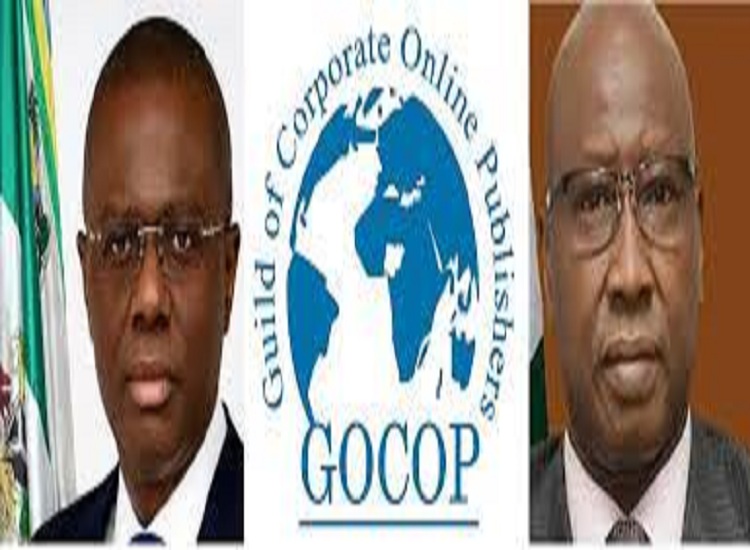
Governor Babajide Sanwo-Olu of Lagos State and Secretary to the Government of the Federation (SGF), Boss Mustapha, have confirmed their participation at the fifth annual conference of the Guild of Corporate Online Publishers (GOCOP).

The two-day conference with the theme “COVID-19 Pandemic: Recovery and Reconstruction in Nigeria” will take place at the Sheraton Hotel, Ikeja.
A statement by GOCOP Publicity Secretary, Olumide Iyanda, disclosed that Mr. Sanwo-Olu’s presence was confirmed to the conference organising committee by the Lagos State Commissioner for Information and Strategy, Gbenga Omotosho.
Mr. Mustapha’s participation was confirmed by a letter dated September 14, 2021, and signed by the Permanent Secretary – General Service Office, Office of the Secretary to the Government of the Federation, Nnamdi Maurice Mbaeri.
The conference will open on Wednesday, October 6 with a business session which will have Editor-in-Chief of Premium Times, Musikilu Mojeed; Group Executive Editor of DigitalSENSE Africa Media Ltd, Remmy Nweke, and Editor-in-Chief/CEO of NATIONAL ACCORD, Tom Chiahemen, as facilitators.
Corporate affairs managers from the public and private sectors will also be hosted to lunch on the opening day of the conference.
All programmes on the opening day are strictly by invitation.
Governor Sanwo-Olu will be chairman on the second day of the conference, Thursday, October 7, when the SGF will deliver a keynote address on the conference theme.
Lagos State Commissioner for Health, Prof. Akin Abayomi, and Director, Nigeria Centre for Disease Control (NCDC), Dr. Yahaya Disu, will serve as panelists.
The choice of topic and speakers at the conference was informed by contemporary political, economic, security, socio-cultural challenges facing Nigeria occasioned by the coronavirus pandemic, which has crippled socio-cultural and economic activities not only in Nigeria but around the world and the concerted efforts made nationally and globally to tame the scourge, the statement by GOCOP said.
Broadcasting
A dangerous Concentration of Power: Is CBN’s Fixed Income Securities Takeover a Ticking Bomb for Nigeria’s Economy?

By Blaise Udunze
The Central Bank of Nigeria’s decision to take full control of government securities issuance has been described by some as a bold move toward transparency and market efficiency. Yet, beneath the surface of this reform lies a web of structural dangers that could tighten credit even further, push interest rates higher, escalate exchange-rate instability, trigger regulatory turf wars, and strangulate the private sector, especially small and medium enterprises (SMEs) that already struggle to survive in Nigeria’s high-cost economy.

The policy shift became more pronounced with the rollout of a new Treasury Bills (T-Bills) auction regime, mandating that all bids be submitted through the CBN’s S4 digital interface. This transition officially bypasses the longstanding Primary Dealer Market Maker (PDMM) framework and represents the clearest sign yet that the apex bank is asserting complete control over how government securities are issued, priced, and distributed. In fact, the first major test of this system will occur with the federal government’s planned N700 billion T-Bills issuance scheduled for November 20, 2025 which is an unprecedented rollout that effectively transfers auction power from market intermediaries directly to the CBN.
Analysts say this shift is not merely operational; it is structural. The S4 interface, which has existed since 2014 but never fully deployed as the primary submission platform, now becomes the exclusive gateway for government securities issuance. All bids, whether retail or institutional must be lodged through S4 between 8:00 a.m. and 11:00 a.m., with the CBN maintaining full discretion to adjust the offer amount or reject bids it considers inconsistent with market conditions. Settlement will occur within 24 hours.
According to market expert Tajudeen Olayinka, CEO of Wyoming Capital Partners, the policy “is consistent with the CBN’s signal that it would take charge of the primary segment of the fixed-income market where government securities are issued.” Another veteran dealer put it more bluntly: “With S4, no dealer can see what rate others are quoting. All bids now meet at the same window. This dismantles the old advantage PDMMs enjoyed.”
Although transparency is improved by removing dealers’ visibility over competing bids, concerns have intensified over the broader consequences of the CBN monopolizing the government securities market. The danger is that this reform which is unaccompanied by strong institutional coordination between the CBN, the DMO, and the Ministry of Finance could trigger deeper systemic imbalances.
One of the most pressing fears is the crowding-out effect. If the CBN aggressively issues more government securities as part of its liquidity-management operations, banks, already heavily invested in government debt, will divert even more of their portfolios toward these risk-free instruments rather than lending to the real economy.
Nigeria’s top five banks known as the FUGAZ group (First HoldCo, UBA, GTCO, Access Corp, and Zenith Bank) provide compelling evidence of this shift. Their financial statements show a combined N49.152 trillion investment in securities and Treasury Bills as of September 2025, a sharp rise from N42.204 trillion at the end of 2024. In just nine months, they added nearly N7 trillion to these holdings.
Interest income from these investments surged by 33 percent, hitting N4.8 trillion in the first nine months of 2025 compared to N3.6 trillion in the same period of 2024.
– Access Corporation led the pack with N15.25 trillion in securities holdings,
– followed by UBA with N13.59 trillion,
– Zenith at N9.05 trillion,
– First HoldCo with N6.35 trillion, and
– GTCO at N4.91 trillion.
These investments generated robust returns: Access earned N1.3 trillion; Zenith N1.14 trillion; UBA N1.03 trillion; FBN HoldCo N720 billion; and GTCO N570 billion.
For analysts, these numbers expose a structural vulnerability as Nigerian banks are quickly transforming into large-scale government lenders rather than engines of private-sector credit. As Dr. Muktar Mohammed of Lagos Business School explains, “Banks have found refuge in government instruments because they are safe, liquid, and yield high returns in a volatile economy, but this behaviour constrains credit growth to the real sector.”
Lending data confirms this.
– Zenith Bank’s loan-to-deposit ratio slipped from 43 to 40 percent;
– Access Corporation maintained a flat 41.2 percent despite rising deposits;
– UBA’s ratio dropped to 28.2 percent;
– GTCO’s remained stagnant; and only
– First HoldCo showed notable improvement.
This trend is dangerous. Nigeria’s private sector, especially SMEs is already starved of credit. Lending rates hover between 28 percent and 35 percent, making capital unaffordable for most small businesses.
With the CBN taking full control of securities issuance, the likelihood is high that more liquidity will be absorbed through T-Bills and OMO bills, pushing interest rates further upward. The more attractive government securities become, the less incentive banks will have to lend to SMEs. This is how economies slide into cycles of low productivity, high unemployment, and weak domestic investment.
The implications do not end there. Excessive issuance of government securities could also destabilize the exchange rate. When interest rates remain artificially high to attract foreign portfolio investors into T-Bills, Nigeria becomes dependent on “hot money” which turns out to be short-term foreign inflows that exit the economy at the slightest shock. This pattern has historically triggered sharp naira depreciation, panic in the FX markets, and severe liquidity shortages in the banking sector. If the CBN uses this securities-controlled regime to sustain high yields, Nigeria risks attracting unstable capital inflows that will exit rapidly, putting pressure on the naira.
Beyond monetary and credit risks, there is a troubling regulatory dimension. The CBN’s move to migrate fixed-income trading and settlement from the FMDQ Securities Exchange, which is under SEC oversight to its own Real-Time Gross Settlement (RTGS) and S4 platforms has ignited a full-blown turf war between the CBN and the Securities and Exchange Commission.
Under the Investments and Securities Act (ISA) 2025, the SEC holds exclusive authority over trading venues. Critics warn that the CBN’s attempt to operate exchange-like infrastructure violates statutory boundaries and risks destabilizing the market.
Dr. Akin Olaniyan, CEO of Charterhouse Limited, described the move as “a potential recipe for dual regulation and confusion,” arguing that it may undermine investor confidence. Similarly, Dr. Walker Ogogo, pioneer Registrar of the Institute of Capital Market Registrars, noted that since the CBN already owns 16 percent of FMDQ, operating parallel infrastructure creates conflicts of interest that send negative signals to foreign investors.
MoneyCentral reports that the migration could trigger a 67 percent drop in FMDQ’s trading volume, weakening a system that has long supported Nigeria’s fixed-income ecosystem.
Veteran banker Victor Ogiemwonyi stated, “the CBN is not an exchange; it should not be involved in issuing, dealing, and settling securities. Conflating these roles creates unnecessary risk.” His concerns are grounded in the principle that market operators must be independent from regulators to prevent conflicts of interest. The CBN’s dual role as both regulator and operator blurs these lines and may set a dangerous precedent.
The real casualties of these structural conflicts will be SMEs and the broader private sector. These enterprises rely on bank credit to fund inventory, acquire machinery, expand operations, and withstand economic shocks. When banks prefer government securities over lending,
– SMEs face higher rates,
– stricter collateral requirements,
– fewer loan products, and shorter tenors.
– Many will be forced to downsize, lay off workers, or close altogether.
In an economy where SMEs account for over 90% of jobs, this contraction would be disastrous.
Another major overarching risk is that:
– The CBN’s consolidation of securities issuance power without corresponding checks from the DMO and Ministry of Finance creates an unbalanced financial architecture where monetary priorities overshadow fiscal realities and private-sector growth.
– Policies crafted in silos rarely produce macroeconomic stability. They produce distortions, uncertainty, and systemic fragility.
Nigeria stands at a critical junction. Securities issuance can be made transparent without centralizing all power in the CBN. Fixed-income markets can be cleaned up without dismantling the institutional balance that preserves confidence. What the country needs is coordination, not consolidation; collaboration, not domination.
If the CBN continues its takeover without robust guardrails, the result may be a financial system where banks stop lending, SMEs continue to collapse, interest rates remain high, the naira stays volatile, and regulatory conflicts scare away both local and foreign investors.
To avoid the dangerous risks ahead, Nigeria must:
1. Strengthen collaboration between CBN, DMO, and Ministry of Finance. Debt issuance must reflect both monetary and fiscal realities not just liquidity needs.
2. Prioritize long-term bonds over short-term T-Bills. This reduces rollover risk and provides stable funding at lower long-term cost.
3. Implement SME-focused credit interventions through private banks, not direct CBN lending. Monetary policy should not attempt to replace commercial banking.
4. Reduce government’s domestic borrowing needs. This requires fiscal reforms, spending discipline, and revenue expansion not more debt.
5. Protect private-sector credit allocation. Regulators should discourage excessive bank investment in government securities.
Without these safeguards, the economy risks tilting dangerously toward monetary domination and private-sector suffocation.
The gains of transparency cannot come at the cost of institutional imbalance. Nigeria’s economic recovery depends on a thriving private sector, not an expanding government debt market. The central bank must not become the single most powerful issuer, dealer, regulator, and judge in its own market. That path leads not to stability but to systemic risk, risk that Nigeria’s fragile economy can ill afford.
Meanwhile, it is important for CBN to provide clarity on the economic rationale behind this centralisation of power. The CBN must come forward to justify how this shift will tangibly benefit the economy, particularly in the areas most sensitive to credit availability, financial stability and stability for Nigeria’s broader economy.
Blaise, a journalist and PR professional writes from Lagos, can be reached via: [email protected]
Broadcasting
Is Nigeria Economically Broke? Challenges and Opportunities in Africa’s Largest Economy

Is Nigeria, Africa’s largest economy, economically broke? It is a question no patriotic citizen wants to confront, yet one that confronts every Nigerian daily at the fuel pump, the market stall, the school gate, the hospital reception, and increasingly, in the national accounts. The country’s fiscal reality is no longer a debate in economic circles alone; it is a lived experience for millions and a gathering storm for future generations.

To understand the gravity of the nation’s situation, one must look beyond political speeches and interrogate Nigeria’s borrowing patterns, revenue profile/debt numbers, public spending, and the economic behavior of both federal and state governments under President Bola Ahmed Tinubu’s. administration. What emerges is a troubling picture as taxation is squeezing small businesses, borrowing is mortgaging the nation’s tomorrow, and shockingly, the trillions shared among federal, state, and local governments every month translate into little visible development. Nigeria’s books show figures, but her streets show a different reality.
Since President Bola Ahmed Tinubu assumed office in June 2023, Nigeria’s public debt has spiraled from N33.3 trillion to N152.4 trillion by mid-2025 which represents a staggering 348.6 percent increase in just two years. Economies do not collapse overnight; they weaken gradually, sending warning signs that only become obvious in hindsight. Nigeria is flashing all the red signals today. Between July and October 2025 alone, the government secured over $24.79 billion, €4 billion, ¥15 billion, N757 billion, and another $500 million in sukuk bonds. These figures, in a functional economy, should translate into expanded electricity capacity, world-class healthcare systems, vibrant industries, better roads, thriving SMEs, and export-oriented value chains. Instead, much of Nigeria’s real sector remains stagnant as energy is unstable, industrial output is weak, and infrastructure remains largely stuck in the realm of political promises.
Borrowing, in itself, is not the crime. Nations borrow to grow. Borrowing becomes a problem when the funds are not directed toward productive, self-liquidating projects capable of paying back the debt through increased economic activity. Nigeria borrows aggressively but produces too little. The loans are not translating into productivity or growth, which is why the debt-servicing burden continues to rise. Today, more than 90 percent of government revenue is spent on servicing old debts. In some quarters, debt servicing now consumes 25 percent of Nigeria’s entire annual revenue. This means that governance has been reduced to fiscal survival, with vital sectors such as education, healthcare, and industrialization competing for the crumbs left after creditors take their share.
Professor Uche Uwaleke of Nasarawa State University captured it aptly: “Nigeria’s debt service ratio is inimical to economic development… The opportunity cost for the country is high.” The tragedy is clear as the country has substituted borrowing for revenue and debt servicing for development. At the 2025 IMF and World Bank Meetings, global leaders lamented Africa’s growing debt, which has now exceeded $1.3 trillion. Sub-Saharan African governments spent over $89 billion servicing debts in 2025 alone. Yet Nigeria’s case stands out because of its size, population, weak industrial base, and persistent revenue leakages. Nigeria continues to borrow through Eurobonds, multilateral loans, bilateral facilities, and sukuk instruments, even without a corresponding rise in productivity. This raises a painful but necessary question: if these loans are development financing, where is the development?
Recently, the House of Representatives approved President Tinubu’s request to borrow $2.35 billion to finance part of the 2025 budget deficit. This is not borrowing to invest, it is borrowing to plug holes, pay salaries, and service existing debts. This is fiscal survivalism, not economic transformation. Countries that borrow to build infrastructure grow out of debt. Countries that borrow to fund recurrent expenditure sink deeper into it. Nigeria is drifting toward the latter.
The African Democratic Congress (ADC) bluntly accused the president of being “addicted to debts,” noting that if all requested loans for 2025 are approved, Nigeria’s debt stock could reach N193 trillion. The Debt Management Office confirmed the possibility. In the ADC’s words: “You cannot claim your house is in order while taking new loans to stop the roof from collapsing.” The loan in question was the N1.15 trillion request by President Tinubu to fund the 2025 budget deficit, which the Senate and House of Representatives gave their approval during last Wednesday’s plenary.
Despite government assurances that inflation is easing by recording 18.02 percent headline inflation and 16.87 percent food inflation, Nigerians feel no relief. Prices remain high, purchasing power continues to collapse, and businesses are shutting down. There is no statistical comfort in an empty dinner plate.
While federal borrowing continues to dominate conversations, an equally critical yet often ignored dimension lies at the state level. Since the fuel subsidy removal in June 2023, state governments have become quiet but major beneficiaries of the enlarged FAAC allocations as a feeding bottle.
NEITI and OAGF/NBS records show that between June 2023 and June 2025, FAAC distributed N25.65 trillion yet few Nigerians can point to commensurate development in their states. Roads remain terrible. State industries are dead. Capital projects are abandoned. Health and education sectors are underfunded. Internally generated revenue remains weak.
Many states have weaponized FAAC allocations into a system of dependence. They line up monthly for their share but fail to harness the natural resources, agricultural potential, tourism corridors, or industrial hubs available within their territories.
Nigeria’s fiscal health is not a function of what federal government collects alone, it is a function of what the states produce. Development is a chain; a weak link breaks the entire system. Many states have become consumption centers instead of production hubs, contributing significantly to the national productivity crisis. Until FAAC allocations are tied to measurable development outcomes, Nigeria will continue to share poverty, not prosperity.
All these realities force Nigerians to ask again if Nigeria is economically broke?
A country is economically broke:
· when it borrows to survive rather than to grow;
· when it spends the bulk of its income servicing old debts;
· when its states depend on allocations instead of productivity;
· when taxation cripples rather than empowers businesses; and
· when development is measured by political speeches, not real outcomes.
By these metrics, Nigeria is edging dangerously close to fiscal insolvency, living on borrowed money and borrowed time.
Yet despite this troubling landscape, Nigeria’s economic prospects are not irredeemable. The country possesses immense opportunities that, if harnessed, could transform its economic future to becoming one of the most vibrant in the world.
1. Diversification: Agriculture, Technology, and Services –
Nigeria’s over-reliance on oil remains its most dangerous economic vulnerability. Oil accounts for more than 90 percent of export earnings and over half of government revenue. A single fluctuation in global oil prices can destabilize the entire economy. Diversification is not optional; it is a national emergency.
Agriculture, however, offers a powerful alternative. With vast arable land, abundant labor, and high domestic demand, agriculture can drive food security, export expansion, and industrial value chains.
Technology stands as another frontier of opportunity. Nigeria’s youthful population, fast-rising digital economy, and growing tech hubs offer pathways for innovation, employment, and global competitiveness.
The services sector which consists of telecommunications, finance, logistics, entertainment, and tourism also holds massive potential to absorb millions of jobs and stimulate economic growth and reduce reliance on oil revenue.
2. Job Creation and Youth Productivity:
Nigeria’s unemployment and underemployment rates remain dangerously high, particularly among young people. A productive youth population is an economic asset; an idle youth population is a socio-economic risk. Entrepreneurship support, industrial hubs, vocational training, and SME financing can unlock millions of new jobs.
3. Infrastructure Development:
However, none of these sectors can thrive without addressing Nigeria’s infrastructural deficit. Poor power supply, crumbling roads, inefficient transport systems, and inconsistent regulatory policies continue to choke businesses. Infrastructure is the backbone of any modern economy; without it, productivity remains low regardless of potential.
4. Governance, Transparency, and Anti-Corruption:
Governance and transparency play an equally critical role. Nigeria cannot build a productive economy on the foundation of corruption, mismanagement, and opaque financial practices. Strengthening institutions, enforcing accountability, digitizing public services, and ensuring full transparency in FAAC disbursements, budget execution, and loan utilization are essential steps toward restoring public trust and investor confidence. Transparency must become the norm not the exception.
The path to a resilient Nigerian economy requires a national reset in fiscal discipline. The following steps are critical:
– Borrowing must be tied strictly to revenue-generating, self-liquidating projects.
– Recurrent expenditure borrowing must stop.
– Debt ceilings should be legally enforced.
– States must be compelled to boost local productivity and mobilize internal revenue.
– FAAC allocations should be linked to measurable development benchmarks.
– Public finance transparency must be non-negotiable
– Economic diversification must be pursued with urgency, not rhetoric.
Currently, Nigeria stands at an intercession. One path leads to deeper debt, economic stagnation, and a future where the next generation inherits nothing but liabilities. The other path leads to reform, productivity, innovation, and the emergence of a strong, resilient economy capable of withstanding global uncertainties.
So, is Nigeria economically broke? The uncomfortable truth is that Nigeria is not yet bankrupt but it is dangerously close. A nation cannot continue borrowing to survive, consuming more than it produces, or neglecting the engines of real growth. The time for action is now. Nigeria’s challenges are vast, but so are her opportunities. With discipline, transparency, and visionary leadership, Africa’s largest economy can still reclaim its promise and chart a sustainable path toward shared prosperity.
Blaise, a journalist and PR professional writes from Lagos, can be reached via: [email protected]
Broadcasting
FG’s Suspension of 15% Fuel Import Duty: A Holistic Step Toward Economic Relief and Market Stability

By Blaise Udunze
In a welcome display of policy sensitivity and economic rationality, the Federal Government has suspended the planned 15 percent ad-valorem import duty on petrol and diesel. This move, announced by the Nigerian Midstream and Downstream Petroleum Regulatory Authority (NMDPRA), is more than a technical adjustment, it is a timely intervention that reflects empathy for the prevailing economic realities confronting citizens and businesses alike.

Just weeks ago, in my earlier article titled, “Tinubu’s 15% Fuel Duty: Taxing Pain in a Broken Economy,” I had argued that the proposed import duty, though designed with reformist intentions, was ill-timed and risked compounding Nigeria’s inflationary crisis. The central message was simple, which is reform must not inflict further hardship on already struggling citizens. It is therefore commendable that the Federal Government heeded that call, demonstrating a rare responsiveness to constructive public criticism. The decision to suspend the 15 percent duty shows that this administration is willing to listen, to adjust, and to prioritise the welfare of Nigerians above bureaucratic rigidity.
Nigeria’s economy is still recovering from the inflationary aftershocks of subsidy removal, exchange rate harmonization, and fiscal tightening. Against that backdrop, any additional import tariff on fuel which is the single most critical commodity in the nation’s cost structure would have triggered a cascade of price increases across transportation, food, manufacturing, and logistics. The government’s decision to halt the policy therefore represents a holistic step toward economic relief and market stability.
When the import duty was first approved in October 2025, it was presented as a forward-looking reform. The Federal Inland Revenue Service (FIRS), led by Zacch Adedeji, proposed the measure to align import costs with local refining realities and discourage importers from undercutting domestic producers. In principle, the idea had merit. It sought to strengthen local refining, promote crude oil transactions in the naira, and ensure a stable, affordable supply of petroleum products.
Yet, good intentions alone cannot override economic timing. The implementation, scheduled for late November, risked amplifying inflation at a time when Nigerians were already grappling with high transport fares, shrinking disposable incomes, and rising living costs. It would also have widened the gap between policy aspiration and market readiness, given that domestic refineries, including the Dangote Refinery and several modular plants, are still ramping up to full capacity.
By suspending the policy, the Tinubu administration has demonstrated that economic reform is not about rigid adherence to plans but about flexibility and responsiveness to market signals. This decision not only stabilizes prices but also strengthens public confidence that government is capable of balancing fiscal goals with social welfare.
The economic logic of this suspension is straightforward that in an energy-dependent economy like Nigeria’s, any increase in fuel import cost transmits directly into inflation. Transport fares go up. Food distribution costs rise. Manufacturing inputs become more expensive. Even small scale traders in the street feel the pinch as diesel prices affect electricity alternatives. Therefore, by preventing an artificial rise in fuel prices, the government has effectively averted another wave of inflationary pressure. It has also given room for other economic stabilisers such as improved power supply, localized production, and currency management to take effect.
Moreover, the NMDPRA’s assurance of a robust domestic fuel supply underscores the government’s effort to ensure market stability while preventing hoarding or profiteering. Its commitment to monitor distribution and discourage arbitrary price increases is a critical safeguard for consumers and businesses alike.
However, while the suspension offers immediate relief, it also presents an opportunity to rethink the broader framework for achieving energy security and local refining growth. If the ultimate goal is to strengthen local refining, stabilize fuel prices, and secure energy independence, there are smarter and more inclusive alternatives than import tariffs. The government should guarantee crude oil supply to modular refineries through transparent contracts and fair pricing mechanisms. Many smaller refineries struggle not because they lack capacity, but because they face erratic access to feedstock. Ensuring predictable crude allocation will allow them to operate profitably and contribute meaningfully to domestic supply.
Instead of penalizing importers through duties, the government can offer targeted tax incentives and financing support for smaller refineries to expand capacity. Access to credit at concessionary rates and tax holidays for equipment importation would accelerate output growth, create jobs, and foster competition. Regulatory fairness is equally essential. The downstream sector must remain open and competitive. The government must ensure regulatory equity so that no single player, whether public or private, dominates the market. Fair competition, not favoritism, will drive efficiency, innovation, and lower prices for consumers.
Nigeria must also address the hidden costs embedded in its energy logistics. The government should invest heavily in energy infrastructure like pipelines, depots, and transport networks to reduce non-tariff costs that inflate fuel prices. Currently, poor infrastructure adds unnecessary layers of cost to the final pump price. Reforming the power sector remains pivotal. Many industries and small businesses rely on diesel generators due to inadequate grid supply. A more reliable electricity system would ease demand for diesel, freeing up supplies for transport and export, while improving overall energy efficiency.
The government should also adopt a transparent pricing mechanism that allows market participants and consumers to understand how fuel prices are determined. Transparency discourages manipulation, hidden subsidies, and monopolistic practices. When prices reflect actual costs, trust grows, and market discipline follows. Such reforms will not only strengthen local capacity but also build a foundation for competition, accountability, and long-term sustainability, which are the true pillars of a resilient energy economy.
As the government nurtures the growth of local refining, it must also guard against a creeping danger of monopolistic capture. Protecting Dangote’s investment as the largest single-train refinery in the world is understandable. The refinery represents national pride and an enormous private commitment to Nigeria’s industrialization. However, promoting a monopoly, even unintentionally, would undermine the very goals of competition and consumer protection. No single operator, however efficient, should control access to crude supply, dictate market prices, or influence import policy. The Petroleum Industry Act (PIA) empowers the government to create fiscal measures that promote investment, but these must be implemented with fairness, transparency, and a clear focus on public interest.
A healthy downstream sector requires multiple active players involving modular refineries, state refineries under revitalization, and independent marketers, all operating on a level playing field. The government must therefore guarantee open access to crude oil, enforce transparent pricing of both feedstock and finished products, and prevent any operator from cornering market advantage through political influence. Monopoly breeds inefficiency, stifles innovation, and ultimately hurts consumers. What Nigeria needs is a competitive ecosystem that rewards efficiency, not proximity to power. A balanced and inclusive market structure is the surest path to sustainable self-sufficiency.
Beyond economics, this policy reversal underscores a deeper truth showing that reform must be humane. Citizens are not fiscal instruments but human beings whose welfare defines the legitimacy of policy. The suspension of the 15 percent import duty shows that the government can still listen, learn, and adapt, which is a welcome shift from the top-down approach that has often characterized Nigerian policymaking. But this responsiveness must become institutionalized. Policymaking should be driven by data and dialogue, not decrees. Stakeholders from refinery operators to transport unions and consumer groups must be part of the conversation before policies take effect. Reform, to succeed, must be sequenced with empathy, not arrogance.
Economic transformation is not measured merely by revenue gains or fiscal alignment, but by how it improves the quality of life of ordinary citizens. A humane reform process ensures that no policy, however noble, becomes a burden too heavy for its people to bear. The reversal of the 15 percent import duty on petrol and diesel is more than a temporary reprieve; it is a course correction toward sustainable and inclusive growth. It demonstrates that reform, when guided by compassion and common sense, can build confidence rather than resentment.
But government must go further to institutionalize competition, prevent monopolistic dominance, and pursue energy self-sufficiency without sacrificing fairness. Only by balancing protection with competition, efficiency with empathy, and ambition with accountability can Nigeria achieve the promise of the “Renewed Hope” Agenda. If this new direction is sustained, the suspension will not merely be remembered as a fiscal decision but as a moment when government rediscovered its moral compass, proving that in economic policy, the best outcomes are those that serve both the market and the people.
Blaise, a journalist and PR professional writes from Lagos, can be reached via: [email protected]
Telecom2 days agoT2 Condemns Misrepresentation of Industry Facts, the Spread of Disinformation Regarding IHS and Network Operations
Telecom2 days agoT2 Debunks Viral Posts on IHS Towers, Affirms Network Stability
General News2 days agoIHS Nigeria, FCT-HSES Begin Distribution of Smart Cooking Gas as Part of “Breathe Clean Air, Abuja” Campaign
Telecom2 days agoMTN Nigeria, WWF/NCF and UNDP Nigeria Announce the Top 10 Finalists of 2025 Nigeria PachiPanda Challenge
News2 days agoNigerian Man Sentenced in U.S. for Sextortion Scheme Leading to Death of American Student
General News2 days agoPrince Edward Hosts Global Youth Forum in Lagos, Champions Expansion of Duke of Edinburgh’s Award
Telecom2 days agoTelecoms Industry Cuts 383 Jobs in One Year
E-Financial2 days agoSERAP Demands Answers over Missing N3 Trillion in CBN Account