

News
Social and Global Impact: Engaging for Growth

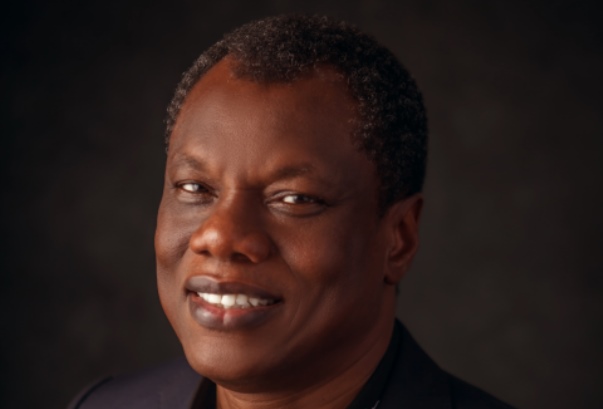
By Austin Okere
The leadership challenge is clear. It will be impossible to achieve true social and economic development without collaborative action by business, government, NGOs and civil society, while Effective governance creates frameworks for stronger institutions, transparency and respect for rule of law.
After Founding and listing CWG as the largest Security in the Technology sector on the NSE, I turned my effort towards enabling shared prosperity through mentoring Businesses to scale geometrically to optimize the jobs they create through the Ausso Leadership Academy.
Being a Consultant at the SDG Africa Centre in Rwanda has opened my eyes to the global framework for economic growth that protects the fundamental pillars of humanity and the planet. The SDGs are about People, Planet, Prosperity and Peace – and about driving development in an inclusive way that leaves no one behind.
I am pleased to announce that I will be using this platform to launch the new model that I have developed called Austin’s five forces model for analyzing sustainable growth (A5F) – You will be the first to see it (of course besides my son, Omimi Okere who helped me with the artwork of the diagram).
I see Five Forces driving sustainable growth as follows – Organisations, Population, Enablers, Infrastructure, Socio-Political Environment. I will use the A5F to talk through my presentation and end with a short video on Champion testimonies at the Ausso Leadership Academy.
Organizations
The more and of scale in the polity, the more jobs they can provide, and the better for social mobility and sustainable growth
Many of those in a society stuck at the wrong end of the Gini-coefficient is majorly locked out of the ‘consumption pool’ for a variety of reasons; including affordability, availability and awareness.
According to Efosa Ojomo, a research fellow at the Clayton Christensen Institute for Disruptive Innovation, the way we define competition, and the method employed by companies to assess the competitive landscape leaves out the most important competitor of all – non-consumption.
And nowhere is this feisty competitor more prominent than in emerging markets. While companies compete for the few people in the consumption pool, their fiercest competition is the huge segment of society that is not consuming.
Finding ways of including this large demography will not only boost production, sales and distribution but will also provide additional jobs to meet the increased demand. This sets off a self-sustaining cycle of growth and further inclusiveness.
Entrepreneurs, investors, and managers can invest in what Harvard Business School Professor, Clayton Christensen calls ‘market-creating innovation to transform complicated and expensive products into simpler and less expensive products, making them accessible to significantly more people in society, for instance, Indomie Noodles
Market-creating innovations pull people from non-consumption into the consumption pool. Companies that engage in these types of innovations are the engines of economic growth in an economy.
A perfect example of a market-creating innovation is Henry Ford’s Model T car. Henry Ford was able to manufacture a car that was inexpensive enough for an American with a modest income to purchase.
He also made the car easier to drive so that owners would not have to hire a driver or need special expertise. Some of Ford’s innovations were the assembly line which reduced the Model T chassis assembly from 12.5 hours to 1.5 hours.
Ford passed on the cost savings to the new class of consumers of automobiles such that by 1925 the price of his car had plummeted from $825 to $260.
Most developed economies are built of the back of the deep entrepreneurial activity
Just imagine if we could mentor each of the 36,994,578, micro-business to scale to the point of adding just one more employee – this will absorb all the 21m unemployed in the working-age population with much more leftover for immigrants
Population
While society in the past was split between the haves and have nots, society today is split more along the lines of those who are included and those left behind. This inequality is most heavily felt in emerging markets, where 80% of the world resides.
Take for instance, fast developing India. While globalisation has significantly increased GDP, it has also expanded the already wide chasm between the rich minority and poor majority.
For instance, seven companies on Fortune’s 2016 Unicorn List were in India, mostly in the e-commerce sector. That’s more than South Korea, the Netherlands and Canada combined.
However, the 12.5m employed directly and indirectly by the ICT sector and contributing 25% of India’s export revenue, accounts for only 2.5% of the national labour force.
The bottom line is that India is an agrarian society with more than half the population engaged in agriculture and allied industry. By cutting subsidy on irrigation and other rural needs and switching farm output from food crops to fertiliser intensive cash crops, the poor have gotten poorer.
On the other end of the chasm, dollar billionaires in India have jumped to 110 in 2015; the third-largest after the US and China, while dollar millionaires have crossed the 250,000 marks.
This is what the Canadian political philosopher, Crawford Macpherson describes as the ethic of possessive individualism.
In his book, Innovation and Entrepreneurship, famed author Peter Drucker wrote about an entrepreneurial society and its impact on economic development. An entrepreneurial society is one that it is either prosperous or on a path to prosperity; different from mere growth.
Economies can grow without becoming prosperous. We saw this happen in the 2000s when many African economies, such as Nigeria, Angola, and Equatorial Guinea, were the fastest growing in the world but failed to create prosperity for millions of their citizens
A close examination of those left behind shows that they are mostly the youth of our society. For example, while the unemployment/underemployed rate in Nigeria is 32.6%, the rate among the age bracket of 15-24 years is as high as 58.3%.
The sheer size of unemployed youths is surely a time bomb waiting to explode, as they are left to be seduced by terrorist ideals or other antisocial proclivities out of desperation.
A highly engaged Labour Force earn salaries for an expanding stable middle class, that ensures purchasing power, and they pay taxes for Infrastructure development and social welfare
By 2050, Africa’s population will double, reaching 2.5b people – just about the current combined population of India and China. In Nigeria, the working-age population increased from 111.1 million in 2017 to 115.5million in 2018
What is worrisome is that while the population was growing at a rate of 2.6%, the GDP growth rate was just 1.9 %, lower than that of the USA 3.1% in Q1 2019 and 6.9% and 6.6% China and India respectively
Enablers
Enablers refer to Regulators, Technology, Education, Healthcare, Financial Institutions and Social Impact Organisations
While Regulators can either be a source of tailwind or headwind depending on your clime, Technology such as Artificial intelligence, Machine Learning, Virtual, Augmentation, Virtual Reality and Big Data has drastically disrupted the landscape, with the most impact felt in technology platforms
The biggest impact of technology has been in Platforms, such as Facebook, Google, Amazon, Uber and Airbnb. There is hardly an area of economic and social interaction that is left untouched by these Platforms in some way or form.
Two major areas in which the Platform Czars have riled the establishment are in transportation and hospitality; the major ‘culprits’ being Travis Kalanick of UBER and Brian Chesky of Airbnb.
UBER, until recently a relatively unknown company out of Silicon Valley in California, employs 3m drivers and 75m riders globally today. This transport services disrupter is now valued at $82.4b and operates in many major cities across the globe.
Airbnb, a previously obscure company with similar roots, has over 5m listings worldwide and is now valued at $35b.
These Platforms provide a means of significantly extending services at low-cost efficiencies, and as a result draw many people into the consumption pool, while also creating many jobs along the value chain which would otherwise simply not exist
The ubiquity of broadband and the proliferation of smartphones has extended the life of Platforms and made services that were hitherto unavailable to a large section of the population possible.
This heralds an era of unprecedented inclusiveness. For instance MPESA today has more than 60% of Kenya’s 33 million mobile users and in 2015 transacted $28m on her platform – equivalent to a whopping 44% of their GDP. Similar applications have metamorphosed across Africa, and Mobile Money services are today generating 6.7% of Africa’s GDP.
While Platforms will bring inclusiveness and bring a lot of people into the consumption pool, there are major regulatory challenges that have to be surmounted as a result of issues that were not foreseen when the governing statutes and regulations were enacted.
To fill the regulatory gaps these Platform behemoths have resorted to what could be referred to as spontaneous deregulation, which has arisen as a result of Platform disrupters ignoring laws and regulations that appear to preclude their business model.
Believing in the efficacy of their utility model and its appeal to pent-up global demand, these disrupters seem to see many rules and regulations as belonging to the past and impractical for today’s innovative clime.
They therefore simply ignore them, opting for their own version of self-regulation, usually based on a mutual rating system between service providers and consumers. Facebook has had to face Regulators in the US and Europe over this, while it has claimed UBER Founder Travis Kalanick
A bigger dilemma perhaps is the placement of regulation. For instance, who should regulate the plethora of Fintech companies springing up globally and providing Platforms for financial inclusion; should it be Central Banks or the Communications Commissions? The jury is still out on this.
Another major worry is the issue of the Platform provider having an undue advantage by also being players on their Platform. This makes them the judge and jury in their own case. A glaring example will be Facebook and her Libra Cryptocurrency which is threatening to replace the US Dollar as the global reserve currency
Education one area where there is a need to reach far more than our traditional schools can cater to. Here again, leveraging on online learning Platforms to provide Massive Open Online Courses (MOOCs) are coming to the rescue.
Research and Markets forecasts that e-learning will grow to $325 Billion by 2025 from $107b in 2015; perhaps becoming the future of education
Infrastructure
Infrastructure speaks to Power, Ports, Transportation, Communication and Housing. By 2050…the infrastructure needed for the for 2.5b Africans will be unprecedented in the history of humankind.
700m housing units, 300k schools, and 100k health centres. Can you imagine Nigeria without a significant network of Rail or a functional underground transport system in 2050?
The UK has Underground Tube system moves 1.35b people annually and has been operating for about 150 years. African countries such as Ethiopia and Kenya are making strident advances in rail transportation
Socio-Political Environment
Nothing impacts the attraction of Capital and rapid Economic Development like a stable socio-pollical environment. Nigeria is a classic example of a nation rich in-laws but weak in enforcement. The blind application of the law without regard to status, colour or creed is what enshrines deterrence and increases the value of the real estate of the postcode.
There is no doubt that the recent imposition of a hefty $15b fine by the US Government on German carmaker, Volkswagen, for emission results falsification will cause contemporaries to think twice before yielding to any similar yearnings for shortcuts.
It is the pursuit of deterrence that drives developed countries from sparing any high ranking members of the society who fall foul of the law, not least their Presidents, who are held to a higher account. The celebrated case of former American President, Richard Nixon in the Watergate scandal is a good example.
On this score, we have a lot to do to change the negative perception of the Nigerian (and indeed African) postcode. The rule of law is more about enforcing existing rules than creating new laws. Any society that does not abide by some code of conduct whether in public or private matters tend to become chaotic, and virtually ungovernable.
The whole society eventually descends into a macabre dance of impunity. Conscience is thrown out, and justice is on sale to the highest bidder. According to Yury Fedotov, Executive Director, United Nations Office on Drugs and Crime,
“Corruption represents a major threat to the rule of law and sustainable development the world over. It has a disproportionate, destructive impact on the poor and most vulnerable, but it is also quite simply bad for business”
CONCLUSION
Notice that I have not included natural resources such as Oil and Gas or other commodities as a significant factor in sustainable development. These are a bonus that the state can capitalize on to accelerate growth but are no means a necessity
There are many successful nations with no significant natural resources that have done very well, such as Singapore and Dubai, and some with significant natural resources that have also done well such as Norway
The difference between the poor and rich nation does not depend on the available natural resources, there is, therefore, no substantiation to the notion of substantial natural resources as a curse – otherwise, why is Norway not cursed?
Japan has limited territory, 80% mountainous, unsuitable for agriculture or farming, but is the second in the world’s economy. The second example is Switzerland, it does not grow cocoa but produces the best chocolates in the world
Executives from rich countries who interact with their counterparts from poor countries show no significant intellectual differences. The good news is that racial or colour factors also do not evince importance: migrants heavy in laziness in their country of origin are forcefully productive in rich European countries.
What then is the difference? The difference is the attitude of the people, moulded for many years by education and culture.
When we analyse the conduct of the people from the rich and developed countries, it is observed that a majority abide by the following principles of life: Ethics, as basic principles, Integrity, Responsibility, The respect for Laws and Regulations, The respect of the majority of citizens for the rule of law, The love for work and pride in their work, the effort to save and invest, The will to be productive and Punctuality.
In poor countries, a small minority follow these basic principles in their daily life. We are not poor because we lack natural resources or because nature was cruel towards us. We are poor because we lack the right attitude
According to the ancient Greeks, the founders of modern civilization, there are three kinds of people in any society
Idiots – all out for his personal pleasures and his personal treasures
Tribesmen – does not necessarily mean belonging to a certain tribe; which is not bad in itself, but people with a tribalistic mentality; their primary, only and ultimate allegiance is to their tribe. Their tribe is their god and their religion is tribalism
Citizens – the ideal person, they called the citizen; someone who has the skills and the knowledge to live a public life, who is able to live a life of civility.
The citizen recognizes that he or she is a member of a commonwealth and thus strives for the common good. The citizen knows his right in society but also knows his responsibility to society
The citizen can fight for his right but always with an awareness of, and with the respect for the rights and interest of others. Of their neighbours, of the smallest minority and of the worst of his enemies
Indeed, no sovereign can make any significant advancement when the number of idiots and tribesmen far outnumber the number of citizens… take a guess at what percentage of Nigerians behave like idiots, tribes people and citizens. Do the results shock you?
“Law of Sovereign Advancement”
Nigeria is her people; If we want to see change, we have to start by being citizens of our country.
Let me end with a quote from Maria Robinson that says, “Nobody can go back and start a new beginning, but anyone can start today and make a new ending.”
Austin Okere is the Founder of CWG Plc, the largest ICT Company on the Nigerian Stock Exchange & Entrepreneur in Residence at CBS, New York.


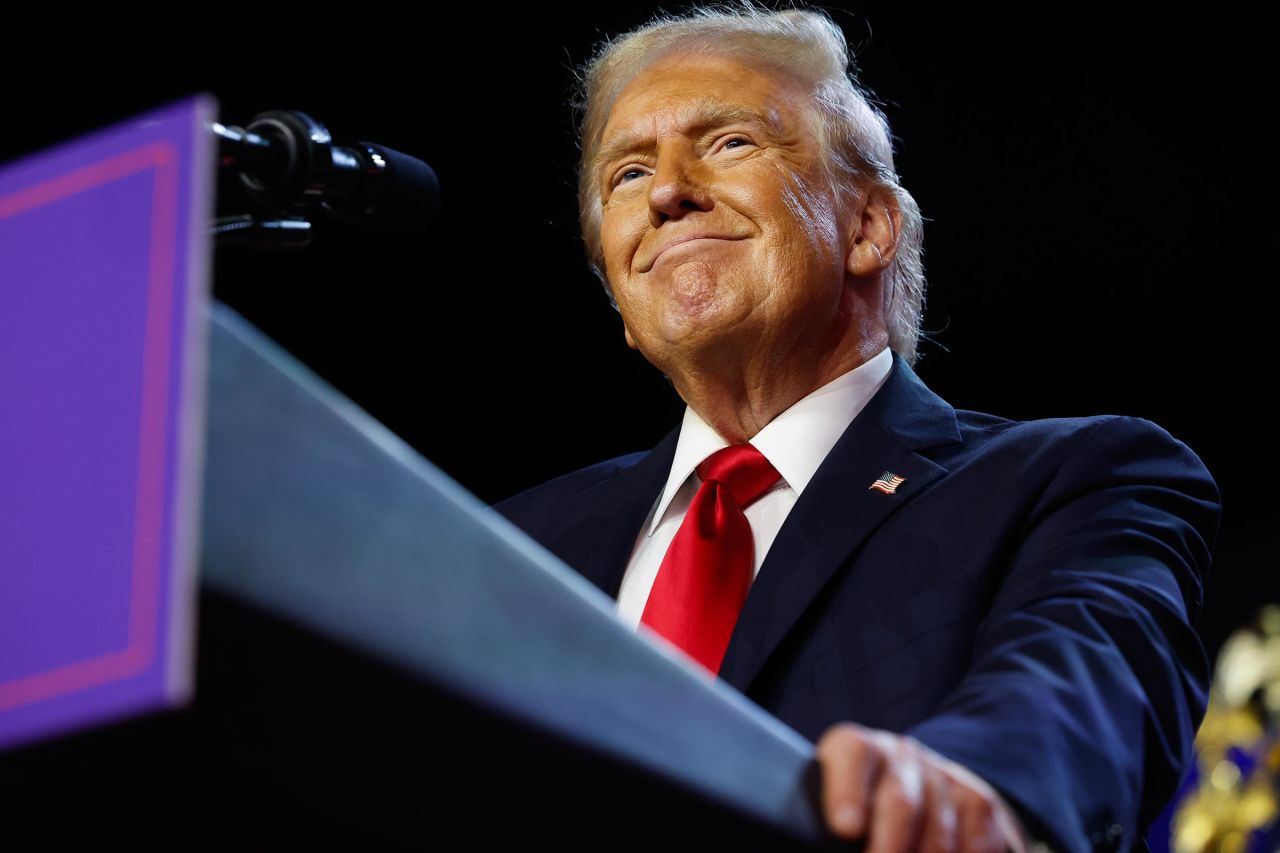
The United States has signed a five-year agreement with Nigeria to strengthen its health system, with a strong emphasis on promoting Christian faith-based health care providers.

The Department of State, in collaboration with Congress, will commit nearly $2.1 billion to expand essential preventative and curative services for HIV, TB, malaria, polio, and maternal and child health.
Under the bilateral agreement signed at the weekend, the Nigerian government will increase its domestic health expenditures by nearly $3 billion during the five-year term.
The Memorandum of Understanding is the largest co-investment any country has made to date under the America First Global Health Strategy, said Thomas Pigott, State Department spokesperson.
The MOU was negotiated within the context of Nigeria’s reforms to protect Christian populations from violence and includes significant dedicated funding to support Christian healthcare facilities.
The investments were approved to complement the efforts of Nigeria’s 900 faith-based clinics and hospitals, currently serving millions of people, and strengthen the country’s health infrastructure.
The U.S. government stressed that the President and Secretary of State retain the right to pause or terminate any programs which fails to align with the national interest.
“The Trump Administration expects Nigeria to continue to make progress ensuring that it combats extremist religious violence against vulnerable Christian populations,” Pigott added.
The MOU was signed despite the U.S. designation of Nigeria as a Country of Particular Concern and its recent inclusion in the travel ban list, which President Donald Trump premised on terrorism and visa overstay rate.
The America First Global Health Strategy, released in September 2025, covers dozens of countries. It shifts the focus of U.S. health aid to self-reliance, data security, HIV, TB, malaria, and maternal and child health services.

Socio-Economic Rights and Accountability Project (SERAP) has urged President Bola Tinubu to “urgently direct Mr Lateef Fagbemi, SAN, the Attorney General of the Federation and Minister of Justice to widely publish a certified true copy of the version of the tax bills received from the National Assembly and a certified true copy of the tax laws signed by you.”

SERAP
The documents requested by SERAP are the National Revenue Service (Establishment) Act, Joint Revenue Board of Nigeria (Establishment) Act, Nigeria Tax Administration Act; and Nigeria Tax Act.
SERAP urged Tinubu “to direct Mr Lateef Fagbemi to clarify whether the version of the tax bills received from the National Assembly are exactly the same contents as the bills that were signed into law by you and the version ultimately gazetted.”
The body made the demand of President Tinubu in a Freedom of Information request dated December 20, 2025.
It was signed by its Deputy Director, Kolawole Oluwadare.
The organisation said in the FOI request: “The law-making processes including the passing of any bills and signing them into laws, as well as gazetting the laws must meet the requirements of the Nigerian Constitution, the rule of law and separation of powers.
“This means that any passed bills and signed laws must be accessible, authentic, intelligible, clear, legitimate, and predictable so that people can know and comply with them.
“Clarifying whether the version of the tax bills received from the National Assembly are exactly the same contents as the bills that were signed into laws by the President and tax laws ultimately gazetted would promote transparency and accountability, and help to address any threats to Nigerians’ human rights.
“We would be grateful if the recommended measures are taken within 7 days of the receipt and/or publication of this letter. If we have not heard from you by then, SERAP shall take all appropriate legal actions to compel your government and the Attorney General to comply with our request in the public interest.
“Widely publishing the certified true copies of the tax bills passed by the National Assembly and the tax laws signed by the President and the gazetted versions would also allow Nigerians to identify if the provisions of the laws are consistent with their human rights, and seek effective remedies to challenge any infractions of the rights.
“Your government has the obligations under the Nigerian Constitution and the human rights treaties to which the country is a state party to promptly, independently, impartially, transparently and effectively investigate the alleged unlawful allegations of the tax laws and to ensure full accountability in this case.
“Our requests are brought in the public interest, and in keeping with the requirements of the Nigerian Constitution, the Freedom of Information Act, and the International Covenant on Civil and Political Rights and the African Charter on Human and Peoples’ Rights to Nigeria is a state party.
“According to our information, the National Assembly recently alleged that there are unlawful alterations and some material differences between the tax bills passed by the legislative body and the tax laws gazetted by the Federal Government.
“A Sokoto lawmaker, Abdussamad Dasuki, raised the issue under a matter of privilege, drawing the attention of the House to the alleged discrepancies between the harmonised versions of the tax bills passed by both chambers of the National Assembly and the copies gazetted by the Federal Government.
“The National Assembly said the alterations contained in the gazetted copies did not receive legislative approval. These alleged unlawful alterations raise questions over the legality and legitimacy of both the law-making processes and the versions of the tax laws currently being circulated by the Federal Ministry of Information.
“The National Assembly established that substantive provisions were inserted, deleted, or modified after passage by both chambers. Several oversight, accountability, and reporting mechanisms approved by parliament were reportedly removed in the final Acts. New coercive and fiscal powers (e.g., arrest powers, garnish without court order, compulsory USD computation, appeal security deposits) were also reportedly inserted in the final Acts without legislative approval.
“Section 39 of the Nigerian Constitution, article 9 of the African Charter on Human and Peoples’ Rights and article 19 of the International Covenant on Civil and Political Rights guarantee the right to seek, receive and impart information.
“The Nigerian Constitution, the African Charter on Human and Peoples’ Rights and the International Covenant on Civil and Political Rights impose duties on your government to ensure transparency and accountability in lawmaking processes.
“By the combined reading of the provisions of the Nigerian Constitution, the Freedom of Information Act, the International Covenant on Civil and Political Rights, and the African Charter on Human and Peoples’ Rights, there are transparency obligations imposed on your government to widely publish the certified true copies of the version of the tax bills received from the National Assembly and the tax laws signed by you.
“The Nigerian Constitution, Freedom of Information Act, and the human rights treaties rest on the principle that citizens should have access to information regarding their government’s activities.”
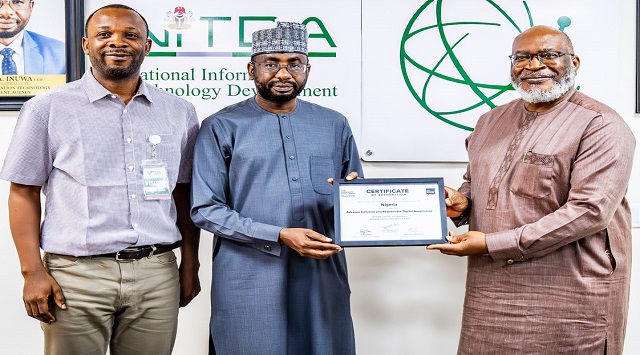
The Director General of the National Information Technology Development Agency (NITDA), Kashifu Inuwa, CCIE, has reaffirmed Nigeria’s commitment to open governance, transparency and inclusive digital development as the Open Government Partnership (OGP) team formally presented the award and certificate received at the OGP Global Summit Spain 2025 to the Agency’s leadership.

Nigeria emerged as the overall global winner in the Digital Governance category in recognition of the country’s excellence in deploying digital tools and policies to strengthen government transparency, accountability, and citizen engagement. In addition, Nigeria received the Regional Award for advancing Open Digital Governance across Africa and the Middle East, reaffirming its leadership role in promoting open government principles and driving digital transformation across the region.
These recognitions were largely attributed to initiatives led by NITDA in collaboration with civil society partners, such as Dataphyte, which showcased innovative and inclusive approaches to digital governance at the summit.
The summit, which was organised in Vitoria-Gasteiz, Spain, brought together more than 1,500 high-level representatives of governments, civil society leaders, and policymakers from around the world to exchange experiences, best practices, and progress on open government initiatives and implementation on key issues.
Receiving the OGP delegation at NITDA, Inuwa described the recognition as a national honour rather than an institutional one, stressing that the award reflects Nigeria’s collective efforts across government, civil society and the private sector in advancing open governance principles through the digital space.
According to him, such global recognition comes with heightened responsibility to deliver on commitments made under the OGP framework.
“This is not just about NITDA. It is a national recognition, and every recognition comes with responsibility,” the DG said.
“If we fail to execute the commitments we have made, it will not only affect our image locally but also at the international stage. This is also not something NITDA can do in isolation,” he added.
Inuwa linked the achievement directly to the Renewed Hope Agenda of President Bola Ahmed Tinubu, noting that digital transformation, transparency, economic diversification, job creation and efficient public service delivery remain central presidential priority areas.
He emphasised that leveraging digital technologies to deepen openness and accountability aligns with national objectives of strengthening institutions, improving governance outcomes and building trust between government and citizens.
Highlighting the importance of collaboration, the NITDA boss underscored the role of the OGP platform as a catalyst for a strong multi-stakeholder approach in Nigeria’s digital ecosystem.
He called on civil society organisations, development partners, the private sector and other government institutions to provide technical expertise, guidance and sustained engagement to ensure effective implementation of agreed commitments.
“We need to leverage the OGP platform. We need your expertise, your guidance, your support and your commitment to hand-hold us in delivering on these commitments,” he said.
He further noted that “a multi-stakeholder approach in the digital space is critical to fostering a resilient ecosystem that delivers real value to citizens.”
Inuwa disclosed that NITDA has already begun internal reviews of its OGP commitments and has tasked its representatives, including Dr Rousseau, to work with colleagues to develop a clear execution strategy.
He proposed the creation of joint work streams with OGP stakeholders to support implementation, ensure accountability and keep all parties on track.
“We are humans. Oversight and collaboration help us stay focused. With commitment, nothing is impossible, and I believe these goals are achievable,” he added, assuring the delegation of NITDA’s readiness and political will to deliver on all agreed commitments.
Inuwa also welcomed the idea of engaging the political leadership of OGP, including the Honourable Minister of Budget and Economic Planning, with a view to briefing President Tinubu on the achievement. He noted that celebrating milestones is important, as it reinforces morale and demonstrates that Nigeria’s efforts in digital governance are gaining global recognition.
“It’s also good when there are wins, we should celebrate, because we too never knew that the little things we are doing are noticed not just within Nigeria, but globally, to the extent of earning us this award,” he asserted.
He concluded by expressing gratitude to the Nigerian National OGP Secretariat and the global OGP leadership, reaffirming NITDA’s commitment to strengthening collaboration and building a more productive working relationship that will translate open governance principles into measurable national impact.
Earlier in his remark, Mr Olusoji Apampa, who led the OGP deelegation, said the honours were earned through a strong partnership between government and civil society, with NITDA playing a critical role, particularly in commitments focused on improving digital governance in Nigeria.
Apampa expressed hope that the awards would serve as added momentum to deepen ongoing commitments under NITDA’s leadership and accelerate the practical implementation of reforms aimed at strengthening digital governance across the country.

US Okays $2.1Bn for Christian Healthcare in Nigeria

Leo Stan Ekeh: A “Rare Avis”, an Unconquerable Entrepreneur

SERAP Asks Tinubu to Release CTC of Tax Bill

Tim Akano Recounts 20-Year Growth, Media Support at NITRA End-of-Year Meet

Sterling Bank, Water.org, Sterling One Foundation Partner on WASH Loan for Millions

Nigeria Records Highest Weekly Cyberattacks in Africa — Report

Cyber Tsunami Hits Nigeria as Breaches Surge 1,047%, esentry Q3 Report Reveals

Jumia’s Data Shows Nigerians Turning to Digital Retail to Navigate Inflation Pressures

GenAI Adoption Among African workers Outpace Global Peers

Minister Claims Bandits Exploit Poor Network, Bounce Calls Off Multiple Towers




 General News2 days ago
Jumia Kicks Off December Holiday Sale, Bringing Festive Deals to Shoppers Nationwide

 E-Financial2 days ago
Access Holdings Shareholders Approved to Raise N40bn Capital Through Private Placement

 Broadcasting2 days ago
NIMC rolls out Pre-Enrolment Portal for seamless NIN registration

 General News2 days ago
Dangote, Monopoly Power, and Political Economy of Failure

 General News2 days ago
OAU, Baptist Day School Oluponna honour Akano with Distinguished Alumnus Awards

 General News16 hours ago
The Mood Market to Light Up Lagos with a Rooftop Gifting, Food & Lifestyle Fair this Christmas
 E-Financial10 hours ago
Sterling Bank, Water.org, Sterling One Foundation Partner on WASH Loan for Millions
 News9 hours ago
US Okays $2.1Bn for Christian Healthcare in Nigeria