

General News
Strategies for Businesses to be More Sustainable for Tomorrow


By Emmanuel Asika
The world’s natural reserves are fast diminishing at a worrisome speed, almost two times quicker than mother earth can recreate. This figure is projected to be 2.3 times what is sustainable by 2050. Yearly, 50 million tonnes of e-waste contribute to this, which is tantamount to the size of all commercial aircraft ever made.

Hence, achieving a sustainable environment is incumbent on implementing a circular business model like waste reduction, recycling, and regenerating products, and advocating sustainable production processes. Nonetheless, global economy is just 7.2% circular – implying that more ground needs to be covered.
With an essential role expected of multinationals, organizations of every size and sector can still adopt circular business models. Considerably, SMEs are driving platform sharing and collaborative consumption much as start-ups, from the onset, are incorporating circular models.
An excellent example of this seen in Nigeria, where business sustainability focus is circular as propagated by the Nigeria Circular Economy Working Group, a founding member of the Africa Circular Economy Alliance.

Incidentally, HP is deepening sustainability with years of experience. Its operations’ journey, particularly, will be entirely circular, driven by services and products modifications. Below are few approaches to reference:
Getting the Buy-in of the Considerate Consumer
Customers are getting more aware today than ever. So, businesses that make circularity a priority will accomplish long-term environmental and commercial profits; and ultimately fulfil customer expectations.
While circularity models need upfront funding, it helps to reduce outlays, optimize efficiency, and even discover new revenue sources. To further endear customer trust and loyalty, organizations must offer measurement tools that identify waste prevention and cost optimization mechanisms that help to establish enterprise superiority.
Circular enterprise models also produce profitable results. For instance, our Sustainable Impact Strategy has been boosted by HP’s socio-economic components on climate-focused programs.
HP’s alliance with NGOs to launch an ocean-bound plastics recycling program to help indigenous workers is yielding positives in Haiti. Now, these plastics are fused into HP products design aesthetics, encouraging circularity, and providing revenue and homegrown education opportunities.
Start and continue with the environment as a priority
As a rule, circular products are designed with environmental considerations from the start. Sustainable sourcing should be among the initial priorities, with concentration on ethical practices and ambitious but attainable goals.
This ties in to ‘Circular Lagos’, a sustainability initiative of the Lagos State government which seeks to design economic value from waste recycling.
As reference case, HP, since 2016 has mandated all its brand papers to be derived from ecologically reusable or certified sources. It was extended to paper-based packaging in 2020 for home and office printers and supplies, PCs and displays.
By 2030, HP’s goal is to become Forest Positive; thereby, eliminating deforestation for non-HP paper used in print services and product lines.
What creates distinction in packaging is innovation. 100% compostable chitin-based materials are a new development, whereas 3D-printed moulded fibre tooling can drive eco-packaging at scale.
Printing improvements, including printing directly onto product cargo boxes and using water-based inks most likely initiate supplementary benefits. HP’s goal is to eradicate 75% of single-use plastic packaging by 2025 compared to 2018―as of 2021, we were halfway there. Commendable Indeed!
Decrease waste, enhance lifecycle
One vital aspect for electronic devices is energy usage, though this can be puzzling for consumers. Companies and institutions can help customers make valid choices. Also with comparison tools, manufacturers can assist with clear and accurate details on labels, packaging, along with marketing and brand collaterals.
HP supplies are often highly valued for repairability, with institutions like iFixit providing reparability scores and self-repair (DIY) guides. Institutions can help in reducing request for fresh raw supplies by giving extended warranties and ensuring repair options.
Clearly, sustainable customer experience can be improved with ‘as-a-service models’; whilst promoting circularity through company-led takeback; hence, responsible companies aim to be value facilitators via repair and reuse of supplies when customers are done with them.
Significance of closed-loop recycling
Closed-loop reutilizing plays huge part in circularity, and HP is loaded with initiatives to support it. A good case study is HP’s Planet Partners program that helps to ensure that ink and toner cartridges do not end up in landfills.
Over a billion cartridges have been recycled through this program, a major landmark in 2023. Provisionally, HP’s Evocyle toner cartridges, made from closed-loop recycled plastic, are serving the sustainability goals of customers in France, Germany, and the UK.
In the reuse of a much wider range of resources, we are also getting better. For example, you might find bio-derived content like coffee grounds in monitors or cooking oil in laptop covers.
Partnership−a necessary paradigm for enterprise scaling
A circular business model is vital. It’s hinged on team play and partnerships with strategic stakeholders – government, suppliers, merchants/dealers etc. Strengthening networks with NGOs, research institutes, and think tanks, also positions serious institutions above contemporaries. Lagos has entrenched the model by introducing initiatives which encourage community members to drop off used plastic bottles and containers at designated recycling points for reuse.
To improve its fibre sourcing and certification programs, HP is collaborating with World Wildlife Fund and the Forest Stewardship Council.
Regardless of where they are on their circularity journey, collaboration certainly benefits all types of companies. Participating in industry bodies, working with manufacturing partners, and ideas exchange with regulators and professional associations can help advance policy influencing, build consensus, and progress legislation.
Institutions with established existing programs perhaps extend their impact by involving their business environment. Another reference now driving change at scale is HP’s Amplify Impact partner program, which has engaged over 3,500 partners worldwide.
Envision the future
A vision of a more regenerative and sustainable future is presented with the concept of a circular economy. It could boost the global economy by $4.5 trillion by 2030, if executed appropriately, with accountable sourcing and packaging, materials and products that remain in use longer, and closed loop recycling.
Evolution to circularity is now a necessity with no option. To actualize it, we must immediately shift mindsets, embrace circular practices, and cultivate alliance and frameworks essential for success. Bountiful rewards sure await the businesses that leads the way.
Nigeria, the leading importer of electrical and electronic equipment on the African continent which processes over half a million tons of discarded electronics each year, in January 2022, amended its national environmental regulations to tackle the country’s growing e-waste problem.
So, whether you are just starting or already on the path ― the time is here and now to take the next big step. The future is indeed circular, and it’s up to businesses globally to make it come to fruition.
Emmanuel Asika is Country Head, HP Nigeria


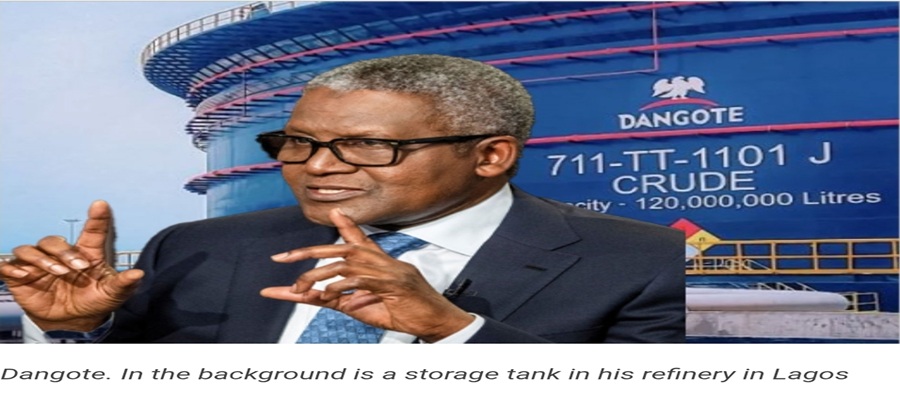
Dangote Petroleum Refinery is reportedly nearing completion of a $2.5 billion private placement that values the company at about $40 billion ahead of its planned public listing.

Private placement is the direct sale of company shares or bonds to pre-selected investors instead of the general public and it is used to raise money quickly while avoiding strict public reporting rules.
People familiar with the transaction said investors acquired as much as 6 per cent of the refinery, according to a BusinessDay report.
The reported terms would value the business at approximately $40 billion.
Neither Dangote Group nor the refinery has publicly announced the final amount raised, the identities of most subscribers or the precise percentage sold.
The figures should therefore be treated as transaction details supplied by unnamed sources rather than confirmed company disclosures.
The reported $2.5 billion total is nevertheless significant as it indicates strong demand for exposure to a privately controlled refinery that has rapidly become central to Nigeria’s fuel supply and an increasingly important exporter of petroleum products.
The placement was said to have attracted more demand than the available shares, allowing the company to secure substantially more than the amount initially associated with the fundraising exercise.
Femi Otedola, chairman, First HoldCo, is the only major participant publicly identified in the report.
He reportedly committed $100 million to the transaction and sold his investment in Geregu Power Plc to finance the acquisition.
Nigeria’s pension industry was also reportedly cleared to participate.
Access to more than $17 billion in retirement assets would broaden the refinery’s potential investor base beyond wealthy individuals and conventional institutional buyers.
Participation by Pension Fund Administrators would, however, require careful attention to valuation, liquidity and portfolio-concentration limits.
Retirement funds must balance the attraction of a large Nigerian industrial asset against their responsibility to protect contributors’ savings.
The implied $40 billion valuation represents investor expectations about the refinery’s future earnings rather than only the physical cost of constructing the facility.
Its ability to process 650,000 barrels of crude daily gives it a central role in supplying Nigeria and other markets, but its commercial performance remains connected to crude availability, product prices, exchange rates and regulation.
The refinery has struggled to obtain all the Nigerian crude it requires under the government’s naira-for-crude arrangement.
It has consequently purchased some feedstock internationally and recently moved local petroleum-product pricing into dollars to align sales revenue more closely with its foreign-currency expenses.
Those constraints will be important during any public offering.
Prospective shareholders will want greater clarity on crude-supply contracts, debt, operating margins, export revenue and the company’s relationship with Nigerian regulators.
It is also unclear whether the private placement involved newly issued shares, a sale by existing owners or a combination of both.
That distinction determines whether the reported $2.5 billion becomes fresh capital for the refinery or proceeds received by selling shareholders.
The transaction could provide a useful price reference for the planned initial public offering.

Federal government will next month launch Nigeria’s first national organized crime strategy to strengthen the country’s response to terrorism, cybercrime, human and drug trafficking, kidnapping, illicit financial flows, and other forms of organized crime.

Major General Adamu Laka, national coordinator of the National Counter Terrorism Centre under the Office of the National Security Adviser, disclosed this in Abuja during the validation of the strategy document.
He said the strategy provides a coordinated national framework for tackling organized crime through improved intelligence sharing, stronger collaboration among security agencies, and closer cooperation with the criminal justice system, civil society organizations, and international partners.
Major General Laka explained that the document was developed through a partnership involving the Federal Government, the United Nations Office on Drugs and Crime (UNODC), the United States Government, and other stakeholders.
Speaking at the event, Cheikh Toure, UNODC representative, said the strategy would strengthen Nigeria’s capacity to combat transnational crimes, including drug trafficking, cybercrime, human trafficking, kidnapping, and illicit financial flows.
Also speaking, Douglas Grane, acting director of the United States Department of State’s Bureau of International Narcotics and Law Enforcement Affairs, reaffirmed the U.S. government’s support for Nigeria’s efforts to tackle organized crime through stronger inter-agency and international cooperation.
Representatives of the National Institute for Strategic Studies, the Nigeria Financial Intelligence Unit, and the National Cyber Security Centre also endorsed the initiative, describing it as a major step towards improving Nigeria’s fight against organized crime.
FATE Foundation, with funding from the Citi Foundation, has launched the Youth Entrepreneurship Incubation Programme to equip young people in Nigeria with financial literacy and entrepreneurship skills.

Delivered through free, safe, and accessible platforms, the programme supports the incubation and scaling of youth-led enterprises, enabling income generation and job creation.
In October 2025, FATE Foundation was selected as a recipient of Citi Foundation’s 2025 Global Innovation Challenge to Accelerate Youth Employability. Joining the cohort of 50 organisations globally, the Foundation will receive $500,000 over two years to advance its youth employability initiative.
“We are excited to be selected for Citi Foundation’s 2025 Global Innovation Challenge,” said Ayomide Akindolie-Igwe, Executive Director of FATE Foundation.
“This support enables us to equip young entrepreneurs in Nigeria with the financial literacy and skills needed to build and scale sustainable businesses.”
The programme addresses youth employability by tackling Africa’s growing jobs crisis. By 2030, the African continent will be home to 40% of the world’s youth, and with one in three under 35 already unemployed, this initiative will support Nigerian youth with a two-phase approach. It begins with financial literacy training before progressing to entrepreneurship development, incubation support, and access to tools needed to build viable, job-creating businesses.
“Through this innovative initiative, FATE Foundation is supporting low-income Nigerian youth to develop essential financial and entrepreneurial skills using accessible platforms.
“This support is not just helping individuals to succeed; it is building a solid foundation for sustainable enterprises that will drive job creation and contribute significantly to our nation’s economic vitality. This initiative is empowering and investing in the future of Nigeria, one youth at a time,” said Nneka Enwereji, MD/CEO Citibank Nigeria Limited.

Dangote Refinery’s Private Placement Reportedly Hits $2.5Bn

FG, UNODC Plan National Strategy against Organized Crime

EFCC Busts NIS Visa Overstay Racket, Uncovers N700m in an Account

CBN to Monitor Every Dollar with FXBT, Forex Tracker

NCC, NDLEA Partner to Fight Piracy and Drug Trafficking

NRC, Ponzi Scheme Collapses Resulting Loss of Billions of Naira

NASENI Moves to Digitize CCB’s 5m Assets Declaration and Operations

Lebara Nigeria Launches Lebara Play, Africa’s First Telecom-Owned Micro-Drama Platform

CANAL+ Partners Samsung to Pre-Load DStv Stream on New Samsung TVs In Nigeria, Other African Countries

Tokenization, Blockchain Technology will Transform Financial Institutions – IMF



 News1 day ago
EFCC Busts NIS Visa Overstay Racket, Uncovers N700m in an Account

 News2 days ago
FAAN to Replace Physical ID Check with V-Pass Biometric Verification

 Telecom2 days ago
Airtel Delivers Free Employability Training to Young Nigerians @ World Youth Skills Day

 Telecom2 days ago
ntel Plays Down Calls and Data Services, Moves to BET Agenda

 General News2 days ago
Nigeria Facing Rising Cybercrime Losses – Report

 News2 days ago
CBN Introduces Digital Tracker to Monitor BDC Forex Transactions

 General News2 days ago
TotalEnergies Inaugurates Africa’s Largest Hybrid Renewable Project

 News2 days ago
CAC Begins Removing 100,000 Companies from Register Over Regulatory Non-Compliance