

Broadcasting
2023: Who Will Go for the Igbo? – Our Best 3 Candidates

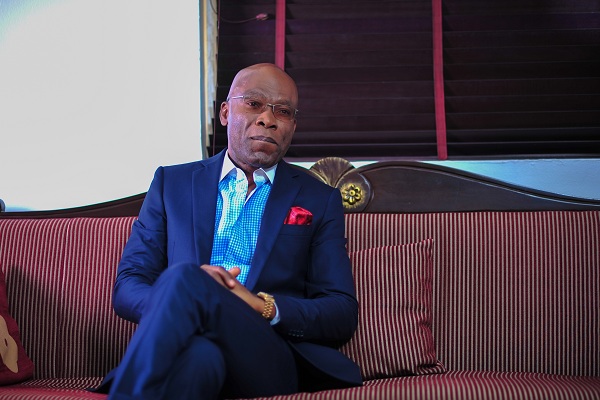
By Jonathan C. Nnakwube (Ph.D.)
With 2023 just around the corner, the race to determine who succeeds incumbent President Muhammadu Buhari as the holder of the top job in Nigeria is beginning to gather steam.

Already, several candidates have thrown their hats into the ring, with some of them, like the former Lagos State Governor, Asiwaju Bola Tinubu not hiding their clear interest in the presidency.
One of the major issues shaping the conversations around the 2023 presidential election is the Igbo question. There is a strong argument for the South East to get a shot at the presidency, especially considering the fact that the region has endured an extended hiatus from the seat of power, coupled with the school of thought that an Igbo presidency has the tendency to quell the worrisome agitations in the region and provide the much-needed sense of belonging.
Further shoring up the argument for the Igbo cause is the position of political watchers, many of whom have pointed out the fact that the South East has a strong case of marginalization, notably when one considers how it has fared in comparison to other regions, as far as the presidency is concerned.
For this school of thought, presidential powers in Nigeria have largely rotated between the North and the South West. They point to the Olusegun Obasanjo presidency which saw Atiku Abubakar, who hails from Adamawa in the North East as his side-kick for eight years; the short-lived Umar Musa Yar-Adua administration which threw up a South-South deputy in the person of Goodluck Jonathan and who later contested and won a four-year term with another Northerner, Namadi Sambo as vice president; as well as the incumbent eight-year administration of Buhari with a South-Western candidate, Yemi Osibanjo as vice president.
In their view, the fair thing would be to return the presidency to the South and allow the South-South to complete its eight years, four of which have already been enjoyed by Jonathan or better still, support an Igbo candidacy as successor to Buhari.
While another school of thought has continued to argue that the South East lacks a truly unified voice, a throwback to the republican nature which lends a fiercely decentralized, individualistic mindset in most South Easterners, others have also insisted that the region lacks the nous, the know-how and the guile to play national politics; the top-tier type loaded with high-wire stakes, lobbying and horse-trading that would guarantee a shoo-in for its candidate into Aso Rock.
Nevertheless, one thing that all parties agree on is the fact that the South East certainly deserves a chance to lead Nigeria again.
Undoubtedly, 2023 is perceived widely as a pivotal year for Nigeria on the political front. Bedeviled for donkey years by a combination of inept leadership and stunted development, the Nigerian state is home to a growing army of digitally savvy youths, many of whom are now boldly challenging the status quo and calling more loudly for better governance. The foregoing came to the fore during the #EndSARS protests which rocked Nigeria in October 2020 as an army of disenchanted youths, under a movement which began as an opposition to widespread police brutality, expanded its agitations to clarion calls for an end to bad leadership. It took the combined might of state power and a bloody night at the now-infamous Lekki Toll Gate in Lagos to put down the movement.
However, the warning signals are there that these youths are no longer just frustrated at the current state of affairs, but that they would also no longer stand by and watch with folded arms.
Also reinforcing the critical importance of the 2023 elections for the future of Nigeria is the sweeping changes in the global ecosystem, led by the growing powers of technology as a leveler and heightened by the COVID-19 pandemic. Many Nigerian youths today are resident in the country but working for firms or corporations abroad from the comfort of their homes. Others are fleeing the country in droves, either migrating as skilled hands or fueling the ranks of those seeking higher education in advanced climes, as COVID and the pervasive influence of technology continue to disrupt the global economy.
The foregoing has seen more Nigerians gainfully join the Diaspora, with these new additions who have now experienced working systems in other climes, lending their voices and joining the bandwagon of those demanding a better Nigeria.
The view among some of these thinkers and a growing segment of political watchers in Nigeria is that, in order to get it right on the leadership front, Nigeria requires a shift from traditional politicians, many of whom have failed to distinguish themselves in office. In other words, the reasoning is that the time is right for the country to explore the possibility of backing credible entrepreneurs who have built successful businesses, rather than rely on the established norm of having ill-suited career politicians in office.
Viewed from this perspective and against the backdrop of the Igbo candidacy, there is a consensus that the South East can certainly throw up a handful of very strong names, highly capable candidates that can bring their wealth of entrepreneurial experience to bear in leading Nigeria out of the woods and repositioning it as a dominant force on the continent and one to be reckoned with globally.
This list is certainly not exhaustive but here is a short list of three names that remain top of mind after rigorous examination. These men do not only rank as successful entrepreneurs, but they have equally demonstrated proof of being men whose leadership abilities can be counted on.
ABC Orjiako: Simple, unassuming and a man of means, Ambrose Orjiako is one of the useful names that springs up when it comes to sound entrepreneurial presidential options from the South East. A medical doctor by training, Dr. Orjiako holds the record of being the brains behind Seplat – the first publicly listed oil company in Nigeria. To his credit, ABC Orjiako has years of credible experience as a successful entrepreneur, having first cut his professional teeth with Shebah E&P, an oil exploration company which later metamorphosed into Seplat Petroleum Development Company, becoming the first Nigerian company to take over operation of a Joint Venture asset from Shell, Total and Eni. Given his vast international connections, Orjiako is a man whom many believe would be able to attract significant global investments to Nigeria. He is also well-educated, a factor that would represent a clear departure from the previous grain of past leaders of Nigeria. The only blot on Orjiako’s seemingly pristine record would be his misadventure with Seplat which has been embroiled in a long legal tussle with some commercial banks over alleged indebtedness and from which he is expected to stand down as Chairman in May 2022 after the company’s Annual General Meeting (AGM) when an independent chairperson will take over.
Leo Stan Ekeh: If there is one man who would receive unanimous acclaim, not only locally here in Nigeria but globally, as presidential material of Igbo extraction, it would be Leo Stan Ekeh. An internationally recognized tech guru, Leo Stan, as he is fondly called by his peers, is Chairman of the Zinox Group, a business conglomerate which has dominated the Nigerian and Sub-Saharan African technology ecosystem for many decades. Ekeh is a man of few words but his legendary strides as a globally certified serial digital entrepreneur speaks volumes. He is also the brains behind the Konga Group, a flourishing e-commerce chain which he acquired, almost at the point of asphyxiation, from foreign owners but which, from feelers gathered, has been transformed by him and his team into a profitable entity and the beautiful bride of Nigerian and African e-commerce. He also holds the enviable record of building many successful businesses in his chosen field of technology, all of which have greatly contributed in putting Nigeria on the map. Most importantly, Ekeh has remained above reproach in his personal and business dealings, with informed sources describing him as one Nigerian businessman who has hardly taken any loans or been indebted to any banks, either here in Nigeria or abroad. In addition, Ekeh is of the digital parish, a charismatic knowledge democracy promoter, a gender sensitive enthusiast, generous philantropist and a global citizen who is on first name terms with other global tech icons such as Amazon’s Jeff Bezos and Alibaba’s Jack Ma. His far-reaching connections and influence in technology, which today has become widely regarded as the determinant of the wealth of nations, are factors that further distinguish him, aligned to his selflessness, humane disposition and legendary humility. While the true measure or extent of Ekeh’s wealth remains a subject of conjecture – a point that can be attributed to the fact that he is not a noise maker – those in the know describe him as a man who is of a vastly firmer financial standing than some of the popular names in the Nigerian business space. Also working in his favour is the fact that the Zinox Chairman has friends across boundaries in Nigeria, by virtue of his business dealings which have seen him deploy solutions or set up offices or stores across the nooks and crannies of the country. This point is of critical importance as the new Nigeria requires a leader with a broad, national outlook. The only downside in Ekeh’s resume is that he has never hidden the fact that he is not a politician, but this, in itself, can be considered a plus or positive as one can be assured that in Ekeh, Nigeria would not have a leader bogged down by the foibles or failings of traditional politics and its debilitating nuances.
Allen Onyema: Chief Executive Officer (CEO) and founder of Air Peace, Chief Allen Onyema is yet another name out of the South East whom many believe has the credentials to lead Nigeria. Onyema has made a success of Air Peace which he launched in 2013 and has continued to use the business to demonstrate his status as a responsible corporate citizen and a nationalist. Onyema, through Air Peace, has consistently airlifted stranded Nigerians, notably during the lockdown imposed as a result of the COVID-19 pandemic in the UK and other countries. Also, other Nigerians stranded or set for deportation in some African countries such as Libya have enjoyed the benevolence of the Air Peace Chairman. Onyema, a lawyer by training, is a man who has displayed keen business intelligence and aptitude, as demonstrated in the way he has taken Air Peace to the pinnacle of the highly competitive and capital-intensive airline industry. His dedication to the Nigerian cause is not in doubt and while he may not be a career politician, Onyema’s entrepreneurial exploits and understanding of the challenging diversity of Nigeria certainly place him in good stead for the top job in the land. Perhaps, the only blot on his record is his alleged indictment for bank fraud and money laundering to the tune of $20 million by the United States government.
Jonathan C. Nnakwube (Ph.D.) writes from Germany



Nigeria has ranked first globally in the ownership of the two largest stablecoins, Tether (USDT) and USD Coin (USDC), reflecting the country’s growing reliance on dollar-linked digital assets.

USDT, USDC
Stablecoins such as USDT and USDC are designed to maintain a fixed value against the U.S. dollar, allowing users to store money digitally while avoiding the price volatility associated with cryptocurrencies like Bitcoin.
According to the 2026 Stablecoin Utility Report released by BVNK, about 59 percent of Nigerian crypto users hold USDT, while 48 percent own USDC, giving the country the highest combined ownership rate among all nations surveyed.
The report placed Nigeria ahead of several major economies, including Australia and India, highlighting the country’s strong adoption of dollar-denominated digital assets. Australia ranked second with 34 percent USDT ownership and 29 percent USDC, while India placed third with 30 percent USDT and 27 percent USDC holdings.
The study also examined adoption levels across other regions. Countries such as Colombia and Singapore showed strong usage of both stablecoins, while adoption levels were also notable in South Africa and the United States.
Other markets included in the analysis were Philippines, Thailand and Argentina, where stablecoin ownership has also increased significantly. Among European economies, the report said France and Germany showed moderate levels of adoption, while Latin American markets such as Mexico and Brazil recorded smaller but growing usage rates.
The United Kingdom also appeared in the ranking with modest levels of stablecoin ownership. The report noted that USDT ownership exceeds USDC in many countries, including Nigeria, Australia, India, Singapore, the Philippines, Thailand, Argentina and France.
However, USDC is often viewed as a more compliance-focused stablecoin because of its stronger transparency and regulatory alignment. In some markets, including South Africa, Colombia, Germany and Brazil, the report found that USDC adoption slightly exceeds USDT.
More broadly, the data suggests that stablecoin adoption is being driven largely by emerging economies rather than advanced financial markets. According to the report, countries such as Nigeria, Argentina and the Philippines are among the biggest users of stablecoins, where people increasingly rely on dollar-pegged digital assets to protect savings from currency volatility and facilitate cross-border payments.
Spotify has unveiled Nigeria-specific data from its annual Loud & Clear report, highlighting how Nigerian artists generated more than ₦60 billion in revenue from the platform alone last year, amid explosive growth in streams, local consumption, and global discovery.

The report, which analyzes millions of data points to illuminate music streaming economics, shows Nigerian artists’ revenue surged over 140% in the past two years.
This boom stems from rising global appeal and stronger domestic engagement, with 30.3 billion streams and 1.6 billion listening hours on Spotify in 2025. First-time discoveries of Nigerian music hit 1.3 billion, up 26% from 2024.
Locally, Nigerian tracks dominated Spotify Nigeria’s Daily Top 50, accounting for over 80% of features, while consumption of homegrown artists jumped 170% year-on-year.
“Nigeria’s music scene thrives on creativity, innovation, and global influence,” said Jocelyne Muhutu-Remy, Spotify’s Managing Director for Africa. “Loud & Clear spotlights how artists are forging sustainable careers and deepening local ties.”
Key highlights include:
55% year-on-year growth in local streams for Nigerian female artists.
75% surge in streams for independent Nigerian artists.
Independents and indie labels earning 58% of all royalties from Nigerian artists on Spotify.
Spotify’s editorial playlists featured nearly 2,000 Nigerian artists in 2025, boosting visibility. Nigerian music appeared in 320 million global user playlists and over 12 million in Nigeria, totaling more than 60 million playlists worldwide.
The report also notes evolving tastes, with top-growing genres in Nigeria over five years including pop urbaine, alternative pop, anime, emo, and drill.
For full details, visit spotify.com/loudandclear.
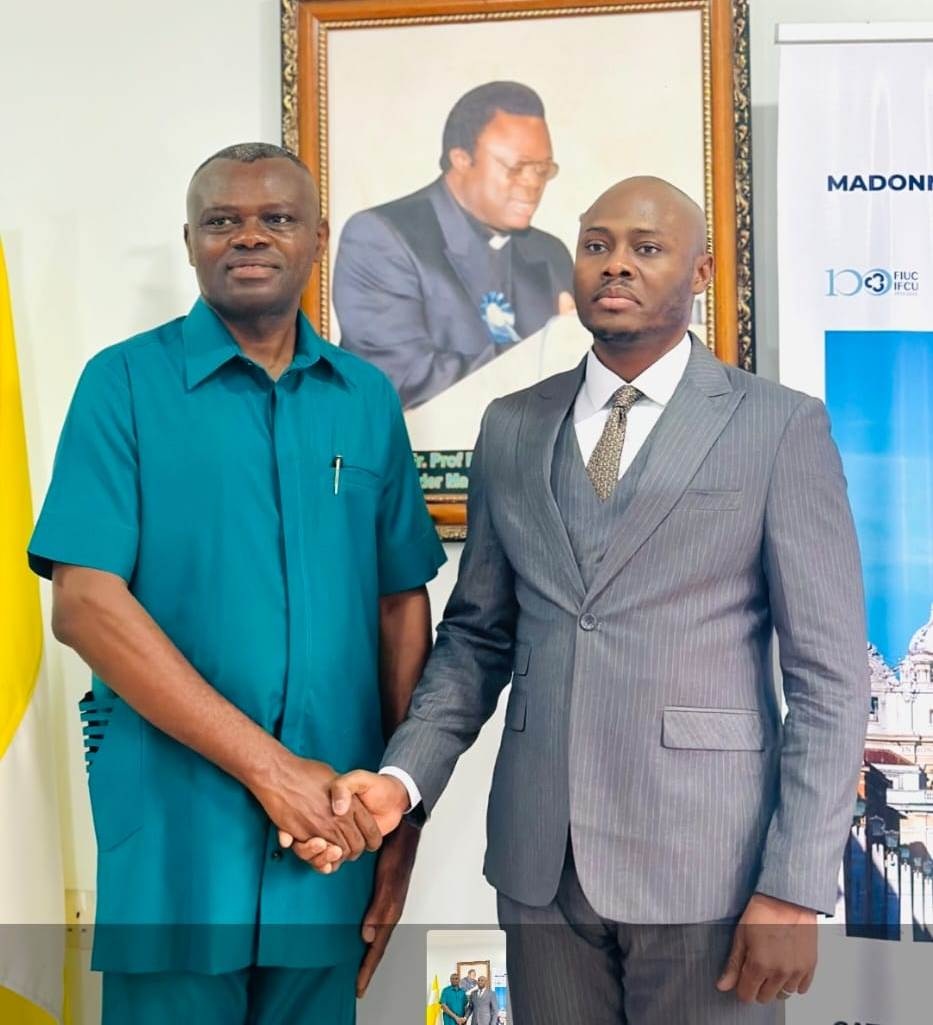
Technology strategist Rock Adote has been appointed to the Board of Trustees of Madonna University Nigeria, a move expected to strengthen the institution’s push toward digital governance and modern technological systems in higher education.

Madonna University
Adote, who has built a reputation in cybersecurity, enterprise identity management and digital transformation, brings over a decade of experience in designing secure digital infrastructure and managing identity systems for organizations.
Stakeholders believe his expertise will support the university’s efforts to strengthen data security and modernize its academic and administrative digital frameworks.
The appointment reflects the university’s growing commitment to technology-driven leadership as institutions increasingly rely on digital systems for academic operations, data management and research collaboration.
Universities today manage large volumes of sensitive digital information, including student records, research data and staff credentials, making strong cybersecurity and identity management frameworks essential.
As a member of the Board of Trustees, Adote will participate in providing institutional oversight and guiding strategic policy direction for the university.
The board is responsible for safeguarding academic standards while steering long-term development initiatives and ensuring the institution remains responsive to evolving global trends in education and technology.
Industry observers say Adote’s background in enterprise digital systems positions him to contribute significantly to the university’s digital transformation agenda, particularly in strengthening technological resilience and governance frameworks across its operations.
Other newly appointed members of the board include Sir Nwagwu Aloysius Emeka, Chief Arthur Obi Okafor (SAN), Professor Anagboso Martin Osita, Mrs. Ike Angela Unaoaku, Barrister Augustine Nenwa Obo and Rev. Fr. Stephen Ifeanyichukwu Nwatah.
Speaking on the appointment, Adote expressed appreciation for the opportunity to serve, emphasizing the importance of aligning higher education institutions with emerging technological realities.
According to him,
“Digital transformation will play a crucial role in shaping the future of academic administration, research and learning environments”.
Analysts note that the inclusion of technology leaders in university governance structures signals a growing recognition that digital transformation is becoming central to the competitiveness and sustainability of modern higher education institutions.
With Adote’s appointment, Madonna University is expected to further strengthen its technology strategy and position itself as a forward-looking institution within Nigeria’s higher education landscape.

UBA, NiDCOM Deepen Collaboration to Unlock Diaspora Capital for Nigeria’s Growth

Vitel Wireless Lures Subscribers with “Data that Never Expires” Campaign

FG Deploys Technology, Approves $54m Drugs to Tackle Tuberculosis

BoI, MTN Foundation Launch N1Bn Fund for Women Entrepreneurs

Luno Launches First Crypto Prediction Market in Nigeria

Kaspersky Discovers New Phishing Campaign Exploiting Google Tasks Notifications to Steal Corporate Credentials

esentry 2025 Report Shows Healthcare, Financial Services and Telecoms as Staging Grounds for Increased Cyberattacks in Africa

AfDB, UNDP Launch $10Bn AI Initiative for Africa

Mutual Benefits Assurance Settles ₦5.9bn Claims in January 2026

MultiChoice Suspends Yearly DStv Price Hike as Canal+ Pushes Growth




 Broadcasting2 days ago
Spotify’s Loud & Clear Report Reveals Over ₦60Bn Revenue for Nigerian Artists in 2025

 Telecom2 days ago
PwC Warns Nigeria Telcos of AI Fraud Risks

 E-Financial2 days ago
CBN Relaxes Dormant Account Rules with Removal of Affidavit Requirement

 News2 days ago
Elumelu Tags Elon Musk, Disowns AI-Generated Scam Video

 E-Financial2 days ago
Crypto Transactions Hit $96Bn in Nigeria -SEC

 E-Business2 days ago
FG Determined to Protect Rights, Privacy Online- NITDA

 E-Business2 days ago
Firm Warns of Malware Aiming to Steal Data from Individuals, Organisations in Nigeria

 News2 days ago
NITDA DG Appraised the Role of Teachers as Key to Nigeria’s Digital Transformation