

General News
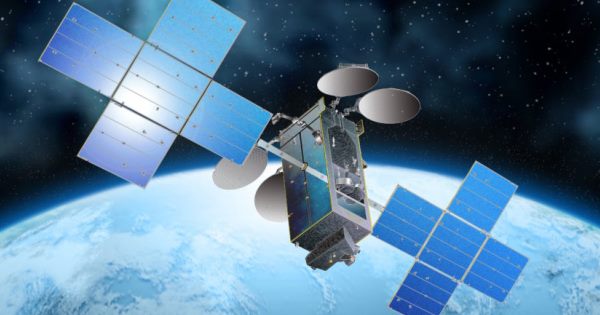
Satellite Technology is Ready When Needed for Border, Port & Maritime Security

By Andrew Aroh
We are still trying to figure out a lot of things in terms of threats, vulnerabilities and the integration of resources. We need to ensure that the satellite realm is recognized as critical infrastructure.

Satellite is a technology, which plays a critical role already, but most often omitted from formal discussions, and this is a huge problem.
Satellite communications is rarely mentioned as a specific solution or recommendation that spells out the need for improved communications and interoperability. There are instances, however, where attention is focused on a possible satellite solution such as border, port and maritime security. Recall the long-range vessel tracking system. In this case, we develop and implement a long-range automatic vessel tracking system for all vessels in Nigeria waters that are equipped with the Global Maritime Distress and Safety System or equivalent satellite technology. The system shall be designed to provide the safety agencies or the authority the capability of receiving information on vessel positions at interval positions appropriate to deter transportation security incidents.
The above underscores the pivotal role of satellite technology at sea, and offers a possible way to solve the vessel tracking puzzle, which is an important dimension of port and maritime security under a much broader concept known as maritime Domain Awareness [MDA] as well as the system known as the Universal Shipborne Automated Identification System [AIS].

SECURING CARGO AND PORTS:
- The goal here is to increase security throughout the entire international logistics chain by implementing security verification techniques. Building security into the global supply chain is a huge challenge.
- By expanding the role of satellite based systems such as GPS, AIS and the vessel Monitoring system, we can reinforce and extend our existing security verification techniques. Satellite technology is essential to making key elements of overall MDA system work.
- AIS a top priority which has been kicked into high gear by MDA. As a GPS-based system, AIS does include a possible long range interface with a satellite feed, for example.
The International Maritime Organization [IMO] is speeding up required carriage of AIS as well.
We have to have sufficient transparency and be able to verify low risk cargo as we go about building more confidence into our maritime and port security apparatus in general.
The process of tracking cargo as it moves along throughout complex intermodal transportation system mandates that we move our borders out, and provide security that moves with the box or container in question.
- Although satellite enjoys general recognition in terms of the key role it can play here, satellite is not going to happen without real advocacy. A good paper trial has to be wrapped around a regulatory model to drive more innovations in the maritime domain. This will enable the exploration of new technology such as electronic seals, vessel tracking and electronic notification of vessel arrivals.
- There is a growing interest in the use of satellites and GPS and global location systems to track the movement of cargo in real time. We are aware several companies have piloted advanced devices such as transponders and electronic seals, which when used with satellite technology, can pinpoint the location of a truck chassis, container, truck, ship or railcar in real time.
While the results of these demonstrations have been promising, we have also seen that this technology is feasible in a complex, commercial supply chain, on a practical as well as on an economic level.
Testing of satellite technology also upholds the devices for their ability to withstand the rigors of the commercial sea container/port environment, the effectiveness of the communication infrastructure, and their scalability, with the goal of developing requirements and protocols that can be commercialized within a competitive marketplace.
- While satellite technology is able to assist maritime security, primarily in terms of tracking ships or cargo consignments, resources could be a problem.
Again, it would be inordinately expensive to track everything, and would create a blockage nightmare as well.
However, if some sort of compromise over the level of blockage can be achieved, there is much promise in satellite technology.
- Remember, success will be very much reduced if some sort of tracking is not introduced for at least suspect vessels. So satellites would help very much, but again, depending upon the resources available. The Coast Guard [as the only resource] will certainly be stretched to do this vessel tracking job in a thorough manner.
BORDER PATROL LINKED VIA SATELLITE:
As for the nation’s borders, and the role of satellite technology in such programs as Smart Border Initiative, the National Transportation Security Plan and the National Land Border Security Plan, the door remains wide open. This is because for the large states, Cellular Digital Packet Data [CDPD] or Radio Frequency [RF] is not viable options.
- Therefore, we need the applications of satellite for data transfer. We can implement a limited number of satellite voice units to supplement regular radios in fringe coverage areas.
Absolutely, the recommendation is that the federal Government should spend more money to equip state law enforcement agencies in rural Border States with more satellite equipment [linked to NigComSat-1R] both for routine use as well as for enhanced border security purposes. Note that the border is one of the areas where we have the weakest coverage utilizing our existing radio technology. Hence any activity we participate with in those areas should see the benefit of satellite technology regardless of whether it is border security, search & Rescue or our other law enforcement missions.
- In every state, we can start with two vans assigned to perform commercial vehicle enforcement tasks equipped with two-way satellite terminals that can be used for dispatch as well as to instantaneously access driver and vehicle data anywhere in the state, including its remote border region. With the satellite technology, one can quickly check all the paperwork, validate the driver and verify that any Department of Transportation permits are valid, if required. One goal here is to simply increase monitoring presence in this remote and scarcely populated region both for safety and security purposes. The cost and ease of use of satellite gear are important considerations as well. There is no question that commercial vehicle enforcement activities represent a critical part of the overall plan to enhance border protection.
SATELLITE IMAGERY CONTROL:
- Besides making sure that satellite technology is used in the most effective way to protect borders, coasts, and port, government and military officials must also ensure that any group seeking to do harm does not gain access to high-resolution satellite imagery.
- We need policies for prohibiting the release of imagery beyond a certain resolution such as the guidelines provided by the appropriate security department, notification when an image crosses an international boundary, or when such a request is made by a person or group.
There is thus, a great need for effective and efficient schemes for facilitating such controlled dissemination of satellite imagery and the information products generated from it.
- Experts in the area of information systems security have access control model for high-resolution satellite image databases.
Commercial Satellite Organizations should proactively address sensitive satellite-related issues such as the fact that image collection or distribution must be constrained where there is an immediate and substantial threat to national security or foreign policy commitment.
FUTURE SOLUTIONS VIA SATELLITE:
Reliable and affordable satellite solutions are reliable and most can be quickly obtained as off the shell, commercial satellite products.
Enhancing border, port and maritime security may require the creation of novel hybrid solutions which can be useful to multiple agencies. Using the broad footprint of satellites, along with the proven reliability of satellite-based solutions can be brought to bear quickly on a variety of security-related objectives.
Andrew Aroh is President SSPI Nigeria


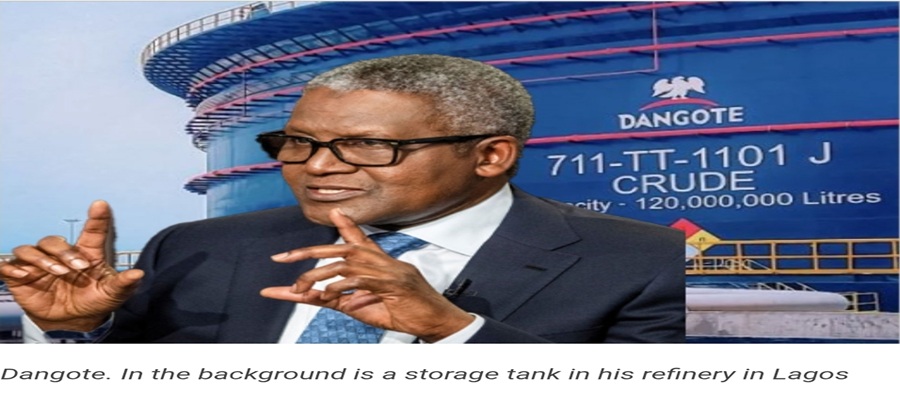
Dangote Petroleum Refinery is reportedly nearing completion of a $2.5 billion private placement that values the company at about $40 billion ahead of its planned public listing.

Private placement is the direct sale of company shares or bonds to pre-selected investors instead of the general public and it is used to raise money quickly while avoiding strict public reporting rules.
People familiar with the transaction said investors acquired as much as 6 per cent of the refinery, according to a BusinessDay report.
The reported terms would value the business at approximately $40 billion.
Neither Dangote Group nor the refinery has publicly announced the final amount raised, the identities of most subscribers or the precise percentage sold.
The figures should therefore be treated as transaction details supplied by unnamed sources rather than confirmed company disclosures.
The reported $2.5 billion total is nevertheless significant as it indicates strong demand for exposure to a privately controlled refinery that has rapidly become central to Nigeria’s fuel supply and an increasingly important exporter of petroleum products.
The placement was said to have attracted more demand than the available shares, allowing the company to secure substantially more than the amount initially associated with the fundraising exercise.
Femi Otedola, chairman, First HoldCo, is the only major participant publicly identified in the report.
He reportedly committed $100 million to the transaction and sold his investment in Geregu Power Plc to finance the acquisition.
Nigeria’s pension industry was also reportedly cleared to participate.
Access to more than $17 billion in retirement assets would broaden the refinery’s potential investor base beyond wealthy individuals and conventional institutional buyers.
Participation by Pension Fund Administrators would, however, require careful attention to valuation, liquidity and portfolio-concentration limits.
Retirement funds must balance the attraction of a large Nigerian industrial asset against their responsibility to protect contributors’ savings.
The implied $40 billion valuation represents investor expectations about the refinery’s future earnings rather than only the physical cost of constructing the facility.
Its ability to process 650,000 barrels of crude daily gives it a central role in supplying Nigeria and other markets, but its commercial performance remains connected to crude availability, product prices, exchange rates and regulation.
The refinery has struggled to obtain all the Nigerian crude it requires under the government’s naira-for-crude arrangement.
It has consequently purchased some feedstock internationally and recently moved local petroleum-product pricing into dollars to align sales revenue more closely with its foreign-currency expenses.
Those constraints will be important during any public offering.
Prospective shareholders will want greater clarity on crude-supply contracts, debt, operating margins, export revenue and the company’s relationship with Nigerian regulators.
It is also unclear whether the private placement involved newly issued shares, a sale by existing owners or a combination of both.
That distinction determines whether the reported $2.5 billion becomes fresh capital for the refinery or proceeds received by selling shareholders.
The transaction could provide a useful price reference for the planned initial public offering.

Federal government will next month launch Nigeria’s first national organized crime strategy to strengthen the country’s response to terrorism, cybercrime, human and drug trafficking, kidnapping, illicit financial flows, and other forms of organized crime.

Major General Adamu Laka, national coordinator of the National Counter Terrorism Centre under the Office of the National Security Adviser, disclosed this in Abuja during the validation of the strategy document.
He said the strategy provides a coordinated national framework for tackling organized crime through improved intelligence sharing, stronger collaboration among security agencies, and closer cooperation with the criminal justice system, civil society organizations, and international partners.
Major General Laka explained that the document was developed through a partnership involving the Federal Government, the United Nations Office on Drugs and Crime (UNODC), the United States Government, and other stakeholders.
Speaking at the event, Cheikh Toure, UNODC representative, said the strategy would strengthen Nigeria’s capacity to combat transnational crimes, including drug trafficking, cybercrime, human trafficking, kidnapping, and illicit financial flows.
Also speaking, Douglas Grane, acting director of the United States Department of State’s Bureau of International Narcotics and Law Enforcement Affairs, reaffirmed the U.S. government’s support for Nigeria’s efforts to tackle organized crime through stronger inter-agency and international cooperation.
Representatives of the National Institute for Strategic Studies, the Nigeria Financial Intelligence Unit, and the National Cyber Security Centre also endorsed the initiative, describing it as a major step towards improving Nigeria’s fight against organized crime.
FATE Foundation, with funding from the Citi Foundation, has launched the Youth Entrepreneurship Incubation Programme to equip young people in Nigeria with financial literacy and entrepreneurship skills.

Delivered through free, safe, and accessible platforms, the programme supports the incubation and scaling of youth-led enterprises, enabling income generation and job creation.
In October 2025, FATE Foundation was selected as a recipient of Citi Foundation’s 2025 Global Innovation Challenge to Accelerate Youth Employability. Joining the cohort of 50 organisations globally, the Foundation will receive $500,000 over two years to advance its youth employability initiative.
“We are excited to be selected for Citi Foundation’s 2025 Global Innovation Challenge,” said Ayomide Akindolie-Igwe, Executive Director of FATE Foundation.
“This support enables us to equip young entrepreneurs in Nigeria with the financial literacy and skills needed to build and scale sustainable businesses.”
The programme addresses youth employability by tackling Africa’s growing jobs crisis. By 2030, the African continent will be home to 40% of the world’s youth, and with one in three under 35 already unemployed, this initiative will support Nigerian youth with a two-phase approach. It begins with financial literacy training before progressing to entrepreneurship development, incubation support, and access to tools needed to build viable, job-creating businesses.
“Through this innovative initiative, FATE Foundation is supporting low-income Nigerian youth to develop essential financial and entrepreneurial skills using accessible platforms.
“This support is not just helping individuals to succeed; it is building a solid foundation for sustainable enterprises that will drive job creation and contribute significantly to our nation’s economic vitality. This initiative is empowering and investing in the future of Nigeria, one youth at a time,” said Nneka Enwereji, MD/CEO Citibank Nigeria Limited.

Dangote Refinery’s Private Placement Reportedly Hits $2.5Bn

FG, UNODC Plan National Strategy against Organized Crime

EFCC Busts NIS Visa Overstay Racket, Uncovers N700m in an Account

CBN to Monitor Every Dollar with FXBT, Forex Tracker

NCC, NDLEA Partner to Fight Piracy and Drug Trafficking

NRC, Ponzi Scheme Collapses Resulting Loss of Billions of Naira

NASENI Moves to Digitize CCB’s 5m Assets Declaration and Operations

Lebara Nigeria Launches Lebara Play, Africa’s First Telecom-Owned Micro-Drama Platform

CANAL+ Partners Samsung to Pre-Load DStv Stream on New Samsung TVs In Nigeria, Other African Countries

Tokenization, Blockchain Technology will Transform Financial Institutions – IMF




 Telecom3 days ago
Helios Towers Secures $29m Facility to Expand Across Africa

 News3 days ago
ValueJet Expands Fleet with Boeing Aircraft, Targets Wider African Network

 E-Financial3 days ago
First Securities Brokers Empowers Nigerians to Trade in the Stock Market with the Launch of FirstInvest App

 Telecom3 days ago
NCC Begins Stakeholder Consultation on MVNO Business Rules

 News3 days ago
Court Orders Final Forfeiture of 48 Properties Linked to Former AGF Abubakar Malami

 Telecom3 days ago
Surge in Fibre Cuts Hobbles Service Provisioning

 Broadcasting3 days ago
NBC Scraps Annual Digital Access Fee on DSO

 News3 days ago
Court Grants Former CCT Chairman Danladi Umar N100m Bail Over EFCC Charges