

General News
Activists Turn to Bitcoin for #EndSARS Protests as Banks Shut Them Out

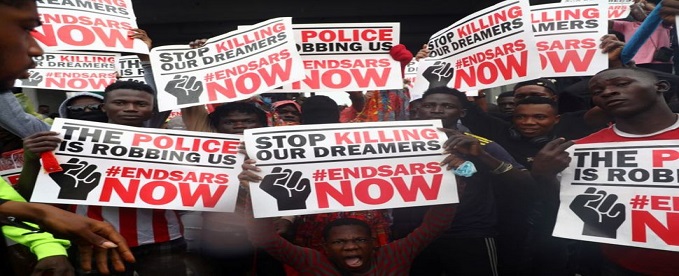
As protests surge through Nigeria in response to police brutality, one enclave of protestors has turned to bitcoin as a financial lifeline during turbulent times, according to CoinDesk.

The Feminist Coalition’s bank account was shuttered this month after its involvement in the End SARS protests came to light, according to a person familiar but unaffiliated with the group who asked to be identified as Emma (a pseudonym).
End SARS is a movement in Nigeria to abolish the Special Anti-Robbery Squad (SARS), a subdivision of the police force with a track record of abusing and harassing citizens.
Cast out of the traditional system, the Feminist Coalition is now raising donations in bitcoin.
The #EndSARS protests
The Feminist Coalition was founded in July with a mission to “champion equality for women in Nigerian society with core focuses of education, financial freedom, and representation in public office.”
With the outbreak of protests against police brutality this month, the group has concentrated on providing medical care, legal aid and even funeral funding for those participating in the peaceful demonstrations.
Since the protests surfaced in the beginning of October, 10 Nigerians have died at the hands of police, according to CNN.
As of Oct. 16, the Feminist Coalition has collected a total of 69,891,637.15 naira (a couple bucks shy of $185,000), 15,443,280.00 of which ($40,000) has been deployed to aid 128 protests across the country, according to the coalition’s website.
Bitcoin and censorship-resistant fundraising
All of this fundraising attracted the attention of authorities, though, and they were shut out of Flutterwave, the payments platform and something of a virtual bank they used to process donations.
At press time, Flutterwave had not returned CoinDesk’s request for comment.
That’s when they turned to alternatives.
“Quite a few members of the group work in tech,” so they made the decision to use bitcoin as another payment option, said Emma.
They started by using Sendcash, a platform which converts bitcoin payments into naira and then deposits these funds into a recipient’s Nigerian bank account.
The service is intuitive and highly useful, but it carries the risk that banks will almost certainly sniff out the source of the Feminist Coalition’s funds and shut down its accounts again.
The coalition no longer uses Sendcash because of this likely outcome.
But they still accept bitcoin: Alex Gladstein, chief strategy officer of the Human Rights Organization, set them up with a BTCPay Server.
Emma called the self-hosted payment process “a safer wallet” compared to other options.
Because it operates obliquely to the banking system, the censorship-resistant payment portal is an essential tool for the Feminist Coalition’s fundraising, Gladstein told CoinDesk.
“I would say BTCPay is important because it protects the privacy of donors and prevents the government from easily figuring out what service the protestors are using to cash out their bitcoin into naira,” he said.
Since adding the BTCPay bitcoin donation option on Oct. 14, the coalition has amassed roughly 3.14 BTC (~$36,000).
Bigger than Bitcoin
As CoinDesk has reported previously, Nigerians are no strangers to how the Bitcoin system lets them move money in the shadows of the legacy financial system.
Some Nigerian expats, for instance, use the Paxful exchange to send remittance funds back home, while others use bitcoin to trade directly with China.
More germane to the recent protests against police brutality, others have even used Bitcoin as an unconfiscatible bank account to avoid police shakedowns for cash. As though they see the writing on the wall, the Nigerian government is also spinning up a digital version of the naira.
Still, Emma said that bitcoin is “not popular among the masses yet at all. There are large barriers mostly in terms of education. However, a lot of young Nigerians are now starting to adopt cryptocurrency and it’s growing across the population.”
Further, the Feminist Coalition’s successful fundraising using bitcoin sheds “some positive light on cryptocurrency,” she says, and promotional efforts by Binance in Nigeria are also softening Bitcoin stigma in the country.
Of course, Bitcoin is only one tool in Nigeria’s fight for civil rights – it is not a cure – all for its citizens. What’s really needed is concrete reform.
Nigerians have been protesting as far back as 2016, Emma said, for SARS’ abolition and for police reform. It wasn’t until the most recent bout of unrest beginning in October that the government acquiesced to the protestors’ demands and formally disbanded SARS.
To many Nigerians, though, this is merely political theatre, and they expect SARS abuses to migrate to one of the new task forces that the government is forming to take its place.
That’s why the protests haven’t stopped, Emma said, “because [Nigerians] want to see actual change in terms of police reform.”
With SARS now abolished, though, the protesters’ something-of-a-victory has left Emma hopeful. Not necessarily that things will immediately change, but that the Nigerian people, collectively, are beginning to “wake up” to the government’s abuses.
There’s more activity now than ever pressing for change, she said, and that’s something to be thankful for.
“We’re very tired of the lies and deceit, and there’s a widespread consciousness and awakening among young Nigerians right now that many are saying they’ve never seen before. I know I’ve never seen it before and I’m so relieved that it’s finally here.”


Recent research by Kaspersky has shown that the so-called “grey” websites repeatedly target all world regions, and this may be driving both financial loss and large-scale data harvesting.

Grey websites are deceptive online platforms that fall outside traditional phishing definitions but still manipulate users into voluntarily handing over money and personal data. Kaspersky’s new report provides detailed insights into the threats posed by the grey websites on global and regional levels.
Unlike classic phishing attacks, which aim to steal credentials outright, grey websites rely on persuasion, misleading interfaces, and hidden terms to exploit users. They often impersonate legitimate services such as e-commerce platforms, financial tools, AI services, or subscription-based content, making them significantly harder to detect.
Kaspersky analysis shows that the majority of suspicious resources globally fall into several recurring categories:
- Fake browser extensions and “security tools” that actually harvest browsing data and track user activity.
- Fraudulent financial platforms including crypto exchanges, trading tools, and investment schemes promising unrealistic returns.
- Intermediary services (e.g., legal or real estate), charging for low-value or nonexistent services while harvesting sensitive personal data.
- Subscription traps offering low-cost trials that convert into costly recurring payments hidden in fine print.
- Fake online shops that either deliver counterfeit goods or nothing at all.
Example of a grey website.
A notable trend is the emergence of tools disguised as AI services or image-processing platforms, reflecting attackers’ ability to adapt to current digital trends and target younger audiences.
There are proven security solutions that help users to detect grey websites across different types of devices – those running on Windows, Linux, Android and iOS. The detection model is based on many factors, including domain name and age, IP reputation, stability of the infrastructure used, DNS configurations, HTTP security headers, digital identity and popularity of the web resource and other criteria.
Regional specifics
Regional variations in grey websites demonstrate how threat actors localise scams based on user behaviour and trending technologies.
In Europe, the threat landscape is dominated by links to suspicious browser extensions and fake “privacy-enhancing” tools.
These resources often present themselves as security solutions, promising safer browsing or anonymous search capabilities. In reality, they function as browser hijackers – intercepting traffic, collecting cookies, tracking user behaviour, and injecting advertisements.
The popularity of these threats reflects a high level of user concern around privacy and security, which attackers actively exploit. Additionally, these regions show a steady presence of phishing intermediaries and crypto-related scams, indicating a blend of technical and financially motivated attacks.
Across African markets, financial scams are the most prominent category of suspicious resources. Fraudulent trading platforms, fake brokers, and investment schemes frequently mimic legitimate financial services, often accompanied by fabricated licenses or endorsements.
These platforms typically prevent users from withdrawing funds, instead introducing additional “fees” or taxes to prolong the scam. The concentration of these threats highlights how attackers leverage growing interest in online investing while exploiting gaps in regulatory enforcement and financial literacy.
In the Middle East and North Africa region, suspicious resources frequently mimic communication (Internet telephony) tools, financial platforms, or betting services. Additionally, Ponzi-style investment schemes and crypto scams are widespread, often presented through polished interfaces that mimic legitimate platforms.
Web browser-based threats also play a significant role, with malicious extensions targeting user data and browsing activity. The regional threat profile reflects a convergence of financial fraud and technical compromise, where users risk both data exposure and monetary loss.
“Suspicious websites don’t look harmful at first glance. But they exploit trust, urgency, and familiarity, and a single click on what looks like a harmless AI image tool, a “secure” browser extension, or a heavily discounted online shop could be all it takes to lose money or expose sensitive data.
Instead of direct credential theft, attackers turn to behavioural manipulation – whether that’s subscribing, investing, or installing software,” comments Anna Larkina, Web Content and Privacy Analysis Expert at Kaspersky.
General News
MSMEs Paucity of Funds Receives Boost as Senate Backs Bill Seeking to Unlock Cash for them


Businesses across Nigeria, particularly micro, small and medium enterprises (MSMEs), may soon be able to convert unpaid invoices and credit sales into immediate cash without relying on conventional bank loans following the passage of the Factoring, Assignments and Receivables Financing Bill for second reading in the Senate.

The bill, which seeks to establish a legal framework for factoring and receivables financing, is expected to improve access to credit, boost liquidity for businesses and enhance domestic and international trade.
It also seeks to provide legal certainty for the assignment of receivables through factoring, promote transparency, modernise assignment laws and facilitate greater access to credit for businesses across the country.
Leading debate on the bill which was sent from the House of Representatives for concurrence, Senate Leader Opeyemi Bamidele said on Tuesday that the proposed legislation would create an enabling environment for debt factoring to thrive in Nigeria while defining the rights and obligations of creditors, factors and debtors involved in such transactions.
He explained that the bill provides for factoring contracts between sellers and factors and clarifies the legal relationship among parties in receivables financing arrangements.
According to Bamidele, the legislation has already passed all legislative stages in the House of Representatives and has complied with the Senate’s procedural requirements under Order 78(3) of the Senate Standing Orders.
He told lawmakers that the Senate Ad Hoc Committee on Compliance, chaired by Abdul Ningi, had scrutinised and cleared the bill for concurrence.
“The committee confirmed that all procedural requirements for consideration and concurrence by the Senate have been fully met,” he said.
Seconding the bill, Adetokunbo Abiru said the legislation would provide businesses with an alternative source of financing by enabling them to turn credit sales into cash and improve their working capital.
Abiru noted that factoring has become increasingly popular across Africa over the last decade, largely through initiatives supported by the African Export-Import Bank (Afreximbank).
He disclosed that the African factoring market is currently valued at over $50 billion, but Nigeria’s participation remains below one per cent.
According to him, countries such as Egypt and Morocco have benefited significantly from the financing model, adding that Nigeria risks missing out on the growing market without a clear regulatory framework.
“I think that passing this major legislation will help support our micro, small and medium enterprises in terms of converting most of their credit sales into cash without going through the normal borrowing arrangement,” Abiru said.
In his remarks, Ningi also assured lawmakers that the compliance committee had reviewed the bill and found no legal impediments to its passage.
Following a voice vote, the Senate approved the bill for second reading and subsequently referred it to the Committee of the Whole for clause-by-clause consideration.

The IMF on Tuesday warned of risks surrounding Nigeria’s plan to borrow up to $5 billion through a derivatives agreement with First Abu Dhabi Bank, saying such transactions are often opaque and complex.

Recall that the Senate in April gave its approval to the agreement, joining other Africa borrowers like Senegal and Angola who have tapped similar arrangements over the past year.
“Our view is that the transaction in these types of structures carry risks. Usually they are opaque so the terms are not always very transparent when we reviewed these instruments across countries,” Christian Ebeke, IMF resident representative in Nigeria, told reporters.
Ebeke said Nigeria could instead issue eurobonds to finance its deficits or other means to raise funding, including on concessional terms.
Nigeria intends to use proceeds from the total return swap, or TRS, to refinance expensive debt and pay for infrastructure.
In its latest Article IV review, the Fund praised Nigeria’s sweeping reforms, saying they had strengthened economic stability and investor confidence, but warned that the benefits had yet to reach millions of citizens and could be undermined by global shocks, including the Middle East conflict.
The reforms since 2023 under President Bola Tinubu – including fuel subsidy removal, tighter monetary policy and exchange rate liberalisation – had rebuilt buffers and improved macroeconomic management, the IMF said.
However, it cautioned that the reforms were also contributing to social strain, with poverty levels at 63% and millions facing food insecurity, underscoring a widening gap between macro gains and household realities.
The IMF said improved policy credibility and forex reforms had helped Nigeria regain access to international capital markets and attract portfolio inflows, while reducing risk premiums. The central bank says gross reserves are at $50 billion, the highest in 17 years.
But reliance on volatile foreign portfolio investment poses rollover risks, the IMF said, urging a shift towards more stable, long-term capital such as foreign direct investment.

Airtel Africa Foundation Publishes Inaugural Annual Report

Mobile Internet Gender Gap Widest in Africa – GSMA

Kaspersky Warns of “Grey” Scam Websites Exploiting User Trust

Access Holdings Affirms Long-Term Value Strategy @ 4th AGM

Zoho Unveils Homegrown Server, Takes Bold Step Toward Tech Independence

CBN Extends PoS Geo-Fencing Enforcement Deadline to August 2026

FG to Launch Nationwide Free Digital TV Platform June 17

Jumia Nigeria Records Strong Q1 2026 Growth as Technology-Led Strategy Drives Market Expansion

NCC Drafts New Rules for Virtual Mobile Operators

FG to Balance Innovation with National Security with Stronger Drone Regulations




 E-Business3 days ago
NDPC, Meta Launch 2-Year M-SIDP after Regulatory Settlement

 E-Financial3 days ago
Report Faults Banks over N91.1 Trillion Sterilised at CBN

 E-Financial3 days ago
CBN to Deploy AI in Fight Against Payment Fraud

 E-Business2 days ago
Kaspersky Report Shows Early 2026 Witnessed an Increase in Cyberattacks on the Manufacturing Sector

 Telecom2 days ago
Nigeria, Others Stuck on WiFi 4 As World Adopts WiFi 6, WiFi 7

 Telecom2 days ago
Yuno Partners with Onafriq to Unlock Pan-African Payments for Global Merchants

 General News2 days ago
IMF Warns Nigeria of Risks in $5Bn Swap Deal with First Abu Dhabi Bank

 Telecom2 days ago
Zedvance Targets Threefold Growth in Lending After Disbursing N120bn to SMEs