

E-Financial
Banks’ N1.96Trn Black Hole: Who Took the Loans, Who Defaulted, and Why the Real Economy Suffers

By Blaise Udunze
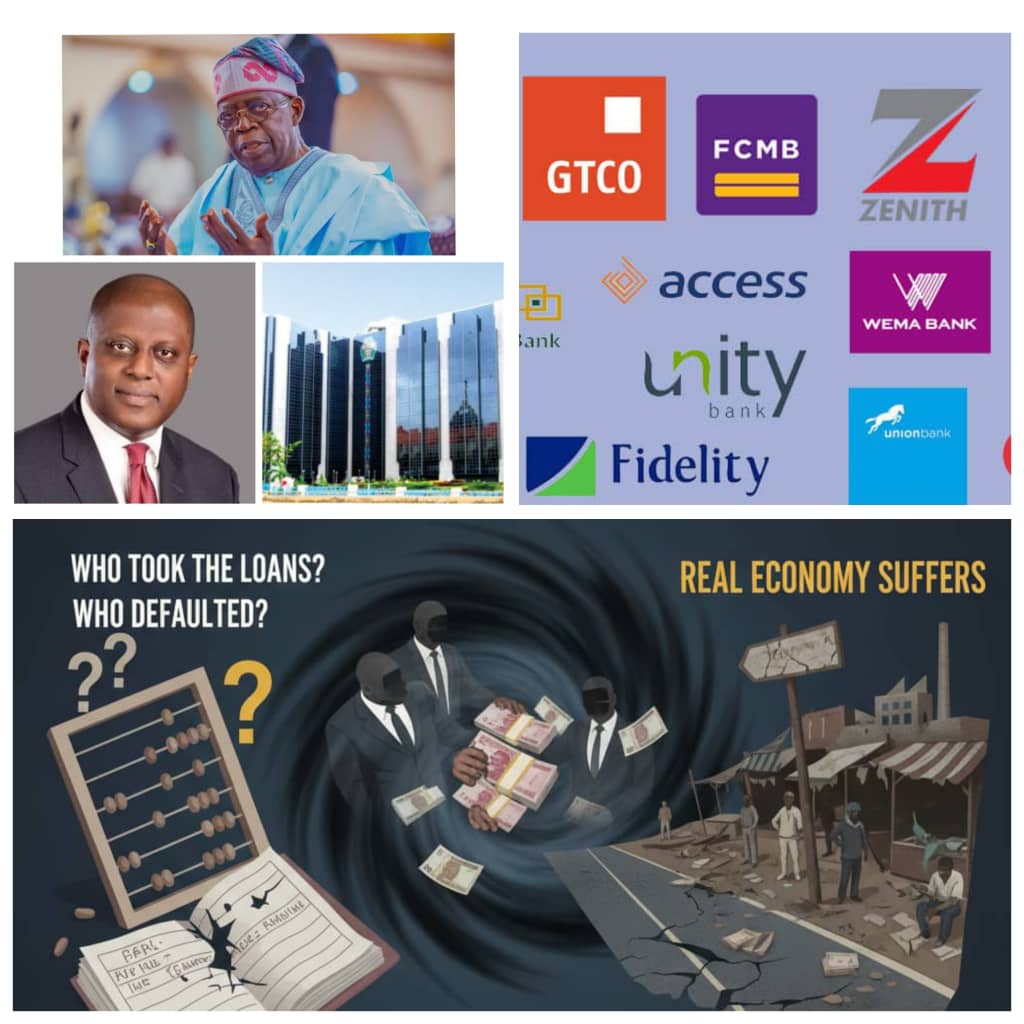
Nigeria’s banking sector has entered a season of reckoning. Eight of the nation’s biggest banks have collectively booked N1.96 trillion in impairment charges in just the first nine months of 2025 which represents a staggering 49 percent increase from the N1.32 trillion recorded in the same period of 2024.

Behind these figures lies a deeper question that speaks to the very soul of Nigerian finance on who received these loans that have now turned sour? Were they the small and medium enterprises (SMEs), entrepreneurs, and job creators that fuel real economic growth, or were they politically connected insiders and corporate giants whose failures are now being quietly written off at the expense of the public trust?
The Central Bank of Nigeria (CBN) is unwinding its pandemic-era forbearance regime, a policy that allowed banks to restructure non-performing loans and delay recognizing potential losses. It was a relief measure meant to protect the economy during the COVID-19 shock. But as the CBN begins to phase out this regulatory cushion, the hidden weaknesses in many banks’ balance sheets are now coming to light.
The apex bank has since placed several lenders under close supervisory engagement, restricting them from paying dividends, issuing executive bonuses, or expanding offshore operations until they meet prudential standards. Those that have satisfied the conditions are being gradually transitioned out ahead of the full forbearance unwind scheduled for March 2026. This shift, though painful, is forcing banks to confront the true state of their loan books and the picture emerging is anything but flattering.
A review of financial statements of Nigeria’s top listed banks reveals the distribution of impairment charges as of the third quarter of 2025.
– Zenith Bank Plc leads the pack with an eye-popping N781.5 billion in impairments, a 63.6 percent jump from N477.8 billion in 2024. Most of this amount to about N711 billion which occurred in the second quarter of 2025, driven by losses on foreign-currency loans and the end of regulatory forbearance. The bank’s gross loans declined by 9 percent to N10 trillion, and though its non-performing loan (NPL) ratio improved to 3 percent, that was largely due to massive write-offs.
– Ecobank Transnational Incorporated (ETI) followed closely, provisioning N393.7 billion, up 47 percent year-on-year. Inflation, exchange-rate volatility, and macroeconomic stress in Nigeria and Ghana all contributed to loan-quality deterioration. Its total loan book stands at N21.1 trillion, with a modestly improved NPL ratio of 5.3 percent.
– Access Holdings Plc posted impairments of N350 billion, representing a 141.5 percent surge year-on-year. About N255 billion of this came from loans to corporate entities and organizations, while the rest were loans to individuals. The bank cited changing macroeconomic conditions, inflationary pressures, and continued regulatory adjustments as the main culprits.
– First HoldCo reported N288.9 billion, up 68.6 percent from N171.4 billion a year earlier. The bank attributed the spike to revaluation losses and write-downs of legacy exposures in the energy and trade sectors. Notably, about N100 billions of this was incurred in the third quarter alone.
– United Bank for Africa (UBA) saw a dramatic improvement, cutting impairments from N123.5 billion to 56.9 billion, thanks to recoveries of N50.4 billion. The bank’s proactive loan-book management and collateral recoveries were credited for this performance.
– Guaranty Trust Holding Company (GTCO) posted N69.8 billion, up slightly from N63.6 billion last year. The group wrote off a key oil-and-gas exposure but maintained strong profitability, with pre-tax return on equity (ROAE) of 39.5 percent.
– Stanbic IBTC Holdings Plc recorded N11.6 billion, a sharp 80 percent decline year-on-year following recoveries of N16.3 billion on previously impaired loans.
– Wema Bank Plc, with N11 billion in impairments, reported one of the lowest provisioning levels in the industry, despite 30 percent loan growth.
Altogether, these eight banks have set aside almost N2trillion in provisions to cover potential losses, a sum roughly equivalent to Nigeria’s entire federal capital expenditure for 2025.
There have been recent claims of a modest level of loan growth that is not commensurate with the overall expansion of the banking system’s balance sheet. Data from MoneyCentral shows that the combined total loans of the nine banks stood at N65.37 trillion as of September 2025, representing a 7.42 percent increase from N60.86 trillion in 2024. This contrasts sharply with a 52.63 percent surge in combined loans recorded in the 2024 financial year and a 32.64 percent increase in 2023, according to data gathered by MoneyCentral.
The underlying question, therefore, is which sectors of the economy are actually benefiting from this reported loan growth?
The real puzzle behind these numbers is who actually received these loans that are now being impaired. While banks have long positioned themselves as engines of private-sector growth, evidence suggests that much of their lending goes to a narrow base of corporate borrowers, politically connected elites, and oil-and-gas companies. These sectors offer large-ticket deals and quick interest earnings but also carry enormous risk.
In contrast, the SME sector, which employs more than 80 percent of Nigeria’s workforce, continues to face credit starvation. Many small businesses are forced to rely on expensive informal loans or personal savings because banks deem them too risky. The pattern is clear that banks chase safety and short-term profits over inclusive growth. When their big corporate bets fail, they write them off through impairment charges, but the cumulative effect is that real economic activity suffers while the credit system grows more fragile.
Another dimension to the problem is the banking industry’s heavy investment in government securities. Over the past two years, Nigerian banks have channeled N20.4 trillion into treasury bills, bonds, and other fixed-income instruments, reaping risk-free returns rather than funding productive ventures. This “securities trap” is profitable for banks but disastrous for the economy. Instead of financing factories, farmers, or tech innovators, banks earn easy money by lending to government thereby crowding out private investment and weakening the transmission of credit to the real sector. When interest rates rise or currency values swing, the market value of these securities falls, forcing banks to record mark-to-market losses that translate into impairment charges. Thus, the same safety net that shields banks from loan risk ends up creating financial volatility of its own.
Beyond macroeconomic challenges, Nigeria’s banks are also grappling with homegrown problems like insider abuses, weak corporate governance, and ineffective risk management. Past crises in the banking sector, from the 2009 consolidation fallout to the 2016 oil-sector shock, reveal a consistent pattern: directors and senior executives often have outsized influence over loan approvals, sometimes extending credit to themselves or politically exposed entities without proper collateral or due diligence. These insider-related loans frequently turn toxic, hidden under layers of restructuring and accounting manoeuvres until a regulatory audit forces exposure.
The recent impairments may well reflect a new cycle of these historical sins as loans extended under pressure, influence, or misplaced optimism, now coming home to roost as the CBN tightens oversight. Corporate-governance codes exist, but enforcement remains uneven. Some banks continue to operate “relationship banking,” were loyalty trumps prudence. The lack of whistleblower protection, combined with weak internal-audit independence, further compounds the problem. Until boards and regulators impose real consequences for reckless lending, the system will continue rewarding the wrong behaviour and punishing taxpayers and shareholders in the long run.
At its heart, impairment is a measure of how well banks anticipate and manage risk. A rise in impairments signals that too many loans were made without properly assessing the borrower’s ability to repay, or that risk models failed to adjust to changing macroeconomic conditions. Several banks blamed their losses on exchange-rate volatility and inflation, but these are hardly new risks in Nigeria’s economic environment. The fact that impairments ballooned even as profits remained high suggests that risk-management frameworks were reactive rather than preventive which focused on compliance rather than foresight. In some cases, the sheer scale of provisioning, such as Zenith’s N781 billion or Access’s N350 billion, points to systemic underestimation of credit risk.
Every naira written off as an impairment represents not just a failed loan but a lost opportunity for the real economy. N1.96 trillion could have funded tens of thousands of new small businesses, millions of jobs, and critical infrastructure projects. Instead, these funds are trapped in the closed circuit of banking losses or vanish into opaque corporate failures. This has broader implications: as banks absorb losses, they tighten lending criteria, making it harder for genuine borrowers to access loans. High impairments signal instability, discouraging foreign investors and depositors, while credit flow dries up, productivity and job creation suffer. The result is a paradoxical economy where banks post impressive profits yet the productive sector languishes.
If there is a silver lining, it is that some banks, notably UBA, Stanbic IBTC, and Wema Bank are demonstrating improved loan-recovery strategies, more disciplined credit models, and a stronger focus on risk-weighted assets. Their experiences prove that impairment is not inevitable; it is the outcome of choices like governance, culture, and accountability. For others, the current round of provisioning should serve as a wake-up call to rethink their business models, diversify exposures, and strengthen compliance culture.
To its credit, the CBN’s forbearance unwind is a critical step toward transparency. By compelling banks to recognize their true loan losses and restricting dividend payouts until they meet prudential standards, the regulator is forcing a long-overdue cleansing of the system. However, reform must go deeper than technical compliance. The CBN must enforce public disclosure of insider-related loans, tighten penalties for concealment, and promote lending to productive sectors through targeted incentives. For instance, a tiered capital framework could reward banks that extend a higher proportion of credit to SMEs and manufacturing, while imposing stricter capital charges on speculative or insider-related lending.
Nigeria’s banking sector has shown resilience through crises, from the global financial meltdown to oil-price collapses. But resilience should not become an excuse for complacency. The N1.96 trillion impairment charges of 2025 are more than a balance-sheet adjustment; they are a mirror reflecting structural flaws in lending culture, governance, and the alignment between finance and development. To rebuild trust and relevance, banks must reorient lending toward real-sector growth, invest in credit analytics and risk intelligence that anticipate shocks, enforce transparency in board-level loan approvals and insider exposures, and collaborate with regulators to design sustainable credit frameworks for SMEs. Above all, there must be a moral recalibration of banking purpose from chasing short-term profits to fueling long-term national prosperity.
The spike in impairment charges does not mean Nigeria’s banks are collapsing. Rather, it signals an industry confronting its hidden fragilities. As the forbearance curtain lifts, the system has a chance to reset to clean up bad debts, rebuild credibility, and reconnect finance with development. But that opportunity will be wasted if the same patterns persist: insider lending, governance lapses, and a preference for easy returns over real investment. Until these issues are confronted head-on, the question will continue to echo through boardrooms and regulatory halls are Nigerian banks truly financing growth or merely recycling risk and protecting privilege? Only transparency, discipline, and a renewed sense of purpose can answer that question in the affirmative.
Blaise, a journalist and PR professional writes from Lagos, can be reached via: [email protected]



Central Bank of Nigeria (CBN) has directed banks and other financial institutions to complete a newly deployed cybersecurity self-assessment tool (CSAT) as part of efforts to strengthen resilience across the financial system.

In a circular dated March 30, the apex bank said the tool was introduced in line with its mandate under the Banks and Other Financial Institutions Act 2020 and is designed to assess the cybersecurity posture of regulated entities.
According to the circular signed by Olubunmi Ayodele-Oni for the director of the compliance department, deposit money banks are required to submit their completed assessments within three weeks, while other institutions have five weeks.
The directive, which takes immediate effect, applies to deposit money banks, payment service banks, microfinance banks, payment service providers, finance companies, and development finance institutions.
“The CSAT is a structured supervisory instrument designed to obtain comprehensive information on the cybersecurity posture of regulated institutions,” the circular reads.
“It covers key areas including cybersecurity governance, risk management practices, technology and third-party risk controls, incident response capabilities, and overall operational resilience.
“Insights derived from the CSAT will support risk-based supervision and enhance regulatory oversight of cybersecurity risks across the financial system.
“Accordingly, all the referenced institutions are required to complete and submit the CSAT through a dedicated submission portal.”
The regulator added that access to the submission portal and guidance would be provided to chief information security officers and other relevant officials of the affected institutions.
CBN said all submissions must reflect data as of December 31, 2025, and be accompanied by relevant supporting documentation where applicable.
The apex bank warned that “submission of false, misleading, or inaccurate information constitutes a regulatory breach,” and would attract sanctions in line with BOFIA 2020.
CBN also said validation exercises, including off-site reviews and supervisory engagements, would be conducted to verify the accuracy of submissions.

NGX Regulation Limited (NGX REGCO), a wholly owned subsidiary of Nigerian Exchange Group (NGX Group) has sanctioned five trading license holders for alleged market manipulation and other prohibited trading activities, imposing fines totaling N291million.

In a notification dated March 27, 2026, and addressed to Emomotimi Agama, director-general of the Securities and Exchange Commission (SEC), the regulator said the decision followed deliberations of its Regulatory and New Business Committee (RNBC) held on March 16 and 24, 2026.
The sanctioned firms are CSL Stockbrokers Limited, Cowry Securities Limited, Meristem Stockbrokers Limited, SMADAC Securities Limited, and Associated Asset Managers Limited.
NGX RegCo stated that the cases were escalated by its Investigation Panel after hearings on February 25 and March 17, 2026, which uncovered repeated infractions such as wash trades, self-matching transactions, artificial price formation, and misleading market activity.
CSL Stockbrokers was fined N91.29 million, while Cowry Securities, Meristem Stockbrokers, SMADAC Securities, and Associated Asset Managers were each penalized N50 million in accordance with the Investment and Securities Act 2025.
The Exchange also directed the affected firms to undertake mandatory compliance and market conduct training to reinforce regulatory adherence and enhance market discipline.
It noted that the sanctions are proportionate to the violations and are intended to deter future misconduct, reaffirming its commitment to safeguarding market integrity, protecting investors, and strengthening confidence in Nigeria’s capital market.

Federal government has launched the “Cross-Border Digital Payments and Identity in Nigeria under the AfCFTA” report, urging stakeholders to unlock trade opportunities for Micro, Small and Medium Enterprises (MSMEs) to access the $3.5 trillion African Continental Free Trade Area (AfCFTA) market.

The high-level report, hosted by the Office of the Vice President in collaboration with ODI Global under the Supporting Investment and Trade in Africa (SITA) programme, was unveiled by Ibrahim Hassan-Hadejia, deputy chief of staff to the President, in Abuja.
Hassan-Hadejia described the research as both timely and strategic, noting the strong coordination by the Office of the Vice President and the leadership of the Federal Ministry of Industry, Trade and Investment.
He revealed that the cross-border payments report followed earlier milestones, including the development and launch of Nigeria’s Digital Trade Strategy and a capacity-building programme for subnational leaders.
Furthermore, he said Nigeria is increasingly assuming a leading role in shaping the digital trade agenda across the African continent, necessitating that the country remains at the forefront of AfCFTA implementation.
He noted that deepening engagement with AfCFTA and enabling businesses, particularly SMEs, to conduct seamless cross-border transactions will be critical to unlocking trade, fostering growth, and creating jobs.
He further stated that efficient cross-border payments, supported by trusted digital identity systems as recommended in the report, will be key to realising President Bola Ahmed Tinubu’s Renewed Hope vision for Nigerian MSMEs.
The Deputy Chief of Staff also observed that while the report identifies the Pan-African Payment and Settlement System as a critical platform for cross-border digital payments, Nigerian fintech firms such as PalmPay and Moniepoint, which have some of the largest and most active user bases, will play a pivotal role in driving adoption.
He assured that the Federal Government remains committed to strengthening critical infrastructure, regulatory frameworks, and partnerships to ensure Nigeria is not only ready for digital trade but continues to lead.
“I appreciate the efforts of all stakeholders and urge us to move AfCFTA beyond a continental agreement to a $3.5 trillion trade juggernaut that will reinvigorate our industries, unlock intra-African trade, and domesticate African prosperity,” he added.
He said “intra-African trade will be driven not only by large corporations but by small businesses empowered through digital trade and e-commerce, while noting that issues of trust, identity, and logistics, as highlighted in the report, must be addressed”.
Commenting on the report, Temitola Adekunle-Johnson, special Adviser to the President on Job Creation and MSMEs, said the report – developed under the purview of the Office of the Vice President-would significantly strengthen the MSME ecosystem.
He expressed optimism that the report’s findings and recommendations would enable Nigerian SMEs to achieve seamless access to continental markets.
Salihu Dasuki, special Assistant to the President on ICT Policy, Office of the Vice President, disclosed that the office, in partnership with development partners, has developed a framework to fast-track seamless cross-border payments for MSMEs.
He added that “a key pillar of President Tinubu’s Renewed Hope Agenda is enabling Nigerians to access digital trade, which informed the capacity-building programme conducted for subnational governments last year”.
Shuda Ahmed, special assistant to the President on Project Support, Office of the Vice President, commended ODI Global for leading the research underpinning the report.
She noted that without seamless and affordable cross-border payment systems, MSMEs across the continent would be unable to scale beyond their domestic markets.
The event was attended by officials of ODI Global, representatives of AfCFTA, the National Information Technology Development Agency (NITDA), National Identity Management Commission (NIMC), Nigerian Petroleum Development Company (NPDC), Federal Competition and Consumer Protection Commission (FCCPC), and MSMEs, among other key stakeholders.

How Recycled SIM Card Linked to N50m Kidnapping Nearly Landed me in Jail – Businesswoman

Senate Gives Tinubu Nod to Borrow Fresh $6Bn

FG Earmarks $2Bn to Launch 2 Satellites in 2028, 2029

CBN Directs Banks, Fintechs to Complete Cybersecurity Audit Tool

FG Launches CLHEEAN to Streamline Access to Government Services

Spotify’s Loud & Clear Report Reveals Over ₦60Bn Revenue for Nigerian Artists in 2025

Madonna University Taps Tech Guru Adote for Strategic Board Role

China Threatens to Shut Nigeria’s Satellite Over $11.44m Unpaid Debt

Jumia Tech Week 2026 Begins with Tech Deals on Smartphones, Electronics, and Everyday Technology

FCCPC Bans Lagos ‘No Refund’ Policy, Vows Fines and Shutdowns for Traders




 E-Financial2 days ago
CBN bars large‑ticket loan defaulters from banking services in tough new crackdown

 General News2 days ago
ARN Rejects Medical Bill over Attempt to ‘Scrap’ Profession

 Telecom2 days ago
NIGCOMSAT Supports Startups Growth with the Launch of Accelerator 3.0

 News2 days ago
Meningitis Kills a Quarter Million People a Year -Study

 Telecom2 days ago
FG Unveils Digital Economy Research Fund Scheme

 News2 days ago
Stakeholder says AI is Crucial to Nigerian Data Centres Amid Persistent Grid Collapse
- General News2 days ago
Nigeria Advances Digital Governance as NITDA takes over NGEA Portal

 General News2 days ago
Zarttech Reflects on Its Role in Changing Global Perceptions of Africa