

News
LASG, Tech Co-create Solutions for Smart City Agenda

In fulfillment of Lagos State’s promise to engage with the technology ecosystem in co-creating solutions for its Smart City agenda, Art of Technology 1.0, themed ‘Bridging The Gap’ was held on the 5th and 6th of December at the Lagos Oriental Hotel.
Sponsored by the Lagos State Government, through the office of the Special Adviser on Innovation and Technology and the Eko Innovation Centre, the event attracted over 1,500 people drawn from government, tech, finance and academics.
According to the Curator of Art of Technology Lagos 1.0 and Founder of Eko Innovation Centre, Mr. Victor Gbenga Afolabi, the two-day summit was building on the earlier engagement of government and the tech community during the design thinking parley which saw the co-creation of solutions in the areas of access, infrastructure, talent and capital culminating in the Lagos Innovation Master plan.
He said, “For the first time in this country, whether state, sub-regional, or national, we are having a government committed to an innovation master plan. It is part-product of the co-creation session. It is called Lagos State Innovation Master Plan; it tells us where we are going, where we need to be and how we can achieve more.”
The Lagos Innovation Master plan was unveiled by Mr. Babajide Sanwo-Olu, Governor of Lagos State, in the company of Dr. Obafemi Hamzat, Deputy Governor, Lagos State; Mr. Hakeem Popoola Fahm, Commissioner of Science and Technology, Lagos State and Mr. Tunbosun Alake, Special Adviser, Innovation and Technology to the Governor of Lagos State.
In addition, the Governor announced a tech fund of N250 million to be managed by the Lagos State Science, Research and Innovation Council (LASRIC) headed by the Vice-Chancellor of the University of Lagos, Prof. Oluwatoyin Ogundipe. This will support research and development of tech-focused solutions across the six pillars of his administration’s development agenda. LASRIC will also invest in research and development in the areas of Artificial Intelligence (AI), robotics, health informatics and green energy.
Buoyed by its commitment to deepening collaboration between government and the tech ecospace, Governor Babajide Sanwo-Olu also launched the Open Government Initiative, and Lagos State Solution Hub. It is expected that these initiatives will further drive synergy between policymakers in the public sector and innovators in the private sector.
Commenting on the Lagos State Solutions Hub, he said, “Democratising access to state actors is a critical strategy of this government as such, the Lagos State Solutions Hub serves as the first point of call for innovators, solutions providers and innovators on proposing their solutions to the state. It will enable us to evaluate different solutions from you, our most important stakeholders. The website is LagosSolutionsHub.com.”
On the Open Government Initiative, he stated: “Data Access is seen as critical for the building blocks of a solutions culture. Open data promotes inclusiveness, participation and more fit for purpose solutions. The Open Government initiative has kicked off and we will be communicating subsequent milestones with the public soon.”
Andrew Nevin, Advisory Partner & Chief Economist, PwC made a case for Lagos becoming a major player in Nigeria’s tech ecosystem given the growing number of Nigerian startups coming up with innovative solutions to societal problems during his keynote address.
Juliet Ehimuan, Country Director, Google Nigeria, also a keynote speaker, discussed how technology is being deployed to solve problems in education, transportation, health and business.
Kola Aina, Founder, Ventures Platform shared practical ways for government and tech to work together in his keynote address, ‘The Enabling Role of Stakeholders in Innovation.’ He posited that Lagos should focus on enabling market creating innovations and strengthening the ecosystem.
Amauche Emenari, Doctoral Researcher, M.I.T., looked at how humans can leverage on artificial intelligence to build better solutions to individual and societal challenges during his keynote address.
The highly interactive event also featured hard talk conversations as well as plenary and breakout sessions on tech & culture, building MVPs, consumer-centric products (not just apps), the future of work, funding mechanics and women in tech.
Mr. Tunbosun Alake, Special Adviser, Innovation and Technology to the Governor of Lagos State, launched Idea Hub, a mentorship platform designed to help innovators take their ideas from conception to actualisation.
He said, “The platform allows people to input their ideas, get matched with mentors to get their ideas validated for execution.” He added: “The Idea Hub is supposed to professionalise your idea, structure it properly, so that you get a minimum viable product and then launch into the market.”
Another high point of Art of Technology Lagos 1.0 was when StanLab claimed victory in the keenly contested maiden edition of Collaborate Lagos Pitch Competition. StanLab is a 3D virtual laboratory that leverages Virtual Reality (VR) and Augmented Reality (AR) to provide practical science education to schools without traditional science laboratories.
Mr. Job Oyebisi, CEO, StanLab said, “It was an awesome experience exhibiting our product and participating in the pitch competition. We had insightful feedback from judges and participants who came to know about our EdTech product. The highlight was the MoU from the Lagos State Government and the acceleration support from Eko Innovation Centre.”
Commenting on the involvement of Eko Innovation Centre, Mr. Afolabi said, “Our emphasis is on localising technology to solve our problems. As part of our commitment to Collaborate Lagos, Eko Innovation Centre will offtake the winner, StanLab and accelerate them for government adoption.”
He also expressed his satisfaction with the high turnout and quality of engagement recorded at Art of Technology Lagos 1.0. “AoTLagos is positioned to continue the engagement. We have to solve our problems ourselves, let’s get to work now!”



National Agency for Food and Drug Administration and Control (NAFDAC) has alerted Nigerians on counterfeit and unregistered Cerelac Mixed Fruits and Wheat products being sold in Lagos.

NAFDAC said Nestle Nigeria, the genuine Marketing Authorisation Holder of the product, received a complaint of suspected counterfeit purportedly manufactured by Nestlé Spain, bearing Batch Code 308002910.
It said that Nestle Nigeria reported that the complainant described that the counterfeit product emitted an odour suggestive of possible contact with fuel.
NAFDAC said that preliminary review of the product by Nestle Nigeria indicated that it had expired, in spite of the container displaying an expiry date of 10-2026, which suggested that the date coding had been tampered with (revalidated).
Nestle Cerelac Mixed Fruits and Wheat is a nutritious infant cereal, designed to be a delicious first food for infants.
NAFDAC said that its post-marketing surveillance’s directorate officers in Lagos conducted a surveillance visit to Maxland Shopping Centre, 193 Ago Palace, Okota, where the product was purchased by the complainant.
It added that the suspected counterfeit and unregistered Cerelac were found on sale at the premises and subsequently mopped up, while Nestle assisted in identifying the distinguishing features between registered and unregistered product.
According to the regulatory agency, Nestle revealed that the unregistered product used a hyphen (-) to separate the day from the year, while the registered product used a slash (/) to separate the day from the year.
“It is important to note that Nestle Nigeria is not aware of the channels through which the products are supplied into the country.
“Healthcare professionals and consumers are advised to report any suspicion of the sale of substandard and falsified regulated products to the nearest NAFDAC office, call 0800-162-3322, or send an email to [email protected],” NAFDAC said.
The agency warned that counterfeit formula often lacked essential nutrients, vitamins and minerals, leading to stunted growth or developmental issues.
It said that such formula might also contain contaminants that might lead to severe health consequences to infants or even death.
NAFDAC reiterated its commitment to safeguarding public health adding that it would continue surveillance activities to ensure the quality, safety, and efficacy of all NAFDAC-regulated products circulating in Nigeria.
It said that all zonal directors of the agency and state coordinators had been directed to carry out surveillance and mop up the revalidated product, if found within the zones and states.
The agency urged distributors, retailers, healthcare professionals, and caregivers to exercise caution and vigilance within the supply chain, to avoid the distribution, sale, and use of fake products.
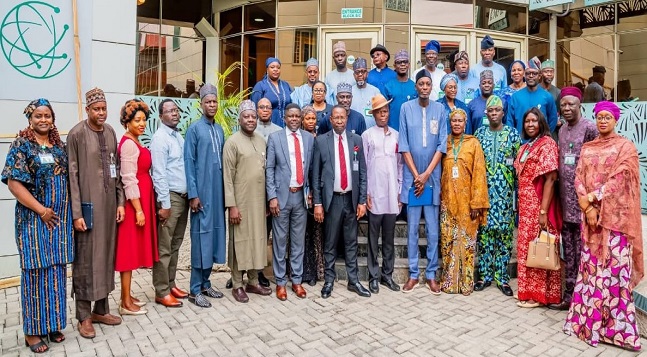
The National Information Technology Development Agency (NITDA) has reinforced its commitment to advancing Nigeria’s digital transformation agenda through strengthened collaboration with key strategic institutions, as it hosted the Director General of the National Institute for Policy and Strategic Studies (NIPSS), Professor Ayo Omotayo, alongside participants of the Senior Executive Course (SEC) 48, 2026.

The visit, which builds on an earlier strategic study tour, provided a platform for in-depth engagement on the role of digital innovation in driving sustainable economic growth, with particular focus on the Orange Economy.
Representing the Director General of NITDA, Kashifu Inuwa CCIE, the Director of Stakeholder Management and Partnerships, Dr Aristotle Onumo, highlighted the Agency’s commitment to fostering a vibrant digital ecosystem through inclusive policies, strategic partnerships, and capacity development initiatives.
“NITDA is committed to creating an enabling environment where innovation can thrive by bringing together government, private sector, academia, and creatives to drive Nigeria’s digital economy,” he stated.
Inuwa underscored the growing importance of the Orange Economy, describing it as a critical driver of innovation and economic value through intellectual property. He identified sectors such as digital content creation, film, animation, and digital art as key contributors to national development.
“The Orange Economy represents a powerful opportunity to transform our rich cultural heritage and creativity into sustainable economic growth,” he noted.
He further highlighted Nigeria’s unique advantage, particularly its youthful and creative population, while calling for stronger collaboration among stakeholders to fully harness the sector’s potential.
“With our youthful population and rich cultural assets, Nigeria is well-positioned to become a global leader in the Orange Economy if we deepen collaboration and investment across the ecosystem,” he added.
During the engagement, NITDA also presented its strategic initiatives aimed at supporting the digital and creative sectors, including digital infrastructure development, promotion of digital literacy, and implementation of policies that enable startups and innovators to scale.
Addressing challenges facing the sector, Inuwa pointed to issues such as limited access to funding, infrastructure gaps, weak intellectual property protection, and ecosystem fragmentation, while emphasising the need for coordinated action.
“Addressing challenges such as funding gaps, infrastructure deficits, and intellectual property protection is critical to unlocking the full potential of Nigeria’s creative economy,” he said.
The Agency reiterated its target of achieving 70 per cent digital literacy by 2027, noting that ongoing programmes are equipping millions of Nigerians with essential digital skills, including those in underserved and informal sectors.
In his remark, Professor Omotayo described the visit as an important opportunity to deepen understanding of how digital technologies are reshaping economic sectors, particularly the creative industry. He noted that the insights gathered would contribute significantly to policy recommendations aimed at strengthening Nigeria’s economic framework.
Participants of the SEC 48 programme engaged actively during the session, raising questions on capacity development, access to tools, and frameworks for protecting digital content. NITDA highlighted its ongoing collaborations with industry stakeholders to provide training, innovation hubs, and access to digital tools for young Nigerians.
The engagement concluded with a renewed commitment from both NITDA and NIPSS to strengthen collaboration in research, policy development, and capacity building, aimed at positioning Nigeria as a globally competitive force in the digital and creative economy.

Nigeria Revenue Service (NRS) has assumed responsibility for collecting mineral royalties from mining operators nationwide, following new tax laws effective January 1, 2026.

NRS
The shift emerged from a Thursday meeting between Solid Minerals Development Minister Dele Alake and NRS Chairman Dr. Zacch Adedeji. Their joint statement, endorsed by both, confirms NRS now administers all federally collectible revenues, including royalties.
Enacted by President Bola Tinubu on June 26, 2025, the Nigeria Tax Laws 2025 empower this transition. The Ministry of Solid Minerals Development remains a key partner, supplying pricing data, geological insights, and sector coordination.
NRS Special Adviser Dare Adekanmbi’s statement outlines collaborative steps: a nationwide sensitization program for operators on filing and payments; development of a digital royalty system; and regular joint technical sessions to address issues.
Both agencies pledge orderly, transparent implementation to boost the mining sector. Operators must comply with obligations and join upcoming programs.
The move aims to streamline revenue collection while fostering mining growth.

Offset Communications Slams N50m Suit against Qore Technologies for Alleged Copyright Infringement

Compensation for Poor Service Quality is Automatic- NCC

SERAP Sues CCB over Electoral Act, New Tax law

Tinubu Approves N3.3 Trillion Payment Plan to Boost Power Supply

FG to Strengthen Cybersecurity Coordination as NDPC Probes Alleged Data Breach

Spotify’s Loud & Clear Report Reveals Over ₦60Bn Revenue for Nigerian Artists in 2025

Madonna University Taps Tech Guru Adote for Strategic Board Role

China Threatens to Shut Nigeria’s Satellite Over $11.44m Unpaid Debt

Healthcare Under Attack: Why Cybersecurity is Now Critical Care

Why JustMarkets Is a Strong Choice for Gold Trading




 General News3 days ago
FG, Others Say Nigeria Wastes 38m Tonnes of Food Annually

 E-Financial3 days ago
CBN, Banks, Fintechs Launch PSPC to Boost Nigeria’s Payment System

 News3 days ago
NITDA Strengthens Collaboration with NIPSS to Drive Digital Innovation, Orange Economy Growth

 E-Financial2 days ago
N4.65 Trillion in the Vault, but is the Real Economy Locked Out?

 E-Financial3 days ago
CycleFlow, IFC Launch Supply Chain Finance Platform in Nigeria

 General News2 days ago
Union Bank Looted: How Former Directors Gambled with Billions and Nearly Destroyed a National Bank

 E-Financial3 days ago
Anchor Gets Nigerian, Canadian Licences as Transactions Crosses $2.5Bn

 News3 days ago
NRS Takes Over Mineral Royalties Collection Under New Tax Laws