

General News
Nigeria is Ripe for Institute of Cybercrime Monitoring-Uwaje

Dr. Chris Uwaje, is president of Global Network for Cyber Solutions (Organisers of the Conference) and first vice president of the Institute of Software Practitioners of Nigeria (ISPON). He is also managing director of Connect technologies Limited. A valuable asset to the ICT industry, Uwaje is a well sought after speaker globally and consults for the federal government on a number of projects. Uwaje spoke to chike Onwuegbuchi
Cybersecurity Summit
First, let me congratulate Nigeria CommunicationsWeek for coming out with a very educative and informative concept in what I would call ‘technology reporting,’ which has been missing over the last decade. What we have around generally is regular reporters and they cannot be blamed because they have not being exposed to technology reporting skills. That is why I want to congratulate you for being different. Now, to your question about what informed the cybersecurity conference or my initiative with respect to involvement in cybersecurity; it dates back to 1999. Consequently, with my project leader initiative as a consultant for the First Bank Nigeria PLC, as a software engineer, I saw a lot of vulnerabilities in the daily operations and when I had the opportunity in year 2000 to pioneer the National Policy Transformation of Technology, I was privileged to have incorporated cyber police units as far back as 7 years ago. The issue of cybersecurity that has now taken centre stage globally – it is not just about the security content but it is about the sovereignty of the community of people.
That is why the issue of cybersecurity is very important. As we speak, I am dealing with a cybersecurity issue here; I have been communicating with some cyber criminals who are posing as a friend of mine. They say he is stranded in a 5 Star hotel somewhere outside Nigeria and has lost his international passport and need some money, I have been trying to make them give me a bank account number where l will make the payment but they have insisted that I send the money through Western Union Money Transfer. This communication started about 2 weeks ago; these miscreants hijacked the email of one of my friends. What they do is send a message saying that your Yahoo! account is being reconstructed and you should renew your identity and password. Once you do that, they hijack that mail box and you cannot have access to it anymore. Now they begin to operate with that mail box and some people fall prey to their schemes. This is about technology and Nigeria has what is called technophobia syndrome. Nigerians are very shy of technology; it is not their faults because Science and Technology has been on the downturn. If it had been upground, the issues we are facing today would not have been strange. So, there is need to involve Science and Technology contents in our everyday lives.
It is very important to ensure that Nigerians understand what technology is. Nigerians have created a fallacy of technology definition; it is not just computing, aeronautics, automobile, electronics; these are the products of technology. Technology is the concept and process that creates the product; so we should concentrate on the core content of technology. But we neglect the process and go for the product only and that is why about 80% of what Nigerians consume is imported, and with such a scenario, it shows that we are not creative entities.
Fighting Cyber Criminals
The issue really is that there are two ways Nigeria can get herself set. One of the ways is the institution of critical infrastructure and of course, massive capacity building for knowledge workers and ‘code warriors.’ For Nigeria to be prepared in terms of dealing with the cyber criminality of the world it needs to produce a reserved pool of nothing less than 1 million code warriors from our tertiary institutions, secondary and primary schools, as well as industry. Because e-Government has to be protected, businesses have to be protected; even our cultures have to be protected. What we are witnessing today is no different than what our ancestors witnessed about 500 years ago. Technology has the centre stage today. Some people believe that Slave Trade is just about the ship, the cargo and the Whiteman. That is not so. What is at the centre of Globalization, which is Slave Trade 500 years ago, is the compass – the face of technology. Ideally, without the compass, those sailors of that time would not have ventured into the seas. So, the centre of globalization has always been technology. Indeed, technology is another word for the internationalization of trade and commerce. So, the cell phone of today has security content for Nigerians; the computer of today has security content for Nigerians; the Internet of today has greater security content for Nigerians; and there is going to be more ferocious attacks on this sub-region. We learnt that during the time of the 9/11 attacks, Al-Qaeda used some of the IP addresses within Nigeria to wreak some havoc. So, we should be prepared. It is important and paramount – above all, professionals should be put in place to engage these cyber criminals that are almost ruining us.
If Nigeria knows IP and cybersecurity issues, they should domicile them at the footstep of the professionals in the CPN, the NCS and Atcon. These are people who have been trained in the area of informatics and information technology development; they should be the experts advising Government. How can we have a nation that does not have an IT adviser to the president? And you want to safeguard your country from digital attack. There must be a special assistant to the office of Mr. President, who would be a senior adviser on information technology. These are the things that need to be put in place in the Federal Republic of Nigeria, which is very strategically imperative that we need to do as fast as we can. There is no reason why we should not have an Institute of Cybercrime Monitoring; there is no reason why we cannot have Cyber Engineering in our institutions; there is no reason why we should not inculcate the cybersecurity curriculum from primary school upwards. Just the same way we used to have the civic lessons of the old, cybersecurity and cybercrime can be introduced at the primary and secondary schools levels.
Local Software and Patronage
I have spoken about technophobia. First, let me point out the difference between indigenous software and local software. The former are those that are developed and politically managed and supported by Nigerians, for Nigerians without the transfer of foreign exchange. Whereas foreign software is one hundred percent transfer of our local currency, in other words, this transfer does not have the potential of capacity building. We are creating jobs and labour for other people externally. It is the duty of every nation to protect its indigenous software. I can put it to you that there is no software that is developed for external use; they are developed for resolution of the challenges in the immediate environment. It is technophobia and a fallacy to say that foreign software is better than indigenous one. It is sheer ignorance and a lot of people do not understand software because it is an intangible thing that one cannot see. But they buy computer; now they are saturated with hardware and they then see that the hardware itself has not solved their problems and they are still where they are. There is a difference between computerization and automation. They must automate and that is when the software starts to drive them. When we say foreign software, we are talking about application software and services; not system software because that is still far away. There are lots of services that Nigerians can render as outsourcing entities to fellow Nigerians and other African countries, much better than people from elsewhere. An example is our payroll – our payroll was based on our state and national structure and foreigners from India and the U.K are finding it difficult to sell payroll here because their own structure had informed the development of their software. They were developing for their region. Digital colonies would be built this century and the way they are going to build it is to take control of the software engines that run the lives of the entire people of a community, nation or sub-region. That is why we are passionate when we say that ISPAN needs grants – Government grants, individual grants, if you take say, ten companies today and tell them to give us a software that can run in Nigerian banks in about six years from now, I can assure you that that can be done. That is what other countries do; they create what is called ‘failed projects’ in software development and when these projects are done, people learn from them because they can always experiment. We shy away from research and development in software because nobody is ready to invest. It is high time our Governments understand the imperative of indigenous software and also know that Nigerians are capable of producing world-class software.
In fact, a lot of Nigerians are working in laboratories abroad. If they can do that there, why can they not do same here? ISPAN has been campaigning and of course, it has yielded a little result by ensuring that we created IT departments in the ministries as a pilot. We have gotten a circular from the last regime that indigenous software should be considered before any foreign one for use within government departments. We have an agreement with Government that 50% of the cost of every foreign software imported into this country should be charged as a tariff to check their influx into the country. There is a lot of software – the core banking applications, among others, that have failed in this country. Nobody talks about them and Nigeria is losing money. The cost of these failed software is enough to build software institutes, is enough to provide superlative employment for software code warriors all over the country.




Spotify
This year, Spotify is bringing back the fan-favourite features people already love, while adding new experiences that spotlight how listeners across Africa moved, prayed, worked, partied and rested with audio. Wrapped Party invites fans to dive into their stories with friends and family, and 50 fan destinations worldwide give listeners a place to come together, celebrate their year in music and feel part of something truly global.
From design to in-person experiences and data stories rooted in local listening, this is how the 2025 Wrapped campaign comes to life across Africa.
A modern visual mixtape for Africa
Before streaming, mixtapes and burned CDs were the original playlists: handpicked, decorated and passed between friends, cousins and neighbours as deeply personal gifts. The 2025 Wrapped design builds on that tradition, turning a year of listening into a bold, dynamic visual mixtape for more than 700 million fans around the world – including millions across Africa.
Every gradient and texture reflects that unpredictable mix of emotion and rhythm that makes listening so personal. With a reduced colour palette, bold imagery and a blend of analogue and digital aesthetics, 2025 becomes the most expressive and modern-feeling Wrapped yet. From amapiano dance circles in Johannesburg to late-night studio sessions in Lagos and road-trip singalongs in Nairobi, the look and feel of Wrapped mirrors how African fans actually experience music – loud, layered and full of feeling.
Immersive real-world experiences – and an amagwinya road trip
The Wrapped creative campaign is live in more than 30 markets globally as Spotify moves beyond traditional billboards to create immersive experiences that celebrate the artists who defined 2025. Across Africa, installations and pop-ups bring Wrapped digital storytelling into the real world with artist integrations, interactive photo moments and live performances for top listeners.
In South Africa, Wrapped quite literally hits the road. Inspired by the heartbreak of reaching the front of the line only to hear the gwinyas are finished – and the way Darwin Rev turned that moment into a national mood with Amagwinya Aphelile – the Where Are the Gwinyas? fan destination sends a Wrapped-branded amagwinya kombi on a multi-city road trip.
The truck travels through Cape Town, Durban, Johannesburg and Pretoria, serving up gwinya with a Wrapped twist – from fish fillet to bunny-chow-inspired curry fillings and classic snoek, atchar and polony. At each stop, fans turn up their favourite Wrapped anthems, transforming the kombi from simple food truck into rolling street party.
“Wrapped has always been about reflecting fans’ stories back to them, and this year those stories from Sub-Saharan Africa are literally spilling into the streets. From the amagwinya road trip in South Africa to the data stories coming out of Nigeria and Kenya, we’re showing that the numbers behind Wrapped are really about how people here live, move and connect through music,” says Spotify’s Head of Marketing for Africa, Sithabile Kachisa.
How Africa listened in 2025
Wrapped is ultimately about turning listening data into stories fans can see themselves in – and nowhere is that more vivid than in Africa.
In South Africa, early mornings belonged to Ciza’s Isaka, with more than 46,000 fans pressing play at exactly 6:00 a.m., turning sunrise into a shared soundtrack. Mafikizolo’s Uyoncengwa Unyoko passed 14 million plays, proving some songs are built for repeat on both the dancefloor and in the taxi rank.
In Nigeria, Fido’s Joy is Coming found its way onto more than 700 playlists tagged as sad, as listeners reached for hope even when the mood was low. Davido’s With You amassed over 42 million streams, underlining the staying power of one of the country’s most beloved hitmakers.
In Kenya, Extra Pressure was added to fans’ gym playlists, turning workouts into high-stakes training montages, while Njerae’s Aki Sioni crossed 3.2 million streams, transforming vulnerability into a chart-ready strength.
Across the continent, these moments show how Wrapped transforms numbers into narratives. The stats reveal not just what Africa listened to in 2025, but how, when and why it mattered – from perfectly timed play buttons and weekday rituals to songs that travelled through communities as gifts, prayers, jokes and declarations. Wrapped gathers all of that energy and hands it back to fans as a story only they could have written.


Corporate Affairs Commission (CAC) has warned Nigerians against dealing with 15 unregistered entities using company names and registration numbers that are not in the commission’s records.

In a public notice signed by CAC Management, the commission said it had discovered the use of purported company names and RC numbers that are not registered with the CAC, urging the public to disregard them and verify all business information directly from its portal.
“The CAC remains committed to protecting the integrity of the Companies Register, upholding the law, and ensuring a safe and transparent business environment in Nigeria,” the CAC said.
According to the notice, the following are the entities not registered with the CAC:
Famas Services Nigeria Limited (RC: 216312)
Promo Dutch Investment Limited (RC: 396654)
Dialack Concept Nig. Ltd (RC: 297772)
Purpleheart Construction and Real Estate Mgt. Co. Ltd (RC: 1210548)
M/S Loktu Enterprises (BN: 373466)
Loktu Enterprises (BN: 400390)
Badatoyak Ltd (RC: 521322)
Johson Nats Limited (RC: 198492)
Peoples Club Nigeria International (CAC/IT/41191)
Jiba Enterprise (BN: 577523)
Civil Engineering Solutions Nigeria Limited (RC: 33001)
Gabdoff Hotel Ltd (RC: 112409)
Amoka Group (BN: 545221)
BEEC Nigeria Limited (RC: 30143)
- Adetunji (BN: 657466)
Explaining the reason for the commission’s publication, the statement noted that it aligns with its statutory role of maintaining an accurate and reliable companies register, protecting investors, and preventing fraudulent activities in the business environment.
The commission urged Nigerians to always confirm the status of any company or business name through its official portal.
General News
IHS Nigeria Leads Gender Based Violence Awareness Walk, Reaffirms Zero Tolerance with Advocacy Seminar

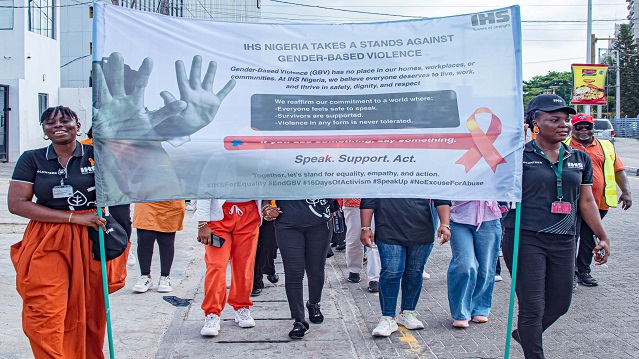
Demonstrating unwavering commitment to a safe and dignified workplace, IHS Nigeria held an awareness walk followed by a high-impact seminar as part of activities to commemorate the global 16 days of activism to End Gender-Based Violence against women and girls.

The initiative underscored the organisation’s ongoing efforts to sensitize the community, educate employees, strengthen internal safeguards, and reinforce its zero-tolerance policy for all forms of harassment and abuse.
After the walk along Adeola Odeku and Idejo Streets on Victoria Island, employees convened for a seminar at the IHS Nigeria corporate head office, where Bukola Konkwo, Associate Director, Operations Excellence IHS Nigeria and one of the leaders of the Women in IHS Network (WIIN), reiterated the organisation’s position on gender-based violence in her opening remarks:
“Violence does not discriminate, and neither should our compassion. At IHS Nigeria, boldness is not just a value on paper, it is a call to action. We are intentional about ensuring every employee feels safe, respected, and empowered.”
The seminar featured two leading voices in Gender Based Violence advocacy. Titiola Vivour Adeniyi, the Executive Secretary of the Lagos State Domestic and Sexual Violence Agency and Nwanne Okafor, Victimologist and Gender Based Violence Advocate. Speaking during the seminar, Titilope stressed the urgency of prevention and education:
“Gender-based violence is not a special-class problem. Anybody can be a victim. Our responsibility is to know the signs, protect one another, and intervene early. When we know better, we do better.”
She also encouraged organisations to prioritise consent education, confidential reporting, and background checks, practices IHS Nigeria has already integrated through its Safe Zone Committee, a confidential support system for staff.
Nwanne Okafor, also spoke on the role of colleagues in recognizing and responding to abuse in the workplace:
“Many victims don’t need you to fix their situation, they need your support, your sensitivity, and your discretion. Speak up when necessary. Silence gives violence permission.”
Her session included real-life cases that underscored how abuse affects workplace productivity, mental health, and safety.
The awareness walk, saw both male and female staff members from across various departments marching in solidarity with survivors and advocates worldwide and served as a public declaration of IHS Nigeria’s commitment to building a culture rooted in respect, safety, and accountability.
Reinforcing IHS Nigeria’s stand, during her closing remarks, Titilope Oguntuga, Director, Sustainability, IHS Nigeria, captured the spirit of the event:
“This conversation doesn’t end today. Now that we know better, we must all do better, by advocating, supporting, and actively contributing to a workplace free of violence in any form.”
IHS Nigeria continues to strengthen its internal systems, policy frameworks, training programs, safe reporting channels, and continuous awareness sessions, to ensure that every employee is protected and empowered. The organisation reaffirms its zero-tolerance policy for any form of harassment, abuse, or violence, and remains committed to leading the corporate sector in progressive, people-centered safety standards.

PAPSS Cowry to Benefit Manufacturers, SMEs

Access Bank’s Digital Innovation Earns Top Financial Inclusion Award

CBN’s New Cash Policy: A Welcome Liberalisation or a Risky Retreat?

Africa Must Build Its Own Cybersecurity Intelligence, Says Tizel CEO At AfriTech 5.0

Afrilearn Expands Drive to Make Quality Education Attainable for African Children





 E-Business2 days ago
Jumia’s Data Shows Nigerians Turning to Digital Retail to Navigate Inflation Pressures

 E-Business2 days ago
Nigeria Records Highest Weekly Cyberattacks in Africa — Report

 News2 days ago
SEC to Enhance Investor Engagement with USSD Code, ISS Audio

 Telecom2 days ago
Airtel Nigeria Wins Best in Technology for Development @ 2025 SERAS Awards

 Telecom2 days ago
Nigeria-South Africa Chamber Celebrates Silver Jubilee of Bilateral Trade Ties

 News2 days ago
Firm Detected Half a Million Malicious Files Daily in 2025

 News2 days ago
NEC Endorses N100Bn Overhaul of Police and Security Training Facilities

 Broadcasting1 day ago
It is Official, DStv Confirms Termination of 16 Major Channels