

Telecom
Zoho Corporation to Leverage NVIDIA NeMo to Build LLMs


Zoho Corporation, a global technology company headquartered in Chennai, announced today that it will be leveraging the NVIDIA AI accelerated computing platform – which includes NVIDIA NeMo, part of NVIDIA AI Enterprise software – to build and deploy its large language models (LLMs) in its SaaS applications.

Once the LLMs are built and deployed, they will be available to Zoho Corporation’s 700,000+ customers across ManageEngine and Zoho.com globally.
Over the past year, the company has invested more than USD 10 million in NVIDIA’s AI technology and GPUs, and plans to invest an additional USD 10 million in the coming year. The announcement was made during the NVIDIA AI Summit in Mumbai.
Ramprakash Ramamoorthy, Director of AI at Zoho Corporation, commented, “Many LLMs on the market today are designed for consumer use, offering limited value for businesses.
“At Zoho, our mission is to develop LLMs tailored specifically for a wide range of business use cases.
“Owning our entire tech stack, with products spanning various business functions, allows us to integrate the essential element that makes AI truly effective: context.”
Zoho prioritises user privacy from the outset to create models that are compliant with privacy regulations from the ground up, rather than retrofitting them later.
Its goal is to help businesses realise ROI swiftly and effectively by leveraging the full stack of NVIDIA AI software and accelerated computing to increase throughput and reduce latency.
Zoho has been building its own AI technology for over a decade and adding it contextually to its wide portfolio of over 100 products across its ManageEngine and Zoho divisions.
Its approach to AI is multi-modal, geared towards deriving contextual intelligence that can help users make business decisions.
The company is building narrow, small and medium language models, which are distinct from LLMs. This provides options for using different size models in order to provide better results across a variety of use cases.
Relying on multiple models also means that businesses that do not have a large amount of data can still benefit from AI. Privacy is also a core tenet in Zoho’s AI strategy, and its LLM models will not be trained on customer data.
“The ability to choose from a range of AI model sizes empowers businesses to tailor their AI solutions precisely to their needs, balancing performance with cost-effectiveness,” said Vishal Dhupar, Managing Director, Asia South at NVIDIA.
“With NVIDIA’s AI software and accelerated computing platform, Zoho is building a broad range of models to help serve the diverse needs of its business customers.”
Through this collaboration, Zoho will be accelerating its LLMs on the NVIDIA accelerated computing platform with NVIDIA Hopper GPUs, using the NVIDIA NeMo end-to-end platform for developing custom generative AI—including LLMs, multimodal, vision, and speech AI.
Additionally, Zoho is testing NVIDIA TensorRT-LLM to optimise its LLMs for deployment and has already seen a 60% increase in throughput and 35% reduction in latency compared with a previously used open-source framework.
The company is also accelerating other workloads like speech-to-text on NVIDIA accelerated computing infrastructure.



Telecom companies should invest in sophisticated anti-fraud tools that employ machine learning and Artificial Intelligence (AI) to enhance detection and response times while conducting regular audits to ensure that systems remain up-to date and effective.

That’s according to Pricewaterhouse Coopers (PwC’s) latest paper on AI fraud in the Telecom sector.
The paper notes the dual role of Artificial Intelligence as both a threat and a shield highlights the need for Nigerian telecom operators to adopt AI deliberately and strategically.
It calls for a deeper understanding of how technological disruption is transforming fraud risks today and how those risks may evolve in the.
The professional services firm noted that the rapid adoption of AI is reshaping the fraud landscape in the telecommunications sector, enabling criminals to automate scams, impersonate victims through deepfake technologies, and scale fraudulent schemes with unprecedented speed.
The 16-page report, titled ‘AI’s Dual Role in Telecom Fraud’, noted that while AI is helping fraudsters launch more sophisticated attacks, the same technology can also serve as a powerful defensive tool for telecom operators and financial institutions.
“AI has tremendous potential to drive positive change across sectors, but it also enables fraudsters to create and disseminate scams quickly and at scale,” PwC said, warning that the expanding digital ecosystem linking telecom networks and financial services is creating new vulnerabilities.
Fraud has long posed a significant challenge for telecom operators worldwide, resulting in financial losses, reputational damage, and regulatory scrutiny.
Globally, telecom fraud was estimated at approximately $38.95 bn in 2023, highlighting the scale of the problem. In Nigeria, the sector has also faced rising risks.
According to the Nigerian Communications Commission (NCC), citizens lost approximately N12.5 bn to telecom-related financial crimes between 2019 and January 2023.
PwC said the growing integration between telecom networks and financial services, such as mobile money platforms and digital banking, is further complicating the fraud landscape.
“When fraud occurs across interconnected platforms, both telecommunications and financial services providers face regulatory scrutiny and erosion of customer trust,” the report said.
The firm added that telecom operators are increasingly becoming critical infrastructure for digital financial services, exposing them to greater risk as criminals target the ecosystem.
Despite these risks, PwC said telecom companies have a unique advantage in the fight against fraud due to the vast amount of network and customer data they possess.
By deploying advanced AI systems, telcos can detect suspicious activity patterns, flag unusual call behaviour, and identify fraudulent transactions in real time.
For example, AI-driven pattern recognition can analyse large datasets to detect irregular call durations, unusual call frequencies, or activity occurring at odd hours, indicators that may signal fraudulent activity.
Machine learning models trained on historical fraud cases can also help identify subtle warning signs that traditional detection systems might miss.
PwC noted that some telecom operators are already deploying AI-powered spam detection tools capable of analysing hundreds of behavioural parameters to determine whether a message is fraudulent.
Real-time data analysis, the firm added, can allow companies to block fraudulent activities before they cause major financial damage.
Beyond fraud detection, AI can also help organisations respond more effectively to incidents.
Using natural language processing, generative AI systems can convert technical security data into simplified reports tailored for regulators, executives, and compliance officers.
However, PwC said technology alone will not be enough to curb the growing threat.
The firm stressed that stronger collaboration between telecom operators, financial institutions, and regulators is essential to prevent fraud from spreading across digital platforms.
Telecom companies, it said, possess sophisticated tools capable of monitoring call patterns and network behaviour, which could help banks detect suspicious activities such as SIM swap attempts.
At the same time, banks have developed advanced fraud detection algorithms that could enhance telecom operators’ ability to identify suspicious activity across their networks.
“By sharing insights and real-time threat intelligence, both sectors can strengthen their individual and collective defences,” PwC said.
The firm cited international examples where such collaboration has improved fraud detection and response times, including initiatives in the United Kingdom, Singapore, Australia, and the Philippines. PwC also emphasised the importance of closer engagement with regulators such as the Central Bank of Nigeria and the Nigerian Communications Commission to ensure clear and responsive regulatory frameworks that support innovation while protecting consumers.

MTN Nigeria expanded its lead in Nigeria’s fixed broadband market after adding 13,433 subscribers to its fibre-to-the-home service in December 2025. The gains come as smaller providers struggle to retain users amid rising demand for high-speed internet.

Industry data from the Nigerian Communications Commission (NCC) showed sharp subscriber losses among smaller operators.
21st Century Technologies saw its subscriber base fall from 175 in December to 82 in January, a drop of more than 50 percent.
SWIFT Nigeria recorded an even larger decline.
The company lost 11,285 users, with total subscribers falling from 25,484 to 14,199, a 44.3 percent decrease.
The gap between large infrastructure providers and smaller operators is widening as broadband demand grows across Nigeria.
Companies with extensive fibre networks can offer faster speeds and wider coverage, while smaller competitors face higher costs and limited scale.
MTN has accelerated its investment in network infrastructure to maintain its lead.
The company spent ₦1 trillion, or about $715 million, in capital expenditure in 2025, more than double the ₦443.5 billion invested in 2024.
The investment followed a return to profitability, with profit after tax reaching ₦1.1 trillion after losses in 2024 linked to foreign-exchange pressures.
Spending focused on network modernization, 4G expansion, 5G rollout and deeper fibre deployment.
The operator expanded its fibre-to-the-home footprint to about 4 million households, concentrating deployments in Lagos, Abuja, Port Harcourt, Kano and Ibadan as data traffic rose 34 percent.
Network vandalism remains a challenge. MTN recorded 9,218 fibre cuts in 2025, an average of 25 incidents per day, affecting 211 base stations.
Key Takeaways
Nigeria’s broadband market is entering a scale phase where infrastructure investment is becoming the main competitive advantage.
Telecom operators with strong balance sheets are deploying billions of naira into fibre networks to capture demand for high-speed connectivity driven by streaming, remote work, digital payments and cloud services.
Fibre infrastructure also strengthens mobile networks by connecting base stations and improving 4G and 5G performance.
However, the economics of building and maintaining fibre networks remain challenging in emerging markets. Infrastructure vandalism, power supply instability and high deployment costs increase operational risk.
These factors make it difficult for smaller internet service providers to compete with large telecom operators that can spread costs across millions of customers.
As demand for broadband continues to grow in Africa’s largest economy, the sector may see further consolidation, with dominant operators strengthening their market position while regulators face increasing pressure to maintain competition and affordable access to high-speed internet.
credit…. dabafinance.com
Telecom
VDT Communications Achieves Two Prestigious Certifications ISO /IEC 27001:2022, ISO/IEC 27032:2023 Reinforcing its Leadership in Broadband Service Provision

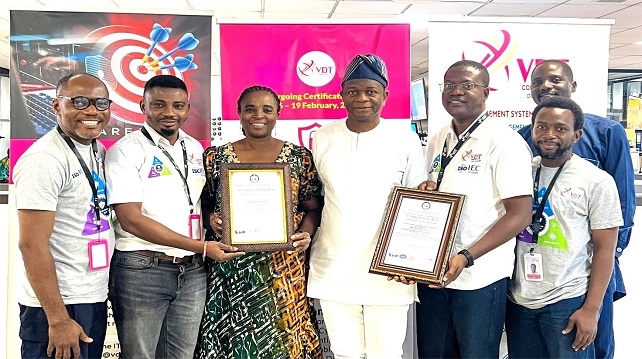
VDT Communications Limited, a provider of Enterprise communication solutions, is proud to announce that it has been awarded the ISO/IEC 27001:2022 Information Security Management System (ISMS) and ISO/IEC 27032:2023 Cybersecurity Management System certifications.

These prestigious certifications demonstrate VDT’s commitment to maintaining the highest standards of information security and cybersecurity, ensuring the protection of sensitive customer data and maintaining the trust of its clients.
These certifications are a testament to VDT’s dedication to implementing robust information security and cybersecurity measures, aligning with international best practices.
The ISO/IEC 27001:2022 certification recognizes VDT’s ability to establish, implement, maintain, and continually improve its ISMS, ensuring the confidentiality, integrity, and availability of customer information. The ISO/IEC 27032:2023 certification highlights its commitment to protecting its customers’ information assets and preventing Cyber threats.
VDT Communications Limited has consistently demonstrated its commitment to excellence, previously earning and maintaining ISO 9001:2015 Quality Management System and ISO 20000-1:2018 IT Service Management certifications. These certifications have enabled the company to deliver high-quality services, ensuring customer satisfaction and loyalty.
“We are thrilled to receive these two prestigious certifications, which reinforce our commitment to information security and cybersecurity. These certifications demonstrate our dedication to implementing robust security measures that ensure confidentiality, integrity and availability of customer data” said Engr. Abiodun Omoniyi, GMD of VDT Communications Limited.
The ISO/IEC 27001:2022 and ISO/IEC 27032:2023 certifications bring numerous benefits to VDT’s customers, including:
- Enhanced information security and cybersecurity posture
- Protection of sensitive customer data
- Compliance with international standards and regulations
- Improved risk management and incident response
- Increased trust and confidence in VDT’s services
“We are proud to serve our customers with the highest level of security and quality,” Bimbo Ikumariegbe, Chief Operating Officer (COO) of VDT. “These certifications demonstrate our commitment to excellence and our dedication to delivering innovative communication solutions that meet the evolving needs of our customers” – Olufemi Akinola, Head, Information Technology.

Breaking…….Nigerian Firms Pledge Millions, Create UK Jobs

Crypto Transactions Hit $96Bn in Nigeria -SEC

PwC Warns Nigeria Telcos of AI Fraud Risks

Lawyer Drags FG Court over Controversial Health Data Sharing Agreement with US

Elumelu Tags Elon Musk, Disowns AI-Generated Scam Video

Kaspersky Discovers New Phishing Campaign Exploiting Google Tasks Notifications to Steal Corporate Credentials

esentry 2025 Report Shows Healthcare, Financial Services and Telecoms as Staging Grounds for Increased Cyberattacks in Africa

AfDB, UNDP Launch $10Bn AI Initiative for Africa

Mutual Benefits Assurance Settles ₦5.9bn Claims in January 2026

MultiChoice Suspends Yearly DStv Price Hike as Canal+ Pushes Growth




 E-Financial2 days ago
CBN Rolls Out New Rules for Safer Instant Payments, More Customer Control

 News2 days ago
NIMMME Inaugurates Engr. Michael Orekyeh as 13th National Chairman in Abuja

 Telecom2 days ago
MTN Nigeria Races Ahead in Fibre Broadband Market

 E-Financial2 days ago
CBN Tightens BVN Rules to Curb Fraudulent Banking Transactions

 E-Financial2 days ago
Nova Bank Appoints Jude Anele as Managing Director/CEO

 E-Business2 days ago
Tech Expert Unveils BAT-BOT AI App to Curb Fake News ahead of 2027 Elections

 Broadcasting19 hours ago
Spotify’s Loud & Clear Report Reveals Over ₦60Bn Revenue for Nigerian Artists in 2025
 Telecom19 hours ago
PwC Warns Nigeria Telcos of AI Fraud Risks