

General News
Emirates’ Operation in Europe Injects €6.8Bn to GDP

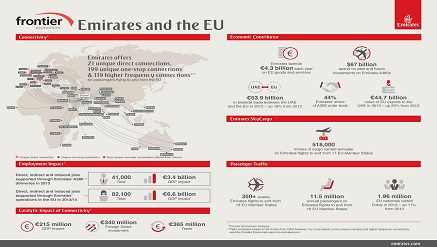
Emirates, a global connector of people, places and economies, and Frontier Economics, a leading European consultancy, released, on Wednesday, the results of a socio-economic impact study that measures Emirates’ contribution to the European economy.
Frontier estimates that Emirates’ operations, including the catalytic impact of the 220 unique connections it offers, supported 85,100 jobs across the EU in 2013/14, equivalent to €6.8 billion GDP of the total EU GDP.
In addition, Emirates’ Airbus A380 deliveries for the same period supported 41,000 jobs, equivalent to €3.4 billion GDP.
“Emirates is fully committed to the European market. The relationship goes back to 1987 when we first started flying from Dubai to London Gatwick. Since then, we have witnessed growth based on demand and now operate over 350 passenger flights a week from Europe, providing global connectivity via our hub in Dubai,” commented Sir Tim Clark, president of Emirates Airline.
“Emirates’ economic impact is significant; based on Frontier’s report, we supported over one hundred thousand jobs across Europe through our operations and our aircraft purchases from Airbus. By stimulating demand for travel and cargo, especially in markets underserved by other airlines, Emirates contributes to the economies of the communities we serve.”
The study conducted by Frontier demonstrates that Emirates’ presence in 28 European cities significantly contributes to regional development, especially in non-hub markets that have traditionally been overlooked by other carriers.
“Some of Emirates’ competitors have in the past accused the airline of having a negative impact on Europe, but the Frontier analysis paints a different picture. Our research shows that the direct, indirect and induced impact of Emirates’ operations and the development of connectivity to secondary cities in particular, makes a substantial contribution to EU GDP”, stated Dan Elliott, founder and director of Frontier Economics. “The economic value this connectivity brings to the EU is at times underappreciated, and something that merits attention.”
The Value of Connectivity
Traditionally, international travel from Europe involved flying from or often backtracking to one of the big European hubs.
This contributed to a connectivity gap for other major European cities, restricting their ability to develop trade and Foreign Direct Investments (FDI) opportunities.
Since launching services to Europe in 1987, Emirates has helped bridge this gap, by gradually and on the basis of demand, increasing services to major and secondary cities across Europe.
The Frontier analysis, which covered 28 cities served by Emirates in 16 EU Member States, identified a total of 220 routes from Europe that are unique to Emirates.
And 21 of these are non-stop connections from European cities to Dubai, and the remaining 199 routes are unique one-stop connections, via Dubai.
Using any other airline or alliance on these unique routes would require at least one more additional stop.
“The connectivity Emirates provides through these 220 unique routes positively impacts FDI and trade and supports the development of regional centres. It also increases tourism, provides choice for the consumer and supports air cargo shipments to and from regional centres”, commented Dan Elliott. “We estimate that an additional 3,000 jobs are facilitated through the catalytic impact of the 220 unique connections, equivalent to €215m of GDP, taking Emirates’ total contribution to €6.8 billion.”
Considering the breadth of Emirates’ network and how air travel demand is expected to double in the next 5-10 years, Emirates is well positioned to bring a growing number of tourists and business travellers to Europe, further enabling trade and investment.
A380 Deliveries
With a total of 140 aircraft ordered, Emirates is the largest purchaser of Airbus’ A380, accounting for more than 40% of the total A380 order book.
In 2013 Airbus delivered 13 A380s to Emirates which represented 50% of the total A380 deliveries that year.
Whilst Emirates has been operating A380s for 6 years, after placing the original order more than 13 years ago, the employment generation in Frontier’s analysis is only calculated for 2013. These numbers can be projected for the duration of the delivery schedule.
Airbus estimates that Emirates’ A380 orders support the employment of 41,000 direct, indirect and induced jobs in Europe.
About 70% of these jobs are split equally between France and Germany, with the UK having 17% and the remaining 5,000 jobs in Spain.
These are high-skilled jobs and impact a high-value supply chain, creating a significant multiplier effect in countries where Airbus has aircraft production facilities.



Taraba State in Nigeria has developed an electronic platform for filing criminal cases in the state’s High Courts, marking the implementation of the new National Case Management System.

The launch, announced on Monday, marks a move from manual to electronic filing of criminal cases and is part of attempts to reform court processes and expand access to justice using technology.
Governor Agbu Kefas stated that the action underlines the government’s dedication to institutional strengthening, the rule of law, and effective governance.
Kefas pledged continued government support for the judiciary, noting that technology is essential for delivering swift, fair and transparent justice.
He also stated that the state would give the resources and infrastructure required to maintain the ongoing judicial reforms.
Justice Joel Agya, Chief Judge of Taraba State, stated that the e-filing facility will enable the electronic filing of originating processes and subsequent applications.
He explained that the system would enhance case tracking from filing to final determination while reducing delays caused by manual registry procedures.
Justice Agya went on to say that the platform would improve the security and accessibility of court records, as well as help judges manage dockets and time better.
He emphasised that the platform is intended to supplement rather than replace judicial decision-making, ensuring that administrative procedures do not impede the delivery of speedy justice.
The development is consistent with a broader national push to digitalise judicial processes across Nigerian courts, which has already been implemented in several regions.

Kaspersky has detected a wave of phishing attacks preying on former customers of the bankrupt crypto lending platform BlockFi.

These scams leverage the ongoing distribution of customer assets following BlockFi’s 2022 bankruptcy, tricking victims into surrendering cryptocurrency wallet seed phrases, potentially leading to financial losses.
BlockFi, once a prominent provider of high-yield interest accounts and crypto-backed loans, announced bankruptcy in November 2022. The company began disbursing repayments to affected clients in 2024 as part of its restructuring plan.
Kaspersky has detected fraudulent emails mimicking BlockFi’s official branding, which falsely invite recipients to “claim the payment” they are “entitled to.” After clicking on the link, users land on a phishing page and are prompted to “connect their wallet”.
The attackers suggest that users import their existing wallet by typing in the secret phrase – this grants attackers direct access to the funds in the victim’s wallet.
“Phishing attacks like this are widespread, capitalising on real-world events to build trust and urgency. Victims who fall for these scams risk exposing their crypto wallets to theft. It’s critical for individuals to verify any communications directly through official channels and to check the address from where the email originates for legitimacy,” comments Roman Dedenok, anti-spam expert at Kaspersky.
The phishing emails feature convincing logos, colour schemes, and language, making them difficult to spot at first glance. Kaspersky recommends the following steps to avoid falling victim to this or similar scams:
- Do not click on links or respond to unsolicited emails.
- Protect Sensitive Information: Never share banking credentials, wallet seed phrases, or other private keys in response to an email or online form.
- Use Security Tools: Enable two-factor authentication (2FA) on all financial accounts, employ reputable security software like Kaspersky Premium, and consider using a password manager to safeguard credentials.

Universal Insurance Plc has secured the approval of its shareholders to raise additional capital of N15 billion through a proposed recapitalisation exercise, as the insurer intensifies efforts to strengthen its balance sheet and position the company for long-term sustainability.

The approval will be granted at an Extraordinary General Meeting (EGM) scheduled for February 5, 2026 in Lagos.
Currently, Universal Insurance’s share capital stands at N8 billion, with 16 billion ordinary shares held by existing shareholders on the NGX. The board is seeking to revalidate, authorise, and regularise 14 billion unissued ordinary shares for the planned capital raise and also secure approval to list and admit the new shares for trading
Following resolutions passed at the Extraordinary General Meeting (EGM), Universal Insurance Plc is moving forward with a comprehensive recapitalisation programme aimed at reinforcing its capital base and improving its capacity to underwrite larger and more diversified risks.
Shareholders approved the plan to raise new equity through a combination of capital market instruments, subject to regulatory approvals, as part of efforts to meet industry capital requirements and support future growth.
Gross premium written rose to N18.59 billion, up from N12.29 billion a year earlier, driven by increased underwriting activity across key insurance segments. Insurance revenue also grew to N14.68 billion, compared with N9.85 billion in the prior period, reflecting stronger risk acceptance and improved pricing discipline.
Despite higher insurance service expenses, the company posted an insurance service result of N1.13 billion, while net investment income surged to N2.79 billion, supported largely by fair value gains on financial assets. As a result, net insurance and investment income increased to N5.18 billion, nearly double the N2.61 billion recorded in the same period of 2024.
On the balance sheet, total assets expanded to N21.82 billion as at September 30, 2025, from N18.14 billion a year earlier, supported by growth in financial assets and investment properties. Shareholders’ funds rose to N14.38 billion, up from N12.33 billion, reflecting improved profitability and reserve accumulation.
Investors have also responded positively to Universal Insurance’s performance, with its stock delivering an 83.33 percent return in 2025, rising from N0.66 to N1.21 per share, and trading volumes exceeding 6 billion shares.
The recapitalisation initiative, combined with the improving financial performance recorded in Q3’25, underscores Universal Insurance Plc’s determination to reposition itself as a more resilient and competitive player in Nigeria’s insurance industry.
The company aims to deliver improved value to policyholders, investors, and partners, while supporting broader economic activity and generating sustainable returns for shareholders.

Spacecoin Secures Licenses to Roll Out Satellite Connectivity in Nigeria, Kenya

FG Shops for N900Bn from Domestic Market with High-Yield Bonds

CBN Raises Alarm over Loan Defaults by Households, Corporates

What the Retail and E-commerce Sector Should Expect in 2026 in Era of AI-driven Shopping and Privacy

Taraba Adopts Electronic Case Management System

Banks quietly move to enforce new ₦50 transfer levy from Jan. 1

FIRS says NIN, CAC Numbers to Serve as Tax IDs from 2026

FIRS Declares NIN, CAC Numbers as Tax IDs from 2026

US Begins Partial Visa Ban on Nigerians January 1

Galaxy Backbone Tops FG’s Website Performance Ranking




 E-Financial2 days ago
Here Are Nigerian Banks That Have Secured Their Licences

 E-Financial2 days ago
Zenith Bank Top Nigerian Bank Pick Ahead of GTCO, AccessCorp

 Telecom2 days ago
MTN CEO Toriola Hails Nigeria’s Telecom Transformation at MIPAD

 News2 days ago
ICPC Charges Ozekhome with Forgery, Corruption Over London Property

 E-Financial2 days ago
Nigeria Processed $92.1Bn Crypto Transactions in 12 Months — PwC

 E-Financial2 days ago
How Crypto Criminals Stole $700m from People – often Using Age-Old Tricks

 Telecom2 days ago
Lebara Launches Agent Registration Portal

 General News1 day ago
Cybersecurity Firm Detects a Wave of Crypto Phishing Following BlockFi Bankruptcy